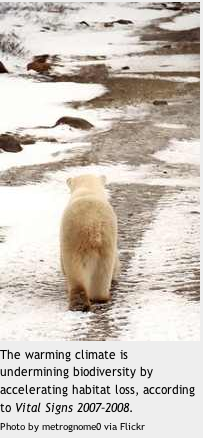
“Climate change is like the Internet — it is never going away”

“Climate change is like the Internet — it is never going away.”
— Paul Dickinson, CEO of the Carbon Disclosure Project

Climate of Change Confronts Wall Street
By Stephen Leahy

Sep 24 (IPS) – Stockholders, investors and financial analysts are now demanding to know how climate change will affect companies’ bottom line, and a new report reveals large corporations’ risks and opportunities.

At the behest of institutional investors managing over 41 trillion dollars, several hundred large corporations voluntarily revealed how they are responding to this new reality in a report released Monday at a major event on New York’s Wall Street, where former U.S. President Bill Clinton will also speak.

“Climate change will change the way we do everything,” said Paul Dickinson, CEO of the Carbon Disclosure Project, an independent not-for-profit organisation.

“Nothing will go back to the way things were,” Dickinson told IPS.

Continue reading

Facebook: Last Hope for Environment?

facebook-header.png

Global trends indicate a looming environmental catastrophe, and engaging high school students around the world may be the only hope.

By Stephen Leahyvital-signs.png

Sept 14’07 (IPS)
Governments, the corporate sector and media continue to champion industrial and economic growth at the cost of escalating impacts on the environment, concludes the latest report from the Washington-based Worldwatch Institute, “Vital Signs 2007-2008“.

For a number of years, the “Vital Signs” report has tracked 44 trends that are shaping the future, and they document a record level of industrial growth, says Erik Assadourian, Vital Signs project director.

“‘Vital Signs’ also documents the escalating impacts of such growth on the environment,” Assadourian told IPS in an interview from Barcelona.

The scale of the environmental crisis, in which catastrophic climate change is just one of many, is undermining the ecosystems that support life on Earth.

“Climate change and other environmental problems are symptoms of the root problem, which is the obsession with consumerism,” he said.

Vital Signs reports that in 2005, more wood was removed from forests than in any previous year. Fossil fuel usage dumped 7.6 billion tonnes of carbon emissions into the atmosphere. Meat production hit a record 276 million tonnes (43 kilogrammes per person) in 2006. Rising meat consumption is driving rising soybean demand to feed cattle, which in turn is a driver of deforestation as tropical forests are turned into soy fields.

And on it goes: global seafood consumption breaks records, steel and aluminium production too. None of this is sustainable — another three or four or five planets would be needed to maintain these levels of production and consumption. Continue reading

Pollute for Free – America’s Economic Model

copyright Pembina Institute

If ever there was a project where sustainable accounting is needed, Alberta tar sands oil extraction is it.” — Mindy S. Lubber

Mindy Lubber, president of Ceres, a leading coalition of investors and environmental groups working on sustainability issues notes in this article today that the current “accounting system meant that companies were long able to “externalize” natural resource costs. In other words, they could pollute for free without paying for environmental damage and cleanups. Society and taxpayers shouldered these costs instead.”

Reform of this not-grounded-in-reality accounting and economic system is essential to move towards sustainable societies.

Canada’s oil or tar sands that supply the US with much of its oil is devastating huge swaths of pristine boreal forest, ruining wild rivers and polluting the air of the north Lubber says. For more on the environmental impacts of the biggest industrial project on the planet see Destroying Canada’s Boreal Forest for America’s Oil

Drowning Country: Tuvalu Symbol of Catastrophe and Hope

Tiny Tuvalu Fights for Its Literal Survival
By Stephen Leahy


Credit:NASA

Funafuti atoll seen from 125 miles above the Eart

VIENNA, Jul 27 (IPS/IFEJ) – The second smallest nation on Earth hopes to turn itself into an example of sustainable development that others can emulate.

But the South Pacific island nation of Tuvalu and its 10,500 people may only have 50 years or less to set that example before it is swept away by rising sea levels due to climate change.

“Construction of the first ever biogas digestor on a coral island is complete,” said Gilliane Le Gallic, president of Alofa Tuvalu, a Paris-based group that is working with the local Tuvaluan government.

Located on a small islet near Tuvalu’s capital of Funafuti, the biogas digester uses manure from about 60 pigs to produce gas for cooking stoves. More importantly, more than 40 Tuvaluans have been trained at the newly opened Tuvalu National Training Centre on renewable energy.

“We are trying to create simple, workable models of sustainable development that can be reproduced by others elsewhere,” Le Gallic, a documentary filmmaker, told IPS from Paris.

Continue reading

Overweight? Hungry? Blame “Hollow Food”

New Studies Back Benefits of Organic Diet: Conventional agriculture produces “hollow food”, with low levels of nutrients and vitamins

wheat harvest sml

By Stephen Leahy

TORONTO, Canada, Mar 4, 2006 (Tierramérica)

(Originally published in 2006, two authoritative 2007 studies with similar findings are referenced at the end)

Organic foods protect children from the toxins in pesticides, while foods grown using modern, intensive agricultural techniques contain fewer nutrients and minerals than they did 60 years ago, according to two new scientific studies.

A U.S. research team from Emory University in Atlanta analysed urine samples from children ages three to 11 who ate only organic foods and found that they contained virtually no metabolites of two common pesticides, malathion and chlorpyrifos. However, once the children returned to eating conventionally grown foods, concentrations of these pesticide metabolites quickly climbed as high as 263 parts per billion, says the study published Feb. 21 (2006).

Organic crops are grown without the chemical pesticides and fertilisers that are common in intensive agriculture.There was a “dramatic and immediate protective effect” against the pesticides while consuming organically grown foods, said Chensheng Lu, an assistant professor at the Rollins School of Public Health at Emory University.

These findings, in addition to the results of another study published in Britain earlier this month, have fueled the debate about the benefits of organically grown food as compared to conventional, mass-produced foods, involving academics, food and agro-industry executives and activists in the global arena.

Continue reading

How to Kick-Start the 21st Century Eco-Economy

restore-cover-wri-sml.jpg Toward a Green Economy
By Stephen Leahy*


May 31 (IPS) – Humanity is facing historic and truly unprecedented challenges from climate change and the rapid decline of ecosystems that sustain life.

This article is final part of a three-part series published by IPS on natural capital and how future global prosperity and equity can be achieved through the preservation of ecosystems. See Part One: Like Enron, Earth Inc. Sliding Into Bankruptcy and Part Two: Global Warming is Real But I didn’t Do It 

The 2005 Millennium Ecosystem Assessment (MA) found that 83 percent of the planet’s natural systems are in serious decline or on the brink. Adding to this already dire situation are the twin pressures of population growth and increasingly consumptive lifestyles.

Global population is expected to soar from today’s 6.6 billion to 9 billion by 2050. Even though we crossed the point of sustainable use of natural resources in the mid-1980s, many of the 2.4 billion people living in China and India are striving mightily right now to approach the materialistic lifestyle of the average North American.

So how can we find our way around the global calamity the human race seems to be hurtling towards?

“Humanity needs a fundamentally new approach to managing the assets upon which we all depend,” said Janet Ranganathan, director of the People and Ecosystems programme at the World Resources Institute, an environmental group based in Washington.

“We need new ways of making decisions at all levels that fully value ecosystems and the services they provide us,” she said.

Continue reading

Global Warming Is Real But I Didn’t Do It


CLIMATE CHANGE:
Overcoming the Ostrich Effect
By Stephen Leahy

May 30 (IPS) – The vast majority of North Americans now declare that they want action on climate change. But whether people are truly willing to embrace “carbon-neutral” lifestyles — including giving up their gas-guzzling sports utility vehicles — remains an open question, say experts.

This article is part two of a three-part series published by IPS on natural capital and how future global prosperity and equity can be achieved through the preservation of ecosystems. See Part One: Like Enron, Earth Inc. Sliding Into Bankruptcy and Part Three: How to Kick-Start the 21st Century Eco-Economy

Scientists have made a strong case that the only way to stave off the worst impacts of climate change — floods, storms, wildfires, disease epidemics and sundry other unpleasant events — is by slashing greenhouse gas emissions a whopping 80 percent from the 1990 baseline by 2050. European policy-makers are already putting plans in place to meet that target.
North Americans, whose region is by far the worst polluter, are beginning to talk about reductions, but few understand the sweeping breadth of the changes needed to reach the 80 percent target.

“The American public’s awareness about global warming is extremely high, but that doesn’t mean very much,” said Anthony Leiserowitz, director of Strategic Initiatives at Yale University’s School of Forestry and Environmental Studies

Continue reading

Like Enron, Earth Inc. Sliding Into Bankruptcy

Earth Inc. Sliding Into Bankruptcy
By Stephen Leahy


Credit:WWF-Canon / Hartmut

Mangrove destruction for shrimp farming in Thailand.

May 29 (IPS) – Build a shrimp farm in Thailand by cutting down mangrove forests and you will net about 8,000 dollars per hectare. Meanwhile, the destruction of the forest and pollution from the farm will result in a loss of ecosystems worth 35,000 dollars/ha per year.

This article is part one of a three-part series on natural capital and how future global prosperity and equity can be achieved through the preservation of ecosystems. See Part Two: Global Warming is Real But I didn’t Do It    Part Three: How to Kick-Start the 21st Century Eco-Economy


Many leading development institutions and policy-makers still fail to understand that this ruthless exploitation for short-term profits could trigger an Enron-like collapse of “Earth, Inc.”, experts say.

For example, the World Bank and other economic development agencies would happily loan a shrimp farmer 100,000 dollars to clear more mangroves. Continue reading

Destroying Canada’s Forests for America’s Oil

“Nowhere else in the world where this much money is being invested”

cover 2.0**REVISED** Oil Stains in the Boreal Forest:

The Environmental Cost of Canada’s Oil Sands

An eBook by Stephen Leahy

Oil Stains in the Boreal Forest is a 30-page eBook presenting a factual overview of the environmental impacts of pumping more than 1.1 million barrels of oil — 175 million litres (50 million gallons) — each day to thirsty US markets.

Based on a 4-part investigative journalism series, leading scientific and environmental experts along with industry officials are interviewed.

Recipe for making a make a gallon of gasoline from the oil sands:

  • burn 1500 cubic feet of natural gas
  • use up 700 litres of water
  • dig up two tonnes of earth and rock
  • dump 948 litres (250 gallons) of mine tailings

And that’s just the beginning – now the crude has to be processed.

Oil Stains in the Boreal Forest   includes pictures of the destruction of virgin boreal forest, links to access additional information, and a peek at a new economic study that shows oil company profits are subsidized by not having to pay for their pollution.

Download your copy of the updated 2009 version 2.1 today for only $3.75
Oil Stains in the Boreal Forest: The Environmental Cost of Canada’s Oil Sands 2.1

eBook -Version 2.1 (2009) – full-color, 8 1/2 x 11″,  30 pages   (14 mb pdf download) 

Learn more about the author


Can Capitalism Be Green?

Copyright 2006 Renate LeahyCan Capitalism Be Green?

By Stephen Leahy

Experts say continuous economic growth, intrinsic to capitalism, is not viable on a planet with increasingly scarce natural resources.

May 7 (IPS/IFEJ) – Capitalism has proven to be environmentally and socially unsustainable, so future prosperity will have to come from a new economic model, say some experts. Just what this new model will look like is the subject of intense debate.

One current states that continuous growth can be environmentally compatible if clean and efficient technologies are adopted, and if economies stop producing material goods and move towards services. This is known as sustainable prosperity.

International agreements to fight global problems, like the thinning of the atmosphere’s ozone layer and climate change, used market principles to achieve compliance by the private sector.

But the problem is, “We are consuming 25 percent more than the Earth can give us each year,” says William Rees, of the School of Community and Regional Planning at the University of British Columbia.

Continue reading