Dirty fossil fuel energy leads to 350,000 premature deaths in Europe
By Stephen Leahy
UXBRIDGE, Canada, Feb 25 2013 (IPS)
Green energy is the only way to bring billions of people out of energy poverty and prevent a climate disaster, a new study reveals.
Conservative institutions like the World Bank, the International Energy Agency and accounting giant Price Waterhouse Coopers (PwC) all warn humanity is on a path to climate catastrophe unless fossil fuel energy is replaced by green energy.
The U.N.’s Sustainable Energy for All initiative intends to bring universal access to modern energy, doubling the share of renewable energy globally, and doubling the rate of improvement in energy efficiency by 2030.
If those targets are met and similar efforts undertaken to reduce deforestation, then climate disaster can be avoided, said Joeri Rogelj of the Institute for Atmospheric and Climate Science in Zurich who headed the analysis published Sunday in the journal Nature Climate Change.
“Poverty eradication, sustainable development and the transition away from fossil fuel energy go hand in hand,” Rogelj told IPS. Continue reading →
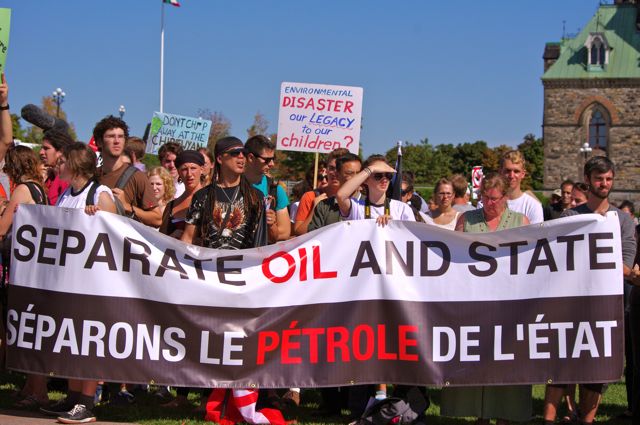
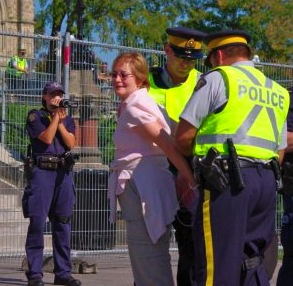
More than 200 Canadians engaged in civil disobedience, with 117 arrested in Canada’s quiet capital city on Monday. The reason? To protest the Stephen Harper right-wing government’s open support for the oil industry and expanding production in the climate-disrupting tar sands.
The normally placid and polite Canadians shouted, waved banners and demanded the closure of the multi-billion-dollar tar sands oil extraction projects in northern Alberta to protect the global climate and the health of local people and environment.
“People are here because they know that if we don’t turn away from the tar sands and fossil fuels soon it will be too late,” Peter McHugh, a spokesperson for Greenpeace Canada, told IPS.
“The tar sands are unsustainable. Canadians are willing to shift away from fossil fuels but our government isn’t,” Gabby Ackett a university student and protester, told IPS as she stood in front of a long line of police.
In what was proudly touted as “civil” civil disobedience, protesters aged 19 to 84 were arrested for using a step-stool to climb a low barrier separating them from the House of Commons, the seat of Canadian government. The police were friendly and accommodating because the organisers had promised there would be no violence.
“We live downstream and see the affects of tar sands pollution on the fish and the birds,” said George Poitras, a former chief of the Mikisew Cree First Nation in northern Alberta.
“Some our young people have rare forms of cancer,” Poitras told more than 500 protesters.
“Expanding the tar sands is not the way to go in a world struggling with climate change,” he said. Continue reading →
The tar sands in Alberta, Canada. Credit: howlmonteal/cc by 2.0
By Stephen Leahy
UXBRIDGE, Canada, Feb 16 2013 (IPS)
The largest climate rally in U.S. history is expected Sunday in Washington DC with the aim of pressuring President Barack Obama to reject the Keystone XL tar sands pipeline.
Activists are calling Keystone “the line in the sand” regarding dangerous climate change, prompting the Sierra Club to suspend its 120-year ban on civil disobedience. The group’s executive director, Michael Brune, was arrested in front of the White House during a small protest against Keystone on Wednesday.
“The Keystone XL pipeline is part of the carbon infrastructure that will take us to dangerous levels of climate change,” said Simon Donner, a climate scientist at the University of British Columbia.
To permit the pipeline would represent a heartbreaking acquiescence to climate change on the part of President Obama and our national leaders.
“By itself, Keystone won’t have much of an impact on the climate, but it is not happening on its own,” Donner told IPS.
Carbon emissions are increasing elsewhere, and the International Energy Agency recently warned humanity is on a dangerous path to four degrees C of warming before the end of this century. Children born today will experience this. Preventing that dire future is inconsistent with expanding tar sands production, Donner said.
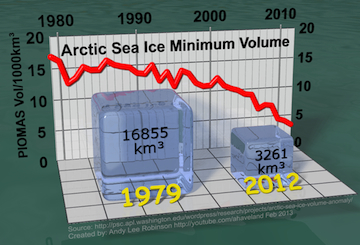
A new study released this week revealed that the volume of Arctic sea ice is declining rapidly. Ice volume has fallen 80 percent since 1980, according to the latest data from European Space Agency satellite, CryoSat-2. Summers with a sea ice-free Arctic are only a few years away, scientists now agree. This will have significant and permanent impacts on weather patterns in the Northern Hemisphere.
“Keystone XL is the key to opening up the expansion of the tar sands industry,” said Jim Murphy, senior counsel with the National Wildlife Federation.
“By rejecting the Keystone XL tar sands pipeline, we can keep this toxic oil in the ground,” Murphy said in a statement.
New study reveals a major trend is underway. More and more countries are acting on climate – only Canada going backward
By Stephen Leahy
UXBRIDGE, Canada, Jan 15 2013 (IPS)
A majority of major economies have made significant progress in addressing climate change, with countries like South Korea and China taking aggressive action so they can benefit from energy- and resource-efficient economies, a new report released Monday found.
The study by GLOBE International and Grantham Research Institute profiled 33 major economies in an annual examination of climate and energy legislation. 32 of them, including the United States, made significant progress in 2012, while only Canada regressed.
“The study reveals a major trend is underway. More and more countries are acting on climate,” said Adam Matthews, secretary general of GLOBE International, an organisation of legislators.
While major international climate conferences such as the Conference of the Parties (COP) held in Doha in November and December 2012 have made little progress, cities, states and national governments around the world are taking action.
The political reality, Matthews told IPS, is that local and national climate regulations and legislation must come first. “An environment minister in Doha couldn’t commit his country to an ambitious carbon reduction target unless the country has already decided to chart a new economic course,” he said. Continue reading →
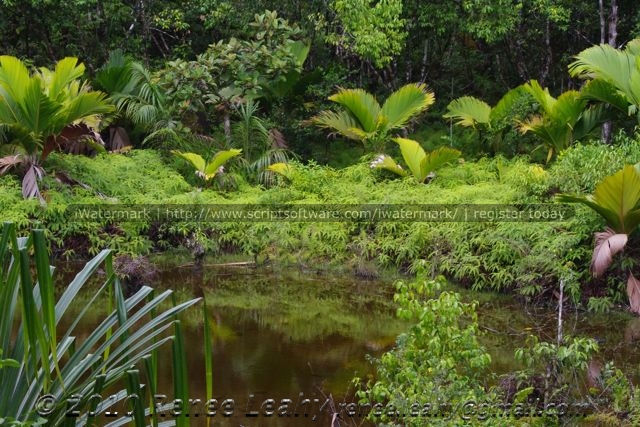
Wetlands regulate, clean and cool water. Mare Aux Cochons high-altitude wetlands, Seychelles Islands (ReneeLeahy copyright)
By Stephen Leahy
UXBRIDGE, Canada, Jan 18 2013 (IPS)
After Hurricane Sandy swept through the northeast of the United States late October 2012, millions of New Yorkers were left for days without electricity. But they still had access to drinking water, thanks to New York City’s reliance on protected watershed areas for potable water.
Instead of using electric-powered water treatment plans, New York City brings its high-quality drinking water through aqueducts connected to protected areas in the nearby Catskill/Delaware forests and wetlands – just one example of how protecting watersheds can provide residential areas with drinking water and flood and pollution protection at bargain basement prices.
New York saved between four and six billion dollars on the cost of water treatment plants by protecting forests and compensating farmers in the Catskills for reducing pollution in lakes and streams.
In 2011, countries around the world invested more than eight billion dollars in similar watershed projects around the world, according to the State of Watershed Payments 2012 report released Thursday. That year, China led the way, accounting for 91 percent of watershed investment.
“Whether you need to save water-starved China from economic ruin or protect drinking water for New York City, investing in natural resources is emerging as the most cost-efficient and effective way to secure clean water and recharge our dangerously depleted streams and aquifers,” said Michael Jenkins, president of Forest Trends, a non-governmental organisation (NGO) in the United States, which compiled the report. Continue reading →
Governments, the media and the public aren’t paying attention to the “planetary emergency” unfolding around them. The situation is like firefighters yelling “fire” in crowded room and still no listens.
“The situation is absolutely desperate and yet there’s nothing on the front pages or on the agenda of world leaders,” said Pat Mooney, executive director of the ETC Group, an international environmental organisation based in Ottawa.
“The lack of attention is a tragedy,” said Mooney, who has 40 years experience in international environment and development issues.
Humanity is failing in its stewardship of the planet. An incredible 85 percent of the world’s oceans are in trouble, said Susan Lieberman, director of international policy at the Pew Environment Group, a U.S. organisation.
“Planetary emergency” is how many in the world’s scientific community describe “the mess we are in“. They will detail their comprehensive state of the planet assessment at the “Planet Under Pressure” conference in London Mar. 26-29.
That assessment will summarise the overwhelming evidence that “the continued functioning of the Earth system as we know it is at risk,” conference organisers previously told IPS.
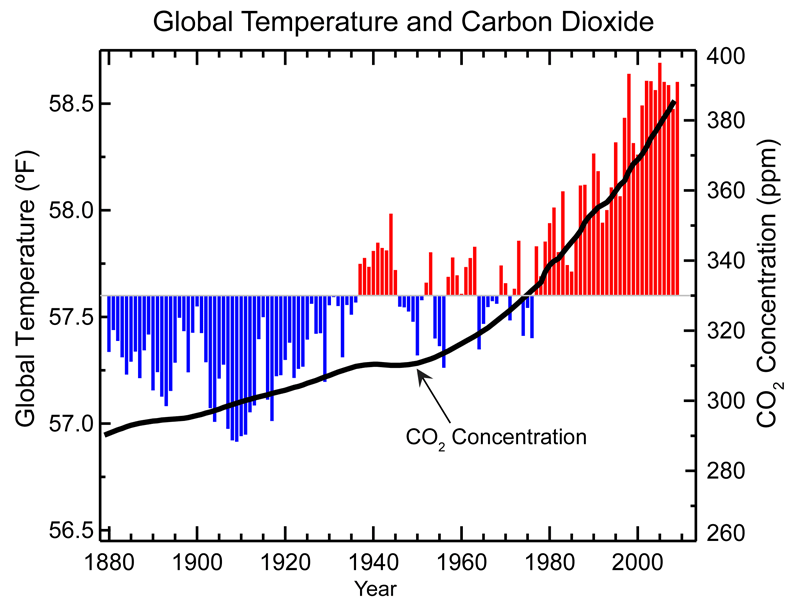
Climate change, which is overheating the planet and making the oceans more acidic, is just one of the major challenges. Another is the ongoing decline of biodiversity, where so many plants and animals are going extinct that the Earth’s living systems on which humanity depends are unraveling.
Fresh water is another “planetary boundary” humanity is pushing up against. Water use has increased six-fold in the past century and in many places the quality of water resources has been degraded. Other challenges include increasing poverty, food and energy security, and the current financial and economic instability.
A first and essential step in a green transition is for nations to commit to phasing out harmful and unsustainable subsidies for fossil fuels, fisheries and industrial agriculture.
According to Mooney, some countries and large corporations see the green economy in terms of a post-petroleum future where resources and energy for industrial production comes from biomass and other living things. Most of those “living resources” are in the global South and local people rightly fear a massive land grab, he said.
Foreign investors have already gained access to more than 35 million hectares in Africa, Asia and South America for food and biofuel production according to GRAIN, a small NGO working with small farmers and farming communities.
Concentrated Solar Power plant of Ain Beni Mathar, Morocco is a first in the world.
Countries cannot afford to miss the green wave of Rio+20
No alternative to low-carbon, resource-efficient economies
By Stephen Leahy
UXBRIDGE, Canada, May 25, 2012 (IPS)
Think of Rio+20 as the hothouse to grow the green ideas and values humanity needs to thrive in the 21st century.
No one is expecting, or even wants, a big new international treaty on sustainable development said Manish Bapna, interim president of the World Resources Institute, a global environmental think tank based in Washington, D.C.
“The important action will be on the sidelines of the formal negotiations,” Bapna told IPS in an interview.
Blocs of countries, civil society organisations and representatives of business will meet, create coalitions and make commitments on specific issues and on regional concerns.
“There could be some exciting specific commitments coming out of Rio,” Bapna said.
Perhaps the most important outcome from Rio+20 would be to put to rest the erroneous belief that protecting the environment comes at the cost of economic growth when it is in fact the opposite. Without a healthy, functioning environment, humanity loses the benefits of the environment’s “free products”: air, water, soil to grow food, stable climate and so on.
“One of the big hurdles to a sustainable future is that officials in many countries think they can’t afford to move onto a more sustainable pathway,” he said.
Bapna hopes Rio+20 will generate a “new narrative” – a wider understanding that there is no viable alternative to the transition to low-carbon, resource-efficient economies that alleviate poverty and create more jobs. Continue reading →
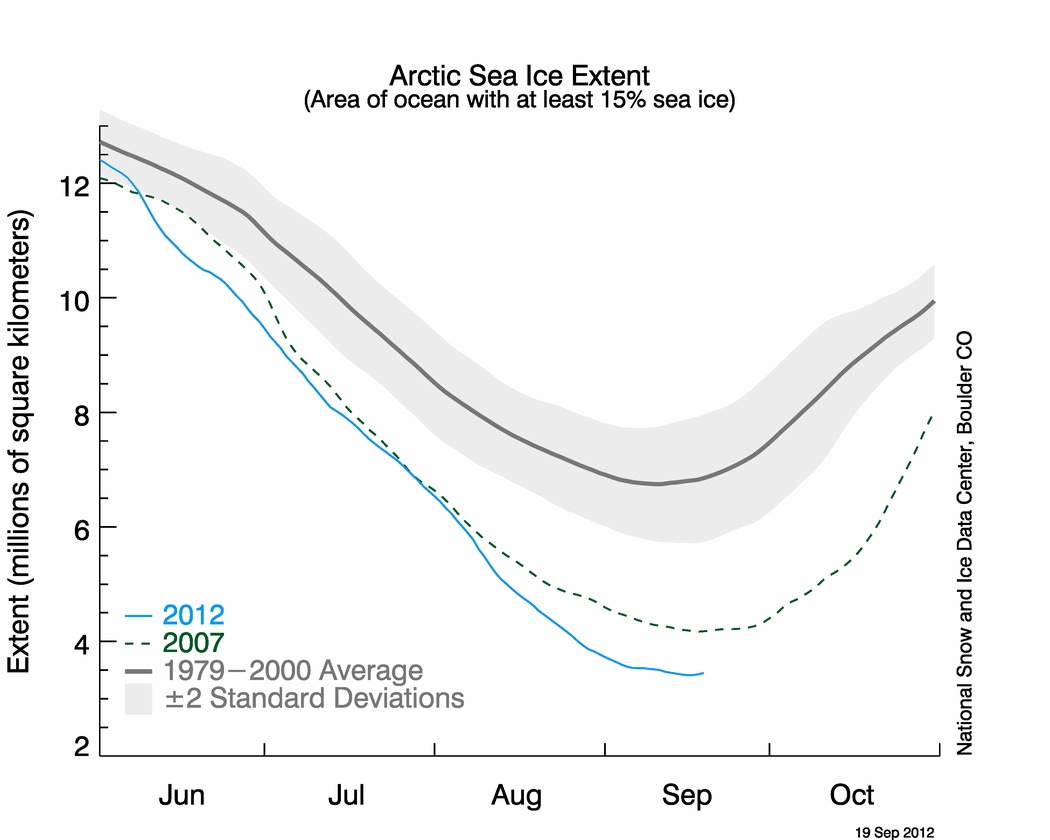
The melt of Arctic sea ice has reached its lowest point this year, shrinking 18 percent from last year’s near-record low.
Summer ice this year is half what it was 30 years ago and is now affecting weather patterns. The massive declines in ice in recent summers have shocked scientists and Arctic experts. Some predict that in just a few years we will witness an event that hasn’t happened in millions of years: the complete loss of summer ice.
“Few of us were prepared for how rapidly the changes would actually occur” as a result of the burning fossil fuels that are warming the planet, said Serreze.
“We could see an essentially ice-free Arctic ocean in late summer by the year 2030,” he told IPS.
Not long ago experts thought the soonest the Arctic would be ice-free was 2070. Now it’s anywhere from four to 18 years away.
The impacts are already being felt across the entire northern hemisphere. The loss of sea ice in recent years has been affecting weather patterns, recent research has shown. The all-important jet stream – the west-to-east winds that are the boundary between the cold Arctic and the warm mid-latitudes – is slowing down, moving north and become more erratic.
“Europe, eastern Asia and eastern North America is connected to unique physical processes in the Arctic,” said James Overland of the NOAA/Pacific Marine Environmental Laboratory in the United States.
“In future, cold and snowy winters will be the rule rather than the exception” in these regions, Overland told IPS in Oslo in 2010.
The summer’s record loss of Arctic sea ice may mean a cold winter for the UK and northern Europe, Jennifer Francis, a researcher at Rutgers University, told the Guardian last week.
The region has been prone to bad winters after summers with very low sea ice, such as 2011 and 2007, Francis said. Continue reading →
Lopiso Lagebo, 25, comes from Kambata, a small town 800km away from Metahar. He starts working at 0500, cuts up to 5 tons (5,000 kg) of sugar cane a day and earns $0.8. The company recruits most of the work force around his home town, where land shortage drives the workers to emigrate. Caption and Photo: Alfredo Bini/Cosmos http://www.facebook.com/alfredobini
[I wrote this article three years ago revealing a global land grab by rich investors that is now estimated to be more than 200 million hectares – my recent update here – Stephen]
By Stephen Leahy*
ANCHORAGE, Alaska, USA, May 5 , 2009 (Tierramérica)
More than 20 million hectares of farmland in Africa and Latin America are now in the hands of foreign governments and companies, a sign of a global “land grab” that got a boost from last year’s food crisis.
Rich countries that are short on land or water at home are looking to secure food-producing lands elsewhere as a way to ensure food security for their populations, said Joachim von Braun, director of the International Food Policy Research Institute (IFPRI).
“There is a major lack of transparency in these land deals,” von Braun said in a telephone press conference from Washington.
The IFPRI study, “‘Land Grabbing’ by Foreign Investors in Developing Countries,” by von Braun and Ruth Meinzen-Dick, which was presented last week, estimates that 15 to 20 million hectares have been acquired or are in the process of being sold.
Von Braun pointed out that this is equivalent to about 25 percent of all the farmland in Europe.
Because hard data is difficult to come by – the study was based primarily on information from press reports – IFPRI conservatively estimates that the deals represent 20 to 30 billion dollars being invested by China, South Korea, India and the Gulf States, mainly in Africa.
“About one-quarter of these investments are for biofuel plantations,” von Braun said. Continue reading →
+15,000 temperature records already broken in the US this year
By Stephen Leahy
UXBRIDGE, Canada, May 4, 2012 (IPS)
What are you doing on Saturday? Peter Nix, a retiree, will be standing on a railway track on Canada’s west coast blocking a coal train destined to ship U.S. and Canadian coal to Asia.
Nix will be joined by dozens of people near White Rock, British Columbia on May 5. They will be in good company as tens of thousands of people around the world participate in global day of action to “connect the dots” between climate change and extreme weather.
“There will be at least 1,200 actions in more than 100 countries,” says Jamie Henn, communications director for 350.org, a U.S.-based environmental group.
Please throw something in the tip jar before reading on. This is how I make my living.
There’s been a general perception that climate change is a future problem but with all the extreme weather disasters and weather records the public is being to realise that climate change is here, says Henn.
“Recent opinion surveys show the more than 60 percent of the U.S. public are connecting extreme weather to climate change,” Henn told IPS.
The U.S. public is not wrong, say scientists.
“All weather events are affected by climate change because the environment in which they occur is warmer and moister than it used to be,” Kevin Trenberth, senior scientist at the U.S. National Center for Atmospheric Research, told IPS previously. Continue reading →

 Dirty fossil fuel energy leads to 350,000 premature deaths in Europe
 The tar sands in Alberta, Canada. Credit: howlmonteal/cc by 2.0




 Stephen Leahy, International Environmental Journalist