Jail Before Climate-Wrecking Tar Sands, Canadians Say

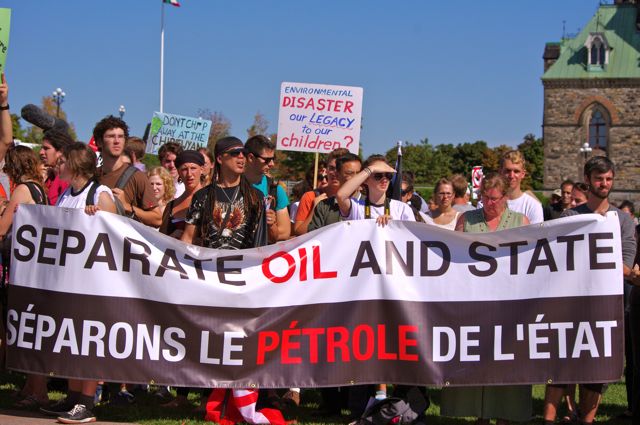
Tar sands protest Sept 2011, Ottawa Pic by R Leahy

[Repost: After the rally against Keystone XL in Washington last Sunday, a reminder that Canadians are willing to be arrested to stop growth of climate-destroying tar sands. — Stephen ]

By Stephen Leahy

OTTAWA, Sep 27, 2011 (IPS)

More than 200 Canadians engaged in civil disobedience, with 117 arrested in Canada’s quiet capital city on Monday. The reason? To protest the Stephen Harper right-wing government’s open support for the oil industry and expanding production in the climate-disrupting tar sands.

The normally placid and polite Canadians shouted, waved banners and demanded the closure of the multi-billion-dollar tar sands oil extraction projects in northern Alberta to protect the global climate and the health of local people and environment.

“People are here because they know that if we don’t turn away from the tar sands and fossil fuels soon it will be too late,” Peter McHugh, a spokesperson for Greenpeace Canada, told IPS.

“The tar sands are unsustainable. Canadians are willing to shift away from fossil fuels but our government isn’t,” Gabby Ackett a university student and protester, told IPS as she stood in front of a long line of police.

In what was proudly touted as “civil” civil disobedience, protesters aged 19 to 84 were arrested for using a step-stool to climb a low barrier separating them from the House of Commons, the seat of Canadian government. The police were friendly and accommodating because the organisers had promised there would be no violence.

“We live downstream and see the affects of tar sands pollution on the fish and the birds,” said George Poitras, a former chief of the Mikisew Cree First Nation in northern Alberta.

“Some our young people have rare forms of cancer,” Poitras told more than 500 protesters.

“Expanding the tar sands is not the way to go in a world struggling with climate change,” he said. Continue reading
Green Approaches to Water Safest and Cheapest Solution

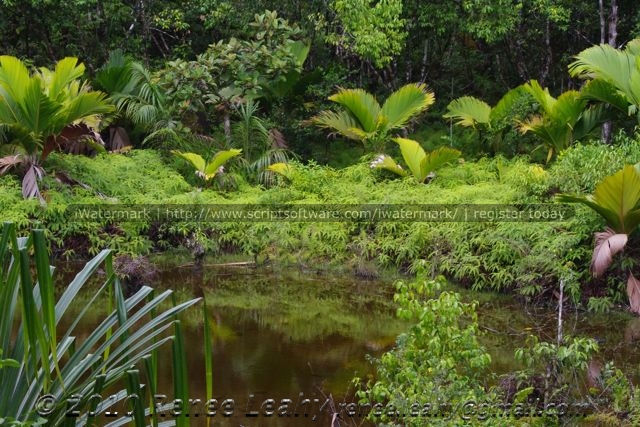
Wetlands regulate, clean and cool water. Mare Aux Cochons high-altitude wetlands, Seychelles Islands (ReneeLeahy copyright)

By Stephen Leahy

UXBRIDGE, Canada, Jan 18 2013 (IPS)

After Hurricane Sandy swept through the northeast of the United States late October 2012, millions of New Yorkers were left for days without electricity.  But they still had access to drinking water, thanks to New York City’s reliance on protected watershed areas for potable water.

Instead of using electric-powered water treatment plans, New York City brings its high-quality drinking water through aqueducts connected to protected areas in the nearby Catskill/Delaware forests and wetlands – just one example of how protecting watersheds can provide residential areas with drinking water and flood and pollution protection at bargain basement prices.

New York saved between four and six billion dollars on the cost of water treatment plants by protecting forests and compensating farmers in the Catskills for reducing pollution in lakes and streams.

In 2011, countries around the world invested more than eight billion dollars in similar watershed projects around the world, according to the State of Watershed Payments 2012 report released Thursday. That year, China led the way, accounting for 91 percent of watershed investment.

“Whether you need to save water-starved China from economic ruin or protect drinking water for New York City, investing in natural resources is emerging as the most cost-efficient and effective way to secure clean water and recharge our dangerously depleted streams and aquifers,” said Michael Jenkins, president of Forest Trends, a non-governmental organisation (NGO) in the United States, which compiled the report. Continue reading

Worlds’ Scientists Say Facing “Planetary Emergency”

Planet Under Pressure – State of the Planet Declaration Mar 29 2012.

By Stephen Leahy

UXBRIDGE, Canada, (IPS)

[Based on my article Climate Summit: A Moment That Must Be Seized ]

Governments, the media and the public aren’t paying attention to the “planetary emergency” unfolding around them. The situation is like firefighters yelling “fire” in crowded room and still no listens.

“The situation is absolutely desperate and yet there’s nothing on the front pages or on the agenda of world leaders,” said Pat Mooney, executive director of the ETC Group, an international environmental organisation based in Ottawa.

“The lack of attention is a tragedy,” said Mooney, who has 40 years experience in international environment and development issues.

Humanity is failing in its stewardship of the planet. An incredible 85 percent of the world’s oceans are in trouble, said Susan Lieberman, director of international policy at the Pew Environment Group, a U.S. organisation.

“Planetary emergency” is how many in the world’s scientific community describe “the mess we are in“. They will detail their comprehensive state of the planet assessment at the “Planet Under Pressure” conference in London Mar. 26-29.

That assessment will summarise the overwhelming evidence that “the continued functioning of the Earth system as we know it is at risk,” conference organisers previously told IPS.

Climate change, which is overheating the planet and making the oceans more acidic, is just one of the major challenges. Another is the ongoing decline of biodiversity, where so many plants and animals are going extinct that the Earth’s living systems on which humanity depends are unraveling.

Fresh water is another “planetary boundary” humanity is pushing up against. Water use has increased six-fold in the past century and in many places the quality of water resources has been degraded. Other challenges include increasing poverty, food and energy security, and the current financial and economic instability.

A first and essential step in a green transition is for nations to commit to phasing out harmful and unsustainable subsidies for fossil fuels, fisheries and industrial agriculture.

According to Mooney, some countries and large corporations see the green economy in terms of a post-petroleum future where resources and energy for industrial production comes from biomass and other living things. Most of those “living resources” are in the global South and local people rightly fear a massive land grab, he said.

Foreign investors have already gained access to more than 35 million hectares in Africa, Asia and South America for food and biofuel production according to GRAIN, a small NGO working with small farmers and farming communities.


Drought and New Deserts by 2060: Most of Mexico, Central America and half of US

Projected drought and dry regions in 2060-2069

By Stephen Leahy

UXBRIDGE, Canada, May 22, 2012 (Tierramérica)

Mexico and Central America look like they are covered in dried blood on maps projecting future soil moisture conditions.

The results from 19 different state-of-the-art climate models project extreme and persistent drought conditions (colored dark red-brown on the maps) for almost all of Mexico, the midwestern United States and most of Central America.

If climate change pushes the global average temperature to 2.5 degrees Celsius above pre-industrial era levels, as many experts now expect, these regions will be under severe and permanent drought conditions.

Future conditions are projected to be worse than Mexico’s current drought or the U.S. Dust Bowl era of the 1930s that forced hundreds of thousands of people to migrate.

These are some of the conclusions of the study “Projections of Future Drought in the Continental United States and Mexico”, which was published in the December 2011 issue of the American Meteorological Society’s Journal of Hydrometeorology and has gone largely unnoticed.

“Drought conditions will prevail no matter what precipitation rates are in the future,” said co-author Michael Wehner, a climate scientist at the Lawrence Berkeley National Laboratory, a U.S. government research centre in California.

“Even in regions where rainfall increases, the soils will get drier. This is a very robust finding,” Wehner told Tierramérica.

Without major reductions in carbon emissions from the burning of fossil fuels, global temperatures will increase to at least 2.5 degrees of warming between 2050 and 2090, depending on rates of emissions of greenhouse gases, climate sensitivity and feedbacks. Continue reading

Wealthy Countries and Investors Buying Up Farmland in Poor Countries

Lopiso Lagebo, 25, comes from Kambata, a small town 800km away from Metahar. He starts working at 0500, cuts up to 5 tons (5,000 kg) of sugar cane a day and earns $0.8. The company recruits most of the work force around his home town, where land shortage drives the workers to emigrate. Caption and Photo: Alfredo Bini/Cosmos  http://www.facebook.com/alfredobini

[I wrote this article three years ago revealing a global land grab by rich investors that is now estimated to be more than 200 million hectares – my recent update here – Stephen]

By Stephen Leahy*

ANCHORAGE, Alaska, USA, May 5 , 2009 (Tierramérica)

More than 20 million hectares of farmland in Africa and Latin America are now in the hands of foreign governments and companies, a sign of a global “land grab” that got a boost from last year’s food crisis.

Rich countries that are short on land or water at home are looking to secure food-producing lands elsewhere as a way to ensure food security for their populations, said Joachim von Braun, director of the International Food Policy Research Institute (IFPRI).

“There is a major lack of transparency in these land deals,” von Braun said in a telephone press conference from Washington.

The IFPRI study, “‘Land Grabbing’ by Foreign Investors in Developing Countries,” by von Braun and Ruth Meinzen-Dick, which was presented last week, estimates that 15 to 20 million hectares have been acquired or are in the process of being sold.

Von Braun pointed out that this is equivalent to about 25 percent of all the farmland in Europe.

Because hard data is difficult to come by – the study was based primarily on information from press reports – IFPRI conservatively estimates that the deals represent 20 to 30 billion dollars being invested by China, South Korea, India and the Gulf States, mainly in Africa.

“About one-quarter of these investments are for biofuel plantations,” von Braun said.  Continue reading

Trashing the Oceans: 3 to 6 X More Trash Than Plankton – ‘Using Oceans as Universal Sewer’ — Cousteau

This is a repost from last year. Sad to see  little progress on this issue. — Stephen

“There is no reason for delay. Governments and industry need to take action and people have to stop pointing fingers at each other and get on with it.”

California nearly became the first U.S. state to ban plastic bags, but a multi-million-dollar lobby effort by industry killed the proposed legislation

By Stephen Leahy

HONOLULU, Hawaii, U.S., Mar 28, 2011 (IPS)

Every day, billions of plastic bags and bottles are discarded, and every day, millions of these become plastic pollution, fouling the oceans and endangering marine life.

No one wants this, but there is wide disagreement about how to stop it.

“Every time I stick my nose in the water, I am shocked. I see less and less fish and more and more garbage,” said Jean-Michel Cousteau, son of the legendary marine ecologist Jacques Cousteau, who has spent four decades making documentaries and educating people about the oceans.

Please throw something in the tip jar before reading on. This is how I make my living.

On trips to the remote and uninhabited northwestern Hawaiian Islands, Cousteau found miles and miles of plastic bottles, cigarette lighters, television tubes, spray cans, broken toys, and thousands of other pieces of plastic on the beaches and thousands of tonnes of derelict fishing nets in the reefs.

“We are using the oceans as a universal sewer,” he told some 440 participants from the plastics manufacturing, food and beverage sectors, environmental organisations, scientists and policy-makers from over 35 countries at the Fifth International Marine Debris Conference in Honolulu, Hawaii, which ended Mar. 25. Continue reading

Rio+20: The Moment in History to Ensure Our Future Survival?

Planet Under Pressure - State of the Planet Declaration Mar 29 2012.

Worlds’ Scientists Say Facing “Planetary Emergency”

By Stephen Leahy

UXBRIDGE, Canada, (IPS)

The upcoming Rio+20 conference has to be the moment in human history when the nations of the world come together to find ways to ensure the very survival of humanity, many science and environmental experts believe.

Except that governments, the media and the public aren’t paying attention to the “planetary emergency” unfolding around them. The situation is like firefighters yelling “fire” in crowded room and still no listens.

“The situation is absolutely desperate and yet there’s nothing on the front pages or on the agenda of world leaders,” said Pat Mooney, executive director of the ETC Group, an international environmental organisation based in Ottawa.

“The lack of attention is a tragedy,” said Mooney, who has 40 years experience in international environment and development issues.

Humanity is failing in its stewardship of the planet. An incredible 85 percent of the world’s oceans are in trouble, said Susan Lieberman, director of international policy at the Pew Environment Group, a U.S. organisation.

Rio+20 is a major opportunity to turn this around, Lieberman told IPS.

The Jun. 20-22 Rio+20 meet is timed to coincide with the 20th anniversary of 1992 Earth Summit in Rio de Janerio. The Earth Summit captured world attention, with leaders from most countries and some 10,000 media attending.

It gave birth to the most important environmental treaties on climate change, biodiversity and land degradation and desertification. World leaders also endorsed Agenda 21, a detailed blueprint on how nations can practice sustainable development.

Years of preparation went into the 1992 Summit, while only months have gone into Rio+20.

“There hasn’t been nearly enough preparation to be able to sign treaties,” said Lieberman. It’s been a struggle to get many governments like such as the US to focus on Rio+20 at all she said.

“Governments are not giving this opportunity enough importance given the mess we are in,” said Lisa Speer, director of the international oceans programme at the Natural Resources Defense Council, a U.S. NGO. Continue reading

No Magic Solutions for the Extinction of Species that Produce Our Air, Water and Water

Photo: Yann Arthus- Bertrand, GoodPlanet Foundation http://www.goodplanet.org/en/

Is there a middle ground between economic interests, livelihoods and conservation?

By Stephen Leahy

VANCOUVER, Canada (IPS)

The Earth’s life support system, which generates the planet’s air, water and food, is powered by 8.7 million living species, according to the latest best estimate. We know little about 99 percent of those unique species, except that far too many are rapidly going extinct.

What can be done to slow down this process, which could eventually lead to the extinction of the human species?

“The challenge is to find the middle ground between economic interests, livelihoods and conservation,” says Braulio Ferreira de Souza Dias, the newly appointed head of the Secretariat of the United Nations Convention on Biological Diversity (CBD), the international agency charged with helping countries slow and reverse the loss of plants, animals and other species.

A native of Brazil, Dias holds a doctorate in zoology from the University of Edinburgh, and worked for many years at the Brazilian Ministry of the Environment, where his last position prior to joining the CBD was as Secretary of Biodiversity and Forests.

An exclusive interview with BRAULIO FERREIRA DE SOUZA DIAS, executive secretary of the UN Convention on Biological Diversity

Q: Why are species going extinct and why does it matter? 
Continue reading

Climate Scientists to Attend Native Knowledge ‘Boot Camp’ in Australia

By Stephen Leahy

First published at National Geographic NewsWatch

In what may be a ‘clash of worldviews,’ representatives from indigenous and local communities are holding a climate workshop with physicists, computer modellers, and other climate scientists from the Intergovernmental Panel on Climate Change (IPCC) in Cairns, Australia 26-28 March.

This is a unique opportunity for Native peoples to discuss their traditional knowledge and experiences as it relates to climate change.

Indigenous peoples are amongst the most affected by current and future climate change but their experiences and knowledge have largely been ignored by science experts at the IPCC. The workshop, Climate Change Mitigation with Local Communities and Indigenous Peoples: Practices, Lessons Learned and Prospects, is a significant effort to change this.

There are an estimated 350 million indigenous peoples according to the United Nations. They legally own more than 11% of the world’s forests and those coincide with areas that hold up to 80% of the world’s terrestrial biodiversity. Traditional knowledge is a different but no less valid way of understanding the world. However, very few scientists of the thousands who have worked with the IPCC have any experience with traditional knowledge.

The IPCC is working on its next big report (to be released in 2014) and has acknowledged that its Fifth Assessment Report needs to look at how climate change will impact indigenous peoples, their role in reducing carbon emissions (mitigation) and what barriers they face in adapting to current and future climate impacts.

The Cairns workshop will focus on how indigenous peoples can help reduce global carbon emissions. It is being held in collaboration with the IPCC, indigenous organizations, the United Nations University (UNU), the Australian government and others.

Follow the workshop on Facebook or Twitter

Every six seconds a hungry child dies | UN Tries to Halt Land Degradation Crisis

By Stephen Leahy

CHANGWON, South Korea, Oct 25, 2011 (IPS)

Every six seconds a child dies of hunger-related causes.

That disturbing reality seems as remote as the moon here in the ultra-modern Changwon Convention Centre, where delegates struggled to create effective ways to stem the ongoing decline of food-producing lands.

Each year, 12 million hectares of land are lost where 20 million tonnes of grain might have been grown, according to the United Nations Convention to Combat Desertification. And that loss of food-producing lands is unlikely to change in the near future, even as the final gavel fell in the early morning hours of Oct. 22 at the end the two-week biannual 10th Conference of the Parties (COP 10).

“This conference has been highly successful,” said Lee Don Koo, minister of the Korean Forest Service and COP 10 president and host.

It was certainly the largest international gathering on land degradation, with 6,450 participants from 161 countries, including 83 ministers and deputy ministers. Lee Don Koo said this meeting sent a strong message to the world community about the need for strong, sustainable land management and for the pressing need to set targets to reduce land degradation.

“Our goal is to build a land-degradation-neutral world,” said Luc Gnacadja, executive secretary of the UNCCD. The target date to reach that goal is 2030, Gnacadja told IPS.

Gnacadja would like countries to officially adopt this goal at the RIO+20 conference in June 2012 in Brazil.

It has taken nearly 20 years to get to the point where there is agreement on 11 scientific indicators to measure land degradation and its impacts. Development and implementation of those indicators will take some years yet. The Convention has yet to address the economic and policy drivers of land degradation, acknowledged Antonio Rocha Magalhães, chair of the Committee on Science and Technology. Continue reading