Is Rio Earth Summit 2.0 Doomed to Fail?

By Stephen Leahy

UXBRIDGE, Mar 7, 2011 (IPS)

Timed to coincide with the 20th anniversary of the 1992 Rio de Janeiro Earth Summit, the Rio 2012 Summit hopes to recapture the optimism of that earlier era.

At the June 2012 Rio Summit it is hoped countries will agree on policies to move toward a green economy from the present “brown” economic system driven by fossil fuel energy and the serial depletion and degradation of natural resources and ecosystems. A green economy promises to bring good jobs, clean energy and water while ensuring a more sustainable and fairer use of resources.

“If we continue on our current path, we will bequeath material and environmental poverty, not prosperity, to our children and grandchildren,” said Rio 2012 Secretary-General Sha Zukang.

“Rio 2012 will be one of the most important events in the coming decades,” Zukang said

Continue reading

A Fatal Addiction to Plastic – Trashing the Oceans and Our own Health

Ocean trash art - plastic soda bottle tops, lighters, misc bits of plastic

By Stephen Leahy

KAUAI, Hawaii, U.S., Apr 1, 2011 (IPS)

“Be fantastic, don’t use plastic!” chanted a troop of 10-year- olds from President Thomas Jefferson Elementary School in Honolulu at the conclusion of an international conference on the millions of tonnes of trash that enter the oceans every year, with serious consequences for marine life and habitats as well as to human health and the global economy.

Most participants were in a celebratory mood at the Fifth International Marine Debris Conference, which concluded Mar. 25 with the Honolulu Commitment to address the growing problem of marine debris.

But Captain Charles Moore, the man who brought the world’s attention to the scope and scale of the problem, was not celebrating.

“I’ve been doing this for 30 years and every year it has only become worse,” Moore told IPS.

Moore is famous for revealing the immense amount of plastic in the north Pacific gyre, formed by ocean currents in a massive slow-moving whirlpool thousands of square kilometres in size.

Moore’s Algalita Marine Research Foundation documented that this vast expanse of oceans has about six kilogrammes of plastic for every kilogramme of plankton. He is careful to point out that there is no plastic island as reported in some media, it’s much more dispersed. Continue reading

April Heat Wave and Drought Breaks European Records

From the coldest December ever recorded to the warmest, driest April  Britain is just one of the countries being whipsawed by extreme weather. Normally wet Scotland is experiencing rare wildfires outbreaks this week. Europe’s wheat crop is at high risk due to very hot and dry temps.

My recent science articles explaining why weather extremes are becoming more common:

Why Our Weather is Weird ‘n Wild and Why It Is Getting Worse

The Yin and Yang of Climate Extremes We Will See More of

Will Year of Climate Extremes End Without Progress on Tackling Climate Change?

10 Years in the Amazon: The Forest Vanishes Before Your Eyes

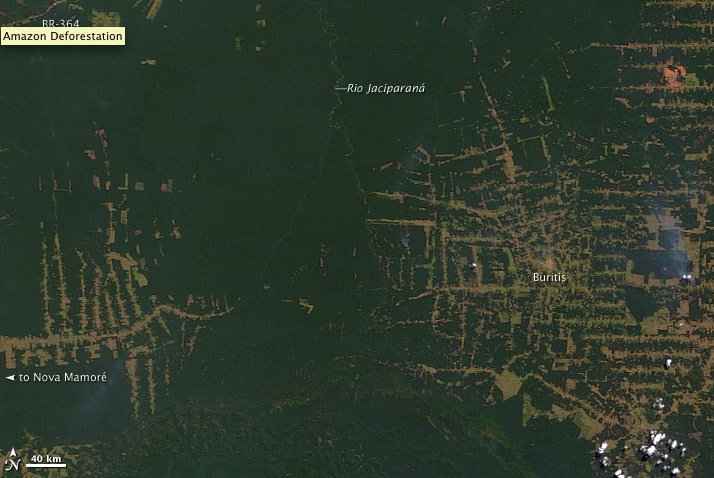
Amazon Forest 2000 - The state of Rondônia in western Brazil

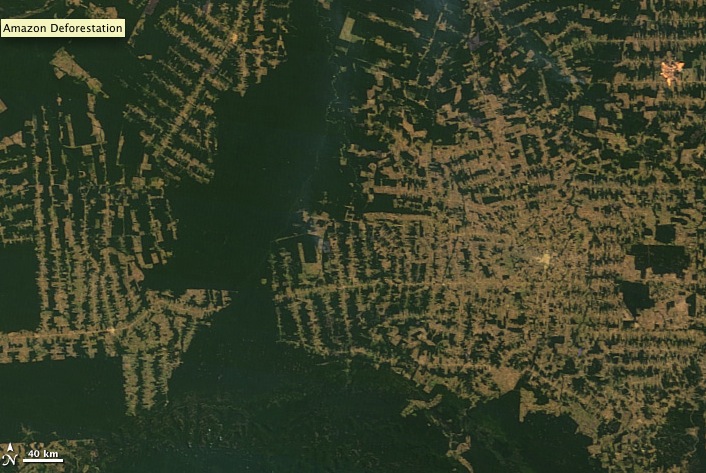
The state of Rondônia in western Brazil — once home to 208,000 square kilometers of forest (about 51.4 million acres), an area slightly smaller than the state of Kansas — has become one of the most deforested parts of the Amazon. In the past three decades, clearing and degradation of the state’s forests have been rapid: 4,200 square kilometers cleared by 1978; 30,000 by 1988; and 53,300 by 1998. By 2003, an estimated 67,764 square kilometers of rainforest—an area larger than the state of West Virginia—had been cleared. Source: Amazon Deforestation – NASA

See also: Amazon Drought Accelerating Climate Change   The REAL Amazon-gate: On the Brink of Collapse Reveals Million $ Study

Amazon Forest 2010 - The state of Rondônia in western Brazil

Multiple Award-winning Journalist and Author

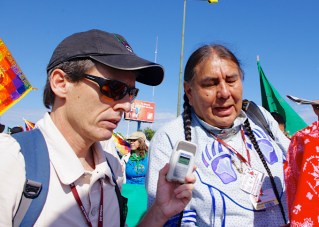
Leahy int Tom Goldtooth - cancun march - renee leahy 2010 copy

My work is featured in publications around the world including National Geographic,  The Guardian,  Vice Motherboard, The Weather Network, Inter Press Service News Agency (IPS), Changing America (The Hill), Ensia, Al Jazeera, New Scientist, The Ecologist, Mo Magazine (Brussels), TerraGreen (India), Toronto Star, Maclean’s Magazine, China Dialogue, Earth Island Journal, The Narwhal and many more.

This site does not have my recent articles. Most of my 1500+ articles, including the very latest, can be found at Authory, My Portfolio. The content is searchable by keyword and media outlet.


AWARDS:

Winner of the 2018 & 2019 SEAL Award for Environmental Journalism celebrating my work in documenting climate change impacts and solutions at National Geographic and Vice.

Environmental journalism matters now more than ever.”

     — Matt Harney, Founder, SEAL Awards.

New Project:

banner caps

Navigating this Decade of Change & Consequence

What do we all need to know at this time of pandemic, existential crisis of climate change and unraveling of nature’s life supports? Not to mention, a time of political, social and technological upheaval? What do we need to know to get through all of this and come out smiling on the other side?And what do we need to know to help us get through each day?

Subscribe to my FREE weekly newsletter: Need to Know: Science and Insight

(Samples below.)


SPEAKER: I’ve spoken at dozens of events both large and small from keynotes to pub talks.  Click here for more.

“Stephen is…a favourite of our audiences. He’s able to make complex issues seem simple without taking anything away from the urgency and importance of his message.”

– David Leonard, Director of Canada’s premiere talk series: Walrus Talks 

CONTACT:

To contact me please click this link and fill out the form at the bottom.

Yes, this really works and I will reply — Stephen.

Tips for Climate-Safe Living on Earth Day

Take time to be outside today and think about everything that nature provides:  air, water, plants and animals that sustain us. Such gifts should not be taken lightly because with our numbers and powerful technologies we are ‘the bull in nature’s china shop’.

We need to take great care and practice Climate-safe Living.

1. Reduce.

Reduce fossil fuel consumption everywhere.

2. Eliminate.

Eliminate all non-essential activities and products that involve burning fossil fuels.

3. Demand.

Demand that business and government provide transport, activities and products that use minimize fossil fuel use.

Reduce. Eliminate. Demand. R.E.D.

May you always cherish this Earth and share in her joys.

Stephen

Governments Responsible for Species Decline – New Panel Learns from IPCC Experience

By Stephen Leahy*

UXBRIDGE, Canada, Mar 6, 2011 (Tierramérica)

After five years of preparation the international community is expected to launch the Intergovernmental Platform on Biodiversity and Ecosystem Services this year. For some of its proponents, even the decisions of the World Trade Organisation should be subject to its analysis.

IPBES would be analogous to the Intergovernmental Panel on Climate Change (IPCC), but focused on biological diversity.

The idea behind this effort is that decisions by all levels of government are largely responsible for the decline in species and ecosystems that support life on the Earth.

To put an end to species decline, governments need an independent, authoritative scientific body that can assess the impacts of proposed policies and decisions that biodiversity experts have long recommended.

“People generally have yet to appreciate the importance of biodiversity and ecosystem services, and how much is at stake in biodiversity loss,” Charles Perrings, professor of environmental economics at Arizona State University in the U.S. southwest, told Tierramérica.

“Biodiversity” is the term used to describe the wide variety of living things that comprise the planet’s biological infrastructure and provide us with health, wealth, food, water, fuel and other vital services.  Continue reading

Peak Water Has Already Come and Gone

Woman from Woukpokpoe village in Benin

By Stephen Leahy

UXBRIDGE, Canada, Mar 22, 2011 (IPS)

Canadian Kevin Freedman is celebrating World Water Day Tuesday by living on 25 litres of water a day, instead of the North American average of 330 litres per day. And he has enlisted 31 others in his “Water Conservation Challenge” to go water- lean, using just 25 litres per day for cooking, drinking, cleaning, and sanitation for the entire month of March.

“People in Canada and the U.S. have no idea how much water they use or how much they waste,” Freedman told IPS.

“Although people live on less, it is very difficult to use just 25 litres a day. You can’t shower or use a washing machine,” he said. “I’m hoping to raise awareness that water is a finite resource.”

Nearly a billion people don’t have good access to safe fresh water. In a single generation, that number could double as growing demands for water will exceed the available and sustainable supply by 40 percent, according a recent study. “Peak water” has already come and gone. Humanity uses more water than can be sustained, drawing on non-renewable reserves of water accumulated over thousands of years in deep aquifers.

“Water cannot be created, it can only by managed,” said Margaret Catley-Carlson, a former senior official with both the Canadian government and at the United Nations, a renowned global authority on water issues, and a director at the Canadian Water Network Continue reading

Japan Nuke Disaster Could Be Worse Than Chernobyl

By Stephen Leahy

UXBRIDGE, Canada, Mar 17, 2011 (IPS)

A global nuclear disaster potentially worse than Chernobyl may be under way in Japan as hundreds of tonnes of highly radioactive spent nuclear fuel are open to the sky, and may be on fire and emitting radioactive particles into the atmosphere.

Many countries have advised their citizens in Japan to leave the country.

“This is uncharted territory. There is a 50-percent chance they could lose all six reactors and their storage pools,” said Jan Beyea, a nuclear physicist with a New Jersey consulting firm called Consulting in the Public Interest.

“I’m surprised the situation hasn’t gotten worse faster… But without a breakthrough it’s only a matter of days before spent fuels will melt down,” said Ed Lyman, a physicist at the Union of Concerned Scientists and an expert on nuclear plant design.

Japan’s Fukushima Daiichi plant was damaged by a powerful earthquake and tsunami on Mar. 11. It has an estimated 1,700 tonnes of used or spent but still dangerous nuclear fuel in storage pools next to its six nuclear reactors, according to Kevin Kamps, a radioactive waste specialist at Beyond Nuclear, a U.S. anti-nuclear environmental group.

The storage pools holding 30 to 35 years worth of spent fuel at reactors No. 3 and No. 4 have lost containment and most if not all of their coolant water. They may be on fire, venting radioactive particles into the atmosphere, Kamps told IPS.

On Thursday, Japanese military helicopters protected by lead shielding managed to dump some seawater on the damaged reactors No. 3 and No. 4 in a desperate and very risky last- ditch effort at the highly radioactive site.

via Japan Nuke Disaster Could Be Worse Than Chernobyl – IPS ipsnews.net.

Cut Climate Damaging Emissions in Half and Double Food Production With Eco-Farming

45- 50% of global warming emissions from industrial agriculture

By Stephen Leahy

UXBRIDGE, Feb 8, 2011 (IPS)

Eco-farming could double food production in entire regions within 10 years while mitigating climate change, according to a new U.N. report released Tuesday in Geneva.

An urgent transformation to ‘eco-farming’ is the only way to end hunger and face the challenges of climate change and rural poverty, said Olivier De Schutter, U.N. Special Rapporteur on the right to food, following the presentation of his annual report focusing on agroecology and the right to food to the U.N. Human Rights Council.

“Agroecology mimics nature not industrial processes. It replaces the external inputs like fertiliser with knowledge of how a combination of plants, trees and animals can enhance productivity of the land,” De Schutter told IPS, stressing that, “Yields went up 214 percent in 44 projects in 20 countries in sub-Saharan Africa using agro-ecological farming techniques over a period of 3 to 10 years… far more than any GM [genetically modified] crop has ever done.”

Other recent scientific assessments have shown that small farmers in 57 countries using agro-ecological techniques obtained average yield increases of 80 percent. Africans’ average increases were 116 percent.

“Today’s scientific evidence demonstrates that agroecological methods outperform the use of chemical fertilisers in boosting food production in regions where the hungry live,” De Schutter said. [Video Interviews with De Schutter]

Continue reading