Killer Heat Waves and Floods Linked to Climate Change

More than 5 million affected by flooding in Pakistan Sept 2011 - a repeat of 2010.
More than 5 million affected by flooding in Pakistan Sept 2011 – a repeat of 2010.

“The first law of humanity is not to kill your children.”

By Stephen Leahy

UXBRIDGE, Canada, Feb 27 2013 (IPS)

Killer heat waves, floods and storms are increasingly caused by climate change, new research reveals.

Scientists in Germany say they have found how greenhouse gases from burning fossil fuels are helping to trap the jet stream, resulting in extraordinary weather such as the 2010 Pakistan flood and the 2011 heat wave in the United States.

Human-driven climate change repeatedly disturbs the flow of atmospheric waves around the globe’s Northern hemisphere, said lead author Vladimir Petoukhov of the Potsdam Institute for Climate Impact Research (PIK) in Germany.rossby.waves1_

Giant atmospheric waves called Rossby waves are meanders in the strong, high-altitude winds known as jet streams and have a major influence on weather. These wave movements are caused by the difference in temperatures between the cold air from the Arctic and hot air from the tropics.

When the waves shift north, they suck warm air from the tropics to Europe, Russia, or the U.S., and when they swing down, they do the same thing with cold air from the Arctic, said Petoukhov.

“During several recent extreme weather events, these planetary waves almost freeze in their tracks for weeks,” he said. “So instead of bringing in cool air after having brought warm air in before, the heat just stays.”

This unnatural pattern is due to human heating of the climate through emissions of greenhouse gases that result from burning fossil fuels, according to the study published this week in Proceedings of the National Academy of Sciences.

However, this heating of the atmosphere is wildly uneven. The Arctic is warming two to three times faster than the global temperature rise of 0.8C and that affects the Rossby waves and is slowing the jet stream.

“(Our research) complements previous research that already linked such phenomena to climate change,” said Hans Joachim Schellnhuber, a co-author of the study. Continue reading
80 percent of Arctic Ice Lost Compared to 30 Years Ago

arctic-sea-ice-min-volume-comparison-1979-2012-small

[This is my first exclusive blog post – virtually everything else on this site are my published articles. Not sure if I’ll have time to do more. Let me know what you think – Stephen ]

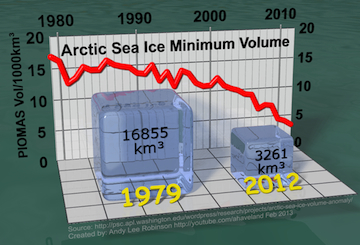
A new study released Feb 13 revealed that the volume of Arctic sea ice is declining rapidly. Ice volume in September 2012 had fallen 80 percent compared with the volume of ice in September 1980 according to the latest data from European Space Agency satellite, CryoSat-2. As the Arctic heats up Most of the ice loss has been in recent years. Between 2003 and 2012 the volume declined a whopping 36 percent. Summers with a sea ice-free Arctic are only a few years away, scientists now agree. This will have significant and permanent impacts on weather patterns in the Northern Hemisphere.

My previous article  Ice-Free Arctic Is “Uncharted Territory” documented last September’s one year record area decline of 18 percent. Here’s what this means:

The impacts are already being felt across the entire northern hemisphere. The loss of sea ice in recent years has been affecting weather patterns, recent research has shown. The all-important jet stream – the west-to-east winds that are the boundary between the cold Arctic and the warm mid-latitudes – is slowing down, moving north and become more erratic.

When continent-sized areas of the Arctic Ocean flip from the all-white ice to dark blue, tremendous amounts of heat are absorbed from the 24-hour summer sun. When the bitter cold Arctic winter sets in over the next few weeks, all the heat in the ocean must be released into the atmosphere before ice can form again.

The Arctic will be ice-covered in winter for decades to come but what’s fundamentally changed is that every fall, unprecedented amounts of heat and water vapour will be released into the atmosphere.

“The polar meltdown shows we’re teetering on the brink of climate change catastrophe,” said Shaye Wolf, climate science director at the Center for Biological Diversity’s Climate Law Institute.

As the sea ice declines, Arctic temperatures increase, thawing more and more permafrost, which will release more climate-heating carbon and methane. Permafrost is frozen soil, sediment and rock spanning 13 million square kilometres of the land in Alaska, Canada, Siberia and parts of Europe. It has twice the carbon that the atmosphere currently holds.

A Swedish study released Feb 17 has found a link between sea ice declines and increases in methane emissions. Methane has 40x the warming of carbon. This is may lead to an even faster meltdown of the Arctic risking the release of huge amounts of permafrost carbon and methane.

US Climate Rally Draws “Line in the Sand” on Keystone Pipeline

The tar sands in Alberta, Canada. Credit: howlmonteal/cc by 2.0The tar sands in Alberta, Canada. Credit: howlmonteal/cc by 2.0

By Stephen Leahy

UXBRIDGE, Canada, Feb 16 2013 (IPS)

The largest climate rally in U.S. history is expected Sunday in Washington DC with the aim of pressuring President Barack Obama to reject the Keystone XL tar sands pipeline.

Activists are calling Keystone “the line in the sand” regarding dangerous climate change, prompting the Sierra Club to suspend its 120-year ban on civil disobedience. The group’s executive director, Michael Brune, was arrested in front of the White House during a small protest against Keystone on Wednesday.

“The Keystone XL pipeline is part of the carbon infrastructure that will take us to dangerous levels of climate change,” said Simon Donner, a climate scientist at the University of British Columbia.

To permit the pipeline would represent a heartbreaking acquiescence to climate change on the part of President Obama and our national leaders.

“By itself, Keystone won’t have much of an impact on the climate, but it is not happening on its own,” Donner told IPS.

Carbon emissions are increasing elsewhere, and the International Energy Agency recently warned humanity is on a dangerous path to four degrees C of warming before the end of this century. Children born today will experience this. Preventing that dire future is inconsistent with expanding tar sands production, Donner said.

arctic-sea-ice-min-volume-comparison-1979-2012-smallA new study released this week revealed that the volume of Arctic sea ice is declining rapidly. Ice volume has fallen 80 percent since 1980, according to the latest data from European Space Agency satellite, CryoSat-2. Summers with a sea ice-free Arctic are only a few years away, scientists now agree. This will have significant and permanent impacts on weather patterns in the Northern Hemisphere.

“Keystone XL is the key to opening up the expansion of the tar sands industry,” said Jim Murphy, senior counsel with the National Wildlife Federation.

“By rejecting the Keystone XL tar sands pipeline, we can keep this toxic oil in the ground,” Murphy said in a statement.

Continue reading

Wild and Weird Weather Getting Worse

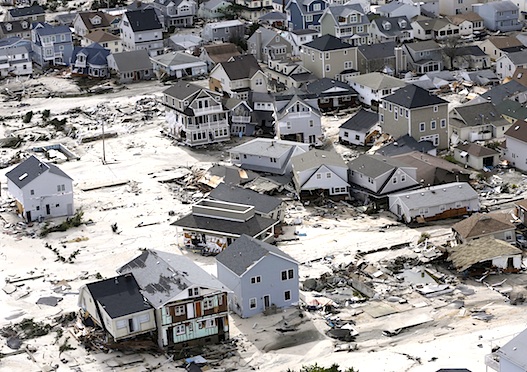
New York City flooding
It doesn’t have to be this way – typical family could reduce their energy use 60 to 75 percent

By Stephen Leahy

UXBRIDGE, Canada, Jan 29 2013 (IPS)

Weird is the only way to describe January temperatures whipsawing between record warm and arctic cold over a span of a few days. Experts say that is what climate change looks like: weird, record-shattering weather.

Here’s a fact that goes beyond weird to astonishing. Anyone who is 27 years old or younger has never lived through a month that was colder than the global 20th century average. In other words, we’ve had 334 consecutive months with above average temperatures, according to the U.S. National Oceanic and Atmospheric Administration.

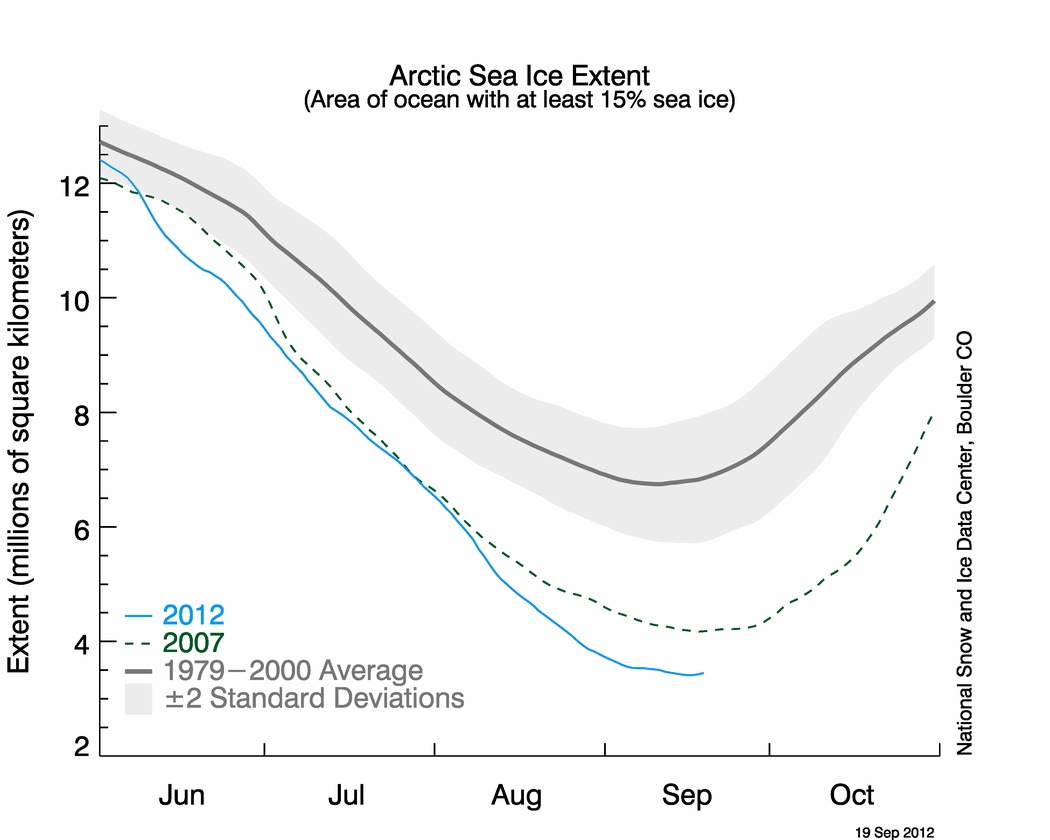
Arctic sea ice extent. Area of ocean with at least 15 percent sea ice as of Sept 12, 2012. Credit: National Snow and Ice Data Center.

Last summer, the Arctic sea ice shrunk to half of what it used to be during summers only three decades ago. Our planet’s weather is driven largely by the two cold polar regions and the warm tropics. With the Arctic defrosting, it should be no surprise our weather is getting weird. And that it’s not going to get better.

Our planet is heating up because we each year put thousands of millions of tonnes of carbon dioxide (CO2) into the atmosphere by burning coal, oil, and natural gas. CO2 acts as heating blanket keeping the planet warm by trapping some of the sun’s heat.

The amount of extra heat-energy being trapped is like exploding 400,000 Hiroshima atomic bombs per day 365 days per year, calculates James Hansen, a climate scientist who heads the NASA Goddard Institute for Space Studies.

Cautious scientists like Hansen are terrified of what’s coming. Conservative institutions like the World Bank and accounting giant Price Waterhouse Coopers (PwC) have warned we’re on a path to heating the entire surface of the planet by an average of four or five degrees C before 2100. That translates into eight to 12 degrees C hotter in places like Canada.

Continue reading

Sandy says: “Childhood is Over: We’re All in this Together”

As the last of my winds and rains ebb I wish you a complete and climate-wise recovery. Our planet is not as it once was. You have seen some of the changes in your lifetime: the superstorms, floods, drought, heat waves, and the melting of the Arctic.

Other changes are invisible such as the 30 percent increase in the acidity of the oceans. This rising acidity is harming coral reefs, fish and many other inhabitants of the oceans. One third of the carbon dioxide (CO2) emitted from burning fossil fuels has been absorbed by the oceans. When CO2 dissolves in seawater it makes them more acidic.

All of these changes and far more with only 0.8C (1F) rise in global temperature. You want to believe all of this is natural. It is true I am part of nature but I have felt and fed off the extra heat energy in the oceans and additional moisture in the air you have unintentionally put there. The air, oceans, landscape have changed. Some call this time of major human impacts on the planet “The Anthropocene”. A big word to describe a big change: the era when humanity is influencing every aspect of life on the planet.

Read full post at Hurricane Sandy Speaks (crosspost)

Sandy Says: “Bigger Superstorms Coming Unless Dial Down Thermostat”

Alaska temps in degrees F

I was born just over a week ago and more than 100 people have died in the US and Caribbean region as a result. For the rest of today please take care as I will continue to bring strong winds, heavy rains and snowfall from North Carolina to well into Canada. Some of the worst flooding hit Haiti in the hours after I’d passed by.

Read full post at Hurricane Sandy Speaks (crosspost)

Ice-Free Arctic Is “Uncharted Territory”

Arctic sea ice extent. Area of ocean with at least 15 percent sea ice as of Sept 12, 2012. Credit: National Snow and Ice Data Center.

Arctic ice half of what it was 30 years ago. Now affecting weather patterns

Heading for +4C and catastrophe – CBD

By Stephen Leahy

UXBRIDGE, Canada, Sep 20 2012 (IPS)

The melt of Arctic sea ice has reached its lowest point this year, shrinking 18 percent from last year’s near-record low.

Summer ice this year is half what it was 30 years ago and is now affecting weather patterns. The massive declines in ice in recent summers have shocked scientists and Arctic experts. Some predict that in just a few years we will witness an event that hasn’t happened in millions of years: the complete loss of summer ice.

“We are now in uncharted territory,” said Mark Serreze, director of the National Snow and Ice Data Center (NSIDC) in Colorado.

“Few of us were prepared for how rapidly the changes would actually occur” as a result of the burning fossil fuels that are warming the planet, said Serreze.

“We could see an essentially ice-free Arctic ocean in late summer by the year 2030,” he told IPS.

Not long ago experts thought the soonest the Arctic would be ice-free was 2070. Now it’s anywhere from four to 18 years away.

The impacts are already being felt across the entire northern hemisphere. The loss of sea ice in recent years has been affecting weather patterns, recent research has shown. The all-important jet stream – the west-to-east winds that are the boundary between the cold Arctic and the warm mid-latitudes – is slowing down, moving north and become more erratic.Measurement of CO2 levels in atmosphere

“Europe, eastern Asia and eastern North America is connected to unique physical processes in the Arctic,” said James Overland of the NOAA/Pacific Marine Environmental Laboratory in the United States.

“In future, cold and snowy winters will be the rule rather than the exception” in these regions, Overland told IPS in Oslo in 2010.

The summer’s record loss of Arctic sea ice may mean a cold winter for the UK and northern Europe, Jennifer Francis, a researcher at Rutgers University, told the Guardian last week.

The region has been prone to bad winters after summers with very low sea ice, such as 2011 and 2007, Francis said. Continue reading

This is an analysis piece from 2011. I will be interviewing experts around the world for a new article on this year’s record breaking melt of Arctic ice. — Stephen

Stephen's avatarStephen Leahy, International Environmental Journalist

Rapidly warming planet biggest threat to all nations

Military budget more than enough to convert USA to 100% renewable energy

Analysis by Stephen Leahy

UXBRIDGE, Canada, Sep 15, 2011 (IPS)

All the analysis and commentary about safety and security on the tenth anniversary of 9/11 ignored by far the biggest ongoing threat to global security: climate change.

Just days before Sunday’s commemoration of the attacks, German scientists pointed to yet another smoking gun of climate change: the Arctic sea ice reached a new historic minimum ice extent.

The rapidity with which the planet is losing its northern ice cap continues to astonish experts. The defrosting northern pole is one of the prime drivers of Earth’s climate system and is changing global weather patterns in unpredictable ways.

The Arctic ice melt is also accelerating the rate of climate change beyond what humanity is doing with every barrel of oil, tonne of…

View original post 843 more words

Canada’s Harper Government Guts Environment, Science and Monitoring Programs

Man w picture of grandchild was arrested for protesting against tar sands expansion, Sept 2011 Ottawa, Canada - Pix by R Leahy

Environment budget slashed while PM Harper’s office places a gag order on government scientists. (And a $60 billion order for military equipment)

By Stephen Leahy

UXBRIDGE, Canada, Nov 9, 2011 (IPS)

Canada’s Stephen Harper government is spending more than 60 billion dollars on new military jets and warships while slashing more than 200 million dollars in funding for research and monitoring of the environment.

Amongst the programmes now crippled is Canada’s internationally renowned ozone monitoring network, which was instrumental in the discovery of the first-ever ozone hole over Canada last spring. Loss of ozone has been previously linked to increases in skin cancer.

“The proposed cuts go so far the network won’t be able to do serious science,” said Thomas Duck, an atmospheric scientist at Halifax’s Dalhousie University.

Canada was the pioneer in ozone monitoring, developing the first accurate ozone measuring tool that led to the discovery that the world’s ozone layer was dangerously thinning in the 1970s, which in turn led to the successful Montreal Protocol on Ozone Depleting Substances.

Canada has about one-third of the ozone monitoring stations in the Arctic region. It also hosts the world archive of ozone data, which is heavily relied on by scientists around the world.

“There’s only one guy running the entire archive, and he’s received a lay-off notice letter,” Duck told IPS.

Ozone monitoring and research is part of Environment Canada, the government department charged with protecting the environment, conservation and providing weather and meteorological information.

“Canada can’t afford to pay scientists but we can line the pockets of big oil?

That is totally backwards.”

Continue reading

Durban May Be Last Chance to Stabilise Climate Under Two Degrees — Africa, Russia To Cook by 2020; Most of Canada and China by 2030

By Stephen Leahy

The International Energy Agency estimates that 80 percent of projected emissions from the power sector in 2020 are already locked in.

CHANGWON, South Korea , Oct 23, 2011 (IPS)

The window to limit global warming to less than two degrees C is closing so fast it can be measured in months, a new scientific analysis revealed Sunday.

Without putting the brakes on carbon emissions very soon, large parts of Africa, most of Russia and northern China will be two degrees C warmer in less than 10 years. Canada and Alaska will soon follow, the regional study shows.

“If one is sincerely committed to limit global temperature increase to below two degrees C… (governments) committing to a global peak emission level and peak year makes sense from a science perspective,” said Joeri Rogelj of the Institute for Atmospheric and Climate Science in Zurich, who headed the analysis published Sunday in the journal Nature Climate Change. [See NCC editorial “Crossing the threshold”]

Governments will be meeting in Durban, South Africa starting Nov. 28 to launch the next round of climate treaty negotiations, which so far have failed to ensure their goal of less than a two-degree C increase will be achieved.

IPS asked Rogelj if government delegates in Durban ought to set a specific year by which global emissions will peak and then decline to ensure the two-degree C target will be met.

“Committing to such targets would ensure that we embark globally on a technologically and economically feasible low-emission path,” Rogelj said.

Rogelj and a group of leading experts show in this state-of-the-art analysis that to have a 66-percent or better probability of staying below two degrees C this century, global carbon emissions must peak before 2020. Global emissions ought to be around 44 billion tonnes of CO2 in 2020. That is four billion tonnes (also called gigatonnes, Gt) less than the estimated emissions for 2010.

After 2020 emissions must decline rapidly, about two to three percent less each year until they fall to 20 Gt by 2050, according to the computer models. This is an emissions “pathway that will be very challenging to achieve”, Rogelj and colleagues conclude in their study.

Very challenging” is scientist-talk for something that will be extremely difficult to do. The International Energy Agency (IEA) estimated that 80 percent of projected emissions from the power sector in 2020 are already locked in, as they will come from power plants that are currently in place or under construction today.

“This significant increase in CO2 emissions and the locking in of future emissions due to infrastructure investments represent a serious setback to our hopes of limiting the global rise in temperature to no more than two degrees C,” said Dr. Fatih Birol, chief economist of the IEA, last May. Continue reading