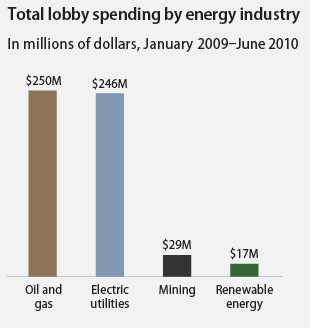
“Big oil companies and other special interests have spent millions of dollars in lobbying and campaign contributions to defeat clean energy and global warming legislation, according to a new analysis released today by the Center for American Progress Action Fund.
The study “Dirty Money” found that the top 35 spending companies and trade associations invested more than $500 million in lobbying and campaign contributions from January 2009 to June 2010 to defeat clean energy legislation. This political pressure spending convinced enough senators to oppose clean energy measures that would have created jobs, reduced oil use, and cut global warming pollution.”
“I meet international freelance journalists quite often. Most make it clear that budget cuts have made it increasingly difficult for just about anyone, especially freelancers, to get into print. It is usually the freelancers who are most willing to risk their lives to get the stories that need reporting the most. If the day arrives when they can no longer carry out their professions, we will all have a serious problem.
Muckraker: A reporter or writer who investigates and publishes reports involving a host of social issues, broadly including crime and corruption
Stephen Leahy, a Canadian, and one of the world’s best-known investigative reporters on environmental issues, has launched a challenge: if corporations won’t pay for the news, then it is up to communities and the public to fill the gap. A free society needs journalism, even if reporting the news is not commercially profitable.
Leahy’s model for supporting the news has the journalist make his pitch over the internet. The completed article can then be distributed by news agencies or magazines that are low on funds but high on public interest. That could be IPS, Reuters-Alertnet, Commondreams, InfoSud, The Essential Edge or any number of other publications and news outlets.
[edit: Wermus concludes]
Leahy observes that: “Many people tell me, we need individuals like you to get real information out.”
It may be too early to tell whether this really signals a new citizen’s approach to the need for hard information that may be crucial to society. In the best of all worlds it could bring together both consumers and media for promoting a better planet. The danger is that it could also produce yet another quagmire of holier-than-thou preaching.”
Update: Community Supported Journalism is working. However 50 people helping out has to become 500 so we all can get the crucial information we need. Please consider becoming one of the 500. Thank you. — Stephen
Three people in a unique Pacific Island community face the first devastating effects of climate change, including a terrifying flood. Will they decide to stay with their island home or move to a new and unfamiliar land, leaving their culture and language behind forever?
Ultimately the documentary “There Once was an Island” is about what makes us who we are and what we all stand to lose as climate change unfolds. — Stephen
As a journalist my experience with the IPCC over past decade has been that their communication is terrible. The Summary for Policy Makers report is unreadable except by the most dedicated jurno with good salary and few deadlines…
Secondly public statements by IPCC are so qualified with caveats to require telepathy to parse the real meanings.
Finally compared to my reading of the latest science the IPCC is woefully out of date and conservative to a fault.
In my view much of the current criticism of the IPCC is misdirected and done so to deliberately confuse the public about the reality of the near and present danger of climate change.
I have interviewed scientists and other experts about how the findings and integrity of climate science/scientists have been systematically attacked and distorted by those with vested interests:
Summary of the InterAcademy Council Review from the excellent Australian science blog Climate Shifts:
The long-awaited review of the IPCC has been delivered by the InterAcademy Council (an Amsterdam-based organization of the world’s science academies). Contrary to the misguided expectations of the denialist community, the Inter-Academy Council has concluded that the periodic assessment reports of the IPCC have been successful overall. There is some need, however, for improving some of the reporting process and for developing a better set of processes to deal with the growing scientific and political complexity of the climate change issue.
Here is the press release posted today by the InterAcademy Council (IAC).
Multi-trillion-dollar ecosystem services can boost local economies and quality of life
By Stephen Leahy
UXBRIDGE, Canada, Sep 10, 2010 (IPS)
What do New York City, Vienna, Quito and Rio de Janeiro have in common? They all get their high quality drinking water through aqueducts connected to protected areas in nearby hills and mountains.
Twenty years ago, a rapidly expanding New York City determined it was far cheaper to protect and restore the source of its water supply, the Catskill/Delaware forests and wetlands, than spend six to eight billion dollars on a water treatment plant.
Cities are dependent on nature. There are many examples of how the ecosystem services provided by nature can provide cost-effective solutions for local municipal services, according to a new major study titled “TEEB report for Local and Regional Policy Makers” released Thursday in India, Brazil, Belgium, Japan and South Africa.
However, the study notes that few politicians and public officials realise that factoring in the planet’s multi-trillion-dollar ecosystem services into their policy-making can help save cities and regional authorities’ money while boosting the local economy, enhancing quality of life, securing livelihoods and generating employment.
“All economic activity and most of human well-being whether in an urban or non-urban setting is based on a healthy, functioning environment,” said Pavan Sukhdev, study leader of The Economics of Ecosystems and Biodiversity (TEEB) initiative hosted by the United Nations Environment Programme. Continue reading →
Noam Chomsky gets it exactly right in my experience when he says that a large minority of scientists are terrified that climate change may be much worse than anyone wants to admit. — Stephen
Last year’s cold and snowy winter directly connected to warmer Arctic new research reveals
By Stephen Leahy
OSLO, 15 June 2010 (IPS)
Last winter’s big snowfall and cold temperatures in the eastern United States and Europe were likely caused by the loss of Arctic sea ice, researchers concluded at the International Polar Year Oslo Science Conference in Norway in June.
Climate change has warmed the entire Arctic region, melting 2.5 million square kilometres of sea ice, and that, paradoxically, is producing colder and snowier winters for Europe, Asia and parts of North America.
“The exceptional cold and snowy winter of 2009-2010 in Europe, eastern Asia and eastern North America is connected to unique physical processes in the Arctic,” said James Overland of the NOAA/Pacific Marine Environmental Laboratory in the United States.
“In future, cold and snowy winters will be the rule rather than the exception” in these regions, Overland told IPS.
[[UPDATE Dec 29 2010 – Winter of 2010-11 appears to follow same pattern, see new post with northern hemisphere temp map for 20 Dec: Arctic Hothouse Turns Europe into an Icebox]]
Scientists have been surprised by the rapid warming of the Arctic, where annual temperatures have increased two to three times faster than the global average. In one part of the Arctic, over the Barents and Karas Seas north of Scandinavia, average annual temperatures are now 10 degrees C higher than they were in 1990.
Overland explains the warming of the Arctic as the result of a combination of climate change, natural variability, loss of sea ice reflectivity, ocean heat storage and changing wind patterns, which has disrupted the stability of the Arctic climate system. In just 30 years, all that extra heat has shrunk the Arctic’s thick blanket of ice by 2.5 million square kilometres – an area equivalent to more than one quarter the size of the continental U.S.
The changes in the Arctic are now irreversible, he said. Continue reading →
Millions of trees, especially from the developing countries of the South, are being shipped to Europe and burned in giant furnaces to meet “green energy” requirements that are supposed to combat climate change.
In the last two months alone, energy companies in Britain have announced the construction of at least six new biomass power generation plants to produce 1,200 megawatts of energy, primarily from burning woodchips.
At least another 1,200 megawatts of wood-fired energy plants, including the world’s largest, in Port Talbot, Wales, are already under construction.
Those energy plants will burn 20 to 30 million tonnes of wood annually, nearly all imported from other regions and equivalent to at least one million hectares of forest.
“Europe is going to cook the world’s tropical forests to fight climate change; it’s crazy,”Simone Lovera, of the non-governmental Global Forest Coalition, which has a southern officed in Asunción, Paraguay, told Tierramérica.
Europe has committed to reducing its carbon emissions 20 percent by 2020 in an effort to fight climate change. Biofuels and biomass energy will have key roles in achieving those goals, experts say.
[UPDATE: New story details regarding subsidies, increased air pollution from wood burning and the big lie that says ‘burning wood is carbon-neutral’: see Europe’s Green Energy Portfolio Up in Smoke?]
“Biomass is a very promising sector for energy companies,” says Jarret Adams, a spokesperson for Adage, a joint venture between French nuclear power giant Areva and the U.S.-based Duke Energy.
Adage is building a 50-megawatt, wood-burning power plant in the southeastern U.S. state of Florida, the first of 12 such “green energy” plants to be built over the next six years, Adams told Tierramérica.
“Burning wood for energy is considered carbon neutral by U.S. federal and state authorities,” he said. In other words, the process of generating electricity by burning wood emits an equal or lesser amount of carbon dioxide than the quantity absorbed by the trees through photosynthesis.
When Tierramérica questioned the assumption of carbon neutrality, Adams replied, “It is, but who knows for certain?”
Malaria spreading to new regions while millions wasted on vaccines that cannot work for more than 2 years [New Article]
By Stephen Leahy
CHICAGO, U.S., Feb 19 (IPS)
Climate change is bringing malaria to regions of Africa where the disease was previously unknown, researchers report from the conference of the American Association for the Advancement of Science in Chicago this week.
Interestingly, the Arctic, where climate change is happening fastest, is the best place to study how warming temperatures are affecting infectious disease transmission.
[Note: Diseases are expected to increase in proportion to the decline/degradation of natural environment experts at Harvard said in my 2008 article “Doctor” Nature in Danger — Stephen]
Insect-transmitted diseases, primarily malaria, kill 3,000 people in Africa each day, said Andy Dobson of Princeton University in the United States.
Understanding how global warming is altering temperatures and the ecology and ranges of the malaria-transmitting Anopheles mosquito is crucial to understanding the dynamics of how insect-transmitted diseases like malaria will change, Dobson told IPS.
Image via Wikipedia
“Ironically, we’re spending huge amounts of money on trying to develop vaccines for malaria but the best possible vaccine we could make wouldn’t last for longer than two years,” he said.
That’s because the natural lifetime of immunity to malaria is perhaps two years and to eradicate malaria using a vaccine would require vaccinating everyone every year because the malaria parasite evolves quickly, he explained.
“We’re not going to be able to do that,” Dobson added.
Instead scientists need to be able to understand and project how and where malaria outbreaks will occur under the altered conditions of climate change. However, there is very little data or research on disease transmission in the field. Rather, the focus has been on developing vaccines and genetic analysis of the malaria parasite and mosquito genome – and that “tells us nothing about transmission”, he said.
“A sad testimony to how the (U.S.) National Institutes of Health and the Gates Foundation spend their money,” Dobson told IPS. Continue reading →
Stephen Leahy interviews science historian NAOMI ORESKES
PARIS, Mar 24, 2010 (IPS)
Even though 2009 was the fifth warmest year since 1850, and 2000-09 the warmest decade ever, according to the World Meterological Organisation, surveys show that public concern about global warming in the United States and Canada has dropped sharply in the past 18 months.
Why? Because of a relentless disinformation effort from an unlikely cabal of fossil fuel interests, Christian evangelicals and the media, says Naomi Oreskes, a professor of history and science studies at the University of California, San Diego.
“They have managed to reopen the debate over global warming in people’s minds,” she told IPS.
In 2004, Oreskes was vilified on TV, radio and in print by commentators for providing clear evidence there was in fact a scientific consensus on global climate change. Her essay in the journal Science examined all of the peer-reviewed scientific papers on climate over the previous 10 years and found none dissented with the theories that climate change was occurring and it was caused by humans. Her survey has never been successfully challenged, despite many attempts.
IPS environmental correspondent Stephen Leahy spoke to Oreskes over the phone. Excerpts of the interview follow.
Q: Where is the vehement opposition to the very idea that we need to do something about climate change?
A: Some of it is ideological, part of a long history in the United States that equates environmental regulation as going down the slippery slope to socialism. And some is religious. Christian evangelicals don’t like science in general and have found common cause with the coal industry as a way to be able to teach creationism. Obviously, the motivation of the coal industry is rather different but now these people have come together to undermine science in general.

 “Big oil companies and other special interests have spent millions of dollars in lobbying and campaign contributions to defeat clean energy and global warming legislation, according to a new analysis released today by the Center for American Progress Action Fund.










 Stephen Leahy, International Environmental Journalist