The Shocking Facts About How Much Water We Use to Make Everyday Products

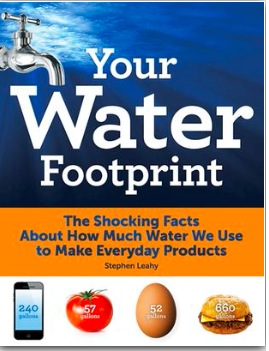
Screen Shot 2014-07-20 at 10.28.00 AMYour Water Footprint 

By journalist Stephen Leahy, winner of the 2012 United Nations Global Prize for Climate Change and Environment Coverage

“…a brilliant and shocking exposé on precisely how much water we use…” – Publishers Weekly

Do you know you’re wearing water? It takes more than 7,600 liters (2,000 gallons) of water to make a single pair of jeans and another 2,460 liters (650 gallons) to make a T-shirt. And you’re eating water too. That morning cup of coffee required 140 liters (37 gallons) of water before it found its way to your table—water that was used to grow, process and ship the coffee beans. If you include toast, two eggs and some milk in your coffee, the water footprint of your breakfast totals about 700 liters (185 gallons).

Furniture, houses, cars, roads, buildings— practically everything we make uses water in the manufacturing process. When we spend money on food, clothes, cellphones or even electricity, we are buying water. A lot of water. Generating electricity from coal, oil, gas, and nuclear or hydro power involves the world’s second biggest use of water after food production.YWF graphic -YWF shirt

…exceptionally lucid narration with arresting, full-page info graphics”  — Booklist,  starred review

Your Water Footprint:  The Shocking Facts About How Much Water We Use To Make Everyday Products

Published by Firefly Books:  160 Pages, 125 Unique Infographics, $19.95 Paperback (Also avail in hardcover)

Order on Amazon.com

In Canada:  Order on Chapters-Indigo

In UK:  Order on WH Smith

My breakfast took 1100 litres (290 gal) of water to make – how much was yours?

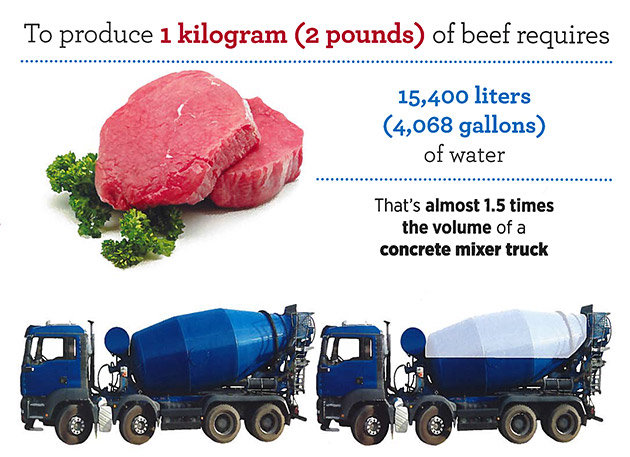
meat sample

( Graphic from  ‘Your Water Footprint’) 

I have a confession: I used 1100 litres of water to make my breakfast today. It was nothing special, just a small glass of orange juice, a cup of coffee, two eggs, toast and two pieces of bacon. But it did take 1100 litres of water to grow and process the ingredients. Thats a whole lot of water considering the average bathtub only holds about 80 litres.

Even after 20 years of covering environmental issues in two dozen countries I had no idea of the incredible amounts of water needed to grow food or make things. Now, after two years working on my book Your Water Footprint Im still amazed the T-shirt Im wearing needed a whopping 2500 litres to grow and process the cotton. Or that 140 litres was needed to grow and process the coffee beans to make my morning coffee. Since a litre of water weighs a kilogram, thats 140 kilos of water, imagine having to haul that much in a bucket every morning!

Your Water Footprint wins Lane Anderson award as best Canadian Science book for general public

Water more valuable and useful than oil

Researching all of this I soon realized were literally surrounded by a hidden world of water. Although we cant see it, there is water in everything we eat, everything we use and buy. Almost anything you can think of – cars, furniture, books, dishes, TVs, highways, buildings, jewelry, toys and even electricity would not exist without water.

Its no exaggeration to say water is far more valuable and useful than oil.

Unfortunately, water is often taken for granted and undervalued, resulting widespread misuse and waste. The idea behind my book is to increase awareness of huge quantities of the hidden water our entire way of life depends on. Your Water Footprint uses colourful infographics to illustrate the size of the water footprints of a wide range things from shoes to whiskey. A water footprint is the amount of water consumed’ to make, grow or produce something. I use the word consumed to make it clear this is water that can no longer be used for anything else. Water can often be cleaned or reused, so those amounts of water are not included in the water footprints in the book.

For example, when you drink a half-litre of bottle water youre actually consuming 5.5. litres. Why so much? Making the plastic bottle consumed 5 litres of water.

After poring through many studies on water footprints, I was really surprised to see how tiny my direct use of water for drinking, cooking, showers and so on was by comparison. Each day the average North American uses 300 to 400 litres. (FYI: Flushing toilets is the biggest water daily use, not showers.) Now, 400 litres is not a trivial amount of water, and we can all get by using less by employing some water-savings tips.


How big is your water footprint? Take a quick test


However, compared to the hidden water, also known as virtual water, thats in the things we eat, wear and use for a day averages an incredible 7500 litres. That means our daily water footprint is almost 8,000 litres (direct + hidden freshwater use). Carrying all this water would be like trying to haul the weight of four mid-size cars every day.

Peak water is here

Water scarcity is a reality in much of the world. About 1.2 billion people live in areas with chronic scarcity, while two billion are affected by shortages every year. That’s two in seven people. And as the ongoing drought in California proves, water scarcity is increasing reality for many of us in the US and Canada. Water experts estimate that by 2025, three in five people may be living with water shortages.

While low-flow shower heads and toilets are great water savers, the water footprint concept can lead to even bigger reductions in water consumption. If a family of four replaced beef with chicken in all their meals, they would reduce their water use an astonishing 900,000 litres a year. That’s enough to fill an Olympic-sized pool to a depth of two feet. The reason is the water footprint of beef is four times larger than chicken.

Vegetables have an even smaller water footprint. If the average family liked the idea of “Meatless Mondays,” they’d save 400,000 litres of water a year.

My hope with Your Water Footprint is to give you enough information to make water-wise choices to reduce your water use which will help you save money, be prepared for shortages and ensure our children and grandchildren will have abundant fresh water. This is all about smart substitutions and changes, rather than sacrifice and self-denial.

To do this we need to know how much we are currently using. We can’t make the water-wise choices unless we begin to see and understand the invisible ways in which we rely on water.

Stephen Leahy is an award-winning environmental journalist based in Uxbridge, Ontario, Canada. He is the author ofYour Water Footprint: The Shocking Facts About How Much Water We Use to Make Everyday Products.

(First published Yahoo Canada News – Mon, 8 Sep, 2014)

Your Water Footprint: The Shocking Facts About How Much Water We Use to Make Everyday Products 

Only $19.95 paperback; 160 pages, 125 unique infographics,

also available as Kindle and in other ebook formats

In US:  AmazonPowell’s Books; Barnes&NobleIndiebound

Canada:  Chapters-Indigo Signed copies avail at Blue Heron Books – Stephen’s home town bookstore; In Ottawa visit the legendary Octopus Books

UK:  WH SmithAmazonWaterstones

Australia: Angus & RobertsonBooktopia

New Zealand: Mighty Ape

Canada’s Plan to Get Rich by Trashing the Climate

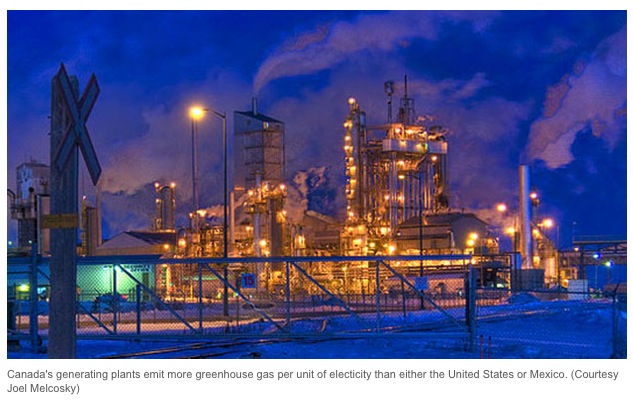
Canada's fossil fuel electricity has highest carbon emissions

By Stephen Leahy

Blame Canada is a four part series revealing how Canada has become a wealthy, fossil-fuelled energy superpower and an international climate pariah. For Part 1, click here.

Like every other country in the world, Canada has promised to help keep global warming to less than 2 degrees C. However Canada’s political and corporate leadership are committed to turning the country into a fossil-fuelled “energy superpower.”

With a drug lord’s just-providing-a-service hypocrisy Canada has openly declared it’s future is tied to the profits from dumping hundreds of millions of tonnes of climate-heating carbon into the atmosphere every year.

And the world’s new energy superpower plans to grow those annual emissions to 1.5 billion tonnes by 2020 giving one of the least populated countries a gigantic carbon bootprint.

Most of this climate-wrecking carbon energy will come from Canada’s tar sands located just underneath the pristine boreal forest and wetlands of northern Alberta. The oil industry likes to call them “oil sands,” although there is no liquid oil only a tarry bitumen mixed deep in the sandy soil.

With an estimated 170 billion barrels, the tar sands are the third largest crude oil reserves. Extraordinary efforts involving colossal amounts of water, heat, chemicals and machinery are needed to get the bitumen out of the ground and into pipelines. This the world’s largest industrial project with more than $300 billion invested since 2001 by the oil industry.

Nowhere has fossil energy expansion or investment been faster or larger. Environmental activists call it “Canada’s Mordor.”

Green Energy Solves Dual Crises of Poverty and Climate

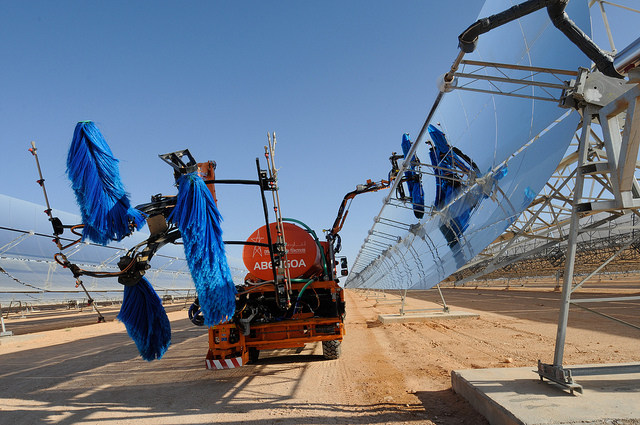
Ain Beni Mathar Integrated Combined Cycle Thermo-Solar Power Plant

By Stephen Leahy

UXBRIDGE, Canada, Feb 25 2013 (IPS) 

Green energy is the only way to bring billions of people out of energy poverty and prevent a climate disaster, a new study reveals.

Conservative institutions like the World Bank, the International Energy Agency and accounting giant Price Waterhouse Coopers (PwC) all warn humanity is on a path to climate catastrophe unless fossil fuel energy is replaced by green energy.

The U.N.’s Sustainable Energy for All initiative intends to bring universal access to modern energy, doubling the share of renewable energy globally, and doubling the rate of improvement in energy efficiency by 2030.

Poverty eradication, sustainable development and the transition away from fossil fuel energy go hand in hand.

If those targets are met and similar efforts undertaken to reduce deforestation, then climate disaster can be avoided, said Joeri Rogelj of the Institute for Atmospheric and Climate Science in Zurich  who headed the analysis published Sunday in the journal Nature Climate Change.


“We’re all scared…But we must tell the truth” — Experts Fear Collapse of Global Civilisation

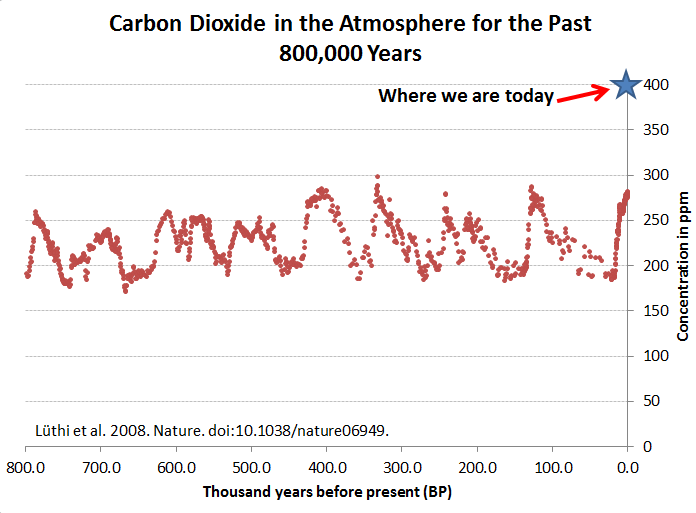
terrifying co2 graph

By Stephen Leahy

UXBRIDGE, Canada, Jan 11 2013 (IPS)

Experts on the health of our planet are terrified of the future. They can clearly see the coming collapse of global civilisation from an array of interconnected environmental problems.

“We’re all scared,” said Paul Ehrlich, president of the Center for Conservation Biology at Stanford University.

“But we must tell the truth about what’s happening and challenge people to do something to prevent it,” Ehrlich told IPS.

Global collapse of human civilisation seems likely, write Ehrlich and his partner Anne Ehrlich in the prestigious science journal, Proceedings of the Royal Society.

This collapse will take the form of a “…gradual breakdown because famines, epidemics and resource shortages cause a disintegration of central control within nations, in concert with disruptions of trade and conflicts over increasingly scarce necessities”, they write.

Already two billion people are hungry today. Food production is humanity’s biggest industry and is already being affected by climate and other environmental problems. “No civilisation can avoid collapse if it fails to feed its population,” the authors say.

Escalating climate disruption, ocean acidification, oceanic dead zones, depletion of groundwater and extinctions of plants and animals are the main drivers of the coming collapse, they write in their peer-reviewed article “Can a collapse of global civilisation be avoided?” published this week.

Dozens of earth systems experts were consulted in writing the 10-page paper that contains over 160 references.

“We talked to many of the world’s leading experts to reflect what is really happening,” said Ehrlich, who is an eminent biologist and winner of many scientific awards.

Our reality is that current overconsumption of natural resources and the resulting damage to life-sustaining services nature provides means we need another half of a planet to keeping going. And that’s if all seven billion remain at their current living standards, the Ehrlichs write.

If everyone lived like a U.S. citizen, another four or five planets would be needed. Continue reading

Fossil Energy Interests Buy Politicians – and they’re cheap says economist

[This interview with economist Robert Repetto (now at Yale) was published two years ago. It is more relevant than ever in showing how fossil fuel money influences politics and prevents real action on climate. — Stephen]

‘What else can you do with coal except burn it? Railways make a lot of money shipping coal’

By Stephen Leahy

UXBRIDGE, Canada, Mar 2, 2011 (IPS)

Powerful fossil energy interests are preventing the United States from making the necessary transition to 21st century energy sources, one of the country’s leading environmental economists documents in a just-published book.

Fossil energy interests are spending “hundreds of millions of dollars” lobbying U.S. politicians in Congress and funding groups to confuse the public about the serious risks climate change poses, says Robert Repetto, author of  “America’s Climate Problem: The Way Forward”.

IPS climate and environment correspondent Stephen Leahy spoke with Repetto about his new book.

Q: Why did you write this book?

A: We’re running out of time. The latest science shows that climate change is coming faster and posing greater risks than previously thought. We are at risk of triggering positive feedbacks that will lead to uncontrollable climate change.

Meanwhile, America is locked in a climate-policy stalemate, with very few in the public comprehending the real risks climate change poses. Most don’t understand that climate change is happening now. They don’t link extreme weather events we’ve been experiencing with climate change. As a result they are not demanding that politicians take action.

Q: Why don’t most Americans understand the fact that climate change is already underway and poses serious risks? Continue reading

The Most Important Number in Human History

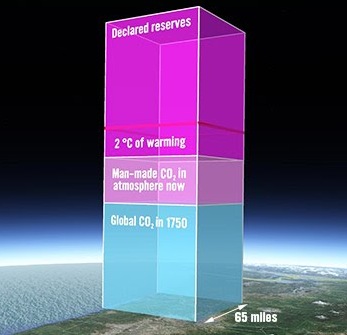
Carbon overload Carbon in atmosphere and amount in fossil fuel reserves

That number was 52 billion tonnes of CO2 in 2012

Only when this number declines will we know we’re making the shift to climate protection

By Stephen Leahy

UXBRIDGE, Canada, Dec 17 2012 (IPS) 

The most important number in history is now the annual measure of carbon emissions. That number reveals humanity’s steady billion-tonne by billion-tonne march to the edge of the carbon cliff, beyond which scientists warn lies a fateful fall to catastrophic climate change.

With the global total of climate-disrupting emissions likely to come in at around 52 gigatonnes (billion metric tonnes) this year, we’re already at the edge, according to new research.

To have a good chance of staying below two degrees C of warming, global emissions should be between 41 and 47 gigatonnes (Gt) by 2020, said Joeri Rogelj, a climate scientist at Switzerland’s Institute for Atmospheric and Climate Science in Zurich.

Only when we see the annual global emissions total decline will we know we’re making the shift to climate protection,” Rogelj told IPS.

Making the shift to a future climate with less than two degrees C of warming is doable and not that expensive if total emissions peak in the next few years and fall into the 41-47 Gt “sweet spot” by 2020, Rogelj and colleagues show in their detailed analysis published Sunday in the journal Nature Climate Change.

The study is the first to comprehensively quantify the costs and risks of emissions surpassing critical thresholds by 2020. Continue reading

Majority of Oil, Gas and Coal Reserves Too Dangerous To Use – International Energy Agency (IEA)

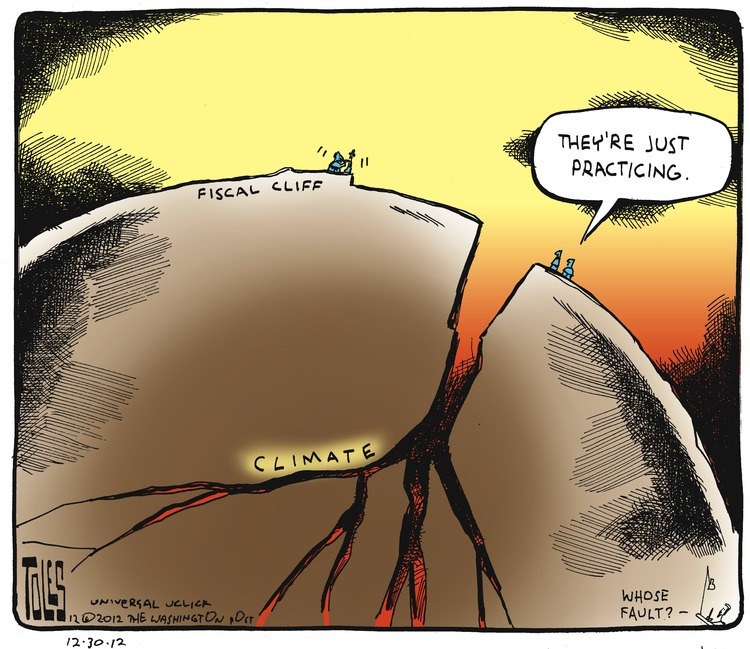
ttfiscal carbon cliff

Industry spent more than $600 billion on new exploration and production in 2012 

By Stephen Leahy

UXBRIDGE, Canada, Nov 15 2012 (IPS)

Two-thirds of the world’s proven fossil fuel reserves cannot be used without risking dangerous climate change, the International Energy Agency (IEA) warned this week.

Preventing the consumption of those two-thirds will be the primary task of the annual U.N. climate negotiations that resume at the end of this month.

Late Wednesday, U.S. President Barack Obama surprised many by saying climate change will be a personal mission in his second term.

“The re-election of President Obama guarantees continuity of the U.S. pledge of reducing emissions 17 percent below its carbon emissions in 2005 by 2020,” said Christina Figueres, executive secretary of the United Nations Framework Convention on Climate Change (UNFCCC).

“The U.S. is fully aware of the need to increase its ambition in terms of mitigation (emissions reduction) and finance to help developing countries adapt,” Figueres told IPS.

The U.S. emission reduction target is equivalent to a three-percent reduction compared to 1990 levels – a baseline most countries use. Global emissions need to be 25 to 40 percent below 1990 levels in the year 2020 to keep temperatures from rising beyond two degrees C, climate scientists have said.

By contrast, the United Kingdom is already 18 percent below its 1990s level and plans to be 34 percent below in 2020.

In 2010, there was a binding agreement to limit global warming to two degrees C at the U.N. climate conference in Cancun, Mexico, said Andrew Steer, president of the World Resources Institute, a Washington-based NGO.

“We are nowhere near to getting there. The situation is urgent. Climate change is not tomorrow’s problem, it is today’s problem. Superstorm Sandy was a wake-up call to the people of the United States,” Steer said at a press conference. Continue reading

Sandy: Don’t Curse Me, I Have Been Pumped Full of Fossil-fuel Steroids

There are estimates that I might cause $20 billion in damages in the US in addition to the $2+ billion in costs in the Caribbean. That’s a lot of money — enough to give every human on the planet $3. But it is only a fraction of the $600 billion the oil and gas industry is spending this year alone [2012 Harvard study, pg 8] in exploration and new production. That $600 billion investment in fossil fuels will bring far greater storms than I.

Read full post at Hurricane Sandy Speaks (crosspost)

Hurricane Sandy Speaks: Storm Surge Flooding Warning: “I have too much energy”

I’m sorry to say that I have so much wind energy from the warm ocean water I am pushing the sea into your living rooms along the mid-Atlantic coast. The ocean is like a bowl full of water, blow hard enough on an angle and it will readily spill over.

Read full post at Hurricane Sandy Speaks (crosspost)