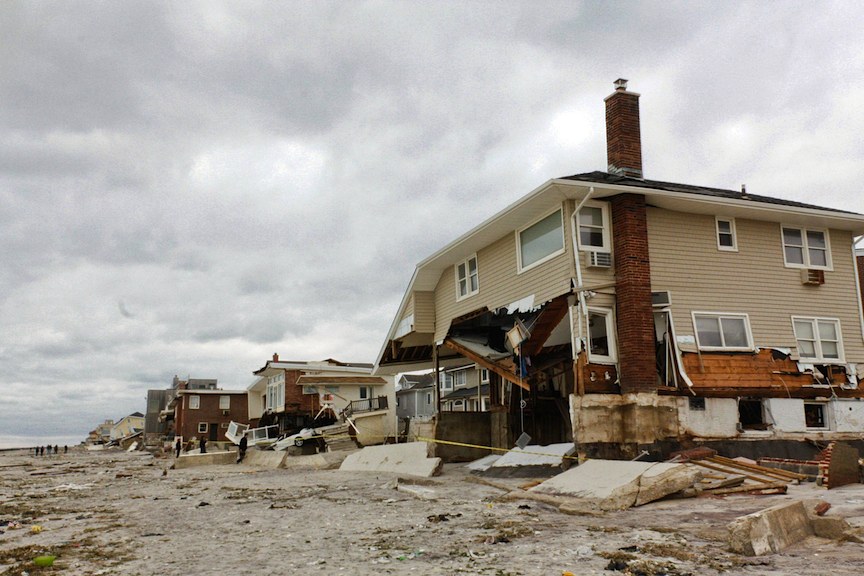
Superstorm Sandy Didn’t Play Politics but Helped to Re-elect President Obama

Hurricane Sandy Speaks:

“I am aware that my arrival last week helped re-elect President Obama.

Superstorms like me don’t play politics but it should be clear by now that your refusal to tackle global warming has serious consequences. Higher sea levels and amped-up hurricanes like me are just two of them. There is an awful price to pay for burning coal, oil, and natural gas I’m sorry to say.

Putting hundreds of millions of tonnes of carbon dioxide (CO2) into the atmosphere is trapping more of the sun’s heat energy. CO2 is the planet’s natural heating blanket but those extra hundreds of millions of tonnes of CO2 has made that blanket thicker. And it is getting thicker every year.

Nearly 200 people were killed in the 10 days I traveled from Jamaica to Canada. Most of the deaths were American. The US remains by far the largest emitter of CO2. With a fraction of the world population, the US is responsible for nearly 30 percent of the world’s CO2 emissions from 1860 to 2009. On a person by person basis, Americans have one of the biggest CO2 ‘footprints’.”

Read full post at Hurricane Sandy Speaks 

Hurricane Sandy a Taste of More Extreme Weather to Come

By Stephen Leahy

UXBRIDGE, Canada, Nov 2 2012 (IPS)

Killing nearly 200 people in the United States, Canada and the Caribbean and crippling much of New York City and surrounding areas earlier this week, Hurricane Sandy was the kind of extreme weather event scientists have long predicted will occur with global warming.

“Climate change is a reality,” said New York Governor Andrew Cuomo after Sandy swept through his state.

Sandy was twice the size of an average hurricane, and it hit the eastern coast of the United States, where sea levels have been rising the fastest, said Kevin Trenberth, senior scientist at the National Center for Atmospheric Researchin Boulder, Colorado.

“All weather events are affected by climate change because the environment in which they occur is warmer and moister than it used to be,” Trenberth, an expert on extreme events, told IPS.

Whether climate change caused Hurricane Sandy is the wrong question to ask, added Trenberth. He explained that climate change helped make Hurricane Sandy more destructive than it otherwise would have been.

“This is the new normal,” Trenberth said. “It doesn’t make sense to rebuild in some regions – they’ll just be swept away again.”

Superstorm Sandy Was Really an “Anthrostorm”

Hurricane Sandy Speaks:

Image

Earlier I called myself a hybrid storm: part nature, part human. That’s not quite right. Humans and Hurricanes are part of nature. We both thrive on this planet thanks to sunlight, water and carbon dioxide (CO2). Hurricanes and tropical storms have been around for millions of years. In the last 50 years things have changed. The oceans are warmer. This week the waters off the US east coast were 3 degrees C warmer than normal.

Read full post at Hurricane Sandy Speaks 

Extreme weather new normal with Climate Change

Climate change plays a role in all extreme weather now – atmosphere is 0.8C hotter and 4-6% wetter – turns out small increases can have big impacts. — Stephen

Stephen's avatarStephen Leahy, International Environmental Journalist

By Stephen Leahy

CAIRNS, Australia, Apr 3, 2012 (Tierramérica)

Extreme weather is fast becoming the new normal. Canada and much of the United States experienced summer temperatures during winter this year, confirming the findings of a new report on extreme weather.

For two weeks this March most of North America baked under extraordinarily warm temperatures that melted all the snow and ice and broke 150-year-old temperature records by large margins.

Last year the U.S. endured 14 separate billion-dollar-plus weather disasters including flooding, hurricanes and tornados.

A new report from the Intergovernmental Panel on Climate Change (IPCC), released Mar. 28, provides solid evidence that record-breaking weather events are increasing in number and becoming more extreme. And if current rates of greenhouse gas emissions are maintained, these events will reach dangerous new levels over the coming century.

Since 1950 there have been many more heat waves and record warm temperatures than in…

View original post 768 more words

Global Temperatures Rising on a Devastating Trajectory

Global temperatures are only 0.7C warmer — on pace for +4C!

By Stephen Leahy

UXBRIDGE, Canada, May 25, 2012 (IPS)

Climate-heating carbon emissions set a record high in 2011, in a 3.2 percent increase over the previous year, the International Energy Agency reported this week. The main reason for this dangerous increase is that governments are failing to implement policies to prevent catastrophic increases of global temperatures.

A new report released on the last days of international climate talks in Bonn, Germany this week reveals that the planet is heading to a temperature rise of at least 3.5 degrees Celsius, and likely more, according to the Climate Action Tracker (CAT), despite an international agreement to keep global temperature rise below two degrees Celsius.

Not only are pledges inadequate, but countries are unable to fulfill even those pledges, a new CAT analysis shows. CAT is a joint project of Dutch energy consulting organisation Ecofys, Germany’s Climate Analytics, and the Potsdam Institute for Climate Impact Research.

“When we compared the emission reduction pledges of countries like Brazil, Mexico and the U.S., we found they did not have the policies in place to meet those pledges,” said Niklas Höhne, director of energy and climate policy at Ecofys.

Höhne told IPS that they looked only at the policies of a few countries, but no country’s policies were enough to meet their targets. Continue reading

There will be 3x more forest fires with global warming and that’s conservative estimate say fire scientists.

Stephen's avatarStephen Leahy, International Environmental Journalist

“In a warmer world, there will be more fire”

Fires already burn an area larger than India every year.

By Stephen Leahy

VANCOUVER, Feb 29, 2012 (IPS)

Rising temperatures are drying out northern forests and peatlands, producing bigger and more intense fires. And this will only get much worse as the planet heats up from the use of ever larger amounts of fossil fuels, scientists warned last week at the end of the major science meeting in Vancouver.

“In a warmer world, there will be more fire. That’s a virtual certainty,” said Mike Flannigan, a forest researcher at the University of Alberta, Canada.

“I’d say a doubling or even tripling of fire events is a conservative estimate,” Flannigan told IPS.

While Flannigan’s research reveals forest fire risk may triple in future, a similar increase in peat fires will be far more dangerous. There are millions of square kilometres of tundra…

View original post 780 more words

Global Forest Decline with Warming Temperatures Scientists Warn

Image

Forests diebacks are taking place all around the world. The evidence is quite sobering,” said tropical biologist Daniel Nepstad of IPAM in Belem, Brazil.

This reinforces the urgent need to reduce emissions of fossils fuels and to develop a global land strategy to turn sources of CO2 into sinks for CO2, he said.

“Most of the evidence shows climate change is speeding up. Meanwhile political action on climate is slowing down,” Nepstad added.

–From a previous post on how the loss of trees to deforestation, drought and disease is accelerating climate change.

Indigenous Peoples Needed to Meet the Challenge of Climate Change

Gimuy Wallabarra Yidinji Dancers performing Welcome to the Country in Cairns, Australia .Photo: Gleb Raygorodetsky

By Stephen Leahy

First published at National Geographic NewsWatch

“Planning is not part of our culture. You just get up in the morning and do what you need to do for the day,” said Marilyn Wallace of the Kuku Nyungka ‘mob’ (aboriginal nation) in northern Queensland, Australia.

“Bama” or caring for their local territory is an important part of aboriginal culture and identity Wallace told participants at a mini-workshop in Cairns, Australia today Sunday March 25th prior to the start of the main workshop Climate Change Mitigation with Local Communities and Indigenous peoples on Monday.

Caring for the land includes monitoring the impacts of climate change and using traditional knowledge to keep or sequester carbon she said.

Click here for full article plus a video visit with Marilyn in her home country.

Durban May Be Last Chance to Stabilise Climate Under Two Degrees — Africa, Russia To Cook by 2020; Most of Canada and China by 2030

By Stephen Leahy

The International Energy Agency estimates that 80 percent of projected emissions from the power sector in 2020 are already locked in.

CHANGWON, South Korea , Oct 23, 2011 (IPS)

The window to limit global warming to less than two degrees C is closing so fast it can be measured in months, a new scientific analysis revealed Sunday.

Without putting the brakes on carbon emissions very soon, large parts of Africa, most of Russia and northern China will be two degrees C warmer in less than 10 years. Canada and Alaska will soon follow, the regional study shows.

“If one is sincerely committed to limit global temperature increase to below two degrees C… (governments) committing to a global peak emission level and peak year makes sense from a science perspective,” said Joeri Rogelj of the Institute for Atmospheric and Climate Science in Zurich, who headed the analysis published Sunday in the journal Nature Climate Change. [See NCC editorial “Crossing the threshold”]

Governments will be meeting in Durban, South Africa starting Nov. 28 to launch the next round of climate treaty negotiations, which so far have failed to ensure their goal of less than a two-degree C increase will be achieved.

IPS asked Rogelj if government delegates in Durban ought to set a specific year by which global emissions will peak and then decline to ensure the two-degree C target will be met.

“Committing to such targets would ensure that we embark globally on a technologically and economically feasible low-emission path,” Rogelj said.

Rogelj and a group of leading experts show in this state-of-the-art analysis that to have a 66-percent or better probability of staying below two degrees C this century, global carbon emissions must peak before 2020. Global emissions ought to be around 44 billion tonnes of CO2 in 2020. That is four billion tonnes (also called gigatonnes, Gt) less than the estimated emissions for 2010.

After 2020 emissions must decline rapidly, about two to three percent less each year until they fall to 20 Gt by 2050, according to the computer models. This is an emissions “pathway that will be very challenging to achieve”, Rogelj and colleagues conclude in their study.

Very challenging” is scientist-talk for something that will be extremely difficult to do. The International Energy Agency (IEA) estimated that 80 percent of projected emissions from the power sector in 2020 are already locked in, as they will come from power plants that are currently in place or under construction today.

“This significant increase in CO2 emissions and the locking in of future emissions due to infrastructure investments represent a serious setback to our hopes of limiting the global rise in temperature to no more than two degrees C,” said Dr. Fatih Birol, chief economist of the IEA, last May. Continue reading