[This re-post of an article showing countries moving to renewable energy to create jobs and reduce dependence on expensive, polluting and climate destroying fossil fuels. — Stephen]
By Stephen Leahy
BONN, Jun 20, 2011 (IPS)
If we’re lucky, by the time a tough but fair international treaty to meet the climate change challenge is finalised, it will be largely unnecessary. The snail’s pace of negotiations certainly gives countries plenty of time to understand the financial, social and environmental advantages of kicking their dangerous addiction to fossil fuels.
That may be a cynical optimist’s hope, but the European Union is already moving in that direction.
Climate change is now seen as an opportunity to deal with the economic downturn in Europe,” said Jürgen Lefevere, a European Commission negotiator at the United Nations Framework Convention on Climate Change (UNFCCC) negotiating session that ended late Friday in Bonn.
“It is no longer just an environmental issue for us,” Lefevere said at a final press conference.
China also understands the opportunity.
Renewable energy sources like wind and solar now account for 11.4 percent of China’s electricity, and that figure will be 20 percent by 2020, says Liu Qiang, a researcher at the Energy Research Institute of the National Development Reform Commission, China.
“China takes this very seriously,” Qiang said, noting that there are significant investments and research in smarter electrical grids and energy storage in China.
Looking to 2050, the era of fossil fuels will be over in a world of vibrant economies and societies powered entirely by clean, cheap and renewable energy, says Niklas Hoehne, director of Energy and Climate Policy at Ecofys, an energy consulting company based in the Netherlands.
“The cost is about two to three percent of global GDP (gross domestic product) from now until 2035, and then the costs decline,” said Hoehne, a co-author of the Ecofys technical study called “The Energy Report“, which demonstrates how the world could reach 100 percent renewable energy by 2050.
That investment is far less than the costs of climate change will be without major reductions in emissions, he told IPS. Continue reading →
“The only way Keystone XL could be considered in the national interest is if you equate that with profits for the oil industry”
By Stephen Leahy
UXBRIDGE, Canada, Sep 2, 2011 (IPS)
With four times as many oil rigs pumping domestic oil today than eight years ago and declining domestic demand, the United States is awash in oil.
The country’s oil industry is primarily interested in who will pay the most on the global marketplace. They call that “energy security” when it suits, but in reality it is “oil company security” through maximising profits, say energy experts like Steve Kretzman of Oil Change International, an NGO that researches the links between oil, gas and coal companies and governments.
The only reason U.S. citizens may be forced to endure a risky, Canadian-owned oil pipeline called Keystone XL is so oil companies with billion-dollar profits can get the dirty oil from Canada’s tar sands down to the Gulf of Mexico to export to Europe, Latin America or Asia, according to a new report by Oil Change International released Wednesday.
“Keystone XL will not lessen U.S. dependence on foreign oil, but rather transport Canadian oil to American refineries for export to overseas markets,” concludes the report, titled “Exporting Energy Security“.
Little of the 700,000 to 800,000 barrels of tar sands oil pumped through the 2,400-kilometre, seven-billion-dollar Keystone XL will end up in U.S. gas tanks because the refineries on the Gulf Coast are all about expanding export markets. One huge refinery operator called Valero has been touting the potential export revenues of tar sands oil to investors, the report found.
Because Keystone XL crosses national borders, President Barack Obama has to issue a permit declaring the pipeline serves the “national interest” in order to be approved.
“The only way Keystone XL could be considered in the national interest is if you equate that with profits for the oil industry,” said Kretzman, who wrote the report.
Canada’s huge tar sands deposits, located mainly in the far north of the province of Alberta, are the world’s second largest oil reserves, but they are landlocked. It’s the industry’s biggest worry and also Alberta Energy Minister Ron Lieper’s biggest concern.
Lieper recently said that without new pipelines “our greatest risk in Alberta is that by 2020 we will be landlocked in bitumen”. Bitumen is thick tarry oil from the tar sands that needs lots of high-energy and chemical processing to be useable – one reason it’s widely considered the world’s dirtiest oil.
The shortest route to the big Asian markets is through the Rocky Mountains to Canada’s west coast via the proposed Northern Gateway pipeline. However, Canadian native people live on some of the land and are staunchly opposed, so the industry thought it would be easier to put an export pipeline right through the U.S. heartland, said Kretzman.
“The oil industry would have done the Northern Gateway first but gambled that resistance to the pipeline would be far weaker in the mid-west,” he told IPS.
They were wrong.
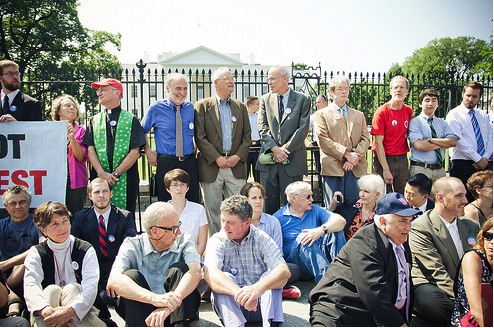
Thousands of people, including landowners and religious leaders, have gone to Washington DC in the past two weeks to tell President Obama to reject Keystone. Nearly 850 people have been arrested for standing on the sidewalk in front of the White House in what protesters call the largest civil disobedience in the history of the U.S. climate movement.
“It’s remarkable, a very dignified and moving protest much like the civil rights demonstrations in the 1960s,” said Maude Barlow, chairperson of the Council of Canadians, a large environmental NGO.
“This is about the rights of the environment and future generations. It is the blossoming of a new movement,” Barlow told IPS from Washington.
Other massive pipelines are being planned, including ones bringing tar sands crude to New England and the Great Lakes, she said. “Keystone is just the beginning. Once these are built they will have to put something in them.”
Infrastructure dictates policy, she stressed. Once pipelines, refineries or power plants are built, it is nearly impossible for governments to shut them down.
Last year, scientists writing in the journal Science concluded there is already enough fossil fuel burning capacity to raise global temperatures by 1.5 degrees C by 2060. Any additional power plants, vehicles, or other fossil fuel burning equipment built from 2011 onward puts humanity at ever greater risk of catastrophic climate change.
Carbon overload – have to stop expanding
“We conclude that sources of the most threatening emissions have yet to built,” the scientists wrote.
The Obama administration knows this but the powerful oil lobby can use its unlimited funds to attack Democratic officials during the next election cycle if they don’t approve the pipeline, says Kretzman.
Changes to U.S. law in 2010 allow corporations to spend as much as they want on elections, and there is no sector with more money than the oil industry.
“That scares the hell out of the Obama administration,” he said.
It’s never been clearer that corporations wield the real power in the United States and Canada, activists say.
“This is the beginning of a very big fight for the future,” Barlow told IPS.
Industry spent more than $600 billion on new exploration and production in 2012
By Stephen Leahy
UXBRIDGE, Canada, Nov 15 2012 (IPS)
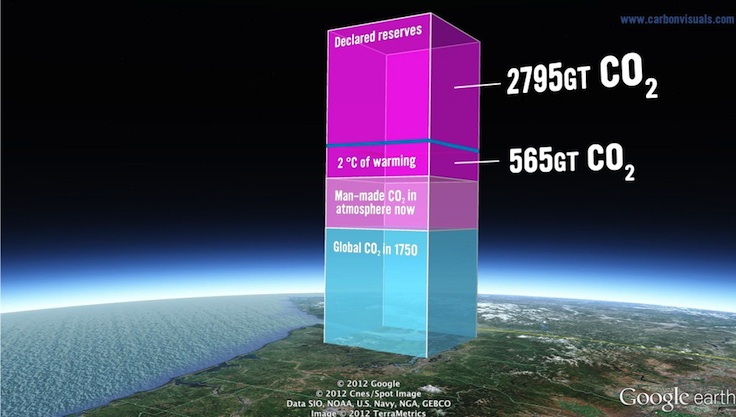
Two-thirds of the world’s proven fossil fuel reserves cannot be used without risking dangerous climate change, the International Energy Agency (IEA) warned this week.
Preventing the consumption of those two-thirds will be the primary task of the annual U.N. climate negotiations that resume at the end of this month.
Late Wednesday, U.S. President Barack Obama surprised many by saying climate change will be a personal mission in his second term.
“The re-election of President Obama guarantees continuity of the U.S. pledge of reducing emissions 17 percent below its carbon emissions in 2005 by 2020,” said Christina Figueres, executive secretary of the United Nations Framework Convention on Climate Change (UNFCCC).
“The U.S. is fully aware of the need to increase its ambition in terms of mitigation (emissions reduction) and finance to help developing countries adapt,” Figueres told IPS.
The U.S. emission reduction target is equivalent to a three-percent reduction compared to 1990 levels – a baseline most countries use. Global emissions need to be 25 to 40 percent below 1990 levels in the year 2020 to keep temperatures from rising beyond two degrees C, climate scientists have said.
By contrast, the United Kingdom is already 18 percent below its 1990s level and plans to be 34 percent below in 2020.
In 2010, there was a binding agreement to limit global warming to two degrees C at the U.N. climate conference in Cancun, Mexico, said Andrew Steer, president of the World Resources Institute, a Washington-based NGO.
“We are nowhere near to getting there. The situation is urgent. Climate change is not tomorrow’s problem, it is today’s problem. Superstorm Sandy was a wake-up call to the people of the United States,” Steer said at a press conference. Continue reading →
This is a re-post from June’11. A landmark study released Jan 15 2013 finds the direct influence of black carbon, or soot, on warming the climate could be about twice previous estimates. More information here — Stephen
There is a quick way to buy more time to make the switch from fossil fuels to alternatives. Serious reductions in air pollutants like soot and smog bring cleaner air, less asthma/lung disease/heart attacks and could cut warming by 30 per cent. No new technology needed as my article shows, just something like a Green Marshall Plan to bring simple things like $20 clean-burning cooking stove to hundreds of millions of people. (more at Global Alliance for Cookstoves) — Stephen
By Stephen Leahy
BONN, Jun 14, 2011 (IPS) – Clean the air, cool the planet and prevent millions of deaths with fast action on soot and smog, a new report urges.
Air pollutants like black carbon (soot) and ground-level ozone (smog) arise from incomplete combustion of fossil fuels and biomass like wood and charcoal.
Nations or regional blocks of nations could decide to put measures into place that…
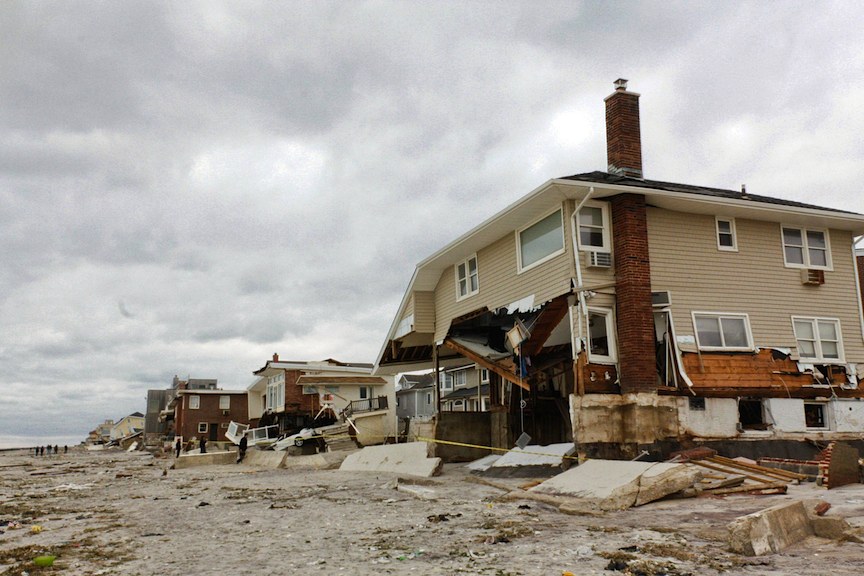
Killing nearly 200 people in the United States, Canada and the Caribbean and crippling much of New York City and surrounding areas earlier this week, Hurricane Sandy was the kind of extreme weather event scientists have long predicted will occur with global warming.
“Climate change is a reality,” said New York Governor Andrew Cuomo after Sandy swept through his state.
Sandy was twice the size of an average hurricane, and it hit the eastern coast of the United States, where sea levels have been rising the fastest, said Kevin Trenberth, senior scientist at the National Center for Atmospheric Researchin Boulder, Colorado.
“All weather events are affected by climate change because the environment in which they occur is warmer and moister than it used to be,” Trenberth, an expert on extreme events, told IPS.
Whether climate change caused Hurricane Sandy is the wrong question to ask, added Trenberth. He explained that climate change helped make Hurricane Sandy more destructive than it otherwise would have been.
“This is the new normal,” Trenberth said. “It doesn’t make sense to rebuild in some regions – they’ll just be swept away again.”
Mexico and Central America look like they are covered in dried blood on maps projecting future soil moisture conditions.
The results from 19 different state-of-the-art climate models project extreme and persistent drought conditions (colored dark red-brown on the maps) for almost all of Mexico, the midwestern United States and most of Central America.
If climate change pushes the global average temperature to 2.5 degrees Celsius above pre-industrial era levels, as many experts now expect, these regions will be under severe and permanent drought conditions.
Future conditions are projected to be worse than Mexico’s current drought or the U.S. Dust Bowl era of the 1930s that forced hundreds of thousands of people to migrate.
“Drought conditions will prevail no matter what precipitation rates are in the future,” said co-author Michael Wehner, a climate scientist at the Lawrence Berkeley National Laboratory, a U.S. government research centre in California.
“Even in regions where rainfall increases, the soils will get drier. This is a very robust finding,” Wehner told Tierramérica.
Without major reductions in carbon emissions from the burning of fossil fuels, global temperatures will increase to at least 2.5 degrees of warming between 2050 and 2090, depending on rates of emissions of greenhouse gases, climate sensitivity and feedbacks. Continue reading →
I was born just over a week ago and more than 100 people have died in the US and Caribbean region as a result. For the rest of today please take care as I will continue to bring strong winds, heavy rains and snowfall from North Carolina to well into Canada. Some of the worst flooding hit Haiti in the hours after I’d passed by.
There are estimates that I might cause $20 billion in damages in the US in addition to the $2+ billion in costs in the Caribbean. That’s a lot of money — enough to give every human on the planet $3. But it is only a fraction of the $600 billion the oil and gas industry is spending this year alone [2012 Harvard study, pg 8] in exploration and new production. That $600 billion investment in fossil fuels will bring far greater storms than I.
To be absolutely clear: I am not “targeting” New York City or anywhere else. I am pushed and pulled by temperature and pressure differences. My winds are powered by warm water and moisture. And there is enough heat and moisture for my winds to make 12-foot high waves over a 3 million sq km area – one third the size of the US.









 Stephen Leahy, International Environmental Journalist