Indigenous Peoples Demand Greater Role in Climate Debate

native-windmill-art

By Stephen Leahy*


ANCHORAGE, Alaska, Apr 20 (Tierramérica) – While indigenous peoples from around the world are meeting in this Alaskan city to seek a greater role in global climate negotiations, the rapidly warming Arctic is forcing some Inuit villages to be relocated.

“We have centuries of experience in adapting to the climate and our traditional lifestyles have very low carbon footprints,” Victoria Tauli-Corpuz, an indigenous leader from the Philippines and chair of the United Nations Permanent Forum on Indigenous Issues, told Tierramérica.

Carbon-based gases are the principal cause of the greenhouse effect, which leads to climate change. The excessive release of these gases, like carbon dioxide and methane, comes from human activities: the combustion of fossil fuels in industry and transportation, and emissions from livestock production and deforestation.

Some 400 indigenous people, including Bolivian President Evo Morales and observers from 80 nations, are gathered in Anchorage, Alaska for the Apr. 20-24 U.N.-affiliated Indigenous Peoples’ Global Summit on Climate Change.

They will discuss and synthesise ways that traditional knowledge can be used to both mitigate and adapt to climate change.

“Indigenous peoples have contributed the least to the global problem of climate change, but will almost certainly bear the greatest brunt of its impact,” said Patricia Cochran, chair of both the Inuit Circumpolar Council and the April Summit. Continue reading
Earth’s Arctic Freezer Turning Into Hothouse

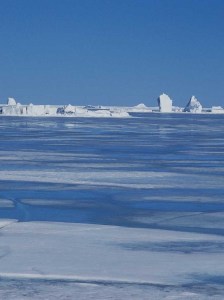
meltwater-ponds-on-sea-ice-off-coburg-island-nunavut-canada-arctic-warming-has-been-associated-with-a-rapid-decline-in-arctic-summer-sea-ice-extent-image-credit-sandy-briggs1By Stephen Leahy

UXBRIDGE, Apr 10 (IPS) – The world is losing its northern freezer as Arctic winter ice is in sharp decline, NASA scientists reported this week. Even with below average winter temperatures, Arctic ice is thinner and covers less area than it did a decade ago.

Arctic sea ice is the cooling mechanism for the global climate system. As it declines and the region warms – already three to five degrees Celsius warmer – then inevitably there are local, regional and hemispheric climate impacts.

“We’ve already lost one third of the summer ice cover since the 1980s. There are already impacts from this,” says Ron Kwok of NASA’s Jet Propulsion Laboratory in Pasadena.

“A completely ice-free summer by 2013 is not impossible,” Kwok said in a telephone news conference. “You would have been laughed out the room if you suggested this five years ago.”

The new study shows that the maximum extent of the 2008-2009 winter sea ice cover was the fifth-lowest since researchers began collecting such information 30 years ago. The past six years have produced the six lowest maximums in that record.

More stunning, and indicative of the rapid warming of the region, is the decline in the thick, hard-to-melt multi-year ice, says Walter Meier, research scientist at the National Snow and Ice Data Centre in Boulder, Colorado. Multiyear ice is ice that is two or more years old and therefore doesn’t melt in the summer.

“Less than 10 percent is multiyear now. It used to be 30 percent in 1981,” Meier said at the news conference.

via ENVIRONMENT: Earth’s Arctic Freezer Turning Into Hothouse.

Global Warming Puts Food Supplies At Risk, New Green Revolution Needed

cattle-oz-rslBy Stephen Leahy

UXBRIDGE, Canada, Apr 2 (IPS) – Don’t forget about agriculture in the upcoming global negotiations to combat climate change, experts warn. Not only is farming most at risk in an increasingly variable and tempestuous climate, it is also a major emitter of greenhouse gases.

But with the right policies in place, agriculture could both continue to feed the world and play a crucial role in solving the climate problem.

“Agriculture has been missing in the run-up talks to Copenhagen,” says Mark Rosegrant of the International Food Policy Research Institute (IFPRI).

The nations of the world will meet in Copenhagen this December to hammer out a new climate treaty to reduce emissions of greenhouse gases (GHGs) and establish a fund to help poorer countries adapt. The complex process began in 2007 at the Bali talks, continued in Poznan, Poland in 2008 and is ongoing this week in Bonn.

Agriculture accounts for about 15 percent of human emissions of GHGs, IFPRI says, although the Intergovernmental Panel on Climate Change puts it higher at 25 percent. Much of those emissions come from developed countries that rely heavily on fossil fuels and fertilisers and raise far more methane-emitting livestock.

With climate change the world is facing reduced yields of up to 20 percent in maize and rice by the year 2050, Rosegrant told IPS. Much of that yield decline will be in the developing world, mainly because sub-tropical and tropical regions are expected to be hit hardest by significant changes in water availability and warmer temperatures.

Climate change could mean ever-rising food prices and therefore significant investments are needed in agricultural research to help countries cope with the coming changes, he says: “We’re trying to work out what the costs for adaptation in agriculture might be.” Continue reading

Organic farming more profitable and better than conventional systems – U of Wisconsin

stanford-food-security-banner-sml

A University of Wisconsin’s College of Agriculture and Life Science study has found that “diversified (organic) systems were more profitable than monocropping”. Looked at the Midwestern crop standards of continuous corn, no-till corn and soybeans, and intensively managed alfalfa.

Study concludes: governmental policy that supports mono-culture systems is outdated and support should be shifted to programs that promote crop rotations and organic farming practices.

This is just one a many recent studies offering clear evidence that diversified/organic/ecoag farming systems are safer, better and more environmentally sustainable than conventional monocultures:

Organic Agriculture Reduces Climate Change, Poverty and Hunger

Organic Provides 3X More Food Per Acre in Poor Countries – podcast

Overweight? Hungry? Blame “Hollow Food”

Organic Cure for Brain-damaging Pesticides Found in US Children

Male Infertility Linked to Pesticides

GM Crops Creating Pest Problems Around World

Skin Would Fry in 5 Mins Without Ozone Treaty says NASA – Precautionary Lesson for Climate

ozone-hole-sept-08Disaster avoided.   If the world didn’t agree to cut back on ozone destroying chemicals that produce the annual polar ozone holes dangerous UV radiation would have increased a whopping 650 per cent by the year 2065 a new NASA study has found. By then two thirds of the protective ozone layer would have vanished creating a global ozone hole.

Five minutes of summer sun would burn skin in the mid-latitude regions like New York, London, Toronto. And it would be far worse in other regions.

And because those same chemicals are potent greenhouse gases the Earth would be 4 degrees warmer by then well past the critical tipping tip of 2 degrees scientists say we dare not exceed.

The world would have become a “real horrible place”, said NASA scientists.

I covered this in an IPS article last September  and how world leaders took a precautionary and averted catastrophe:

“In hard economic times, protecting the environment is often seen as a luxury — or ignored completely. But had that attitude prevailed 20 years ago when it came to taking action to protect the ozone layer, skin cancer rates would have soared and climate change would be even more dramatic than it is today. “

Tourism Can Reduce Poverty But Some Places Must Be Off-Limits

img_0330By Stephen Leahy*

QUEBEC CITY, Mar 24 (Tierramérica)More than ever before, global tourism must play its part in sustainable development and poverty alleviation, stated experts at an international symposium in this Canadian city.

But others wonder if tourism can be truly sustainable when it involves flying thousands of kilometres to reach some “carbon-neutral” eco-lodge in the jungle.

Climate change is a major concern and air transport makes a significant contribution, sustainable tourism expert Costas Christ told more than 500 attendees of the International Symposium on Sustainable Tourism Development, Mar. 16-19.

However, Christ said, it is also important to tell the public that international tourism has played a major role in preserving biodiversity and in conservation in general.

“Without tourism, the Pantanal (in South America), the world’s largest wetland, would have just turned into a major cattle feed-lot for McDonald’s,” said Christ, a former board chair of The International Ecotourism Society.

If it weren’t for tourism, Africa would not have its game parks and nature preserves, and the Coral Triangle (which encompasses the waters of Indonesia, Malaysia, Papua New Guinea, Philippines, Solomon Islands and Timor-Leste) would have been devastated by overfishing, he continued.

“Tourism is not the problem; the challenge is how to do tourism right,” Christ told Tierramérica in an interview. Continue reading

Plastic Bottles Leach Estrogen – ‘Healthy’ Mineral Water Contaminated by Plastic

churning-ocean-sml1An analysis of commercially available mineral waters in Germany reveals estrogenic compounds leaching out of the plastic packaging into the water. What’s worse these chemicals are potent and affected the development of  invertebrate embryos. Estrogen contamination was found in  78% of waters in plastic bottles and waters bottled in composite packaging.

“We must have identified just the tip of the iceberg in that plastic packaging may be a major source of xenohormone* contamination of many other edibles. Our findings provide an insight into the potential exposure to endocrine-disrupting chemicals due to unexpected sources of contamination.” — write the study authors in the journal of Environmental Science and Pollution Research.

*man-made substance that has a hormone-like effect

See also:  A Mar 27/09 discovery that two commonly used food additives are estrogenic has led scientists to suspect that many ingredients added to the food supply may be capable of altering hormones–Environmental Health News

My Related Articles/Posts:
Male Infertility Linked to Pesticides

30 Million Lead-laden TVs Dumped on Poor Countries

Top Ten Worst Pollution Problems That Kill Millions – Including Ones You’ve Never Heard Of

Acid Oceans and Seas Without Fish – Hot New Doc

seachange-header

Lots of buzz about a hot, new documentary film A Sea Change which is about ocean acidification and its potential to empty the oceans of fish. I haven’t seen the film although I had a chance to at a seafood conference in San Diego last month but couldn’t face a visual version of a topic I’ve written about since 2006.  I have enough trouble sleeping as it is… 

Turns out the filmmakers got the idea to make the film by ‘googling’  “ocean acidification” in Nov 2006 and found very few entries. I guess my 2006 articles were among the first-ever articles published about ocean acidification and how climate change is a major threat to the global oceans. — Stephen

July 5 2006

Ailing Reefs Face New Threat of Acidity
By Stephen Leahy

Climate change is making the world’s oceans more acidic, seriously endangering marine ecosystems, including coral reefs. 

Carbon dioxide emissions from the burning of fossil fuels have already made the oceans 30 percent more acidic than they have been in millions of years, according to a new report by leading scientists. And the rate of acidification is accelerating as the oceans absorb more than two billion tonnes of carbon each year from the atmosphere. 

“This is a dramatic change in the world’s oceans, a change that marine organisms have never dealt with before,” said Joan Kleypas, the report’s lead author and a scientist at the National Centre for Atmospheric Research (NCAR) in Boulder, Colorado. 

“The oceans have changed and they are becoming more acidic. There is no debate about this,” Kleypas told IPS. Continue reading

Earth Hour, Mar 28. The world’s first global election.

earhhour-sht

The WWF is using the annual Earth Hour as a way to get folks thinking about climate change and to send a message to policy makers that the people of the planet are deeply worried. Damn right we are — Stephen

From Earth Hour: Vote Earth – The world’s first global election:

THIS IS THE WORLD’S FIRST GLOBAL ELECTION, BETWEEN EARTH AND GLOBAL WARMING.

On March 28 you can VOTE EARTH by switching off your lights for one hour.

IN 2009, EARTH HOUR IS BEING TAKEN TO THE NEXT LEVEL, with the goal of 1 billion people switching off their lights as part of a global vote. Unlike any election in history, it is not about what country you’re from, but instead, what planet you’re from. VOTE EARTH is a global call to action for every individual, every business, and every community. A call to stand up and take control over the future of our planet.

Over 74 countries and territories have pledged their support to VOTE EARTH during Earth Hour 2009, and this number is growing everyday.

“Earth Hour is a way for the citizens of the world to send a clear message. They want action on climate change.”

— UN Secretary-General Ban.

“Earth Hour 2009 will be even bigger because the threats posed by unchecked climate change are escalating, along with people’s concern. We need every individual, government and business to play a part. Earth Hour provides a constructive platform for engaging these stakeholders and demonstrates the impact we can have when we act together. 
— Julia Marton-Lefèvre Director General, IUCN

The results of the election are being presented at the Global Climate Change Conference in Copenhagen 2009. We want one billion votes for Earth, to tell world leaders that we have to take action against global warming.

earthhour-long1

Interview With One of the Last Environmental Journalists Left Standing

steve-on-log-in-oz-rslpixApparently as one of the few independent international environmental journalists I’m a rare beast worthy of public curiosity. In the past year I’ve been asked to do a number of talks at various conferences, colleges and universities in a number of countries and a growing number of media interviews.

Here’s my  15 min radio interview on the well-informed Radio EcoShock— talk about hard questions on big issues of our time. (@ 19:00 min)

Vancouver’s wonderful RADIO ECOSHOCK is the best environmental radio/podcast programs on the planet. One hour each week of new, innovative and intelligent information with a wry sense of humor by host Alex Smith. Check out his blog for even more.

Get links to my latest articles once a week.

This week’s EcoShock program: PROGRESS AND DENIAL

Climate change is not about politics or negotiations, but inevitable physics and science. Latest speeches by Bill McKibben and Van Jones. A look at twisted climate deniers John Coleman and Michael Savage. Interview with indy enviro journalist Stephan Leahy. Humour from Craig Mayhemradio-eco-header