Revealed: In Acidic Oceans Sunlight Kills Planet’s Most Important Organism — Marine Algae

A number of marine diatom cells (Pleurosigma), which are an important group of phytoplankton in the oceans.
Credit: Michael Stringer

“There’s a synergistic effect between increased ocean acidity and natural light”

“It’s clear we are conducting a giant experiment on the planet and we don’t know what we are doing.”

 By Stephen Leahy

UXBRIDGE, Canada, May 8, 2012 (IPS)

Without major reductions in the use of fossil fuels, sunlight will kill an unknown number of ocean phytoplankton, the planet’s most important organism, a new study reports this week.

Not only are phytoplankton, also known as marine algae, a vital component in the ocean’s food chain, they generate at least half of the oxygen we breathe.

In the not so distant future, sunlight, the very source of life for phytoplankton, will likely begin to kill them because of the ocean’s increasing acidity, researchers from China and Germany have learned.

“There’s a synergistic effect between increased ocean acidity and natural light,” says Ulf Riebesell of the Helmholtz Centre for Ocean Research in Kiel, Germany.

Riebesell added that it was also possible “phytoplankton could adapt”.

Researchers were surprised to discover that diatoms, one of the most important and abundant types of phytoplankton, fared very badly during shipboard experiments conducted by co-author Kunshan Gao, from the State Key Laboratory of Marine Environmental Science at Xiamen University, Xiamen China.

Previous experiments in labs like Riebesell’s found that diatoms actually did better in high-acid seawater, unlike most other shell- forming plankton. Burning fossil fuels has made the oceans about 30 percent more acidic researchers discovered less than 10 years ago. Oceans absorb one third of the carbon dioxide (CO2) emitted from using fossil fuels.

The good news is this has slowed the rate of global warming. The bad news is oceans are now more acidic and it will get worse as more CO2 is emitted. This is basic, well-understood ocean chemistry.  Continue reading

Trashing the Oceans: 3 to 6 X More Trash Than Plankton – ‘Using Oceans as Universal Sewer’ — Cousteau

This is a repost from last year. Sad to see  little progress on this issue. — Stephen

“There is no reason for delay. Governments and industry need to take action and people have to stop pointing fingers at each other and get on with it.”

California nearly became the first U.S. state to ban plastic bags, but a multi-million-dollar lobby effort by industry killed the proposed legislation

By Stephen Leahy

HONOLULU, Hawaii, U.S., Mar 28, 2011 (IPS)

Every day, billions of plastic bags and bottles are discarded, and every day, millions of these become plastic pollution, fouling the oceans and endangering marine life.

No one wants this, but there is wide disagreement about how to stop it.

“Every time I stick my nose in the water, I am shocked. I see less and less fish and more and more garbage,” said Jean-Michel Cousteau, son of the legendary marine ecologist Jacques Cousteau, who has spent four decades making documentaries and educating people about the oceans.

Please throw something in the tip jar before reading on. This is how I make my living.

On trips to the remote and uninhabited northwestern Hawaiian Islands, Cousteau found miles and miles of plastic bottles, cigarette lighters, television tubes, spray cans, broken toys, and thousands of other pieces of plastic on the beaches and thousands of tonnes of derelict fishing nets in the reefs.

“We are using the oceans as a universal sewer,” he told some 440 participants from the plastics manufacturing, food and beverage sectors, environmental organisations, scientists and policy-makers from over 35 countries at the Fifth International Marine Debris Conference in Honolulu, Hawaii, which ended Mar. 25. Continue reading

Eliminate GDP and Economic Growth to Create the Real Green Economy Indigenous Peoples Say

Wind-solar electricity generation built by indigenous Telengits community in Russia's Altai  Mountains.   Photo:  Foundation for Sustainable Development of Altai

Wind-solar electricity generation built by indigenous Telengits community in Russia’s Altai Mountains. Photo: Foundation for Sustainable Development of Altai

by Stephen Leahy

First published at National Geographic’s NewsWatch

The planet is in peril, 3,000 scientists and other experts concluded at the recent Planet Under Pressure conference in London. Climate change, overuse of nitrogen and loss of biodiversity are just three of the perils threatening to make much of our home uninhabitable.

World leaders will meet in Rio de Janeiro June 20-22 to address this at the Rio+20 Conference, 20 years after the very first Earth Summit.

Rio+20 needs to be the moment in human history when the nations of the world come together to find ways to ensure ‘the very survival of humanity,’ environmentalists and scientists have said.

A “Green Economy” will be one of the main ideas under discussion in Rio. The idea is to make a transition to an economic system that maximizes human well-being while operating within the planet’s environmental limits. Exactly how this could be accomplished has yet to be defined.

The current economic system rewards those who exploit and destroy nature, said Vicky Tauli-Corpuz, Executive Director, Tebtebba (Indigenous Peoples’ International Centre for Policy Research and Education).

The current system hinders and even blocks Indigenous peoples from practicing their traditional ways of living that actually represent “a real green economy” that can be sustainable, achieve well being and are climate-friendly, said Tauli-Corpuz, a member of the indigenous Kankana-ey Igorot community in the Philippines.

Please throw something in the tip jar before reading on. This is how I make my living.

Continue reading

Traditional Slash and Burn Agriculture Sustainable Solution to Climate Change

Gwendolyn Smith, Amazon Conservation Team. Photo: Stephen Leahy

Climate change is the result of not behaving in the right way says remote Amazon tribe

 by Stephen Leahy

First published at National Geographic’s NewsWatch

Climate change is the result of not behaving in the right way, according to the isolated Trio, an indigenous people living in Suriname’s Amazon forest near its border with Brazil.

“They see climate change as big problem. They say their forests are changing, deteriorating,” said Gwendolyn Smith, a project director for the non-profit organization Amazon Conservation Team (ACT).

ACT was launched by U.S. ethnobotanist Mark Plotkin and Costa Rican conservationist Liliana Madrigain Madrigal in 1996 to work with indigenous peoples in the rainforests of Suriname and elsewhere in the Amazon to retain their traditional knowledge.

The Trio (also known as Tiriyó) number perhaps 2000 and live entirely off their forests as hunters and swidden farmers. Swidden is a form of slash and burn agriculture where small plots are cleared and crops planted for one or two seasons, after which plots in new areas are cleared. Old plots are left fallow for many years, allowing the forest and soils to replinish. On a small scale this is sustainable.

“They have strict rules for managing their forest,” said Smith, who has worked with the Trio for seven years and is also a PhD student at Nova Southeastern University in Florida.

Their knowledge of the forest is unparalleled but the Trio know little about the wider world. “Money was only introduced to them six years ago and they don’t really understand concepts like saving,” she said.

Similarly, the concept of carbon and using their forests to soak up carbon is simply not part of their worldview, she told delegates at The Climate Change Mitigation with Local Communities and Indigenous Peoples workshop in Cairns, Australia. Continue reading

Rio+20: The Moment in History to Ensure Our Future Survival?

Planet Under Pressure - State of the Planet Declaration Mar 29 2012.

Worlds’ Scientists Say Facing “Planetary Emergency”

By Stephen Leahy

UXBRIDGE, Canada, (IPS)

The upcoming Rio+20 conference has to be the moment in human history when the nations of the world come together to find ways to ensure the very survival of humanity, many science and environmental experts believe.

Except that governments, the media and the public aren’t paying attention to the “planetary emergency” unfolding around them. The situation is like firefighters yelling “fire” in crowded room and still no listens.

“The situation is absolutely desperate and yet there’s nothing on the front pages or on the agenda of world leaders,” said Pat Mooney, executive director of the ETC Group, an international environmental organisation based in Ottawa.

“The lack of attention is a tragedy,” said Mooney, who has 40 years experience in international environment and development issues.

Humanity is failing in its stewardship of the planet. An incredible 85 percent of the world’s oceans are in trouble, said Susan Lieberman, director of international policy at the Pew Environment Group, a U.S. organisation.

Rio+20 is a major opportunity to turn this around, Lieberman told IPS.

The Jun. 20-22 Rio+20 meet is timed to coincide with the 20th anniversary of 1992 Earth Summit in Rio de Janerio. The Earth Summit captured world attention, with leaders from most countries and some 10,000 media attending.

It gave birth to the most important environmental treaties on climate change, biodiversity and land degradation and desertification. World leaders also endorsed Agenda 21, a detailed blueprint on how nations can practice sustainable development.

Years of preparation went into the 1992 Summit, while only months have gone into Rio+20.

“There hasn’t been nearly enough preparation to be able to sign treaties,” said Lieberman. It’s been a struggle to get many governments like such as the US to focus on Rio+20 at all she said.

“Governments are not giving this opportunity enough importance given the mess we are in,” said Lisa Speer, director of the international oceans programme at the Natural Resources Defense Council, a U.S. NGO. Continue reading

No Magic Solutions for the Extinction of Species that Produce Our Air, Water and Water

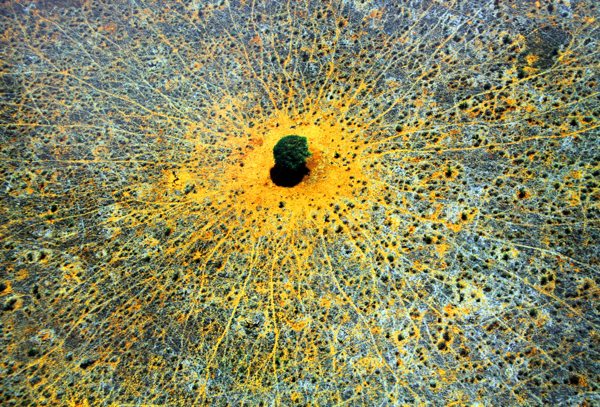
Photo: Yann Arthus- Bertrand, GoodPlanet Foundation http://www.goodplanet.org/en/

Is there a middle ground between economic interests, livelihoods and conservation?

By Stephen Leahy

VANCOUVER, Canada (IPS)

The Earth’s life support system, which generates the planet’s air, water and food, is powered by 8.7 million living species, according to the latest best estimate. We know little about 99 percent of those unique species, except that far too many are rapidly going extinct.

What can be done to slow down this process, which could eventually lead to the extinction of the human species?

“The challenge is to find the middle ground between economic interests, livelihoods and conservation,” says Braulio Ferreira de Souza Dias, the newly appointed head of the Secretariat of the United Nations Convention on Biological Diversity (CBD), the international agency charged with helping countries slow and reverse the loss of plants, animals and other species.

A native of Brazil, Dias holds a doctorate in zoology from the University of Edinburgh, and worked for many years at the Brazilian Ministry of the Environment, where his last position prior to joining the CBD was as Secretary of Biodiversity and Forests.

An exclusive interview with BRAULIO FERREIRA DE SOUZA DIAS, executive secretary of the UN Convention on Biological Diversity

Q: Why are species going extinct and why does it matter? 
Continue reading

Hunt for Metals, Minerals, Gas and Oil Triggers Global Land Rush: No Place Is Off Limits

 Need global moratorium on new large-scale mining, extraction and prospecting

 The average U.S. citizen uses an astonishing 22,000 times their weight in minerals, metals and fuels in their lifetime 

By Stephen Leahy

UXBRIDGE, Canada – March 1 2012, IPS

A global scramble for land and mineral resources fuelled by billions of investment dollars is threatening the last remaining wilderness and critical ecosystems, destroying communities and contaminating huge volumes of fresh water, warned environmental groups in London Wednesday.

No national park, delicate ecosystem or community is off limits in the voracious hunt for valuable metals, minerals and fossil fuels, said the Gaia Foundation’s report, “Opening Pandora’s Box”. The intensity of the hunt and exploitation is building to a fever pitch despite the fact the Earth is already overheated and humanity is using more than can be sustained, the 56-page report warns.

“We’re calling for a global moratorium on new, large-scale mining, extraction and prospecting,” said Teresa Anderson of The Gaia Foundation, an international NGO headquartered in London, UK that works with local communities.

The International Union for Conservation of Nature (IUCN) has recently warned of the threats to World Heritage Sites from planned mining and oil and gas projects. One in four iconic natural areas in Africa is negatively affected, the report notes.

“No matter where you live, land acquisitions for mining, oil or gas are coming,” Anderson told IPS following the report’s launch in London.

The easy-to-get resources are gone. Now the extractive industries, funded by pension funds and commodities speculators, are using new technologies like fracking for natural gas to get at previously unprofitable resources. Continue reading

Wisdom of Elders Better Than Science or the Internet: “They Still Know How to Cook Mammoth”

Petr Kaurgin, a Chukchi reindeer herder from Siberia. Photo: Citt Williams

by Stephen Leahy

First published at National Geographic’s NewsWatch

 “Our elders are the best source of information. Better than science or the internet,” said Petr Kaurgin, a Chukchi reindeer herder from the remote Turvaurgin nomadic tribal community in north-eastern Siberia.
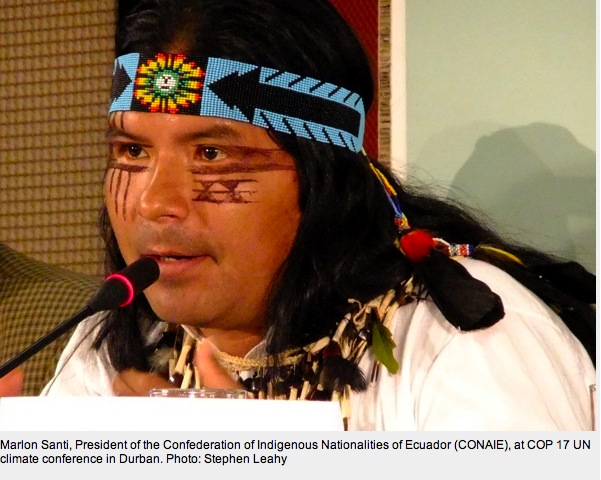
Kaurgin delivered his message to climate scientists from Intergovernmental Panel on Climate Change (IPCC) and other Indigenous peoples at the closing of the Climate Change Mitigation with Local Communities and Indigenous peoples workshop here in Cairns, Australia.

“We need to listen to the wisdom of the elders. We can use everything in nature. But we must not break or destroy things, ” he said through a translator.

It was -45C when Kaurgin left his home to bring his people’s message to climate experts here in the hot, wet tropical part of Australia. The IPCC is the world authority on the science of climate change. And along with the United Nations University (UNU) organized the workshop to figure out how to incorporate Indigenous peoples’ traditional knowledge.

“When we love the land where we live only then we are happy,” he said.

Kaurgin’s people and other local Siberian communities have been experiencing the impacts of climate change such as melting permafrost for the last 20 years said Tero Mustonen, Head of the Village of Selkie in North Karelia, Finland.

For complete article see Nat Geo’s NewsWatch

Climate Scientists to Attend Native Knowledge ‘Boot Camp’ in Australia

By Stephen Leahy

First published at National Geographic NewsWatch

In what may be a ‘clash of worldviews,’ representatives from indigenous and local communities are holding a climate workshop with physicists, computer modellers, and other climate scientists from the Intergovernmental Panel on Climate Change (IPCC) in Cairns, Australia 26-28 March.

This is a unique opportunity for Native peoples to discuss their traditional knowledge and experiences as it relates to climate change.

Indigenous peoples are amongst the most affected by current and future climate change but their experiences and knowledge have largely been ignored by science experts at the IPCC. The workshop, Climate Change Mitigation with Local Communities and Indigenous Peoples: Practices, Lessons Learned and Prospects, is a significant effort to change this.

There are an estimated 350 million indigenous peoples according to the United Nations. They legally own more than 11% of the world’s forests and those coincide with areas that hold up to 80% of the world’s terrestrial biodiversity. Traditional knowledge is a different but no less valid way of understanding the world. However, very few scientists of the thousands who have worked with the IPCC have any experience with traditional knowledge.

The IPCC is working on its next big report (to be released in 2014) and has acknowledged that its Fifth Assessment Report needs to look at how climate change will impact indigenous peoples, their role in reducing carbon emissions (mitigation) and what barriers they face in adapting to current and future climate impacts.

The Cairns workshop will focus on how indigenous peoples can help reduce global carbon emissions. It is being held in collaboration with the IPCC, indigenous organizations, the United Nations University (UNU), the Australian government and others.

Follow the workshop on Facebook or Twitter

Become a Partner in Independent Enviro Journalism

A personal message from Stephen Leahy

“Journalism and media are society’s mirror providing accurate and essential information.

That is no longer the case.

Media are now controlled by a few major corporations like Murdoch’s News Corp. Coverage of environment and science has been gutted. If there is coverage it rarely digs below the surface. It’s not just TV, it’s all media.

After 18 years of being published in major publications on two continents I now count myself lucky to get $150 to $200 for an in-depth article. The few independent media outlets are either non-profits or struggling.

Urgent environmental issues didn’t go away just because most media stopped covering them.

More than 20,000 people attended the international climate meeting in Cancun, Mexico and it received one ten second clip on US network TV according to a Drexel University media study. (Coverage was even worse at last climate meet in Durban)

Nearly every indicator proves things are getting worse but less and less people know about this.

Many people, including leading scientists, tell me: ‘we need people like you to write about these issues‘. I’d like to do far more but it is impossible to continue without your help in what I’m calling Community Supported Journalism. People directly support independent journalists who craft honest and thoughtful articles about important subjects the mainstream media ignores or gloss over.

Community Supported Environmental Journalism Works

In 2010 dozens of people offered their help, donating $5,750 which helped ensure many breaking international stories were covered including the first media reports on the global die-off of corals and how climate change may be bringing colder winters to Europe and eastern North America. Those donors — I prefer to call them partners — enabled me to cover important international meetings like the UN Convention on Biodiversity, UNFCCC climate change conference and much more.

Thanks for reading.” — Stephen

Please join us. Consider a donation of just $10 a month to support enviro journalism that serves the public interest.

Contributions can be made safely and easily via PayPal* or Credit Card*. [You can cancel at any time, automatically. No need to contact me] 

Monthly support options starting @ $10 a month

One-time donations are most welcome. Click and enter the amount.

*More than 100,000 non-profits safely use PayPal Donate service

If you’d like a mailing address or contact me with story ideas, please complete this comment form.

Letters of Support:

We need people like you. In tough economic times, where information flow is increasingly channeled and controlled, you perform a simply critical role. Hang in there. You are an admirable role model for the future.”

– E. Ann Clark, Associate Professor, University of Guelph.

“Stephen Leahy has done a superb job exposing the enormous sums the US government is spending on corporate welfare for big oil.”

Ross Gelbspan, Pulitzer-prize winning editor and author of The Heat is On

My continued appreciation to those who have contributed in the past.