Fight Against Marine Garbage Runs Into Plastics Lobby – Cousteau “shocked” by state of oceans

This is my final article in the Trashing the Ocean series. It looks at the results of the first major international effort to deal with the issue in 11 years. It’s less than satisfying effort largely due to the plastics lobby.  One of the unofficial solutions:  buy local and create local, sustainable communities says the guy who ‘discovered’ the pacific garbage patch. — Stephen

There are three to six kilogrammes of marine trash for every kilogramme of plankton…. California nearly became the first U.S. state to ban plastic bags, but a multi-million-dollar lobby effort by industry killed the proposed legislation

By Stephen Leahy

HONOLULU, Hawaii, U.S., Mar 28, 2011 (IPS)

Every day, billions of plastic bags and bottles are discarded, and every day, millions of these become plastic pollution, fouling the oceans and endangering marine life.

No one wants this, but there is wide disagreement about how to stop it.

“Every time I stick my nose in the water, I am shocked. I see less and less fish and more and more garbage,” said Jean-Michel Cousteau, son of the legendary marine ecologist Jacques Cousteau, who has spent four decades making documentaries and educating people about the oceans.

On trips to the remote and uninhabited northwestern Hawaiian Islands, Cousteau found miles and miles of plastic bottles, cigarette lighters, television tubes, spray cans, broken toys, and thousands of other pieces of plastic on the beaches and thousands of tonnes of derelict fishing nets in the reefs.

“We are using the oceans as a universal sewer,” he told some 440 participants from the plastics manufacturing, food and beverage sectors, environmental organisations, scientists and policy-makers from over 35 countries at the Fifth International Marine Debris Conference in Honolulu, Hawaii, which ended Mar. 25.
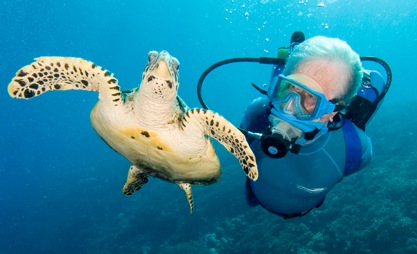
Jean-Michel Cousteau

This independent environmental journalism depends on public support. Click here learn more.

Humanity is risking its own health and survival in treating the oceans this way, Cousteau said. The oceans are the source of life on our planet. Through evaporation, oceans are the most important source of fresh water while phytoplankton generates at least half the oxygen we breathe.

“No one is away from the ocean. We are all intimately connected by every breath we take,” he said.

Continue reading

8.7 Million Species Run Spaceship Earth and Our Life Support System

Charonia tritonis Credit: David Burdick

We share the planet with 8.7 million species. We’re unconcerned about the ongoing loss of 200 species a day since we fail to realize they are our life support system. And we don’t know how many or which species are needed to keep things running. There is metaphor in the article to make that clearer I hope. We are not even close to coming to grips with this issue.  — Stephen

“If the decline in species around us is not significant then I ask what is?”

By Stephen Leahy

UXBRIDGE, Canada, Aug 23, 2011 (IPS)

 The life support system that generates the planet’s air, water, and food is powered by 8.7 million living species according to the newest and best estimate. We know next to nothing about 99 percent of those unique species – except that lots of them are going extinct.

“It is like a complicated engine where we only know about the major pieces. If we lose one or some of the small hidden pieces that play a critical role the engine might stop working,” said Camilo Mora of the University of Hawaii and Dalhousie University in Halifax, Canada.

Many species may vanish before we even know of their existence, of their unique niche and function in ecosystems,” Mora told IPS.

Until now there wasn’t even a decent guesstimate about how many species exist currently: three million? 100 million? Now a new validated analytical technique has pined down the big number to 8.7 million species (give or take 1.3 million).

The analysis published Tuesday in the journal ‘PLoS Biology’ estimated there are 6.5 million species found on land and 2.2 million – about 25 percent of the total – dwelling in the ocean depths.

This independent environmental journalism depends on public support. Click here learn more.

“Not knowing the answer to this fundamental question really highlights our ignorance about life on this planet,” said Boris Worm of Dalhousie University, co-author of the study along with Mora.

“We’re so fixated on the human enterprise we don’t recognise nature’s enterprise… the 8.7 million species that run the planet and provide the air we breathe, the water we drink and the soil we grow our crops in,” Worm told IPS. “If the decline in species around us is not significant then I ask what is? This is all we have on this planet, the only planet that holds life.” Continue reading

Colombian Forest Project Reaps Credits… and Criticism

Procuenca reforestation

By Stephen Leahy*

UXBRIDGE, Canada, May 6, 2010 (Tierramérica)

The “Procuenca Initiative” in the Andes region of western Colombia may be the first in the world to sell certified forest carbon credits with a biodiversity protection component. But alarms are sounding about the potential negative social and environmental consequences.

Under way since 2001, the programme will begin to operate in the international market next year, having received official registration Apr. 16 under the Clean Development Mechanism (CDM).

Part of the Kyoto Protocol on Climate Change, in force since 2005, the CDM allows industrialised countries to earn credits for reducing emissions of greenhouse gases by investing in projects in developing countries that expand their capacity to absorb the carbon emissions.

Procuenca is expected to auction credits for some 350,000 tonnes of carbon that has been sequestered since the project began, initiative director Francisco Ocampo told Tierramérica through a translator.

At the current market value of 20 dollars per tonne, the total would be 7 million dollars for a struggling community, one that is still suffering from the collapse of coffee prices more than a decade ago.

“This project demonstrates the international importance of these forests for carbon storage,” said Ocampo. Continue reading

10 Years in the Amazon: The Forest Vanishes Before Your Eyes

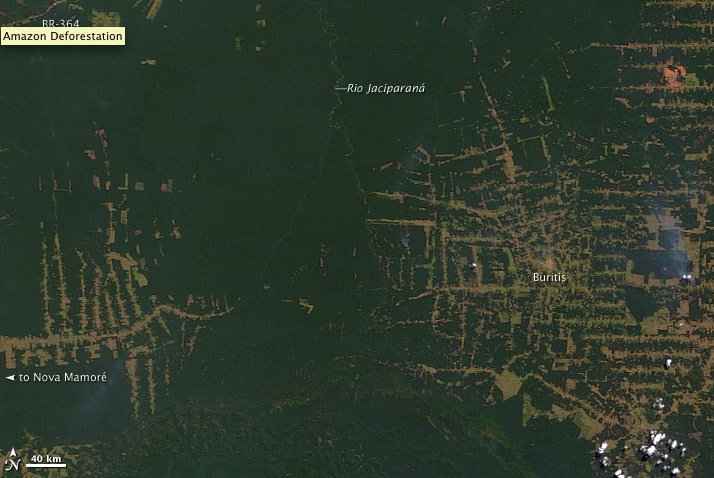
Amazon Forest 2000 - The state of Rondônia in western Brazil

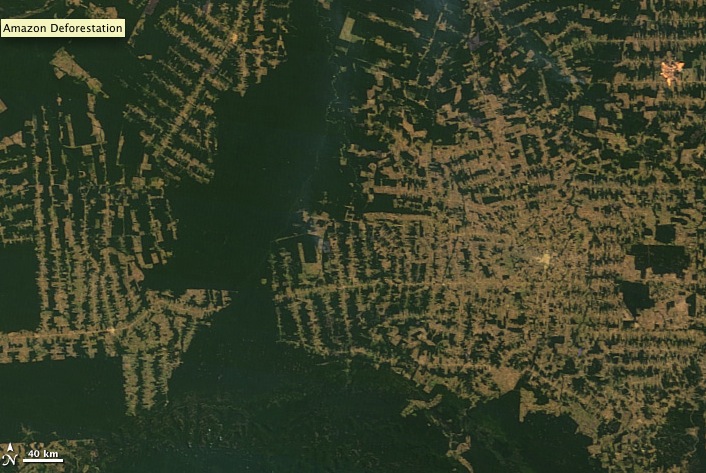
The state of Rondônia in western Brazil — once home to 208,000 square kilometers of forest (about 51.4 million acres), an area slightly smaller than the state of Kansas — has become one of the most deforested parts of the Amazon. In the past three decades, clearing and degradation of the state’s forests have been rapid: 4,200 square kilometers cleared by 1978; 30,000 by 1988; and 53,300 by 1998. By 2003, an estimated 67,764 square kilometers of rainforest—an area larger than the state of West Virginia—had been cleared. Source: Amazon Deforestation – NASA

See also: Amazon Drought Accelerating Climate Change   The REAL Amazon-gate: On the Brink of Collapse Reveals Million $ Study

Amazon Forest 2010 - The state of Rondônia in western Brazil

Cut Climate Damaging Emissions in Half and Double Food Production With Eco-Farming

45- 50% of global warming emissions from industrial agriculture

By Stephen Leahy

UXBRIDGE, Feb 8, 2011 (IPS)

Eco-farming could double food production in entire regions within 10 years while mitigating climate change, according to a new U.N. report released Tuesday in Geneva.

An urgent transformation to ‘eco-farming’ is the only way to end hunger and face the challenges of climate change and rural poverty, said Olivier De Schutter, U.N. Special Rapporteur on the right to food, following the presentation of his annual report focusing on agroecology and the right to food to the U.N. Human Rights Council.

“Agroecology mimics nature not industrial processes. It replaces the external inputs like fertiliser with knowledge of how a combination of plants, trees and animals can enhance productivity of the land,” De Schutter told IPS, stressing that, “Yields went up 214 percent in 44 projects in 20 countries in sub-Saharan Africa using agro-ecological farming techniques over a period of 3 to 10 years… far more than any GM [genetically modified] crop has ever done.”

Other recent scientific assessments have shown that small farmers in 57 countries using agro-ecological techniques obtained average yield increases of 80 percent. Africans’ average increases were 116 percent.

“Today’s scientific evidence demonstrates that agroecological methods outperform the use of chemical fertilisers in boosting food production in regions where the hungry live,” De Schutter said. [Video Interviews with De Schutter]

Continue reading

Coral Reefs In Dire Peril – 75% May Die In Coming Years

One of the most incredible natural wonders of our world is being decimated by our actions: burning fossil fuel, pollution of land and sea, overfishing. The most recent estimate shows 75% of the world’s coral reefs are threatened according to new report by the World Resources Institute (WRI) and 24 other organizations. The report is “Reefs at Risk Revisited“.

Here’s one thing you can do to help. Follow and encourage others to live by these Three Simple Rules:

1. Reduce.

Reduce fossil fuel consumption everywhere.

2. Eliminate.

Eliminate all non-essential activities and products that involve burning fossil fuel.

3. Demand.

Demand that business and government provide transport, activities and products that minimize fossil fuel use.

Reduce. Eliminate. Demand. R.E.D.

More on the Corals, Ocean Acidification, Bleaching, Overfishing.

I have written more than 15 articles in last few years about the serious threats corals face:

Record Heat Killing Caribbean and Indian Ocean Corals

What if our air was 30% more acidic like the Oceans? May be 120% more acidic by 2060

Coral Reefs and Acid Oceans Series

Reefs and Forests Burn as Climate Disruption Takes Hold NOW

Tourism Is Poisoning the Mexican Caribbean

By Stephen Leahy*

UXBRIDGE, Canada, Feb 10, 2011 (Tierramérica)

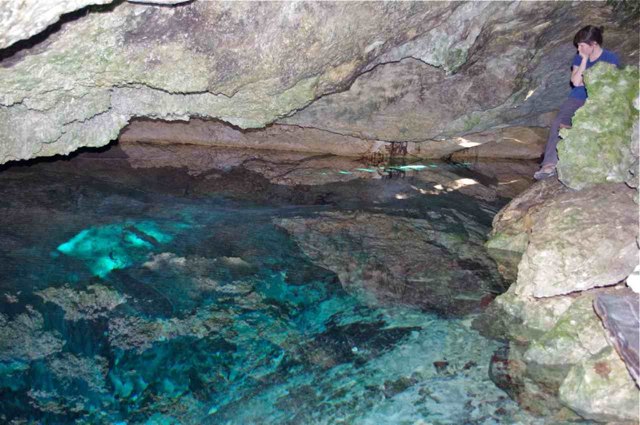
The booming tourist industry along Mexico’s Caribbean coast, particularly in the area of Cancún and the “Riviera Maya,” is polluting the world’s largest underwater cave system and harming the world’s second largest coral reef, a new study has found.

Pharmaceuticals, cocaine residues, shampoo, toothpaste, pesticides, chemical run-off from roads and many other pollutants have been found in the immense system of underground rivers and aquifers south of the resort city of Cancún, located on the Caribbean coast of Quintana Roo state.

“There is little question the pollutants we detected have come from human activity along the coastal region,” said Chris Metcalfe, a researcher with the United Nations University’s Institute for Water, Environment and Health.

The British journal “Environmental Pollution” published a study by the Institute this month, titled ” Contaminants in the coastal karst aquifer system along the Caribbean coast of the Yucatan Peninsula.”

Metcalf told Tierramérica that pit latrines, septic tanks, leaking sewer lines and golf courses were the most likely sources of groundwater pollution.

The flow of groundwater takes much of this pollution into the coastal zone and the region’s famous Mesoamerican Barrier reef, the second largest in the world, after the Great Barrier Reef off Australia.

This independent environmental journalism depends on public support. Click here learn more.

Land-based pollution is just one of the impacts on the coastal reefs, Metcalf said. Overfishing, coral diseases, and climate change have also contributed to an estimated loss of up to 50 percent of coral since 1990.

Without serious attention to preventing groundwater contamination, tourist development will kill the goose that laid the golden egg,” Metcalf said.
Continue reading

Amazon Drought Accelerating Climate Change

World’s Forests Losing Their Green. Billions of tonnes of CO2 Released

By Stephen Leahy

UXBRIDGE, Canada, Feb 3, 2011 (IPS)

Last year’s severe drought in the Amazon will pump billions of tonnes of additional carbon dioxide (CO2) into the atmosphere, a new report has found.

Researchers calculate that millions of trees died in 2010, which means the Amazon is soaking up much less CO2 from the atmosphere, and those dead trees will now release all the carbon they’ve accumulated over 300 or more years.

The widespread 2010 drought follows a similar drought in 2005 which itself will put an additional five billion tonnes of CO2 into the atmosphere, Simon Lewis of University of Leeds in the UK and colleagues calculate in a study published Thursday in Science. The United States emitted 5.4 billion tonnes of CO2 from fossil fuel use in 2009.

The two droughts will end up adding an estimated 13 billion tonnes of additional CO2 – equivalent to combined emissions in 2009 from China and the U.S. – and likely accelerating global warming.

“New growth in the region will not offset those releases,” Lewis told IPS.

This independent environmental journalism depends on public support. Click here learn more.

After the 2005 drought, Lewis and Brazilian scientist Paulo Brando from the Amazon Environmental Research Institute (IPAM) led teams of researchers on the ground to assess the impacts. They determined that only a few trees died per hectare, and so while the forest canopy cover looked relatively unchanged, there had been a significant change in the forest’s carbon balance. Continue reading

Great Barrier Reef Hit Hard By Australian Flooding


Flood caused plankton plume Great Barrier Reef

Australia’s La Niña flooding is unprecedented. At least 20 people have died, with damage and losses estimated in the many billions of dollars.

Much of the flooding is in the northeastern state of Queensland, whose rivers flow into the Coral Sea, and is expected to have a major impact on the nearby Great Barrier Reef.

Enormous amounts of sediments and pollutants are being washed off the land and are likely to have “a huge impact” on the world’s largest coral reef system, said Charlie Veron, former chief scientist at the Australian Institute of Marine Science.

The very strong La Niña is certainly causing the floods, but climate change would seem to be enhancing the effects,” Veron wrote in an email.

See full story on how climate change is worsening the effects of the Na Nina-El Nino (ENSO) cycle.


Ice-cold Atlanta (and eastern US) Is Likely Connected to Arctic Hothouse

But first…

That’s a great cartoon.

Climate change seems to be behind the shockingly warm temps across much of the eastern Arctic all winter and is likely responsible for the snow has fallen across much of the southern US. Much of Arctic ice sea melted last summer, allowing the Arctic ocean to warm up which then took longer to freeze i.e. late Dec/ Jan. And that changed the wind circulation patterns bringing polar air far south. (See my previous post that explains what is happening East Coast Blizzard and Europe’s Snowmaggddon Reveal Fingerprints of Climate Change

And for a collection of global temp graphs see this post
Arctic Hothouse Turns Europe into an Icebox )

And finally here’s a short video by Peter Sinclair of Climate Denial Crock of the Week explaining this: Global Warming. Winter Weirding.

]

This is part of Community Supported Environmental Journalism, independent reporting supported by citizens in several countries thru one-time, weekly or monthly or in-kind donations.