The simple truth: “The whole thing unravels without protecting at least half of the planet”

Job #1. end government subsidies that drive economic activity that damages the environment

By Stephen Leahy

MÉRIDA, Mexico, Nov 17 IPS

At least half the planet must be protected if humanity is to survive the next century, declared conservationists at the conclusion of 9th World Wilderness Congress on Friday, Nov. 13.

“That is what the science said, this is what many aboriginal people say,” said Harvey Locke, the Wild Foundation's vice president of conservation strategy.

“It’s time to speak the simple truth: The whole thing unravels without protecting at least half of the planet,” said Locke.

A leading economic report released in Brussels also on Nov. 13 pegged the cost of the ongoing loss and degradation of nature’s “infrastructure” at a staggering 2.5 trillion to 4.5 trillion dollars a year.

The enormous challenges humanity faces this century – like a warming planet, freshwater shortages, pollution, declining fisheries, desertification and unsustainable food production – cannot be solved without protecting more than 50 percent of Earth’s land and oceans, Locke told IPS.

Protection doesn’t necessarily mean more national parks, but a ban on resource extraction and all forms of development.

Is this article of interest? It exists thanks to contributions from readers. Please click here to learn more about Community Supported Journalism.

“We all know we aren’t sustainably managing the Earth,” he told participants at the WILD9 congress, a partnership between the WILD Foundation, an international, non-governmental non-profit based in the United States, and Unidos para la Conservación, a conservation organisation in Mexico.

“It is time for us to state clearly the scale of conservation intervention needed to make the 21st century one of hope instead of despair,” he said. Continue reading

Conserve Nature – Best Way We Have To Cope With Climate Change & Survive This Century

“….nature is sick, which threatens the survival of the human species”

“Conservation of nature is the first order strategy for climate change and carbon capture sequestration”

The only way forward is that “we must learn to live a simple life that is spiritually based”

By Stephen Leahy

MÉRIDA, Mexico, Nov 12 (IPS)

Lawrence Amos travelled from the Arctic at the top of the world to the tropical middle to recite in a soft voice the ongoing destruction of his home by climate change.

The ice is rougher and not as thick, and melts in May instead of June. There is less snow, more coastal erosion, and permafrost is melting, threatening to swallow homes, said Amos, an Inuit who lives in Sachs Harbour in Canada’s High Arctic, one of the remotest communities on the planet.

Amos was speaking here on Memorial Day at the 9th World Wilderness Congress from Nov. 6-13, where many other indigenous peoples, scientists and conservationists from more than 50 countries documented the escalating impacts of climate change on the land and in the oceans.

Like the roll call of the names of those fallen at Memorial or Remembrance Day ceremonies, Amos’ list of impacts experienced by the people of the western Arctic was tragically long.

Insects, birds and fish never seen before are now appearing in the region. “Grizzly bears are mating with polar bears… Our traditional knowledge about the land is becoming worthless,” he told IPS.

“Mother Nature does not use language. We must be aware of the signs, the changes in species, the melting of glaciers to inform us that nature is sick, which threatens the survival of the human species,” said Bittu Sahgal, founder of Sanctuary Asia, India’s leading environmental conservation magazine and book publisher.

“Nature will not talk to us, it will give us consequences,” he told more than 1,500 participants at the WILD9 congress, a partnership between the WILD Foundation, an international, non-governmental non-profit based in the United States, and Unidos para la Conservación, a conservation organisation in Mexico. Continue reading

Amateur Biologists Join Global Bid to Catalog All the Species on the Planet – Join the Fun

By Stephen Leahy

UXBRIDGE, Canada, Aug 25 (IPS)

(all images courtesy of EOL)

Save the living environment and the physical environment will automatically be saved, according to E.O. Wilson, the world’s leading biologist and father of the online Encyclopedia of Life, which plans to create a web page for every known species – all 1.8-plus million.

Climate and water are parts of the physical environment that rely on the living environment – trees, insects, animals – to keep them clean, healthy and in balance.

But that fundamental reality is not well understood by the public and little progress has been made in preventing the destruction of ecosystems and species, Wilson recently told the New Scientist magazine. That’s why Wilson came up with the idea in 2003 to create a publicly accessible, interactive Encyclopedia of Life (EOL).

Launched in 2008, the EOL is growing quickly with 170,000 entries, over 30,000 still images and video – with some provided by members of the public.

“We want to engage the public. With the EOL they can survey the species in their yard and neighbourhoods and report what they find,” said James Edwards, EOL’s executive director based at the Smithsonian Institution in Washington.

“We’d love to see everyone become a ‘field biologist’ and submit what they’ve found,” he said.

Societal understanding and support is crucial to slow and reverse the loss of ecosystems and species, Edwards told IPS.

“If we can’t do that, we all will be in deep trouble,” he said.

Continue reading

Dwindling Fish Catch Could Leave a Billion Hungry

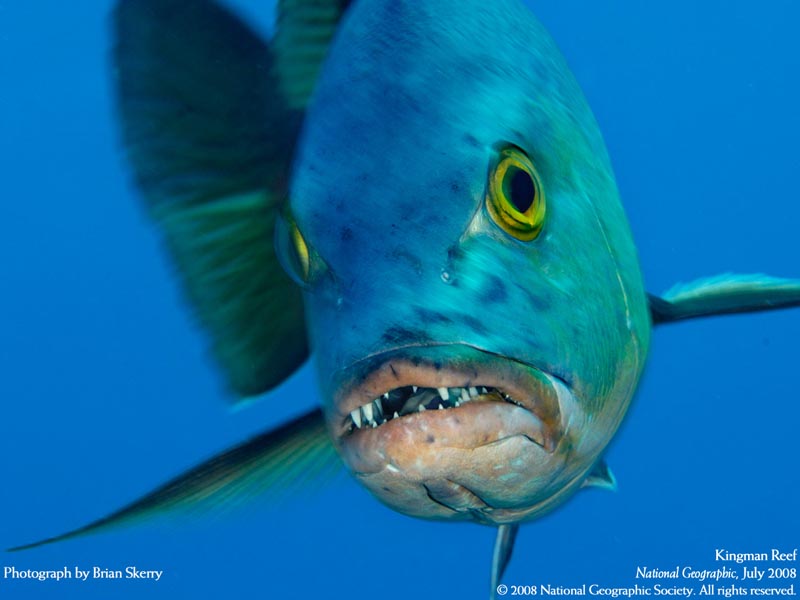
red snapper -- reef fish w teethBy Stephen Leahy

UXBRIDGE, Canada, Oct 9 (IPS)

Without action on climate change “The collapse of fisheries in much of the world would be a sideshow,” Daniel Pauly.

Fish catches are expected to decline dramatically in the world’s tropical regions because of climate change, but may increase in the north, said a new study published Thursday.

This mega-shift in ocean productivity from south to north over the next three to four decades will leave those most reliant on fish for both food and income high and dry.

“The shift is already happening, we’ve been measuring it for the last 20 years,” said Daniel Pauly, a renowned fisheries expert at the University of British Columbia (UBC).

“Major shifts in fish populations will create a host of changes in ocean ecosystems likely resulting in species loss and problems for the people who now catch them,” Pauly told IPS.

In the first major study to examine the effects of climate change on ocean fisheries, a team of researchers from UBC and Princeton University discovered that catch potential will fall 40 percent in the tropics and may increase 30 to 70 percent in high latitude regions, affecting ocean food supply throughout the world by 2055.

The study, published in the journal Global Change Biology, examined the impacts of rising ocean temperatures, changes in salinity and currents resulting from a warming climate. Continue reading

+4 Degrees C By 2060? Alarming But Not Alarmist

07_00_01_News_Panonoramica

By Stephen Leahy

UXBRIDGE, Canada, Oct 9, 2009 (IPS)

The prospect of a four-degree Celsius rise in global average temperatures in 50 years is alarming – but not alarmist, climate scientists now believe.

Eighteen months ago, no one dared imagine humanity pushing the climate beyond an additional two degrees C of heating, but rising carbon emissions and inability to agree on cuts has meant science must now consider the previously unthinkable.

“Two degrees C is already gone as a target,” said Chris West of the University of Oxford’s UK Climate Impacts Programme.

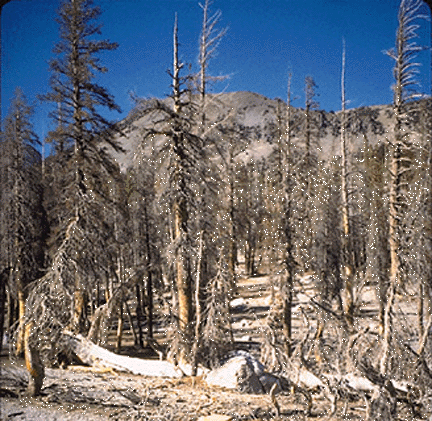
“Four degrees C is definitely possible…This is the biggest challenge in our history,” West told participants at the “4 Degrees and Beyond, International Climate Science Conference” at the University of Oxford last DeadTrees CO2 release naturalweek.

A four-degree C overall increase means a world where temperatures will be two degrees warmer in some places, 12 degrees and more in others, making them uninhabitable.

It is a world with a one- to two-metre sea level rise by 2100, leaving hundreds of millions homeless. This will head to 12 metres in the coming centuries as the Greenland and Western Antarctic ice sheets melt, according to papers presented at the conference in Oxford.

Four degrees of warming would be hotter than any time in the last 30 million years, and it could happen as soon as 2060 to 2070.

“Political reality must be grounded in physical reality or it’s completely useless,” John Schellnhuber, director of the Potsdam Institute for Climate Impact Research, told the conference.

Schellnhuber recently briefed U.S. officials from the Barack Obama administration, but he says they chided him that his findings were “not grounded in political reality” and that “the [U.S.] Senate will never agree to this”.

He had told them that the U.S. must reduce its emissions from its current 20 tonnes of carbon per person average to zero tonnes per person by 2020 to have an even chance of stabilising the climate around two degrees C.

China’s emissions must peak by 2020 and then go to zero by 2035 based on the current science, he added.

“Policymakers who agreed to a two-degree C goal at the G20 summit easily fool themselves about what emission cuts are needed,” Schellnhuber said.

Even with a two-degree rise, most of the world’s coral reefs will be lost, large portions of the ocean will become dead zones, mountain glaciers will largely vanish and many other ecosystems will be at risk, Schellnhuber warned. And there is the risk of reaching a tipping point where the warming rapidly accelerates. Continue reading

Lavish US Lobbying Pushes Nuclear Energy — Taxpayers on the hook for 360 billion to 1.6 trillion dollars (again)

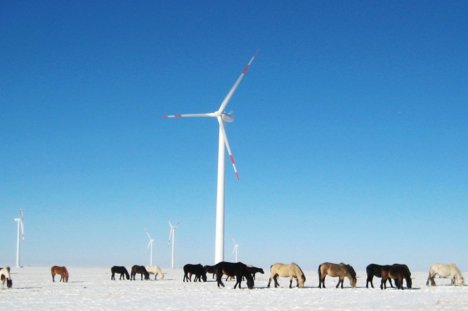
windmill winter poniesBy Stephen Leahy*

BERLIN, Jul 31 (IPS)

Climate change and the resulting need for low-carbon energy sources is driving the current interest in nuclear energy despite the industry’s near universal legacy of staggering cost-overruns, technical difficulties and dependence on enormous government subsidies.

Government interest in new nuclear energy plants seems far more political than practical or economic in light of the fact that Europe’s latest nuclear plant under construction in Finland is four years behind schedule and 50 to 70 percent over budget.

Any claims that nuclear is a viable low-carbon or clean energy source are negated by its extraordinary costs that have increased at least five-fold in the past decade.

Nuclear energy has always been heavily subsidised by governments around the world,” Ellen Vancko, a nuclear energy analyst at the Union of Concerned Scientists, a U.S.-based non governmental organisation.

Under proposed U.S. legislation to reduce greenhouse gas emissions (Waxman-Markey Energy Bill), billions more dollars are headed the nuclear industry’s way in the form of research and development funding, production tax credits, and 20 billion dollars in loan guarantees.

Added to that a major push by some politicians in the U.S. Senate to dramatically expand government-backed loan guarantees to subsidise the construction of 100 new nuclear plants in the U.S. over the next 20 years, Vancko told IPS.

“The U.S. taxpayer could be on the hook for 360 billion to 1.6 trillion dollars. This potentially is as large or larger than the U.S. financial crisis,” she says. Continue reading

“Europe is going to cook the world’s tropical forests to fight climate change; it’s crazy,” — Millions of Trees Burned for ‘Green Energy’

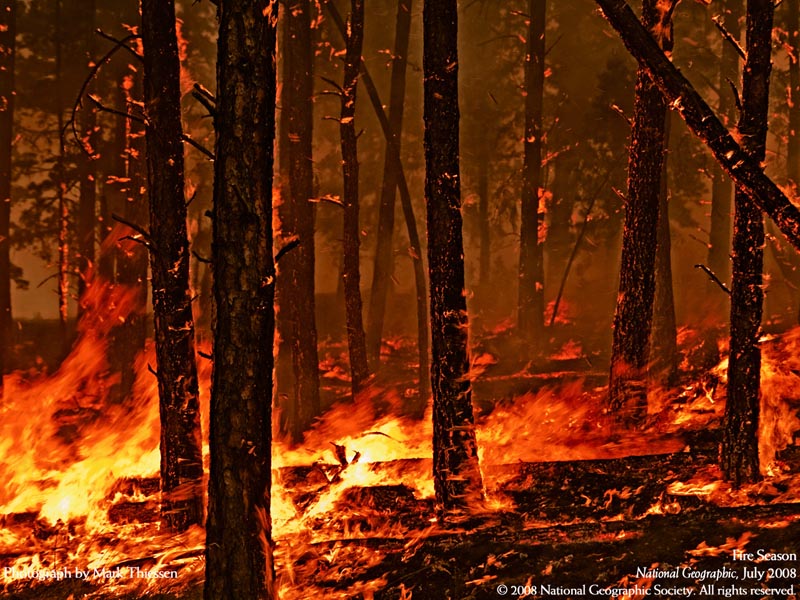
forest fire

Burning trees for energy produces 1.5 times as much carbon as coal – study shows

By Stephen Leahy*

UXBRIDGE, Canada, Sep 24 ’09 (Tierramérica)

Millions of trees, especially from the developing countries of the South, are being shipped to Europe and burned in giant furnaces to meet “green energy” requirements that are supposed to combat climate change.

In the last two months alone, energy companies in Britain have announced the construction of at least six new biomass power generation plants to produce 1,200 megawatts of energy, primarily from burning woodchips.

At least another 1,200 megawatts of wood-fired energy plants, including the world’s largest, in Port Talbot, Wales, are already under construction.

Those energy plants will burn 20 to 30 million tonnes of wood annually, nearly all imported from other regions and equivalent to at least one million hectares of forest.

“Europe is going to cook the world’s tropical forests to fight climate change; it’s crazy,” Simone Lovera, of the non-governmental Global Forest Coalition, which has a southern office in Asunción, Paraguay, told Tierramérica.

This independent environmental journalism depends on public support. Click here learn more.

Europe has committed to reducing its carbon emissions 20 percent by 2020 in an effort to fight climate change. Biofuels and biomass energy will have key roles in achieving those goals, experts say.

Continue reading

Carbon Emissions Can Be Reduced 80% by 2020 – Lester Brown has a plan and he’s not crazy

LesterBrown smlStephen Leahy interviews LESTER BROWN, founder of the Earth Policy Institute

UXBRIDGE, Canada, Oct 7 2009 (IPS)

Lester Brown says his views sometimes appear extreme – because the mainstream media largely doesn’t understand the urgency and challenges in avoiding catastrophic climate change.

The founder and president of the Washington-based Earth Policy Institute, he is also considered by many to be one of the world’s most influential thinkers.

“It looks like I’m a radical because the mainstream media aren’t reflecting the reality of our situation,” Brown says.

A farmer from the eastern U.S. state of New Jersey, Brown entered the U.S. Civil Service in the 1960s, becoming an expert on foreign agricultural policy before leaving to found the Worldwatch Institute in 1974.

The winner of many awards and honourary degrees, Brown is the author of 50 books. In 2001, he founded the Earth Policy Institute to provide a roadmap for achieving an environmentally sustainable economy.

His most recent book is “Plan B 4.0: Mobilizing to Save Civilization”, the fourth and perhaps most urgent version of the Plan B series, available for download at the institutes’s website. In Plan 4.0, Brown calls for carbon emissions cuts of 80 percent by 2020.

“We cannot afford to let the planet get much hotter,” he explains simply. Continue reading

G8 Failure to Launch on Potential Climate Catastrophe

SN851128.JPG

Analysis by Stephen Leahy

BERLIN, Jul 13 (IPS)

The G8’s failure to make meaningful commitments on climate last week pushes the world ever closer to global climate catastrophe, experts warn. Without commitments to take action, there is little comfort in G8 countries’ agreement to keep overall global warming below 2.0 degrees Celsius.

“If they took the 2.0-degree commitment seriously, it would imply a vigourous and immediate carbon emission reduction programme, said Michael Oppenheimer, a professor of Geosciences and International Affairs at Princeton University in the U.S.

“It would mean carbon emissions would have to peak by 2020 and decline. That’s a tall order but that’s what needs to happen to stabilise at around 2.0 degrees C,” Oppenheimer told IPS.

The Group of Eight of the world’s largest economies comprises Britain, France, Germany, Italy, Russia, Canada, Japan and the United States.

Climate experts stress that 2.0 degrees is not in any way a guarantee of safety. There are already significant impacts currently from climate change. However, from what scientists know today, risks increase markedly over 2.0 degrees of warming, Oppenheimer warned.

Global temperatures have already risen 0.8 C in the last hundred years and will reach 1.2 to 1.5 C based on emissions already in the atmosphere.

“The climate system is unpredictable. Two degrees is just a guideline,” Oppenheimer said. Continue reading

Food Supply In Deep Trouble – Agriculture Most Vulnerable to Climate Change

veg food basketBy Stephen Leahy

UXBRIDGE, Canada, Oct 2 (IPS)

Rocketing food prices and hundreds of millions more starving people will be part of humanity’s grim future without concerted action on climate change and new investments in agriculture, experts reported this week.

The current devastating drought in East Africa, where millions of people are on the brink of starvation, is a window on our future, suggests a new study looking at the impacts of climate change.

“Twenty-five million more children will be malnourished in 2050 due to effects of climate change,” such as decreased crop yields, crop failures and higher food prices, concluded the International Food Policy Research Institute (IFPRI) study.

“Of all human economic activities, agriculture is by far the most vulnerable to climate change,” warned the report’s author, Gerald Nelson, an agricultural economist with IFPRI, a Washington-based group focused on global hunger and poverty issues.

The report, “Quantifying the Costs of Agricultural Adaptation to Climate Change“, may be the “most comprehensive assessment of the impact of climate change on agriculture to date”, as IFPRI claims, but researchers concede that there is no current way to quantify all of the future repercussions of changing weather patterns on the food supply.

A critical component of agriculture is knowing the best time to plant seeds, for example. Farmers rely on their past experience and weather records. But one of the most robust science findings is that climate change has and will produce significant increases in weather variability.

This means extremes like droughts or floods will happen more often or last longer, and extreme temperature shifts are more likely. The past is no longer a reliable guide for farmers because the fundamental conditions in the atmosphere have been altered – far more heat is being trapped in the atmosphere today because of carbon dioxide and other greenhouse gases than at any time since the dawn of agriculture.

Nelson told IPS that the IFPRI report is a “conservative estimate” of the potential impacts and does not include impacts of pests and disease, loss of farmland due to rising sea levels or loss of water from melting glaciers. Continue reading