High Seas Represent $148 Billion Carbon Sink But Overfishing is Destroying It

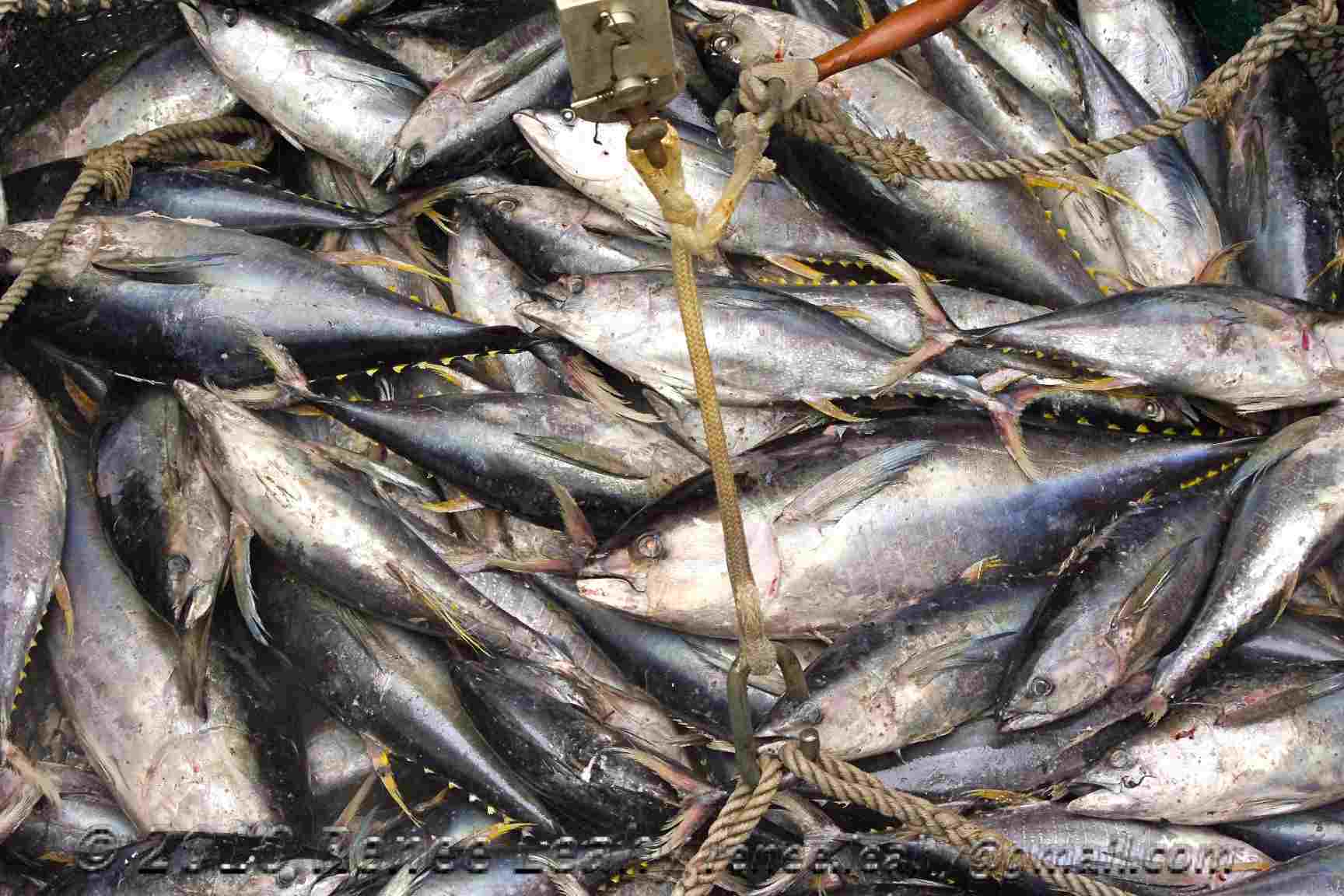
Tuna from the Spanish Purse Seiner

By STEPHEN LEAHY

Stephen Leahy's picture


Scientists estimate that phytoplankton absorb and bury more than 1.6 billion tonnes of CO2 in the seabed every year.

This would be news to readers of Canada’s Globe and Mail newspaper’s detailed two-page spread on the Global Ocean Commission report, which failed to mention this vitally important carbon reduction service (or that it is worth an estimated $148 billion a year).

Additionally, if governments ended fishing in the unclaimed oceans beyond 200-mile economic zones, near-shore fish catches would soar, even more carbon would be safely removed from the atmosphere and the oceans would be healthier said co-author of the study Rashid Sumaila of the University of British Columbia’s Fisheries Centre.

The high seas are like a failed state. Poor governance and the absence of policing and management mean valuable resources are unprotected or being squandered,” said David Miliband, co-chair of the commission and former foreign secretary of the United Kingdom.

The dollar value of all the fish caught in high seas is actually negative

Governments like Japan, Spain, the U.S. and China subsidize fishing fleets to destroy the high seas by overfishing and deep-sea bottom trawling to the tune of $152 million a year.

Here’s the kicker: The dollar value of all the fish caught way out there is actually negative when costs like fuel and subsidies are subtracted. Turns out high seas fishing fleets get 25 per cent of their income from subsidies according to a 2009 analysis by Sumaila.

Most would not be fishing the high seas without subsidies” Sumaila told DeSmog Canada.

Restoring ocean productivity

Fishing should be banned in the high seas, which represent 64 per cent of the world’s oceans just to protect and enhance its role as a carbon sponge, he said. But that is just one of 14 other valuable services the high seas provide humanity according their study, The High Seas And Us: Understanding The Value Of High Seas Ecosystems.

The study was commissioned by the Global Ocean Commission, an 18-month-old organization comprised of business leaders and former senior politicians including former Canadian prime minister Paul Martin.

The commission is calling for the negotiation of a new agreement under the UN Convention on the Law of the Sea to prioritize ocean health and resilience and restore ocean productivity. It also called for an elimination of subsidies on high seas fishing within five years.

The commission’s proposals also call for mandatory tracking of all vessels fishing in the high seas, a ban on the transshipment of fish at sea, measures to end plastics pollution and binding standards for the regulation and control of offshore oil and gas exploration and exploitation.

Carbon really does sink

Phytoplankton are the carbon-eating plants of the seas and pass on this carbon when they’re eaten. When organisms die in the deep seas, their organic matter ends up on the bottom of the ocean, which makes for an effective, natural carbon sequestration process.

Fishing is crippling this free carbon-removal system. This is especially true for bottom-trawlers that bulldoze the sea floor scooping up every living thing. Trawling is by far the most common fishing method and recent studies warn it’s destroying corals and the sea bottom leading to “long-term biological desertification.”

Last May, scientists writing in the journal Science called for an end to “the frontier mentality of exploitation” of the high seas and recommended a ban on trawling to protect the carbon-removal service and halt the decline in the productivity of the oceans. The amount of wild fish caught peaked 20 years ago.

About 70 per cent of fish caught inside the 200-mile limits spend some time in the high seas. If the high seas are protected those fish are likely to grow larger and become more numerous, benefitting near-shore fisheries, Sumaila said.

A number of studies of marine protected zones where fishing is banned or very limited show these areas act as baby-fish incubators increasing the overall population of fish.

If fishing was banned in the high seas, fisheries profits would more than double, the amount of fish would increase 30 per cent and the amount of ocean fish stock conservation would increase 150 per cent according to a study published in PLOS Biology last March.

Given the reality that fishing the high seas is a money loser, even a low carbon price could make a fishing ban valuable, not to mention the other potential benefits of regulating international fisheries. Sumaila said the $148 billion-a-year value of the high seas carbon sponge is a conservative estimate, and it could actually be as high as $222 billion.

Fishing and trawling bans have been proposed before. Last December the European parliament narrowly rejected a bottom-trawling ban on its vessels.

We need wide public understanding of the vital importance of the high seas to all of us,” concluded Sumaila.

Top 10 High Seas Fishing Nations (according to Sumaila’s study) in descending order:
Japan
South Korea
Taiwan
Spain
USA
Chile
China
Indonesia
Philippines
France
First published by DeSmog Canada Wed, 2014-06-25 10:01

Global Experts Call for Moratorium New Tarsands Development Until Climate, Environmental Impacts Assessed

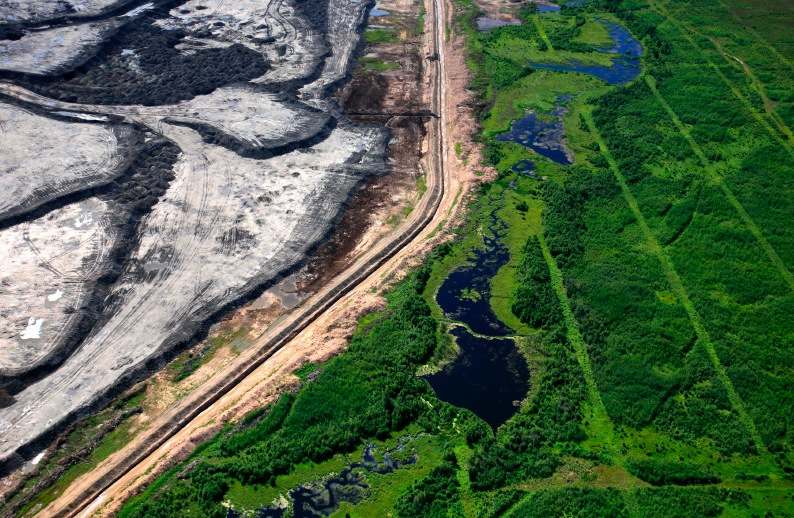
Canada's tar sands projects visible from space
Canada’s tar sands projects visible from space

By STEPHEN LEAHY  Stephen Leahy's picture

A moratorium on any new oilsands expansion is imperative given Canada’s failure to properly assess the total environmental and climate impacts Canadian and U.S. experts say in the prestigious science journal Nature.

Even with a moratorium it will be very difficult for Canada to meet its international promise to reduce CO2 emissions that are overheating the planet according to government documents as previously reported by DeSmog.

Continuing to approve pipelines and new projects guarantees Canada will not meet the Harper government’s Copenhagen emissions reduction target,” said Wendy Palen, an ecologist at Simon Fraser University.

These are the plain facts Canadians need to be aware of,” Palen, a co-author of the Naturecommentary, told DeSmog.

Canadians also have no idea of the overall ‘big picture’ of the impacts of oilsands production and transport because each project is assessed in isolation.

In total more than 280 square kilometres of boreal forest and peatlands have already been eliminated to make way for oilsands development. That amounts to an area more than twice the size of the City of Vancouver.

According to a 2012 study the destruction of this region of the boreal forest – a natural carbon sink –released about 100,000 tonnes of CO2 that had been safely stored underground. And it also meant the end of the region’s ability to absorb some 58,000 tonnes of CO2 every year. Over a 20-year time span that’s 1,161,000 tonnes of CO2 that stays in the atmosphere – close to half the annual emissions of the City of Vancouver.

This does not include CO2 emissions from developing oilsands projects themselves nor the emissions from burning millions of barrels of oil produced there each year.

This piecemeal approach is like determining the risk of cigarette smoking by only looking at the potential harm from smoking one cigarette, environmental economist Mark Jaccard said.

As critics have pointed out during recent pipeline review processes, regulators like the National Energy Board do not consider the climate impacts of pipelines and oilsands projects. It’s considered ‘out of bounds’ Jaccard, another coauthor of the report, said.  Each project is presented as an ultimatum: approve the project or lose an economic opportunity, he said.

This approach artificially restricts discussion to only a fraction of the consequences of oil development,” Jaccard and 7 co-authors argued in the report. The authors represent an interdisciplinary group of experts in environmental science, economics, policy development and decision science.

What Canada and the U.S. need is a “more coherent approach” to evaluate all oilsands projects and pipelines in the “context of broader, integrated energy and climate strategies.”

But first Canada and the U.S. need to impose an immediate halt to new oilsands developments and related pipeline construction, the authors write. (The U.S. is considering developing its own oilsands in Utah and elsewhere). Then the two countries can jointly develop a strategy that allows energy developments to proceed only if they are within environmental limits and respect other national commitments to human health, social justice and biodiversity protection.

However this strategy would need a formal, legislated acknowledgement of the reality that oilsands development impacts the climate. It also should create either a carbon tax or cap-and-trade mechanism to ensure the oil industry absorbs “the full social costs of carbon combustion.”

Finally this strategy should assess the full range of potential impacts compared to alternatives. And it should include the options of saying ‘no’ to a project.

Former Secretary of State Hillary Clinton said Canada and the U.S. need to co-ordinate their climate policies in an interview on the CBC’s The National last week. She acknowledged we need to get beyond project-by-project approvals.

With new regulations on power plants, the U.S. may be on its way to meeting its Copenhagen emission reduction target, which is identical to Canada’s.

While Prime Minister Harper “clearly doesn’t care about climate change,“ Jaccard told DeSmog,  President Obama does and could make approval of the Keystone XL pipeline contingent on Canada meeting its 2020 target.

Economists around the world now agree the costs of carbon pollution far outweigh the benefits,” Jaccard said.

First published by DeSmog Blog Canada Thu, 2014-06-26 12:19


Treehugger Interview with Your Water Footprint Author Stephen Leahy

Screen Shot 2014-11-23 at 11.06.18 AM

Why care about your water footprint?


"Your water footprint" by Stephen Leahy

© “Your water footprint” by Stephen Leahy. Groundwater comes from aquifers that take thousands of years to fill. Globally, aquifers are being drained faster than then can refill.

Margaret Badore (@mbadore) Science / Clean Water

November 18, 2014

We learn in elementary school that water is in a constant cycle of evaporation and precipitation, making our crops grow and flowing from rivers into oceans. While the amount of water on Earth remains fairly stable, its distribution around the globe is changing, and this change is being accelerated by human activities.

A new book, “Your Water Footprint,” by environmental reporter Stephen Leahy, takes a close look at the “virtual water” that surrounds us in everyday life. This isn’t just the water we use to boil pasta or take a shower, it’s the water that’s used to grow our coffee beans and power the local energy plant. As the demand for this kind of water increases, the more threatened our access to fresh water becomes. At the same time, pollution makes vast amounts of water unusable.

I had the opportunity to catch up with Leahy over Skype.

TreeHugger: What were your goals for writing this book?

Stephen Leahy: To help people understand this other aspect of water that we use, that we don’t see. This virtual water concept: the water it takes to make things, the water it takes to grow our food, to make our products, to make our clothing. This is that unseen water that we don’t think about, and because we don’t see it, we’re not really aware of it.

It’s an enormous amount of water that we end up consuming every day without realizing it.

Continue reading

Canada Leading ‘Deforestation Nation’ In Race to Destroy Planet’s Last Wilderness Areas

Canada's tar sands projects visible from space
Canada’s tar sands projects visible from space

Forest Loss Results in Massive Emissions of CO2

UXBRIDGE, Canada, Sep 5 2014 (IPS) 

The world’s last remaining forest wilderness is rapidly being lost – and much of this is taking place in Canada, not in Brazil or Indonesia where deforestation has so far made the headlines.

A new satellite study reveals that since 2000 more than 104 million hectares of forests – an area three times the size of Germany – have been destroyed or degraded.

Since 2000 more than 104 million hectares of forests – an area three times the size of Germany – have been destroyed or degraded.


“Every four seconds, an area of the size of a football (soccer) field is lost,” said Christoph Thies of Greenpeace International.

The extent of this forest loss, which is clearly visible in satellite images taken in 2000 and 2013, is “absolutely appalling” and has a global impact, Thies told IPS, because forests play a crucial in regulating the climate.


The current level of deforestation is putting more CO2 into the atmosphere than all the world’s cars, trucks, ships and planes together, he said, adding that “governments must take urgent action” to protect intact forests by creating more protected areas, strengthening the rights of forest communities and other measures, including convincing lumber, furniture manufacturers and others to refuse to use products from virgin forests.

Greenpeace is one of several partners in the Intact Forest Landscapes initiative, along with the University of Maryland, World Resources Institute and WWF-Russia among others, that uses satellite imagery technology to determine the location and extent of the world’s last large undisturbed forests.

The new study found that half of forest loss from deforestation and degradation occurred in just three countries: Canada, Russia and Brazil. These countries are also home to about 65 percent of world’s remaining forest wilderness.

However, despite all the media attention on deforestation in the Amazon forest and the forests of Indonesia, it is Canada that has been leading the world in forest loss since 2000, accounting for 21 percent of global forest loss. By contrast, the much-better known deforestation in Indonesia has accounted for only four percent.

Brazil's Amazon forest - 2013. Credit_Courtesy of Global Forest Watch

Massive increases in oil sands and shale gas developments, as well as logging and road building, are the major cause of Canada’s forest loss, said Peter Lee of Global Forest Watch Canada, an independent Canadian NGO.

A big increase in forest fires is another cause of forest loss. Climate change has rapidly warmed northern Canada, drying out the boreal forests and bogs and making them more vulnerable to fires.

In Canada’s northern Alberta’s oil sands region, more than 12.5 million hectares of forest have been crisscrossed by roads, pipelines, power transmission lines and other infrastructure, Lee told IPS.

Canada’s oil sands and shale gas developments are expected to double and possibly triple in the next decade and “there’s little interest at the federal or provincial political level in conserving intact forest landscapes,” Lee added.

The world’s last remaining large undisturbed forests are where most of the planet’s remaining wild animals, birds, plants and other species live, Nigel Sizer, Global Director of the Forest Programme at the World Resources Institute, told a press conference.

Animals like Siberian tigers, orangutans and woodland caribou require large areas of forest wilderness, Sizer noted, and “losing these top species leads to a decline of entire forest ecosystems in subtle ways that are hard to measure.”

While forests can re-grow, this takes many decades, and in northern forests more than 100 years. However, if species go extinct or there are too few individuals left, it will take longer for a full forest ecosystem to recover – if ever.

In just 13 years, South America’s Paraguay converted an incredible 78 percent of its remaining forest wilderness mainly into large-scale soybean farms and rough pasture, the study found. Satellite images and maps on the new Global Forest Watch website offer see-it-with-your-own eyes images of Paraguay’s forests vanishing over time.

The images and data collected for the study are accessible via various tools on the website. They reveal that 25 percent of Europe’s largest remaining forest, located 900 km north of Moscow, has been chopped down to feed industrial logging operations. In the Congo, home of the world’s second largest tropical forest, 17 percent has been lost to logging, mining and road building. The Global Forest Watch website also shows details of huge areas of Congo forest licensed for future logging.

Deforestation starts with road building, often linked to logging and extractive industries, said Thies. In some countries, like Brazil and Paraguay, the prime reason is conversion to large-scale agriculture, usually for crops that will be exported.

The new data could help companies with sustainability commitments in determining which areas to avoid when sourcing commodities like timber, palm oil, beef and soy. Market-led efforts need to gain further support given the lax governance and enforcement in many of these forest regions, Thies said.

He called on the Forest Stewardship Council (FSC) – a voluntary certification programme that sets standards for forest management – to “also play a stronger role” and to improve those standards in order to better protect wilderness forests.

Without urgent action to curb deforestation, it is doubtful that any large-scale wild forest will remain by the end of this century, concluded Sizer.

First published on IPS

We Have Five Years to Stop Building Coal Plants and Gas-Powered Cars

Measurement of CO2 levels in atmosphere

By Stephen Leahy

[Authors note: One of the most difficult and important articles I’ve written in 20 years of environmental journalism. Originally published Sept 6 2014 @Vice Motherboard]


Here’s the frightening implication of a landmark study on CO2 emissions:

By 2018, no new cars, homes, schools, factories, or electrical power plants should be built anywhere in the world, ever again, unless they’re either replacements for old ones or carbon neutral. Otherwise greenhouse gas emissions will push global warming past 2˚C of temperature rise worldwide, threatening the survival of many people currently living on the planet.

Every climate expert will tell you we’re on a tight carbon budget as it is—that only so many tons of carbon dioxide (CO2) can be pumped into the atmosphere before the global climate will overheat. We’ve already warmed temperatures 0.85˚C from pre-industrial levels, and the number rises every year. While no one thinks 2˚ C is safeper se, it’s safer than going even higher and running the risk that global warming will spiral out of our control completely.

Last year, the latest Intergovernmental Panel on Climate Change (IPCC) report established a global carbon budget for the first time. It essentially stated that starting in 2014, the carbon we can afford is up to around 1,000 billion tons of CO2. In other words, our cars, factories, and power plants can only emit 1,000 billion tons (1,000 Gt, or gigatons) of CO2 into the atmosphere if we want to have a greater than 50/50 chance of keeping our climate below 2˚C of warming.

Even considering that humanity pumped 36 gigatons of CO2 into the atmosphere last year alone, 1,000 Gt still seems like a big budget. It might even seem like we have room to spare.

Maybe not.

WORLDWIDE, WE’VE BUILT MORE COAL-BURNING POWER PLANTS IN THE PAST DECADE THAN IN ANY PREVIOUS DECADE

New research shows that we may not have been paying attention to the entire CO2 emissions picture. We’ve only been counting annual emissions, and not the fact that building a new coal or gas power plant is in reality a commitment to pumping out CO2 for the lifespan of a given plant—which usually ranges from 40 to 60 years. These future emissions are known as a carbon commitment.

A new study has tallied the carbon commitments from all existing coal and gas power plants by looking at their annual CO2 emissions and current age. The study assumes an operating life of 40 years. A 38-year old coal plant will have far smaller future CO2 emissions, and thus smaller carbon commitment than one built today. The study, “Commitment accounting of CO2 emissions,” determined that most new power plants that went online in 2012 have a very large carbon commitment—19 Gt of CO2.

Building new power plants means more carbon commitments to eat into our 2˚C carbon budget. Build enough giant coal plants today, and their future emissions would tie up the entire budget, leaving no room for any other source of CO2 emissions.

Meanwhile, the rate at which new plants are built far outpaces the closure of old plants. Many US coal plants operate for longer than 40 years; the oldest is currently around 70 years.

“Worldwide, we’ve built more coal-burning power plants in the past decade than in any previous decade, and closures of old plants aren’t keeping pace with this expansion,” said study co-author Steven Davis of the University of California, Irvine.

Image: Flickr

Fossil Fuels Power Plant Carbon Commitment: 300 Gt

In the study, Davis and co-author Robert Socolow of Princeton University calculated that the existing coal and gas power plant carbon commitment turns out to be very large—more than 300 Gt.

Non-Power Plant Carbon Commitment: 400 Gt 

The reality of carbon commitment applies to any new fossil-fuel burning infrastructure, including office buildings and homes using gas heating or automobiles and planes burning jet fuel. All of these have an operating life of several or many years during which they will emit CO2 from now until they are ‘retired.’ These future emissions also count as a carbon commitment. In another upcoming study, Davis calculated the carbon commitments from other CO2 sources, including from the transport, industry, commercial and residential sectors. He estimates that as of 2013 this carbon commitment exceeded 400 Gt.

Together with the power plant commitment of 300 Gt laid out in the current study, that’s more than 700 Gt in carbon commitments on a global carbon budget of 1000 Gt. That leaves less than 300 Gt for future power plants, steel mills, cement plants, buildings, and other stuff that burns fossil fuels.

At current rates we’ll have accounted for the remainder of the budget in only five years.

Here’s how it breaks down:

Estimated Annual Emissions 2014-2018: 200 Gt

Global CO2 emissions from all sources amounted to 36 Gt in 2013. Annual emissions have been growing at a rate of 2 to 3 percent per year. Without major efforts to reduce emissions, another 200 gigatons of CO2 will be emitted between 2014 and 2018.

Estimated New Carbon Commitments 2014-2018: 100 Gt

Davis and Socolow determined that carbon commitments from new fossil fuel burning infrastructure will average at least 20 Gt per year, totaling 100 Gt over five years.

300 + 400 +200 +100 = 1,000 Gigatons of Carbon, Locked in by 2018

Unless coal and gas power plants or other major sources of CO2 are shut down before the end of their life span, the 1,000 Gt global carbon budget will be fully allocated sometime in 2018. No one will notice, because things won’t look or feel too much different than today. CO2 is akin to a slow, trans-generational poison. The climate impacts of blowing the carbon budget won’t be felt until 2030 or 2040 —and for a long time after.

WE’VE BEEN HIDING WHAT’S GOING ON FROM OURSELVES: A HIGH-CARBON FUTURE IS BEING LOCKED IN BY THE WORLD’S CAPITAL INVESTMENTS

Even the climate experts won’t notice much, because annual CO2 emissions have been the sole focus of countries and the United Nations process to address climate change said Davis.

“That’s like driving down the highway and only looking out of the side window,” Davis told me.

Politicians, business leaders, investors, planners, bureaucrats and whole lot of other people should be looking out the front window and paying attention to the hard reality of carbon commitments. If Davis and Socolow’s calculations are correct, it means no new coal or gas power plants can go online after 2018 unless they’re replacing retired plants. It means freezing the size of the global automobile fleet, and the industrial and commercial sectors, unless their energy efficiency increases. And so on.

The fact that much of our current and future infrastructure carries huge carbon commitments is blindingly obvious, but receives little attention.

Can’t solve a problem by making it worse

“If you build it, there will be emissions year after year. This should be a fundamental part of the decision to build most things,”” Davis said.

Ignoring the reality of carbon commitments means we’re investing heavily in technologies that make the problem worse, he said.

“We’ve been hiding what’s going on from ourselves: A high-carbon future is being locked in by the world’s capital investments,” said co-author Robert Socolow. Any plan or strategy to cut CO2 emissions has to give far greater prominence to those investments. Right now the data shows “we’re embracing fossil fuels more than ever,” Socolow told me.

So what can we do to begin to prepare for a jam-packed carbon budget? First, we need to stop building fossil fuel-reliant power plants.

Surprisingly, it appears the Australia is a pioneer here, despite recently rolling back its pioneering carbon tax. Thanks to wide-spread adoption of solar energy on homes and business the country’s electricity use is in steep decline. For the first time in its history, no new coal or gas power capacity will be needed to maintain supply over the next 10 years, according to the Australian Energy Market Operator. Germany too is rapidly adopting clean energy sources like wind and solar, so as to avoid building coal or nuclear power.

Next, we need to think about meeting energy demand by improving efficiency, instead of building more power generation.

Potential energy efficiency gains of 50 percent are possible across many sectors in most countries, Socolow said, and could reduce the number of fossil fuel energy power plants.

The US is the king of energy waste by most estimates. This costs Americans an estimated $130 billion a year, according to the Alliance to Save Energy. But despite the potential for huge cost and emission reductions, governments everywhere put nearly all their energy research efforts into new sources of energy like new power plants rather than helping to develop energy-efficient cars, buildingsm and appliances. It’s 2012 international study also found that improving energy efficiency provides by far the best bang-for-the-buck for energy security, improved air quality, reduced environmental and social impacts and carbon emission reductions.

However, efficiency improvements take time, and there is precious little time left to make the CO2 emissions cuts to stay below 2˚C, said Socolow.

While refusing to say a planet that’s 2˚C hotter is inevitable, he did say that all efforts to reduce emissions must be undertaken as soon as possible: “3˚C is a whole lot better than 5˚C, the current path we’re on.”

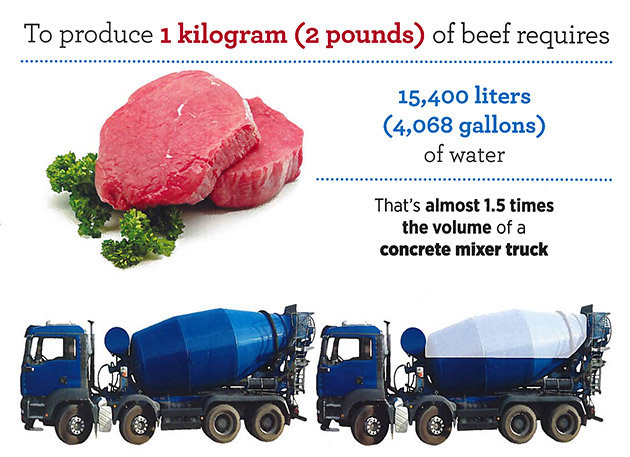
My breakfast took 1100 litres (290 gal) of water to make – how much was yours?

meat sample

( Graphic from  ‘Your Water Footprint’) 

I have a confession: I used 1100 litres of water to make my breakfast today. It was nothing special, just a small glass of orange juice, a cup of coffee, two eggs, toast and two pieces of bacon. But it did take 1100 litres of water to grow and process the ingredients. Thats a whole lot of water considering the average bathtub only holds about 80 litres.

Even after 20 years of covering environmental issues in two dozen countries I had no idea of the incredible amounts of water needed to grow food or make things. Now, after two years working on my book Your Water Footprint Im still amazed the T-shirt Im wearing needed a whopping 2500 litres to grow and process the cotton. Or that 140 litres was needed to grow and process the coffee beans to make my morning coffee. Since a litre of water weighs a kilogram, thats 140 kilos of water, imagine having to haul that much in a bucket every morning!

Your Water Footprint wins Lane Anderson award as best Canadian Science book for general public

Water more valuable and useful than oil

Researching all of this I soon realized were literally surrounded by a hidden world of water. Although we cant see it, there is water in everything we eat, everything we use and buy. Almost anything you can think of – cars, furniture, books, dishes, TVs, highways, buildings, jewelry, toys and even electricity would not exist without water.

Its no exaggeration to say water is far more valuable and useful than oil.

Unfortunately, water is often taken for granted and undervalued, resulting widespread misuse and waste. The idea behind my book is to increase awareness of huge quantities of the hidden water our entire way of life depends on. Your Water Footprint uses colourful infographics to illustrate the size of the water footprints of a wide range things from shoes to whiskey. A water footprint is the amount of water consumed’ to make, grow or produce something. I use the word consumed to make it clear this is water that can no longer be used for anything else. Water can often be cleaned or reused, so those amounts of water are not included in the water footprints in the book.

For example, when you drink a half-litre of bottle water youre actually consuming 5.5. litres. Why so much? Making the plastic bottle consumed 5 litres of water.

After poring through many studies on water footprints, I was really surprised to see how tiny my direct use of water for drinking, cooking, showers and so on was by comparison. Each day the average North American uses 300 to 400 litres. (FYI: Flushing toilets is the biggest water daily use, not showers.) Now, 400 litres is not a trivial amount of water, and we can all get by using less by employing some water-savings tips.


How big is your water footprint? Take a quick test


However, compared to the hidden water, also known as virtual water, thats in the things we eat, wear and use for a day averages an incredible 7500 litres. That means our daily water footprint is almost 8,000 litres (direct + hidden freshwater use). Carrying all this water would be like trying to haul the weight of four mid-size cars every day.

Peak water is here

Water scarcity is a reality in much of the world. About 1.2 billion people live in areas with chronic scarcity, while two billion are affected by shortages every year. That’s two in seven people. And as the ongoing drought in California proves, water scarcity is increasing reality for many of us in the US and Canada. Water experts estimate that by 2025, three in five people may be living with water shortages.

While low-flow shower heads and toilets are great water savers, the water footprint concept can lead to even bigger reductions in water consumption. If a family of four replaced beef with chicken in all their meals, they would reduce their water use an astonishing 900,000 litres a year. That’s enough to fill an Olympic-sized pool to a depth of two feet. The reason is the water footprint of beef is four times larger than chicken.

Vegetables have an even smaller water footprint. If the average family liked the idea of “Meatless Mondays,” they’d save 400,000 litres of water a year.

My hope with Your Water Footprint is to give you enough information to make water-wise choices to reduce your water use which will help you save money, be prepared for shortages and ensure our children and grandchildren will have abundant fresh water. This is all about smart substitutions and changes, rather than sacrifice and self-denial.

To do this we need to know how much we are currently using. We can’t make the water-wise choices unless we begin to see and understand the invisible ways in which we rely on water.

Stephen Leahy is an award-winning environmental journalist based in Uxbridge, Ontario, Canada. He is the author ofYour Water Footprint: The Shocking Facts About How Much Water We Use to Make Everyday Products.

(First published Yahoo Canada News – Mon, 8 Sep, 2014)

Your Water Footprint: The Shocking Facts About How Much Water We Use to Make Everyday Products 

Only $19.95 paperback; 160 pages, 125 unique infographics,

also available as Kindle and in other ebook formats

In US:  AmazonPowell’s Books; Barnes&NobleIndiebound

Canada:  Chapters-Indigo Signed copies avail at Blue Heron Books – Stephen’s home town bookstore; In Ottawa visit the legendary Octopus Books

UK:  WH SmithAmazonWaterstones

Australia: Angus & RobertsonBooktopia

New Zealand: Mighty Ape

Carbon Life: Bacteria to President Barack Obama

EarthsCarbonConcentrations_black_low

Life survives miles below the Earth’s surface

By Stephen Leahy

UXBRIDGE, Canada, Mar 5 2013 (IPS)

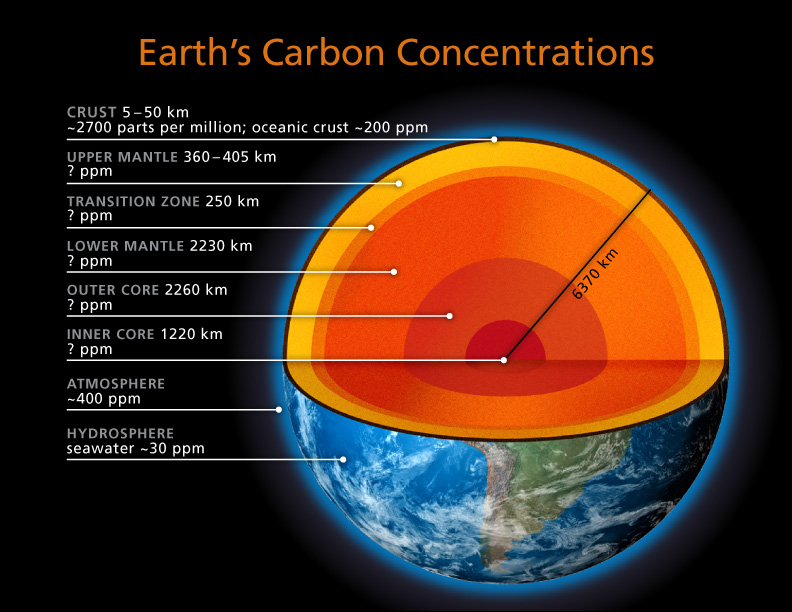
Every living thing from bacteria to President Barack Obama is made of carbon from exploding stars.

Billions of years ago, motes of carbon and other stardust formed the Earth. Carbon is the basis of all life but most vanished deep inside the planet, researchers now believe. And surprisingly, life thrives inside the rocky layers kilometres below our feet.

“Microbes survive by eating rock at those depths,” said Robert Hazen, executive director of the , a decade-long, global collaboration investigating the inner workings of the planet.

“Life is very different under those tremendous pressures and temperatures,” Hazen told IPS.

The variety of bacterial life at extreme high-pressure depths worldwide constitutes a subterranean “Galapagos”, he said. There may be as much as half of all life in the ground deep below us, according to one estimate, although Hazen thinks that might be too high.

“Drill a hole one or two kilometres deep just about anywhere and you will find a sparse but hardy microbial community,” said Isabelle Daniel of l’Université Claude Bernard in Lyon, France.

“These deep microbes, which live in the tiniest cracks and fissures in rocks, survive on the chemical energy of minerals,” said Daniel, who is one hundreds of scientists involved in the Deep Carbon Observatory (DCO).

DNA analysis reveals a diversity of microorganisms, mainly single-celled. However, deep below the ocean floor live fungi-like organisms with complex cell structures. Researchers estimate that these are extraordinarily long-living organisms, conceivably living for millions of years.

“There are also a huge numbers of viruses, their DNA carefully inserted into living cells,” said Hazen.

Continue reading

Help Wanted: 27 Planet Earths

This story was featured on the IPS wire and on the Al Jazeera network in 2011. It shows that national parks, conservation and protected areas do not and cannot halt the decline in biodiversity that is humanity’s life support system. It is hopeless without addressing the root causes: too many of us, taking too much and having too big of an impact. On our present course we’ll need 27 planet Earths by 2050 experts conclude. — Stephen 

By Stephen Leahy

UXBRIDGE, Canada, Jul 29, 2011 (IPS)

Protecting bits of nature here and there will not prevent humanity from losing our life support system. Even if areas dedicated to conserving plants, animals, and other species that provide Earth’s life support system increased tenfold, it would not be enough without dealing with the big issues of the 21st century: population, overconsumption and inefficient resource use.

Without dealing with those big issues, humanity will need 27 planet Earths by 2050, a new study estimates.

The size and number of protected areas on land and sea has increased dramatically since the 1980s, now totaling over 100,000 in number and covering 17 million square kilometres of land and two million square kilometres of oceans, a new study reported Thursday.

This independent environmental journalism depends on public support. Click here learn more.

But impressive as those numbers look, all indicators reveal species going extinct faster than ever before, despite all the additions of new parks, reserves and other conservation measures, according to the studypublished in the journal Marine Ecology Progress Series.

“It is amazing to me that we haven’t dealt with this failure of protected areas to slow biodiversity losses,” said lead author Camilo Mora of University of Hawaii at Manoa.

“We were surprised the evidence from the past 30 years was so clear,” Mora told IPS. Continue reading

Governments Fail to Take Steps to Steer Away From Looming Crisis

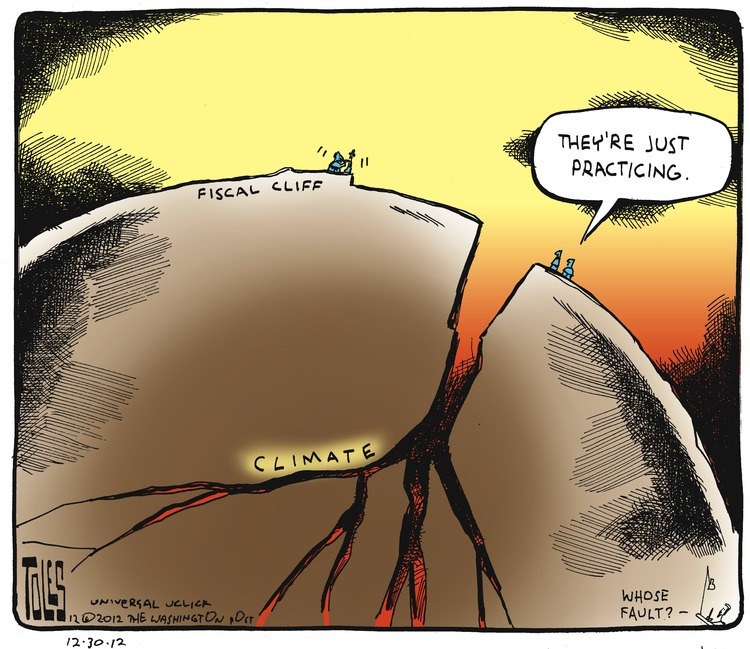
ttfiscal carbon cliff

Rio+20 should have been about life, about the future of our children”

By Stephen Leahy

RIO DE JANEIRO, Jun 19 2012 (IPS)

“Very disappointing.” That was the term business and non-governmental organisations used to describe the formal intergovernmental negotiations at the Rio+20 Earth Summit as of Tuesday.

With overwhelming scientific evidence showing that the Earth’s ability to support human life is at serious risk, the Rio+20 summit is being held to help chart a safe course that will steer away from disaster and bring a better future people around the globe.

After two years, negotiators from more than 190 nations agreed Tuesday to a 49-page draft of the document “The Future We Want”, intended to be the roadmap for this transformation. This document will be presented to heads of states in Rio de Janeiro to revise and finalise by the summit’s conclusion on Friday.

Yet the draft document leaves out a 30-billion-dollar fund proposed by a group of developing countries known as the G77 to finance the transition to a green economy. Nor does it define tangible Sustainable Development Goals (SDGs), which will be substituted for the Millennium Development Goals, which expire in 2015.

“This (the revised text) is extremely disappointing….There is no vision, no money and really no commitments here,” said Lasse Gustavsson, head of the Rio+20 delegation from WWF International, which works to stop environmental degradation worldwide.

Rio+20 should have been about life, about the future of our children, of our grandchildren. It should have been about forest, rivers, lakes, oceans that we are all depending on for our food, water and energy security,” Gustavsson told TerraViva.

Instead, two years of work have resulted in merely a long document that commits to virtually nothing but more meetings, he said.Rio+20 logo

“This document is a great disappointment. There’s no ambition and little reference to the planetary boundaries we face,” said Kiara Worth, representing the U.N.’s Major Group on Children and Youth at Rio+20.

“The voices of civil society and future generations is going unheard. We ought to call this Rio minus 20 because we are going backwards,” Worth told TerraViva. Continue reading

“We Should be Shaking in Our Boots” – UN Environment Official

Construction of the Trans-Amazonian Highway, Brazil -- sml Photo by Hans Silvester

Earth’s Ability to Support Us At Risk – An Indictment of Governments We Elected

By Stephen Leahy

RIO DE JANEIRO, Jun 19 2012 (IPS)

The science is crystal clear: humans are threatening Earth’s ability to support mankind, and a new world economy is urgently needed to prevent irreversible decline, said scientists and other experts at an event on the sidelines of the Rio+20 Earth Summit.

Yet the Global Environment Outlook report, or GEO 5, which was launched on June 6 and assessed 90 of the most important environmental objectives, found that significant progress had been made only in four in the 20 years since the first landmark summit in Rio in 1992.

Achim Steiner, the executive director of the United Nations Environment Programme (UNEP) said the results of GEO 5 were “depressing, even to me”.

“This ought to have us shaking in our boots,” Steiner told TerraViva at the Fair Ideas conference that concluded Sunday. ”It is an indictment of our behaviour over the past 20 years and of the governments we elected. We need an honest conversation about why we are not turning things around.”rio banner sml

Instead, “what’s happening right now in the RioCentro (Rio+20 official site) is that science is being picked out of the text of the final agreement,” Johan Rockström, executive director of the Stockholm Resilience Centre in Sweden, told the conference.

Rockström said he had received updates from the negotiations that the United States and some of the world’s least developed countries were attacking the science showing humanity is pushing up against “planetary boundaries”.

Climate is only one of those “planetary boundaries”. Another is the ongoing decline of biodiversity, where so many plants and animals are going extinct that the Earth’s living systems, upon which humanity depends, are unravelling. Fresh water is another planetary boundary. Water is a limited resource, yet water use has increased six-fold in the past century.

“The science is absolutely clear: we are up against the edges of the planet’s ability to support us and approaching irreversible tipping points,” Rockström said. Continue reading