Common Pollutant as Bad as PCBs?

“They’re crumbling out of couches…”

Blast from the past:  my previously published article on topic that’s back on front pages – Stephen

By Stephen Leahy

Wired News May 22 2004

Scientists reported this week that gull eggs in the Great Lakes region contain rising levels of a contaminant that could be as dangerous as the PCBs banned in the 1970s.

The contaminant, called polybrominated diphenyl ethers, or PBDEs, is used mainly as a flame retardant in upholstered furniture, computers, TVs, carpets and drapes.

While concentrations of the chemical have been shooting upward, doubling approximately every three years since the early 1980s, scientists have yet to investigate the environmental risks the substance poses.

Ross Norstrom, an adjunct chemistry professor at Carleton University in Ottawa, told the Toronto Globe and Mail that, “There is no reason to believe that these things will be any different than the PCBs.”

High levels of PBDEs are also being found in household dust, two new studies report this week. “PBDEs are everywhere,” said Bill Walker of the Environmental Working Group, a nonprofit research group in Washington, D.C., that conducted one of the studies.

“They’re crumbling out of couches and migrating out of plastics and TVs and getting into people’s blood and women’s breast milk,” Walker said in an interview. PBDEs are also being detected in just about every animal and fish around the world.

Lab research on animals shows PBDEs disrupt thyroid hormones, which can impact the developing brain and have other harmful effects. Newborn mice exposed to PBDEs have learning and motor-skill problems, and at least one form of the chemical is carcinogenic.

European countries have banned two of the three main forms of PBDEs, and U.S. manufacturers are also taking them off the market by year’s end. New research shows that the most heavily used remaining form, called “deca,” breaks down into one of the more toxic forms and ought to be banned as well, Walker said.

Many computer and electronics manufacturers such as IBM, Apple Computer and Toshiba are ahead of the curve and eliminating PBDEs from their products. “It also makes good economic sense because other countries are banning them too,” said Walker.

New Projects Dispel Myths and Spread the Truth About Vaccines

By Stephen Leahy

UXBRIDGE, Canada, May 3, 2012 (IPS)

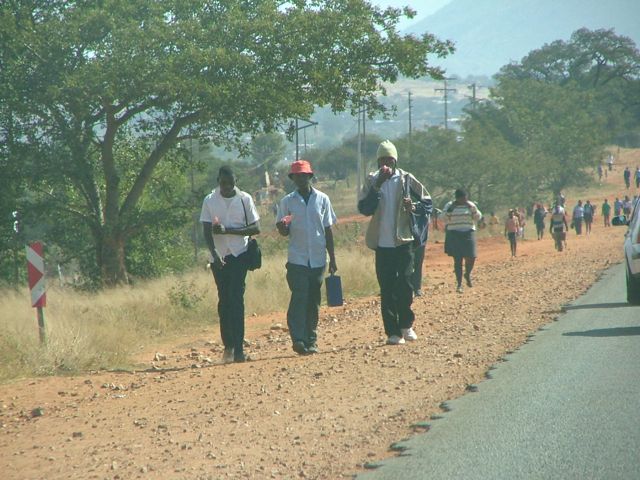
In northern Pakistan, one in ten children dies before the age of five from diseases such as polio, measles or hepatitis, despite the availability of vaccines. And while health workers feared visiting this region, which includes the mountainous Swat district controlled by the Taliban until 2009, local people also fear the potentially life-saving vaccines.

“Some local imams (religious leaders) have been preaching that vaccines are an attempt by the U.S. government to sterilise children,” said Erfaan Hussein Babak, director of The Awakening project, which aims to promote vaccinations in the Swat district.

“The child mortality rate from preventable diseases is distressingly high,” Babak told IPS by phone from the region.

Some people in the region understand that vaccines are safe, but overall, there is little demand by parents for vaccinations, he said. To counter certain negative perceptions, The Awakening project is working to promote child vaccination by establishing village health committees, school clubs and radio programs.

The project is being funded by the Canada-based Sandra Rotman Centre as one of five projects awarded 10,000 U.S. dollars to educate populations in developing countries about the use of vaccines and immunisation to prevent diseases.

Combating myth

By 2004, polio had nearly been eradicated in Pakistan. However, the disease has seen a resurgence in the northern areas, in part due to the mistaken belief that the oral vaccine could render children impotent or sterile.  Continue reading

Global Warming to Ignite the Carbon Bomb in Northern Forests

Anaktuvuk River peat fire 2007

“In a warmer world, there will be more fire”

Fires already burn an area larger than India every year.

By Stephen Leahy

VANCOUVER, Feb 29, 2012 (IPS)

Rising temperatures are drying out northern forests and peatlands, producing bigger and more intense fires. And this will only get much worse as the planet heats up from the use of ever larger amounts of fossil fuels, scientists warned last week at the end of the major science meeting in Vancouver.

“In a warmer world, there will be more fire. That’s a virtual certainty,” said Mike Flannigan, a forest researcher at the University of Alberta, Canada.

“I’d say a doubling or even tripling of fire events is a conservative estimate,” Flannigan told IPS.

While Flannigan’s research reveals forest fire risk may triple in future, a similar increase in peat fires will be far more dangerous. There are millions of square kilometres of tundra and peatlands in the northern hemisphere and they hold more than enough carbon to ramp up global temperatures high enough to render most of the planet uninhabitable if they burn.

A forest fire in Indonesia that ignited peatlands in 1997 smouldered for months, releasing the equivalent of 20 to 40 percent of the worldwide fossil fuel emissions for the entire year, he said.

“There is the potential for significant releases of carbon and other greenhouse gases (from future peat fires),” Flannigan said.

If peat fires release large amounts of carbon, then temperatures will rise faster and higher, leading to further drying of forests and peat, and increasing the likelihood of fires in what is called a positive feedback, he said.

When the increased fire from global warming was first detected in 2006, Johann Goldammer of the Global Fire Monitoring Center at Germany’s Freiburg University called the northern forest a “carbon bomb”. 

“It’s sitting there waiting to be ignited, and there is already ignition going on,” Goldammer said according to media reports in 2006.

Please put something in the tip jar before reading on.
This is how I make my living.

Continue reading

Canada’s Harper Government Guts Environment, Science and Monitoring Programs

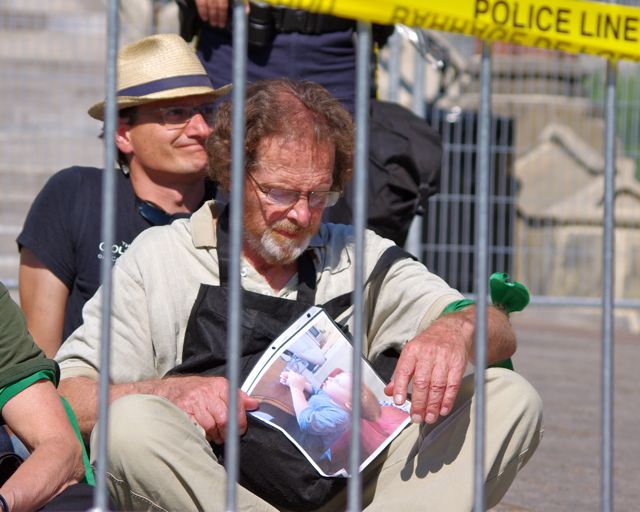
Man w picture of grandchild was arrested for protesting against tar sands expansion, Sept 2011 Ottawa, Canada - Pix by R Leahy

Environment budget slashed while PM Harper’s office places a gag order on government scientists. (And a $60 billion order for military equipment)

By Stephen Leahy

UXBRIDGE, Canada, Nov 9, 2011 (IPS)

Canada’s Stephen Harper government is spending more than 60 billion dollars on new military jets and warships while slashing more than 200 million dollars in funding for research and monitoring of the environment.

Amongst the programmes now crippled is Canada’s internationally renowned ozone monitoring network, which was instrumental in the discovery of the first-ever ozone hole over Canada last spring. Loss of ozone has been previously linked to increases in skin cancer.

“The proposed cuts go so far the network won’t be able to do serious science,” said Thomas Duck, an atmospheric scientist at Halifax’s Dalhousie University.

Canada was the pioneer in ozone monitoring, developing the first accurate ozone measuring tool that led to the discovery that the world’s ozone layer was dangerously thinning in the 1970s, which in turn led to the successful Montreal Protocol on Ozone Depleting Substances.

Canada has about one-third of the ozone monitoring stations in the Arctic region. It also hosts the world archive of ozone data, which is heavily relied on by scientists around the world.

“There’s only one guy running the entire archive, and he’s received a lay-off notice letter,” Duck told IPS.

Ozone monitoring and research is part of Environment Canada, the government department charged with protecting the environment, conservation and providing weather and meteorological information.

“Canada can’t afford to pay scientists but we can line the pockets of big oil?

That is totally backwards.”

Continue reading

Cars Biggest Killer of Children; 2nd for Adults

Update March 2013: Changes in legislation are urgently needed to reduce traffic deaths, and especially among the most vulnerable, says Global Status Report on Road Safety 2013: Supporting a Decade of Action, published by the World Health Organization (WHO) and including data on the Americas gathered by the Pan American Health Organization (PAHO).  See also Fact sheets on road safety in the Americas — Stephen


More than 16,000 people killed or injured on roads EVERY day

Health costs $500 billion ++

By Stephen Leahy

LEIPZIG, Germany, May 31, 2011 (IPS)

The leading killer of children over the age of five is not malaria or dysentery, but cars and trucks. And ninety percent of those children are killed on roads in developing countries.

Each day, 3,500 people are killed and 13,700 injured in road accidents around the world. That death and injury toll is expected to increase by nearly 50 percent over the next decade without serious efforts to improve road safety, says Etienne Krug, director of the Department of Violence and Injury Prevention and Disability at the World Health Organization (WHO).

Krug was here in Leipzig to the launch of the United Nations the Decade of Action for Road Safety at the Organisation for Economic Cooperation and Development’s annual International Transport Forum. The goal for the U.N. Decade is to stabilise the spiralling increase in death and injuries on the world’s roads.

“We have the potential to save five million of lives over the next decade through changes in road safety,” Krug told IPS.

“A cultural shift is needed to create the awareness of the need for road safety,” he said.


Around 90 percent of all road fatalities occur in emerging and developing countries, making it the sixth leading cause of death in those countries. The lack of road safety laws and enforcement combined with increasing vehicle usage and population growth are the major reasons for this, said Krug.

This independent environmental journalism depends on public support. Click here learn more.

Only 15 percent of countries in the world have good legislation on drinking and driving or use of helmets when driving scooters and motorcycles. “We want to push that to 50 percent by the 2020,” he said.

Legislation and enforcement can make a huge difference. Vietnam enacted a helmet law two years ago and the use of helmets went from only 20 percent to over 90 percent, he said. Brazil recently enacted strict drinking and driving laws, while Mexico has made wearing seatbelts mandatory.

“Much more of this is needed,” he said.
Continue reading

Hundreds of Millions May Soon Be Fleeing the Floodwaters

More than 5 million affected by flooding in Pakistan Sept 2011 - a repeat of 2010.

Climate disruption shrinking areas where people can live.

Mexico faces $10 billion in storm/flood damage to roads, schools, clinics, etc every year

By Stephen Leahy

OSLO, Jun 9, 2011 (IPS)

Mass migration will inevitably be part of human adaptation to climate change, experts agree, since parts of the world will become uninhabitable in the coming decades.

Last year, 38 million people were displaced by climate-related disasters such as the flooding in Pakistan and China.

“Human displacement due to climate change is happening now. There is no need to debate it,” Jonas Gahr Støre, Norway’s minister of foreign affairs, told over 200 delegates attending the Nansen Conference on Climate Change and Displacement in the 21st Century in Oslo Jun. 6-7.

Governments and the humanitarian community need to understand this fact – and that it will get much worse in the coming decades, Støre said.

This independent environmental journalism depends on public support. Click here learn more.

Without major emissions reductions, climate change could get far worse than anyone is prepared to think about.

“It may be more realistic to consider four degrees C of warming rather than two degrees C,” suggested Harald Dovland, former head of the Norwegian Delegation to the United Nations climate change negotiations.

The world has already warmed 0.8C and will rise to least 1.6 C even if all emissions of carbon and other greenhouse gases ended today, James Hansen, head of NASA’s Goddard Institute for Space Studies, told the conference.

A four-degree C warmer world is a very different planet and risks runaway climate change. Even two degrees C is not safe, Hansen said. 

“The last time the planet was two degrees C warmer was during the Pliocene (five to 2.4 million years ago) and sea levels were 25 metres higher,” he said. “If we burn all the fossil fuels (coal, oil, natural gas) we’re creating conditions that future generations will be unable to cope with.”

Even though a four-degree C warmer world “is choosing the suicidal path”, experts must avoid fuelling xenophobia with predictions of mass migrations and conflicts, says Francois Gemenne, research fellow at the Institute for Sustainable Development and International Relations in Paris.

“This also feeds into a security agenda of panic and paranoia,” Gemenne said.

At least 20 percent of humanity will be at high risk of severe flooding due to sea level rise and extreme rainfall events in the coming decades.

“Too many people live in low-lying deltas and other parts of the world that are becoming too dangerous to live in,” said Gemenne. They will be forced to move and often this movement will be permanent.

Rather than building walls and barriers, countries and the international community need to encourage people to move to safer ground. “Lift the barriers so that people can use migration to adapt to climate change,” he urged delegates.  Continue reading

Costs for Nuclear Energy Skyrocket While Cost of Renewables Plummet

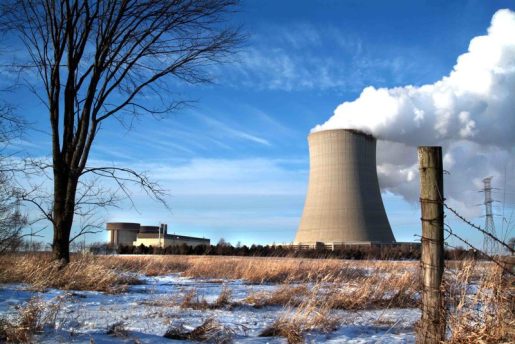
Darlington Nuclear Plant on Lake Ontario

[This is a repost about the financial costs and risks of nuclear technology (written before the Fukushima I Nuclear Power Plant disaster).   If a country is going to spend $10 billion to generate energy and reduce carbon emissions what technology truly offers the best return on a full cost-accounting basis? The latter calculation is not simple or uncontroversial. Two years ago Canada balked at the costs of new nuclear plants now it plans to build some without knowing the price tag.  — Stephen ]

By Stephen Leahy*

BERLIN, Jul 31, 2009 (IPS)

With costs of nuclear energy skyrocketing while the costs of renewables are falling quickly why is nuclear energy back on the table?

One reason is a powerful U.S. lobby where 14 energy companies spent 48 million dollars in 2007 alone to convince American politicians to give the industry huge loan guarantees because they cannot get financing anywhere else, says Ellen Vancko, a nuclear energy analyst at the Union of Concerned Scientists, a U.S.-based non governmental organisation (NGO).

This lavish lobbying effort by the energy and nuclear power sector has been ongoing since the mid-1990s, according to the Center for Responsive Politics, a U.S. NGO and now totals at least 953 million dollars.

Even more has been spent to convince the public that nuclear is one of the keys to energy security so that there is significant public support for new reactors, a Gallup Environment Poll reported this year.

“There are lots of senators and members of congress talking about nuclear as a clean, renewable energy resource,” Vancko says.

The other reason is the French.

France gets about 77 percent of its power from 58 reactors and is often cited as the model for other countries. “France is a special case. The entire industry is 85 percent owned by the government,” says Mycle Schneider, a Paris-based energy and nuclear policy analyst.

The industry gets direct and indirect subsidies, government loans and loan guarantees “on practically anything they want”, Schneider told IPS.

And despite a well-polished reputation for efficiency and low-cost, the French nuclear industry has been plagued by cost-overruns, equipment failures, and relatively low levels of reliability. Even though French reactors are all of similar design, the cost to build a plant in 1998 was 3.5 times higher than the first plants built in 1974, says Steve Thomas, professor of energy policy at the University of Greenwich in the U.K.

Unlike wind or solar energy or virtually any other technology, the costs of nuclear go up over time rather than down even in pro-nuclear France, he said. “I think that is rather telling about the technology,” Thomas told IPS.

The current Finnish nuclear experience echoes the industry’s long history.

Backed byFrench government loan guarantees, Areva, the French government-owned nuclear energy company began construction in 2005 on what is supposed to be the world’s largest and safest nuclear plant at Olkiluoto, Finland.

Plagued by thousands of construction and design problems it is currently 2 to 3 billion dollars over budget and three to four years behind schedule.

“It’s a total disaster for Areva,” Schneider says. Areva will have to sell another 12 reactors to cover the cost overruns thus far or else French taxpayers will, he said.

“The hype around a nuclear power revival or renaissance was based on nothing and is effectively dead.”

Last month Canada backed out of ordering two 1,200-megawatt reactors because cost estimates of 10,000 dollars/kW were three times higher than expected. [update Feb 2011 – Ontario now holding hearings to spend $33 billion to build two new reactors and upgrade others and bans offshore wind!]

However there is real danger that the nuclear industry will continue to promote itself as a ‘silver-bullet’ solution to climate change and give politicians the kind of mega-projects that gets them publicity, warns Schneider.

Equally important is that corporate shareholders of large utility companies can do very well financially on such projects when governments guarantee to cover any losses.

“The worst thing about new nuclear is that it steals billions of public dollars from other more effective things like energy efficiency,” he says.

(Second of two part series)

-30-

Part one:

Lobbyists Push for Nuclear Energy and put Taxpayers on the hook for 360 billion to 1.6 trillion dollars (again)

Injecting Drug Use Spreads HIV in Eastern Europe

By Stephen Leahy

LIVERPOOL, Apr 29, 2010 (IPS)

Poor intervention in Injecting drug use (IDU) is driving the HIV/AIDS epidemic in Eastern Europe and is also largely responsible for the tuberculosis epidemic in parts of Russia, says a new study.

Shockingly, a mere three US cents a day per injecting drug user are being invested to prevent the spread of HIV/AIDS and TB, according to the study released at the opening of the Harm Reduction 2010 conference this week in this English port city.

“Our report shows that just 160 million US dollars a year are being used in total for all the harm reduction programmes to prevent the spread of HIV around the world,” says Gerry Stimson, executive director of the International Harm Reduction Association.

Harm reduction involves providing access to the drug methadone, needle exchange services, and counselling. “Barack Obama’s presidential inauguration cost at least that much,” Stimson, emeritus professor at the Imperial College, London, told IPS in an interview.

In Russia there are an estimated 1.6 million IDUs of which 60 to 70 percent have HIV-related illnesses. In the past decade the number of HIV-infected people increased tenfold from an estimated 100,000 to one million, he said.

“Three cents a day is a terrifying figure and equally terrifying are the HIV infection rates amongst IDUs in parts of Eastern Europe and Asia.

See rest of story here:  HEALTH: Injecting Drug Use Spreads HIV in Eastern Europe 

Former Presidents Denounce Drug War As Failure

By Stephen Leahy

BERLIN, Jul 14, 2010 (IPS)

The failed “war on drugs” has not only badly damaged countries where it is waged, it is responsible for driving up HIV infection rates in some countries, says an official declaration endorsed Wednesday by three former Latin American presidents in advance of the XVIII International AIDS Conference that begins Jul. 18 in Vienna.

In Eastern Europe and Central Asia, injecting drug use is the primary cause of new HIV infections. Outside of sub- Saharan Africa, injecting drug use accounts for approximately one in three new cases of HIV, experts will report at the week-long meeting.

“The war on drugs has failed…Instead of sticking to failed policies with disastrous consequences, we must direct our efforts to the reduction of consumption and the reduction of the harm caused by drugs to people and society,” said former Brazilian president Fernando Henrique Cardoso.

“Repressive policies are firmly rooted in prejudices, fears and ideological visions. The way forward to safeguard human rights, security and health is a strategy of peace not war,” said Cardoso.

This independent environmental journalism depends on public support. Click here learn more.


Cardoso, along with former presidents Ernesto Zedillo of México and César Gaviria of Colombia, have endorsed the Vienna Declaration that lists a range of harms stemming from the war on drugs, and notes that the criminalisation of people who use drugs has resulted in record high incarceration rates, placing a massive burden on taxpayers.

Continue reading

In Corrupt Global Food System, Farmland Is the New Gold and Africans the New Share-croppers

$ Billions Made Speculating on Food

“Africans have become share-croppers, exporting coffee, cotton, flowers and now food while going hungry”

By Stephen Leahy

UXBRIDGE, Canada, Jan 13, 2011 (IPS)

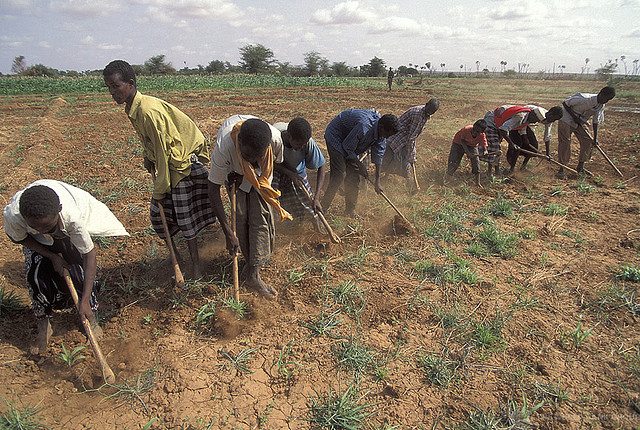
Famine-hollowed farmers watch trucks loaded with grain grown on their ancestral lands heading for the nearest port, destined to fill richer bellies in foreign lands. This scene has become all too common since the 2008 food crisis.

[This is the first of a multi-part series investigating what is driving food prices higher]

Food prices are even higher now in many countries, sparking another cycle of hunger riots in the Middle East and South Asia last weekend. While bad weather gets the blame for rising prices, the instant price hikes of recent times are largely due to market speculation in a corrupt global food system.

The 2008 food crisis awoke much of the world’s investment community to the profitable reality that hungry people will do almost anything, even sell their own children, in order to eat. And with the global financial crisis, food and farmland became the “new gold” for some of the biggest investors, experts agree.

In 2010, wheat futures rose 47 percent, U.S. corn was up more than 50 percent, and soybeans rose 34 percent.

This independent environmental journalism depends on public support. Click here learn more.

On Wednesday, U.S.-based Cargill, the world’s largest agricultural commodities trader, announced a tripling of profits. The firm generated 1.49 billion dollars in three months between September and November 2010.

Meanwhile, U.S. Treasury Bills pay a return of less than one percent. Continue reading