Stunning Satellite Pix of SuperCyclone Yasi on Landfall (and video)

Taken by MTSAT on February 2nd, 2pm (click for larger view)

The newly operational MTSAT-2 images from February 2nd are particularly striking. The images, showing the coldest clouds as white, reveal the extent of swirling white cloud and the deep eye of the storm which is clearly visible just off the coast of Northern Australia. — University of Leicester

My full posting of Yasi including graphs and pixs Will Super Cyclone Yasi be Australia’s Katrina?

Click to see amazing video of the approach of the cyclone on YouTube

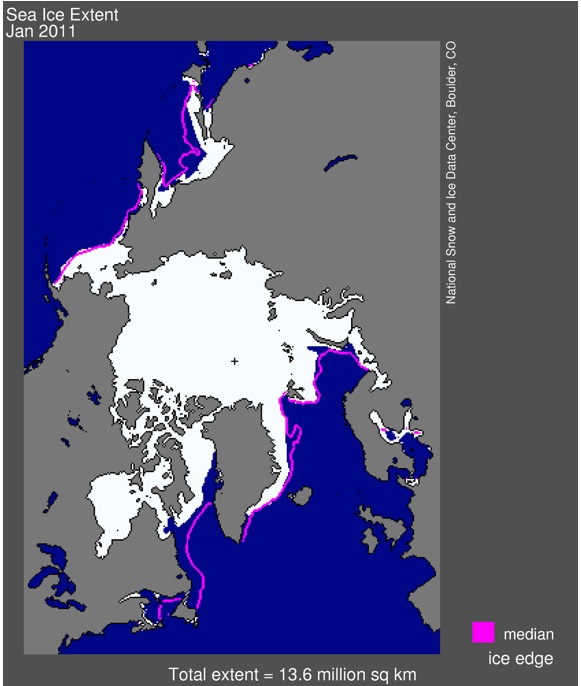
Arctic Hits Bottom – Lowest Jan Sea Ice Cover Ever*

1.27 million square kilometers below avg


The National Snow and Ice Data Center reported wednesday that the Arctic sea-ice extent averaged just 13.55 million square kilometers, the lowest January ice extent since satellite records began in 1979 (*and likely the lowest in thousands of years– SL). That’s a whopping 1.27 million square kilometers below the 1979 to 2000 average.

No surprise given the absurdly warm Arctic temperatures of +21C above normal in Dec/Jan.

I’ve written about why this is happening and the consequences several times in recent weeks:

Arctic Defrost Dumping Snow on U.S. and Europe

Arctic Melt Down Is Bringing Harder Winters and Permanently Altering Weather Patterns

East Coast Blizzard and Europe’s Snowmaggddon Reveal Fingerprints of Climate Change

The Arctic summer’s sea ice melt will likely be another record low pushing the world to an ice-free Arctic one summer in the new future. FYI weather-related records will continue to fall faster than dominos without drastic cuts to our fossil fuel emissions. And frankly I’m tired of writing about it. — Stephen

Bounce the Bottle – Back to the Tap: The Campus Ban On Bottled Water

“Queen’s University became the tenth Canadian post-secondary institute to commit to end the sale and distribution of bottled water on campus, sending the industry a clear message that campuses are backing the tap,” says Water Access Group Member Professor Steven Moore.

Students, staff and faculty are … asking college and university administrations to instead promote investment in accessible public water infrastructure, says press release.

For more visit Inside the Bottle – has great video: “The Story of Bottled Water” – Stephen

My previous post explains why getting rid of plastic water bottles are important for our health and environment (and water tastes much better in steel or glass).

The New Campus Cool: Water Fountains for Drinking – Uni bans bottled water

Watch the Earth Begin to Burn. 1884-2010 Global Temperatures — NASA Animation


Global Temperature Anomalies averaged from 2000 to 2004

NASA has made a this striking animation that shows a 130-year history of how global temperatures have become warmer in most parts of the world. The polar regions are warming fastest and quickest as is clearly shown. Here’s the temperature scale and more detailed explanation from NASA follows. — Stephen


Global Temperature Anomalies averaged from 1920 to 1924.

Source: NASA/Goddard Space Flight Center Scientific Visualization Studio

Five-Year Average Global Temperature Anomalies from 1880 to 2010

This analysis concerns only temperature anomalies, not absolute temperature. Temperature anomalies are computed relative to the base period 1951-1980. The reason to work with anomalies, rather than absolute temperature is that absolute temperature varies markedly in short distances, while monthly or annual temperature anomalies are representative of a much larger region. Indeed, we have shown (Hansen and Lebedeff, 1987) that temperature anomalies are strongly correlated out to distances of the order of 1000 km

This color-coded map displays a progression of changing global surface temperatures anomalies from 1880 through 2010. The final frame represents global temperature anomalies averaged from 2006 to 2010.

Now Historic Flooding Hits Southern Australia

[UPDATE 19 Jan – 25 % of state of Victoria underwater]

While flood levels drop in Queensland and Brisbane, Australia’s state of Victoria has now been hit with historic levels of flooding.

A strong La Nina enhanced by global warming seems to be behind the record flooding in Australia, Brazil, Sri Lanka and elsewhere as documented in my earlier article. Part of the reason for the severity of the flooding is that the atmosphere now contains 4 per cent more water vapour as a result of the increased global temperature of roughly 0.8C.

As the planet continues to warm from the burning of fossil fuels floods will get worse, but so will droughts.

Great Barrier Reef Hit Hard By Australian Flooding


Flood caused plankton plume Great Barrier Reef

Australia’s La Niña flooding is unprecedented. At least 20 people have died, with damage and losses estimated in the many billions of dollars.

Much of the flooding is in the northeastern state of Queensland, whose rivers flow into the Coral Sea, and is expected to have a major impact on the nearby Great Barrier Reef.

Enormous amounts of sediments and pollutants are being washed off the land and are likely to have “a huge impact” on the world’s largest coral reef system, said Charlie Veron, former chief scientist at the Australian Institute of Marine Science.

The very strong La Niña is certainly causing the floods, but climate change would seem to be enhancing the effects,” Veron wrote in an email.

See full story on how climate change is worsening the effects of the Na Nina-El Nino (ENSO) cycle.


Emission Reductions Punted to Durban, Breakthrough Seen on Forests

As carbon emissions bend upward Canada’s Harper government singled out as worst at climate talks. Again.

By Stephen Leahy*

CANCÚN, Mexico, Dec 11, 2010 (IPS/TerraViva)

If success is measured by delaying difficult decisions, then the Cancún climate meeting succeeded by deferring crucial issues over financing and new targets to reduce greenhouse gas emissions to the next Conference of the Parties meeting a year from now in Durban, South Africa.

International negotiations to address climate change proceeded at a glacial pace in the palatial, over-air-conditioned Moon Palace Resort in Cancún. After two long weeks, final talks dragged on into the early hours of Saturday morning, with Bolivia’s refusal to accept a weak agreement that puts the world on a path that “could allow global temperatures to increase by more than four degrees”, said Pablo Solón, Bolivia’s chief negotiator.

In the end, Bolivia’s continued objections were drowned out by applause and cheering by more than 190 national delegations as the chair of the meeting, Mexico’s foreign secretary Patricia Espinosa, gaveled the meeting to a close declaring “a consensus without Bolivia”.

“The Cancún text is a hollow and false victory that was imposed without consensus,” Bolivia said in a final statement.

Based on the science, Bolivia is not wrong.

The World Meteorological Organisation declared last week that the decade will close as the hottest 10- year period on record. The 100+ pages that form the “Cancún Agreements” will do nothing to curb greenhouse gas emissions warming the planet, but did revive the U.N. climate negotiation process after its near death in Copenhagen last year.

This article was made possible thanks to contributions from Janos Mate, James Creskey. Extra special thanks to monthly contributors Julie Davis, Aidan Constable, Patricia A Warwick, Judith A Leahy

[Due to the high costs of covering such important events, support is needed from readers like you. Please consider making a small automatic monthly contribution as a fair exchange for these articles – for more information.] Continue reading

Will Year of Climate Extremes End Without Progress on Tackling Climate Change?

By Stephen Leahy*

CANCÚN, Mexico, Nov 29, 2010 (IPS/TerraViva)

This year will likely be the warmest ever recorded, with soaring ocean temperatures resulting in a near record die-off of tropical corals, extreme heat and drought in Russia and massive flooding in Pakistan – all signs that climate change has taken hold.

But despite the ever more compelling science regarding the urgency and risks of climate change and growing public support for action, representatives from nearly 200 countries meeting here in Cancún for the next two weeks are unlikely to produce a new binding agreement.

At best, matters such as forestry, climate finance and mitigation commitments will be further developed in the faint hope that the next big meeting in South Africa might produce some kind of deal.

“Carbon emissions continue to climb despite the economic recession and yet I have never seen such low expectations for a COP (Conference of the Parties),” said Richard Somerville, an eminent climate scientist at the Scripps Institution of Oceanography in California.

“The science is quite compelling regarding the need for urgent action. We don’t have another five years to reach an agreement,” Somerville told TerraViva.

In 2009, Somerville and others co-authored an update on the latest climate science called ‘The Copenhagen Diagnosis’ which concluded that global carbon emissions had to peak and begin to decline before 2020 to have any hope of keeping global warming to less than 2.0 degrees C.

However, the negotiators in Cancún will mostly not be acting on the science but on their national interests as directed by their political leadership, who largely do not understand climate change, he said.

“Developed countries think they can adapt to warmer temperatures. I don’t see how we can keep warming below 2.0 degrees C.,” Somerville said.
Continue reading

A Reporter’s Diary: EXCLUSIVE COVERAGE OF UN CONVENTION ON BIOLOGICAL DIVERSITY FROM NAGOYA, JAPAN

NOTE: The following are excerpts from my personal notes to friends and supporters written during the heat, confusion and massive information dump of a major international conference. Often written late at night I attempted to offer some personal perspective into what was going on and what I was up to. — Stephen

Tuesday, 19 Oct – Geopolitical obstacles getting in the way

I’m here at the big UN conference on biodiversity. It’s 430 am here, the first day ended about 9 pm. It’s 12-ring cat circus like the Copenhagen climate meeting but the mood here is more positive. There are similar geopolitical obstacles getting in the way of slowing the loss of species and ecosystems. Another major difference is the lack of little public awareness of the fact that we cannot continue to shred nature’s web of life without suffering dire consequences.

I’ll try and do my bit – write 10 -12 articles over next two weeks. I wanted to thank a couple of supporters who helped out to cover some of the travel costs. I want to keep you informed of what’s going on here but these notes take a couple of hours to do.

This week is a story about an important development in Africa: In sincere efforts to make one last major attempt to transform Africa’s poverty and hunger are we imposing our worldview on Africa yet again? Bill Gates and others are donating hundreds of millions to create a New Green Revolution for Africa. This difficult and controversial story took over a week to do and wrote the final draft during my 17 hr flight here.

My other story connects the dots between extreme weather this summer and climate change. No single storm is directly attributable to CC BUT without CC it is unlikely the Russian heat wave and floods in Pakistan would have occurred. (PS those were events were two sides of the same coin)

Finally I received a number of letters, mostly positive but a couple saying I was too negative in last week’s article ‘Don’t Worry Be Happy’ Canada Sees Global Warming “Prosperity” Instead of Calamity’. Any organization that puts out a chart of climate impacts at 4 – 5C of global warming and fails to mention the scale of the calamity that would result is delusional or deceptive. Some take the stunningly selfish and naive view we can ‘adapt’ by turning up the AC.

Do consider making a small automatic monthly contribution as a fair exchange for these articles.

Greenest wishes, Steve


Wednesday, 20 Oct – Diversity R Us

There is an astonishing diversity of people here. Last nite I talked to an Amazonian Indian who took 10 days to get here, had wine accidentally spilled on me by a reindeer herder from Finland and found the lost passport of a Brazilian diplomat. And that is a five minute snap shot. It is a very big world with so many different people it is incredible they have all come here to try and address a common issue. That they can’t agree on what kinds of actions and how to implement should not come as a surprise.

Sunday, 24 Oct – Canada won’t play nice (yet again)

Canada is blocking agreement on a key measure to get a new international agreement to protect biodiversity here. This is not new. In recent years Canada has gone out its way to snub international UN agreements including the outright refusal to fulfill its legal obligations under the Kyoto Protocol. Hard to believe the same government lobbied hard for a seat on the UN security council and actually expected to be rewarded.

Sadly there is no one reporting for Canadian publications to document the irony. (And as a result Canadian’s aren’t really aware of what their government is up to.) Continue reading

Reefs and Forests Burn as Climate Disruption Takes Hold NOW


A lot of coral reefs have died this year due to unprecedented ocean heating largely due to climate change. I broke that story last summer. Few coral reefs will survive the next 50 years most experts say without immediate action to reduce greenhouse gas emissions.


Forests are next in line according a new study in PNAS. Huge uncontrollable wildfires will dominate forest landscapes of the near future without dramatic reductions in the burning of fossil fuels the study found.

I would have done a full article explaining all this but simply can’t find a publication willing to pay me to do the work. That’s why I am trying community supported journalism where readers donate small amounts so these articles get done and made available for millions to read.

— Stephen (November 10 2010)