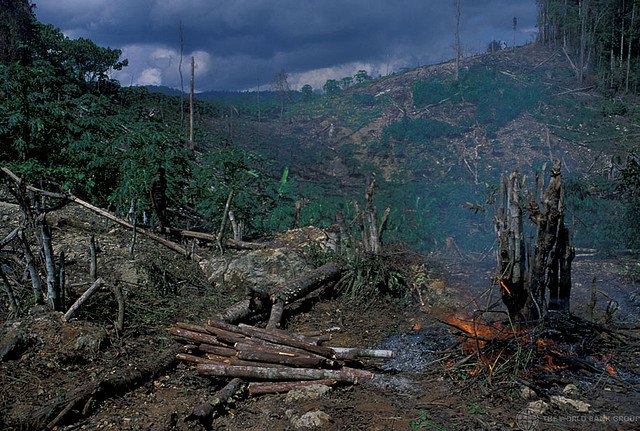
Amazon Drought Accelerating Climate Change

World’s Forests Losing Their Green. Billions of tonnes of CO2 Released

By Stephen Leahy

UXBRIDGE, Canada, Feb 3, 2011 (IPS)

Last year’s severe drought in the Amazon will pump billions of tonnes of additional carbon dioxide (CO2) into the atmosphere, a new report has found.

Researchers calculate that millions of trees died in 2010, which means the Amazon is soaking up much less CO2 from the atmosphere, and those dead trees will now release all the carbon they’ve accumulated over 300 or more years.

The widespread 2010 drought follows a similar drought in 2005 which itself will put an additional five billion tonnes of CO2 into the atmosphere, Simon Lewis of University of Leeds in the UK and colleagues calculate in a study published Thursday in Science. The United States emitted 5.4 billion tonnes of CO2 from fossil fuel use in 2009.

The two droughts will end up adding an estimated 13 billion tonnes of additional CO2 – equivalent to combined emissions in 2009 from China and the U.S. – and likely accelerating global warming.

“New growth in the region will not offset those releases,” Lewis told IPS.

This independent environmental journalism depends on public support. Click here learn more.

After the 2005 drought, Lewis and Brazilian scientist Paulo Brando from the Amazon Environmental Research Institute (IPAM) led teams of researchers on the ground to assess the impacts. They determined that only a few trees died per hectare, and so while the forest canopy cover looked relatively unchanged, there had been a significant change in the forest’s carbon balance. Continue reading
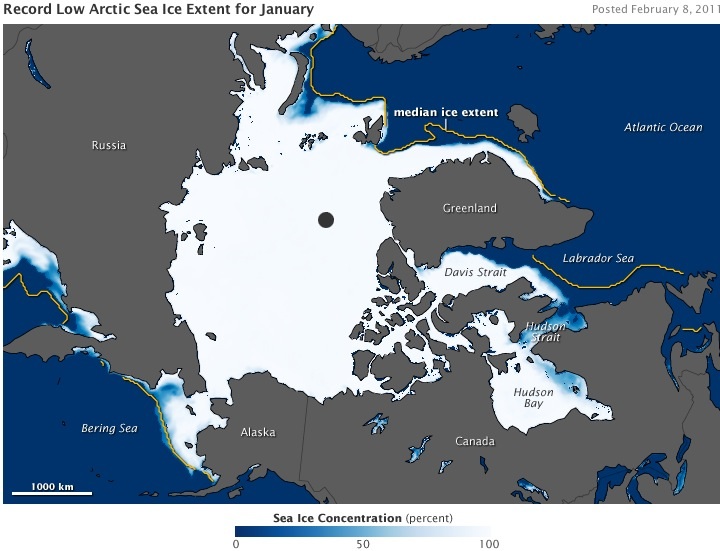
Arctic Sea Ice Record – New Satellite Image

Temperatures of +21C above normal in Dec/Jan in the eastern Arctic. Parts of Hudson Bay remain unfrozen

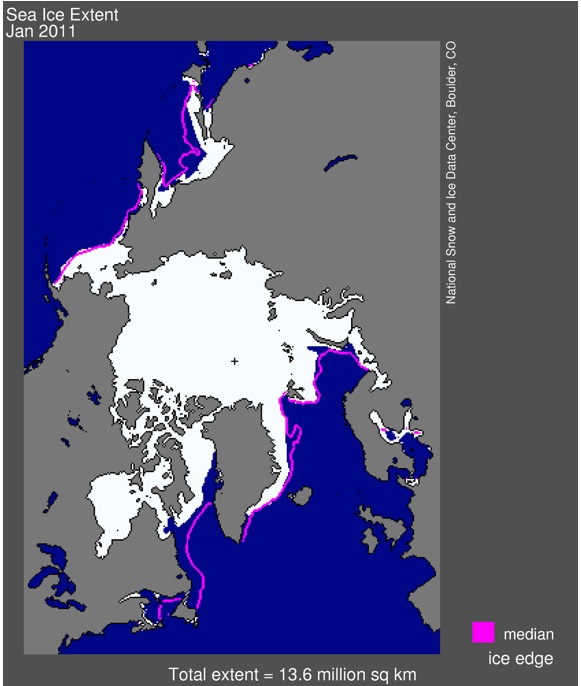
This NASA image shows average Arctic sea ice concentration for January 2011. Blue indicates open water; white indicates high sea ice concentrations; and turquoise indicates loosely packed sea ice. The yellow line shows the average sea ice extent for January from 1979 through 2000.

The U.S. National Snow and Ice Data Center (NSIDC) has reported that Arctic sea ice was at its lowest extent ever recorded for January (since satellite records began).

I’ve written about why this is happening and the consequences several times in recent weeks — Stephen

Arctic Defrost Dumping Snow on U.S. and Europe

Arctic Melt Down Is Bringing Harder Winters and Permanently Altering Weather Patterns

East Coast Blizzard and Europe’s Snowmaggddon Reveal Fingerprints of Climate Change

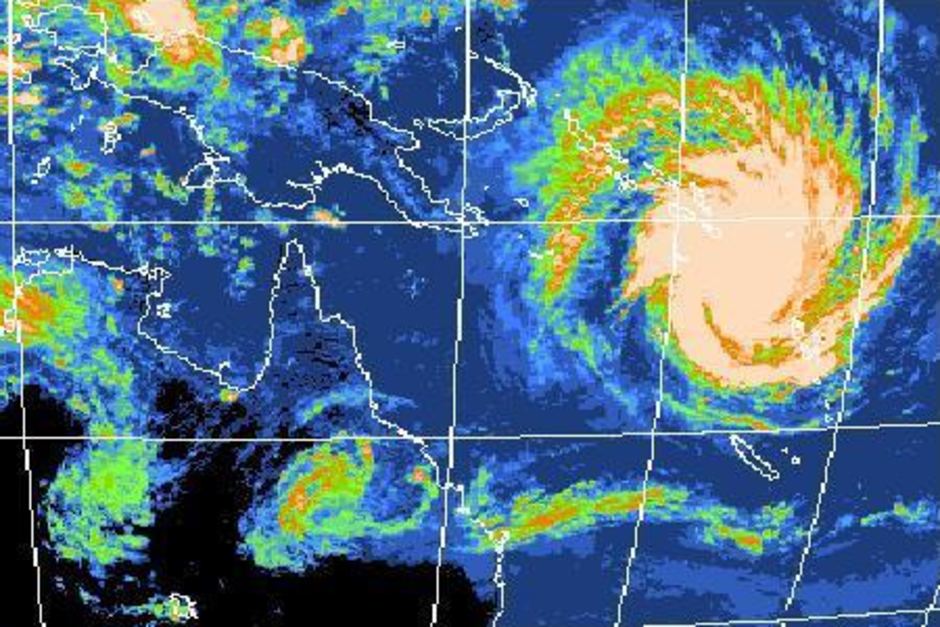
Stunning Satellite Pix of SuperCyclone Yasi on Landfall (and video)

Taken by MTSAT on February 2nd, 2pm (click for larger view)

The newly operational MTSAT-2 images from February 2nd are particularly striking. The images, showing the coldest clouds as white, reveal the extent of swirling white cloud and the deep eye of the storm which is clearly visible just off the coast of Northern Australia. — University of Leicester

My full posting of Yasi including graphs and pixs Will Super Cyclone Yasi be Australia’s Katrina?

Click to see amazing video of the approach of the cyclone on YouTube

Arctic Hits Bottom – Lowest Jan Sea Ice Cover Ever*

1.27 million square kilometers below avg


The National Snow and Ice Data Center reported wednesday that the Arctic sea-ice extent averaged just 13.55 million square kilometers, the lowest January ice extent since satellite records began in 1979 (*and likely the lowest in thousands of years– SL). That’s a whopping 1.27 million square kilometers below the 1979 to 2000 average.

No surprise given the absurdly warm Arctic temperatures of +21C above normal in Dec/Jan.

I’ve written about why this is happening and the consequences several times in recent weeks:

Arctic Defrost Dumping Snow on U.S. and Europe

Arctic Melt Down Is Bringing Harder Winters and Permanently Altering Weather Patterns

East Coast Blizzard and Europe’s Snowmaggddon Reveal Fingerprints of Climate Change

The Arctic summer’s sea ice melt will likely be another record low pushing the world to an ice-free Arctic one summer in the new future. FYI weather-related records will continue to fall faster than dominos without drastic cuts to our fossil fuel emissions. And frankly I’m tired of writing about it. — Stephen

The Great Groundhog’s Day Blizzard – Worst Winter Storm in 60 Years

Images Modis sat - January 31 at 10:30 a.m., 12:05 p.m., and 1:45 p.m. Eastern Time

This is what climate change looks like

One of the largest winter storms since the 1950s has hit 30 U.S. states from New Mexico to Maine and now into central and eastern Canada — +100 million people affected, hundreds of thousands without power. Chicago could get buried by more than 60 centimeters (2-ft) of snow — hundreds stranded already.

Climate change is certainly playing a role in this massive storm.

1. Warmer global temps means there is now four per cent more water vapour in the atmosphere which means heavier snowfalls.

2. There is also more energy in the climate system which makes storms more powerful.

3. Finally the melting of the Arctic sea ice is changing wind patterns in the polar regions bring colder, wetter winters to the eastern US  and western Europe scientists told me several months ago. (See my previous post East Coast Blizzard and Europe’s Snowmaggddon Reveal Fingerprints of Climate Change

Climate change loads the dice in favour of extreme events.

My latest article on this The Yin and Yang of Climate Extremes We Will See More of. — Stephen

Recent related articles:

Climate Change Could Be Worsening Effects of El Niño, La Niña

Arctic Melt Down Is Bringing Harder Winters and Permanently Altering Weather Patterns

Arctic Ice in Death Spiral, Thaws Permafrost — Risks Climate Catastrophe

Will Super Cyclone Yasi be Australia’s Katrina? Landfall Wed as Cat 5 Storm

This is what climate change looks like

[Stunning satellite photo of Yasi on landfall here.]

[Update 24:00 EST Feb 2. Can it be true? No one has been killed or seriously injured? If that holds up over the next few days it will be absolutely stunning. Kudos to Australian govt and Australians.

[Update 17:30 EST Feb 2. Yasi has moved well inland leaving devastated coastal towns and landscape behind – houses flattened, 90% of trees broken, not a leaf left on bushes. Pix here

[Update 10:30 EST Feb 2 LANDFALL: South of Cairns at the beautiful town of Mission Beach as Cat 5. This is where Cyclone Larry came ashore in 2006, the worst cyclone in 100 yrs, and destroyed much of the area. The last 1500 endangered cassowaries — large flightless bird — live in the jungles there.

[Update: 18:00 EST Feb 1- Yasi landfall expected at high tide bringing storm surge of 3-4 9! metres propelled by 280-300 kph winds. City of Cairns in direct path. “Catastrophic” storm says Premier]

Following the recent record-breaking flooding, Queensland, Australia’s is facing yet another extreme weather event as super cyclone Yasi bears down on them. Yasi is expected to reach has reached dangerous Category 4 5 strength, generating winds of up to 280 300 kph when it hits the Queensland state coast early on Thursday (2pm Wednesday, GMT). Yasi is a huge storm as the satellite image above shows – it is about 600-700 km diameter making it an extremely large cyclone (cover half the USA). (Latest Met service satellite imagery)

For comparison Hurricane Katrina was also very large but only about a Cat 1 or 2 on landfall based on final data from NOAA that went largely unreported. Katrina’s storm surge caused most of the damage which could be the case with Yasi. One major difference is that Queensland does not have a major city on the coast (or even a small one protected by poorly designed levees). Shockingly even a year after Katrina more than 500,000 people remained displaced.

Large areas of Queensland are still underwater or mud-covered from flooding just 2 weeks ago that caused billions of dollars in damage. It was so bad that Australians now have to pay a temporary flood damage tax to help cover the costs… And now Yasi.

Australia may need a permanent climate change disaster tax.

This is what climate change looks like – record-breaking extreme weather events. The Queensland floods nor Yasi are the direct result of climate change. However because burning fossil fuels traps more of the sun’s heat in the atmosphere the odds and strength of extreme events increase as climate science has stated for two decades now. Here is my latest article on this The Yin and Yang of Climate Extremes We Will See More of.

Climate change loads the dice in favour of extreme events. Queensland has been very unlucky lately. Help them out if you can. — Stephen

This independent environmental journalism depends on public support. Click here learn more.

Related stories

First Ever: Two Hurricane Landfalls on Same Day – Pix

Flying Blind Into Future Hurricane Seasons

Philippines hit by 13 Major Storms 2007

Northern Canada’s Winter Heat Wave

Canada’s average temperature for 2010 was 3.0°C above normal — the warmest year on record (source: Environment Canada)

Although cooler in the south where every one lives, Canada’s north has been breaking records for warmth in the middle of winter in a region where there is no sun until spring! I’ve covered this a couple of weeks ago and the reasons why Arctic Hothouse Turns Europe into an Icebox

This is a more recent report from the National Center for Atmospheric Research in Boulder by Bob Henson. — Stephen

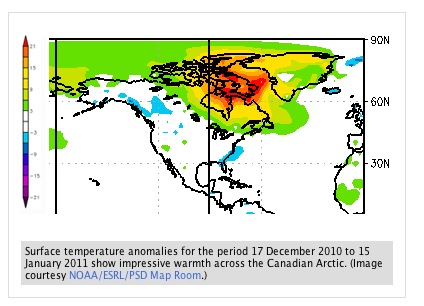
“Just how mild has it been? The map at right shows departures from average surface temperatures for the period from 17 December 2010 to 15 January 2011, as calculated by NOAA’s Earth Systems Research Laboratory.

The blue blip along the southeast U.S. coast indicates readings between 3°C and 6°C (5.4–10.8°F) below average for the 30-day period as a whole…

What really jumps out, though, is a blob of green, yellow, orange, and red covering a major swath of northern and eastern Canada. The largest anomalies here exceed 21°C (37.8°F) above average, which are very large values to be sustained for an entire month.

To put this picture into even sharper focus, let’s take a look at Coral Harbour, located at the northwest corner of Hudson Bay in the province of Nunavut. On a typical mid-January day, the town drops to a low of –34°C (–29.2°F) and reaches a high of just -26°C (–14.8°F). Compare that to what Coral Harbour actually experienced:

  • On the 6th of the month, the low temperature was –3.7°C (25.3°F). That’s a remarkable 30°C (54°F) above average.
  • On both the 5th and 6th, Coral Harbor inched above the freezing mark. Before this year, temperatures above 0°C (32°F) had never been recorded in the entire three months of January, February, and March.

Related articles/posts:

Climate Change Could Be Worsening Effects of El Niño -La Niña

Ice-cold Atlanta (and eastern US) Is Likely Connected to Arctic Hothouse

The Yin and Yang of Climate Extremes We Will See More of

    Report: +2.4C by 2020 leaves Billions Hungry? Scary but Untrue. Inside Story of Good Intentions Gone Wrong (and how the media fell for it)

    Food Report Released Knowing the Science Was Wrong

    By Stephen Leahy

    Jan 19 2011

    In the year 2020 climate change will devastate much of the world’s harvest leaving one in five people starving because the global temperature will have shot up an average of 2.4 degrees C a new report released Tuesday shows.

    Shocking. Stunning. Scary even. And completely untrue.

    Days before the report’s release I told the author Liliana Hisas of the Universal Ecological Fund (FEU), an Argentina-based NGO, it was impossible to get to 2.4 degrees of warming by 2020. Global temperatures have increased 0.8C in the last century and the 64-page report, “The Impacts of Climate Change on Food Production: A 2020 Perspective,” is based on additional 1.6C degree increase in just nine years time.

    I asked several climate experts if it was possible to reach a +2.4 degree average global temperature by 2020. Their answer: “No way”.

    This independent environmental journalism depends on public support. Click here learn more.

    The reason is that the oceans absorb 93 per cent of the additional heat being trapped in the atmosphere due to the burning fossil fuels. If we stopped burning all fossil fuels and emitting other greenhouse gases today, the atmosphere would still continue to slowly heat up over the next 50 to 100 years as the oceans released that stored heat.

    So ‘thank God for the oceans’ I said to Hisas who is also Executive Director of FEU-US when I explained all this via emails. And in an interview with Hisas on Monday I suggested the report be withdrawn. She refused, saying her organization had worked on the report for more than a year and the science was solid. It was all based on the Intergovernmental Panel on Climate Change (IPCC) 2007 report and had been vetted by Osvaldo Canziani, a former co-chair of the IPCC she said.

    Unfortunately Canziani was in hospital and unavailable for an interview. Continue reading

    Now Historic Flooding Hits Southern Australia

    [UPDATE 19 Jan – 25 % of state of Victoria underwater]

    While flood levels drop in Queensland and Brisbane, Australia’s state of Victoria has now been hit with historic levels of flooding.

    A strong La Nina enhanced by global warming seems to be behind the record flooding in Australia, Brazil, Sri Lanka and elsewhere as documented in my earlier article. Part of the reason for the severity of the flooding is that the atmosphere now contains 4 per cent more water vapour as a result of the increased global temperature of roughly 0.8C.

    As the planet continues to warm from the burning of fossil fuels floods will get worse, but so will droughts.

    The Yin and Yang of Climate Extremes We Will See More of

    Extreme weather accounted for 76 percent of all disasters over the past 20 years. Recovery is often impossible even in the US, i.e. New Orleans 5 years after Hurricane Katrina where poor neighborhoods remain devastated

    By Stephen Leahy

    UXBRIDGE, Canada, Oct 13, 2010 (Tierramérica) 

    The floods that affected 20 million people in Pakistan and the devastating six-week heat wave in Russia in recent months are tragic climate events — and they’re closely linked.

    “The Pakistan floods and Russia heat wave were directly connected, the atmospheric science makes that clear,” Kevin Trenberth, senior scientist at the U.S. National Centre for Atmospheric Research, told Tierramérica.

    A long-lasting high pressure system called a “blocking high” essentially gave western Russia a dry Mediterranean summer, which in turn shifted more- than-normal moisture into the Indian monsoon, resulting in record-breaking rainfall in northern Pakistan and India, Trenberth explained.

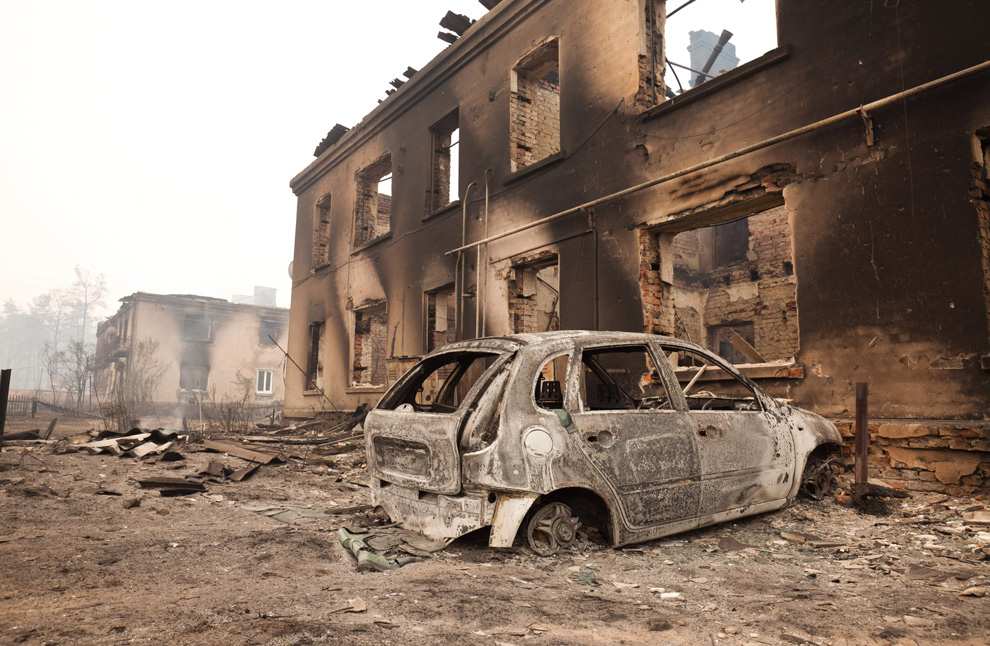
    Wildfires burned many russian villages Aug 2010

    It is difficult to determine whether climate change caused this extraordinary event, but it certainly made it much worse, according to Trenberth. “Without global warming these extremes are unlikely to have occurred,” he added.

    The drought in Russian and the heavy rains in Pakistan are exactly what are expected to happen with climate change, said the expert.

    “Changes in extreme weather events are the main way climate change is manifested,” he said, noting that the storms or floods that used to occur once every 200 years may now occur every 30 years.

    This independent environmental journalism depends on public support. Click here learn more.

    Continue reading