Rising global wealth spells disaster for the planet, with environmental impacts growing roughly 80 percent with a doubling of income, reports the first comprehensive study of consumption.
It adds to the mountain of evidence that the gospel of economic growth must be urgently transformed into the new gospel of resource-efficient green economies, a U.N. expert panel concluded Wednesday.
What are the biggest planetary criminals?
Fossil fuel use and agriculture, the study found. Ironically, these are also the two most heavily subsidised sectors, noted Ernst von Weizsaecker of Norwegian University of Science and Technology, and co-chair of the International Panel for Sustainable Resource Management.
‘Public largely unaware of the e-waste impacts on human health and environment’
By Stephen Leahy
UXBRIDGE, Canada, Nov 1, 2011 (IPS)
Mountains of hazardous waste grow by about 40 million tons every year. This waste, mostly from Europe and North America, is burned in developing countries like Ghana in a hazardous effort to recover valuable metals.
A children’s school in Accra, Ghana’s capital, was recently found to be contaminated by lead, cadmium and other health-threatening pollutants at levels over 50 times higher than risk-free levels. The school is located directly beside an informal electronic waste salvage site.
“Poor people in Africa cannot afford to process Europe’s or America’s electronic wastes,” said Ghanaian researcher Atiemo Sampson.
“Those wastes are poisoning our children,” Sampson told IPS from Accra.
Ghana does not regulate the importation and management of electronic waste, or e-waste. The government hopes to have rules in place next year, he…
Climate change is making oceans warmer and more acidic…expect the worst
By Stephen Leahy
When the carbon dioxide absorbed by the oceans dissolves in seawater, carbonic acid is formed and calcium carbonate, vital for the formation of the skeletons and shells of many marine organisms, becomes scarcer.
Climate change will ruin Chilean sea snails’ ability to sniff out and avoid their archenemy, a predatory crab, according to Chilean scientists who presented their findings at an international science symposium here.
Researchers from Australia also revealed that as the oceans become more and more acidic, some fish become hyperactive and confused, and move towards their predators instead of trying to escape.
“The conditions in oceans are changing 100 times faster than at any time in the past,” said Jean-Pierre Gattuso, a marine biologist with CNRS-INSU and the Laboratoire d’Océanographie de Villefranche in France.
Climate change is making oceans warmer and more acidic. “We are beginning to understand what will happen. I think we can expect the worst,” Gattuso told Tierramérica*.
Gattuso is one of nearly 600 scientists from around the world who presented their research on Sep. 24-27 at the Third International Symposium on the Ocean in a High-CO2 World: Ocean Acidification in Monterey, California.
Researchers discovered only 10 years ago that burning fossil fuels like coal, oil and gas has made the oceans about 30 percent more acidic since the beginning of the Industrial Revolution. Continue reading →
The failed “war on drugs” has not only badly damaged countries where it is waged, it is responsible for driving up HIV infection rates in some countries, says an official declaration endorsed Wednesday by three former Latin American presidents in advance of the XVIII International AIDS Conference that begins Jul. 18 in Vienna.
In Eastern Europe and Central Asia, injecting drug use is the primary cause of new HIV infections. Outside of sub- Saharan Africa, injecting drug use accounts for approximately one in three new cases of HIV, experts will report at the week-long meeting.
“The war on drugs has failed…Instead of sticking to failed policies with disastrous consequences, we must direct our efforts to the reduction of consumption and the reduction of the harm caused by drugs to people and society,” said former Brazilian president Fernando Henrique Cardoso.
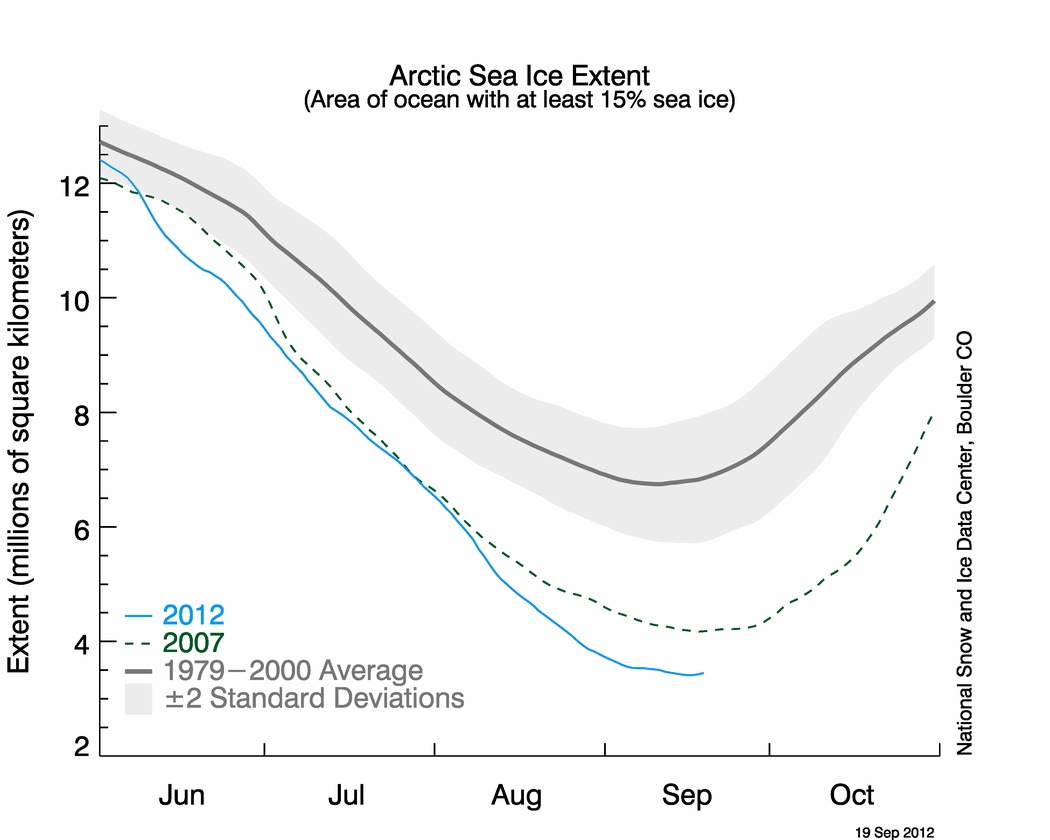
The melt of Arctic sea ice has reached its lowest point this year, shrinking 18 percent from last year’s near-record low.
Summer ice this year is half what it was 30 years ago and is now affecting weather patterns. The massive declines in ice in recent summers have shocked scientists and Arctic experts. Some predict that in just a few years we will witness an event that hasn’t happened in millions of years: the complete loss of summer ice.
“Few of us were prepared for how rapidly the changes would actually occur” as a result of the burning fossil fuels that are warming the planet, said Serreze.
“We could see an essentially ice-free Arctic ocean in late summer by the year 2030,” he told IPS.
Not long ago experts thought the soonest the Arctic would be ice-free was 2070. Now it’s anywhere from four to 18 years away.
The impacts are already being felt across the entire northern hemisphere. The loss of sea ice in recent years has been affecting weather patterns, recent research has shown. The all-important jet stream – the west-to-east winds that are the boundary between the cold Arctic and the warm mid-latitudes – is slowing down, moving north and become more erratic.
“Europe, eastern Asia and eastern North America is connected to unique physical processes in the Arctic,” said James Overland of the NOAA/Pacific Marine Environmental Laboratory in the United States.
“In future, cold and snowy winters will be the rule rather than the exception” in these regions, Overland told IPS in Oslo in 2010.
The summer’s record loss of Arctic sea ice may mean a cold winter for the UK and northern Europe, Jennifer Francis, a researcher at Rutgers University, told the Guardian last week.
The region has been prone to bad winters after summers with very low sea ice, such as 2011 and 2007, Francis said. Continue reading →
Source: American Journal of Respiratory and Critical Care Medicine. 13 Oct 2012
Exposure to air pollution from traffic during infancy is associated with lung function deficits in children up to eight years of age, particularly among children sensitized to common allergens, according to a new study.
“Earlier studies have shown that children are highly susceptible to the adverse effects of air pollution and suggest that exposure early in life may be particularly harmful,” said researcher Göran Pershagen, MD, PhD, professor at the Karolinska Institutet Institute of Environmental Medicine in Stockholm, Sweden.
“In our prospective birth cohort study in a large population of Swedish children, exposure to traffic-related air pollution during infancy was associated with decreases in lung function at age eight, with stronger effects indicated in boys, children with asthma and particularly in children sensitized to allergens.”
The findings were published online ahead of print publication in the American Thoracic Society’s American Journal of Respiratory and Critical Care Medicine.
The study included more than 1,900 children who were followed from birth through age eight. ….
[edit]
“Our study shows that early exposure to traffic-related air pollution has long-term adverse effects on respiratory health in children, particularly among atopic children,” concluded Dr. Pershagen.
“These results add to a large body of evidence demonstrating the detrimental effects of air pollution on human health.”
Yields went up 214 percent in 44 projects in 20 countries in sub-Saharan Africa
“If we don’t radically transform the direction of the global food system we will never feed the billion who are hungry,” De Shutter warns.
“Nor will we be able to feed ourselves in the future.”
By Stephen Leahy
UXBRIDGE, Feb 8, 2011 (IPS)
Eco-farming could double food production in entire regions within 10 years while mitigating climate change, according to a new U.N. report released Tuesday in Geneva.
An urgent transformation to ‘eco-farming’ is the only way to end hunger and face the challenges of climate change and rural poverty, said Olivier De Schutter, U.N. Special Rapporteur on the right to food, following the presentation of his annual report focusing on agroecology and the right to food to the U.N. Human Rights Council.
“Agroecology mimics nature not industrial processes. It replaces the external inputs like fertiliser with knowledge of how a combination of plants, trees and animals can enhance productivity of the land,” De Schutter told IPS.
“Yields went up 214 percent in 44 projects in 20 countries in sub-Saharan Africa using agro-ecological farming techniques over a period of 3 to 10 years… far more than any GM [genetically modified] crop has ever done.”
Other recent scientific assessments have shown that small farmers in 57 countries using agro-ecological techniques obtained average yield increases of 80 percent. Africans’ average increases were 116 percent.
“Today’s scientific evidence demonstrates that agroecological methods outperform the use of chemical fertilisers in boosting food production in regions where the hungry live,” De Schutter said. [Video Interviews with De Schutter]
Agroecology applies ecological science to the design of agricultural systems. It enhances soil productivity and protects crops against pests by relying on the natural elements. Continue reading →
My recent articles only touch on some of the significant problems with fracking. There’s more to come. (And check out trailer for the new fracking movie starring Matt Damon http://bit.ly/TC8qNB) — Stephen
Yet another study reveals fracking has a huge problem of gas leaks. Up to 9% of the gas pumped out of the ground leaks into the atmosphere according to a study by National Oceanic and Atmospheric Administration (NOAA) published in Nature this week. Natural gas (methane) is a powerful greenhouse gas. If these leaks are widespread, fracking is worse than burning coal, accelerating global warming.
In Jan 2012 I detailed new research in the article below showing that replacing coal with natural gas from fracking does little to fight climate change (see below). Now two studies published that since then make an even stronger case that fracking for natural gas is a HUGE MISTAKE:
“The U.S. has led the fight to stem global hunger, now we are creating hunger,” said Lester Brown, president of the Earth Policy Institute.
Series of the latest articles that provide almost everything you need to know about why ethanol and biofuels will not reduce global warming but simply drive up fuel and food costs.
When the carbon dioxide absorbed by the oceans dissolves in seawater, carbonic acid is formed and calcium carbonate, vital for the formation of the skeletons and shells of many marine organisms, becomes scarcer.
MONTEREY, California, Oct 2 2012 (IPS) –
Climate change will ruin Chilean sea snails’ ability to sniff out and avoid their archenemy, a predatory crab, according to Chilean scientists who presented their findings at an international science symposium here.
Researchers from Australia also revealed that as the oceans become more and more acidic, some fish become hyperactive and confused, and move towards their predators instead of trying to escape.
“The conditions in oceans are changing 100 times faster than at any time in the past,” said Jean-Pierre Gattuso, a marine biologist with CNRS-INSU and the Laboratoire d’Océanographie de Villefranche in France.
Climate change is making oceans warmer and more acidic. “We are beginning to understand what will happen. I think we can expect the worst,” Gattuso told Tierramérica*.




 Stephen Leahy, International Environmental Journalist