Heading for +2 degrees C (3.6 degrees F) Carbon Use Must Peak by 2015 Scientists Warn

Carbon overload - have to stop expanding
Carbon overload – have to stop expanding

By Stephen Leahy

“We shouldn’t forget that a 2-degree C global mean warming would take us far beyond the natural temperature variations that life on Earth has experienced since we humans have been around.”

ANCHORAGE, Alaska, Apr 30 (IPS)

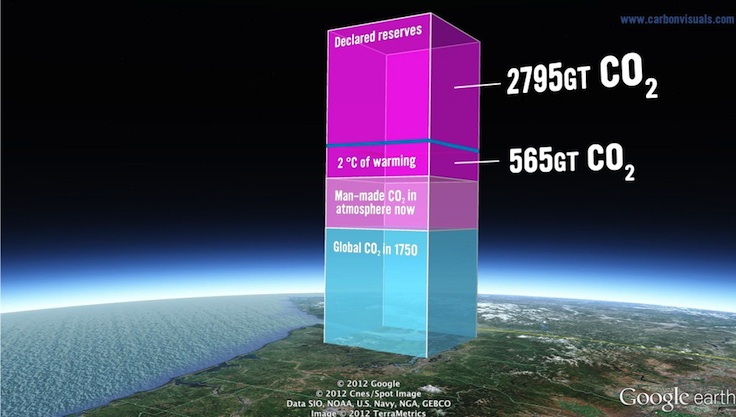
Climate scientists are calling for a phase-out of fossil fuels because humans are now pumping so much carbon dioxide (CO2) into the atmosphere that the ‘2-degree-C climate balloon’ will burst otherwise, new studies show.

That 2-degree C climate balloon has a maximum capacity of less than 1,400 gigatonnes of CO2 total emissions from the year 2000 to 2050, Malte Meinshausen and colleagues report in the current issue of Nature. The European Union and others consider a global temperature rise of more than 2 degrees C as dangerous and potentially catastrophic. Temperatures are already 0.8 C warmer than the pre-industrial period.

UPDATE Nov 2009 Prospect of a four-degree Celsius rise in global average temperatures in 50 years is alarming – but not alarmist, climate scientists now believe. Four Degrees of Devastation

The reality is that global emissions for the last seven years amounted to almost 250 gigatonnes of these long-lived greenhouse gases, meaning that the current and growing rates of fossil fuel emissions would burst the balloon in about 20 years – or less. Even if emissions are held to 1,400 gigatonnes maximum for the next 40 years, there is still a 50-percent probability of exceeding 2 degrees C, said Meinshausen, lead author of the study and climate researcher at the Potsdam Institute for Climate Impact Research.

Indigenous peoples from around the world also called for a phase-out of fossil fuels at the conclusion of the first Indigenous Peoples’ Global Summit on Climate Change in Anchorage, Alaska, that concluded last week.

“That call is well-supported by the evidence in this study,” Meinshausen told IPS.

Is this article of interest? It exists thanks to contributions from readers. Please click here to learn more about Community Supported Journalism.

Continue reading

China, Korea, Saudi Arabia Lead Global Land Rush To Buy Farmland In Other Countries

By Stephen Leahy*

conversion of US grasslandANCHORAGE, Alaska, USA, May 5 (Tierramérica)

More than 20 million hectares of farmland in Africa and Latin America are now in the hands of foreign governments and companies, a sign of a global “land grab” that got a boost from last year’s food crisis.

Rich countries that are short on land or water at home are looking to secure food-producing lands elsewhere as a way to ensure food security for their populations, said Joachim von Braun, director of the International Food Policy Research Institute (IFPRI).

“There is a major lack of transparency in these land deals,” von Braun said in a telephone press conference from Washington.

The IFPRI study, “‘Land Grabbing’ by Foreign Investors in Developing Countries,” by von Braun and Ruth Meinzen-Dick, which was presented last week, estimates that 15 to 20 million hectares have been acquired or are in the process of being sold.

Von Braun pointed out that this is equivalent to about 25 percent of all the farmland in Europe.

Because hard data is difficult to come by – the study was based primarily on information from press reports – IFPRI conservatively estimates that the deals represent 20 to 30 billion dollars being invested by China, South Korea, India and the Gulf States, mainly in Africa.

“About one-quarter of these investments are for biofuel plantations,” von Braun said. Continue reading

Ethanol and Biofuels: Almost Everything You Need to Know

“The U.S. has led the fight to stem global hunger, now we are creating hunger,” said Lester Brown, president of the Earth Policy Institute.

Series of the latest articles that provide almost everything you need to know about why ethanol and biofuels will not reduce global warming but simply drive up fuel and food costs.

maize - mexicoEthanol Worse Than Gasoline

Only Green Part of Most Biofuels is the Wealth (Subsidies) They Generate

Ethanol: The Great Big Green Fraud

International Enviro Standards Needed for Biofuels

Six Experts On Why Ethanol is a Dumb Idea

Food & Fuel: Can Sorghum Be The New Magic Bullet Biofuel??

Biofuels: Another Good Reason to Hate American Policy

(Cellulosic) Greenest Ethanol Still Unproven

Massive subsidies to oil companies continue – Podcast

redeyePodcast from REDEYE RADIO:

Oil companies are some of the most profitable corporations in the world. Yet they receive between 20 and 40 billion dollars a year in subsidies, according to a report produced for the OECD by Earth Track, an independent energy information research organisation in Boston, Massachusetts.

LORRAINE CHISHOLM interviews Stephen Leahy an environmental journalist who documented these facts in a recent article. Listen to podcast

Read article: ‘Bailout’ for Oil Companies $20-40 Billion (and maybe more) every year

Speaking of subsidies, here’s my articles on ethanol and biofuels :

Quotes From Six Experts On Ethanol

Biofuels: Another Good Reason to Hate American Policy

Ethanol: The Great Big Green Fraud

Record $Financing For Biofuels, Not Food


Do Incinerators Kill Goal of Zero Waste?

zero-waste-conceptby Stephen Leahy

The Uxbridge Cosmos Apr 30 2009

Shawn Williamson took out 2.4 bags of trash last year. Williamson hopes to trim that to 1.6 bags of garbage this year from his family of three living in a typical newer home in nearby Brooklin.

“It’s easy,” says Williamson, a consultant and Director at Durham Sustain Ability, who also uses his home as an office. The secret is buying in bulk and “not buying crap”. The family buys 50lb bags of rice, uses glass jars for storage of other bulk food items and does its own backyard composting. [living zero waste – you tube video]

“It makes more sense to compost food waste in your backyard than transport it all over the Region.”

Uxbridge and Durham Region residents may not realize there is a looming garbage crisis. Virtually all of the Region’s more than 100,000 tonnes of trash goes to Michigan. But those landfills will be closed to Ontario’s garbage in 2010. In response Durham Region Council voted last year to build an estimated $230 million incinerator, or energy-from-waste (EFW) facility in Clarington near Lake Ontario.

“No incinerator is clean. Why let the Region blow toxic smoke into your lungs?” Dr. Sean Godfrey, Chief of Pediatrics, Lakeridge Health Oshawa asked about 80 people attending an information session in Whitby in early April. The event was part of a series of sessions organized by a group of Durham residents called ZeroWaste4ZeroBurning who oppose Durham’s proposed incinerator. Continue reading

Indigenous Wisdom Against Climate Change

1993_-_carrie_dannBy Stephen Leahy*

ANCHORAGE, Alaska, Apr 28 (Tierramérica**)While industrialised countries like Canada continue to emit ever-higher levels of greenhouse-effect gases, indigenous peoples around the world are working to survive and adapt to an increasingly dangerous climate.

Over millennia, indigenous peoples have developed a large arsenal of practices that are of potential benefit today for coping with climate change, including some holistic and refreshingly practical ideas.

Why not give automobiles and planes a day of rest? And then later on, two days of rest. That would cut down on pollution,” suggested Carrie Dann, an elder from the Western Shoshone Nation, whose ancestral lands extend across the western United States.

Dann, winner of the 1993 Right Livelihood Award – known as the Alternative Nobel Prize – for her efforts to protect ancestral lands, made her proposal before the 400 delegates gathered in Anchorage, Alaska, Apr. 20-24 for the Indigenous Peoples’ Global Summit on Climate Change.

Dann warned that Mother Nature is getting warmer and the “fever” needed to be cured. “We see many range (grassland) fires in my territory, it is getting so hot,” she said. Continue reading

Native Peoples Sound Dire Warning On Climate

cracked-earthBy Stephen Leahy*

Drought and hotter weather are making it very difficult to grow the staple crop of maize in most regions of Mexico.

ANCHORAGE, Alaska, Apr 22 (IPS) – Humanity’s hot carbon breath is not just melting the planet’s polar regions, it is disrupting natural systems and livelihoods around the world, indigenous people reported this week at a global meeting on climate change in Anchorage, Alaska.

“We indigenous people are the prow of the ship of humanity in the oncoming waves of climate change,” said Vanessa Marsh of the small Pacific island of Niue.

Indigenous people are here to alert humanity and lead the way in healing Earth, Marsh, a youth delegate, told more than 400 representatives of world’s indigenous peoples here.

Coastal erosion, mud slides, longer droughts and more severe hurricanes are just some of the impacts of climate change affecting the Caribbean region, Chief Charles Williams of the Kalinago people on the island of Dominica told the U.N.-affiliated Indigenous Peoples’ Global Summit on Climate Change.

“Most indigenous people live on the margins…their ‘purses’ are not as strong as others when it comes to coping with climate change,” Williams said. Continue reading

Indigenous Peoples Demand Greater Role in Climate Debate

native-windmill-art

By Stephen Leahy*


ANCHORAGE, Alaska, Apr 20 (Tierramérica) – While indigenous peoples from around the world are meeting in this Alaskan city to seek a greater role in global climate negotiations, the rapidly warming Arctic is forcing some Inuit villages to be relocated.

“We have centuries of experience in adapting to the climate and our traditional lifestyles have very low carbon footprints,” Victoria Tauli-Corpuz, an indigenous leader from the Philippines and chair of the United Nations Permanent Forum on Indigenous Issues, told Tierramérica.

Carbon-based gases are the principal cause of the greenhouse effect, which leads to climate change. The excessive release of these gases, like carbon dioxide and methane, comes from human activities: the combustion of fossil fuels in industry and transportation, and emissions from livestock production and deforestation.

Some 400 indigenous people, including Bolivian President Evo Morales and observers from 80 nations, are gathered in Anchorage, Alaska for the Apr. 20-24 U.N.-affiliated Indigenous Peoples’ Global Summit on Climate Change.

They will discuss and synthesise ways that traditional knowledge can be used to both mitigate and adapt to climate change.

“Indigenous peoples have contributed the least to the global problem of climate change, but will almost certainly bear the greatest brunt of its impact,” said Patricia Cochran, chair of both the Inuit Circumpolar Council and the April Summit. Continue reading

Earth’s Arctic Freezer Turning Into Hothouse

meltwater-ponds-on-sea-ice-off-coburg-island-nunavut-canada-arctic-warming-has-been-associated-with-a-rapid-decline-in-arctic-summer-sea-ice-extent-image-credit-sandy-briggs1By Stephen Leahy

UXBRIDGE, Apr 10 (IPS) – The world is losing its northern freezer as Arctic winter ice is in sharp decline, NASA scientists reported this week. Even with below average winter temperatures, Arctic ice is thinner and covers less area than it did a decade ago.

Arctic sea ice is the cooling mechanism for the global climate system. As it declines and the region warms – already three to five degrees Celsius warmer – then inevitably there are local, regional and hemispheric climate impacts.

“We’ve already lost one third of the summer ice cover since the 1980s. There are already impacts from this,” says Ron Kwok of NASA’s Jet Propulsion Laboratory in Pasadena.

“A completely ice-free summer by 2013 is not impossible,” Kwok said in a telephone news conference. “You would have been laughed out the room if you suggested this five years ago.”

The new study shows that the maximum extent of the 2008-2009 winter sea ice cover was the fifth-lowest since researchers began collecting such information 30 years ago. The past six years have produced the six lowest maximums in that record.

More stunning, and indicative of the rapid warming of the region, is the decline in the thick, hard-to-melt multi-year ice, says Walter Meier, research scientist at the National Snow and Ice Data Centre in Boulder, Colorado. Multiyear ice is ice that is two or more years old and therefore doesn’t melt in the summer.

“Less than 10 percent is multiyear now. It used to be 30 percent in 1981,” Meier said at the news conference.

via ENVIRONMENT: Earth’s Arctic Freezer Turning Into Hothouse.

Global Warming Puts Food Supplies At Risk, New Green Revolution Needed

cattle-oz-rslBy Stephen Leahy

UXBRIDGE, Canada, Apr 2 (IPS) – Don’t forget about agriculture in the upcoming global negotiations to combat climate change, experts warn. Not only is farming most at risk in an increasingly variable and tempestuous climate, it is also a major emitter of greenhouse gases.

But with the right policies in place, agriculture could both continue to feed the world and play a crucial role in solving the climate problem.

“Agriculture has been missing in the run-up talks to Copenhagen,” says Mark Rosegrant of the International Food Policy Research Institute (IFPRI).

The nations of the world will meet in Copenhagen this December to hammer out a new climate treaty to reduce emissions of greenhouse gases (GHGs) and establish a fund to help poorer countries adapt. The complex process began in 2007 at the Bali talks, continued in Poznan, Poland in 2008 and is ongoing this week in Bonn.

Agriculture accounts for about 15 percent of human emissions of GHGs, IFPRI says, although the Intergovernmental Panel on Climate Change puts it higher at 25 percent. Much of those emissions come from developed countries that rely heavily on fossil fuels and fertilisers and raise far more methane-emitting livestock.

With climate change the world is facing reduced yields of up to 20 percent in maize and rice by the year 2050, Rosegrant told IPS. Much of that yield decline will be in the developing world, mainly because sub-tropical and tropical regions are expected to be hit hardest by significant changes in water availability and warmer temperatures.

Climate change could mean ever-rising food prices and therefore significant investments are needed in agricultural research to help countries cope with the coming changes, he says: “We’re trying to work out what the costs for adaptation in agriculture might be.” Continue reading