[Update from Nagoya 30 October 2010. Global moratorium passes.]
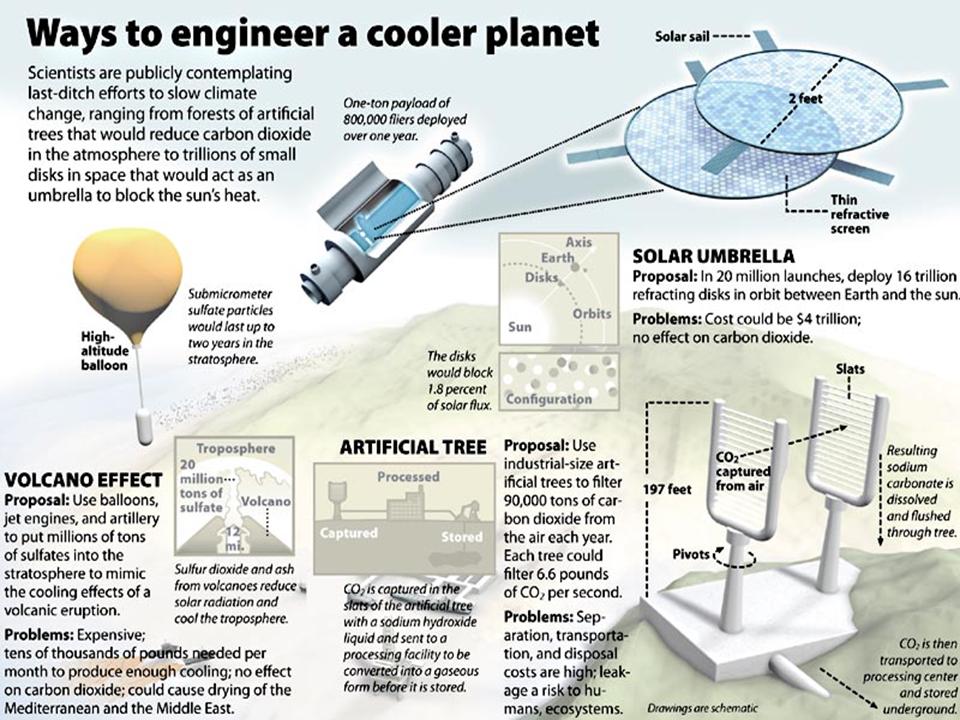
Delegates to the world summit on biodiversity here are calling for a moratorium on climate engineering research, like the idea of putting huge mirrors in outer space to reflect some of the sun’s heating rays away from the planet.
Climate engineering or geoengineering refers to any large-scale, human- made effort to manipulate the planet to adapt to climate change.
The geoengineering proposals include installing giant vertical pipes in the ocean to bring cold water to the surface, pumping vast amounts of sulphates into the stratosphere to block sunlight, or blowing ocean salt spray into clouds to increase their reflectivity.
“Africans have become share-croppers, exporting coffee, cotton, flowers and now food while going hungry”
By Stephen Leahy
UXBRIDGE, Canada, Jan 13, 2011 (IPS)
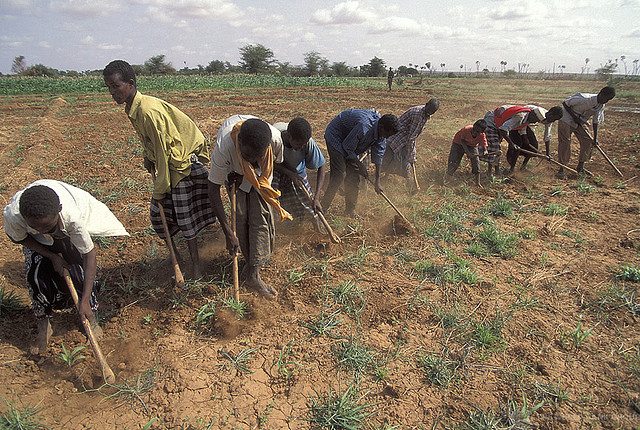
Famine-hollowed farmers watch trucks loaded with grain grown on their ancestral lands heading for the nearest port, destined to fill richer bellies in foreign lands. This scene has become all too common since the 2008 food crisis.
[This is the first of a multi-part series investigating what is driving food prices higher]
Food prices are even higher now in many countries, sparking another cycle of hunger riots in the Middle East and South Asia last weekend. While bad weather gets the blame for rising prices, the instant price hikes of recent times are largely due to market speculation in a corrupt global food system.
The 2008 food crisis awoke much of the world’s investment community to the profitable reality that hungry people will do almost anything, even sell their own children, in order to eat. And with the global financial crisis, food and farmland became the “new gold” for some of the biggest investors, experts agree.
In 2010, wheat futures rose 47 percent, U.S. corn was up more than 50 percent, and soybeans rose 34 percent.
On Wednesday, U.S.-based Cargill, the world’s largest agricultural commodities trader, announced a tripling of profits. The firm generated 1.49 billion dollars in three months between September and November 2010.
Meanwhile, U.S. Treasury Bills pay a return of less than one percent. Continue reading →
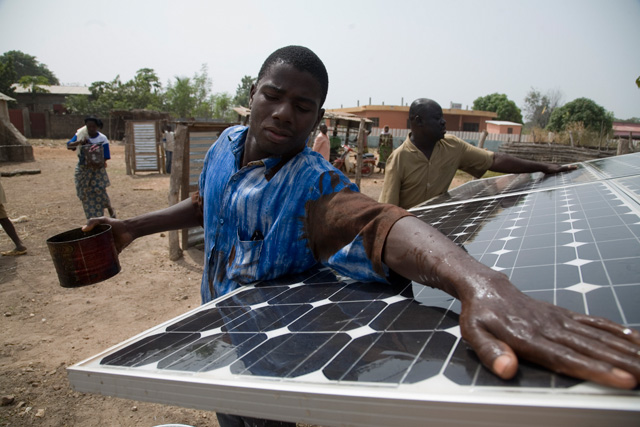
Kenya switched to green energy and now more people than ever have electricity
Universal access to modern electricity would cost much less than current subsidies to fossil fuel industry
By Stephen Leahy*
UXBRIDGE, Canada, Dec 14, 2010 (IPS)
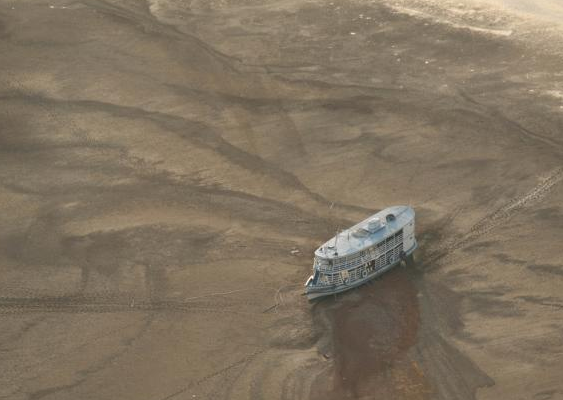
Development in Africa could falter as climate change grips the continent, increasing the length and severity of droughts and floods by altering precipitation patterns, among other impacts.
The region needs a major shift in its economic development policies and thinking towards decentralised, green economic development, experts now say.
“Export growth does not automatically result in green economic growth, we must look at trade for development,” said Panitchpakdi.
In a rejection of failed neoliberal economic policies, Panitchpakdi said strong national policies on investments, taxation, protection of local industries, including subsidies, and changes to less restrictive intellectual property regimes are what is needed to green economies in Africa and elsewhere.
“Green economic development underpins environmental protection, economic growth and development,” he said.
“A four-degree C world would be horrendous and must be avoided at all costs”
By Stephen Leahy*
MEXICO CITY, Dec 7, 2010 (IPS/TerraViva)
Africa will be amongst the hardest hit regions of the world as the climate heats up, threatening the continent’s food security, experts agree. If global temperatures rise 2.0 degrees C, southern Africa will warm an additional 1.5 degrees to a 3.5-degree increase on average.
Such temperatures could be reached as early as 2035. The Hadley Centre for Climate Prediction and Research in Britain recently advised that a 4.0-degree C rise in the global average temperature could be reached as soon as 2060 if the ever-increasing emissions of carbon dioxide and other greenhouse gases are not curbed.
“The prognosis for agriculture and food security in SSA (Sub-Saharan Africa) in a 4°C+ world is bleak,” write the authors of a special issue of the Philosophical Transactions of the Royal Society to be published next month.
“A four-degree C world would be horrendous and must be avoided at all costs,” said Philip Thornton of the International Livestock Research Institute in Nairobi, Kenya and co-author of a paper in the Royal Society special issue “Four degrees and beyond”.
“This special issue is a call to action so we can avoid such a future,” Thornton told TerraViva.
“It is going to get very difficult for rain-fed agriculture in this region,” Thornton warned.
This article was made possible by a contribution from Brewster Kneen of Canada
Due to the high costs of covering such important events, support is needed from readers like you. Please consider making a small automatic monthly contribution as a fair exchange for these articles – for more information.
NOTE:The following are excerpts from my personal notes to friends and supporters written during the heat, confusion and massive information dump of a major international conference. Often written late at night I attempted to offer some personal perspective into what was going on and what I was up to. — Stephen
Tuesday, 19 Oct – Geopolitical obstacles getting in the way
I’m here at the big UN conference on biodiversity. It’s 430 am here, the first day ended about 9 pm. It’s 12-ring cat circus like the Copenhagen climate meeting but the mood here is more positive. There are similar geopolitical obstacles getting in the way of slowing the loss of species and ecosystems. Another major difference is the lack of little public awareness of the fact that we cannot continue to shred nature’s web of life without suffering dire consequences.
I’ll try and do my bit – write 10 -12 articles over next two weeks. I wanted to thank a couple of supporters who helped out to cover some of the travel costs. I want to keep you informed of what’s going on here but these notes take a couple of hours to do.
This week is a story about an important development in Africa: In sincere efforts to make one last major attempt to transform Africa’s poverty and hunger are we imposing our worldview on Africa yet again? Bill Gates and others are donating hundreds of millions to create a New Green Revolution for Africa. This difficult and controversial story took over a week to do and wrote the final draft during my 17 hr flight here.
My other story connects the dots between extreme weather this summer and climate change. No single storm is directly attributable to CC BUT without CC it is unlikely the Russian heat wave and floods in Pakistan would have occurred. (PS those were events were two sides of the same coin)
Finally I received a number of letters, mostly positive but a couple saying I was too negative in last week’s article ‘Don’t Worry Be Happy’ Canada Sees Global Warming “Prosperity” Instead of Calamity’. Any organization that puts out a chart of climate impacts at 4 – 5C of global warming and fails to mention the scale of the calamity that would result is delusional or deceptive. Some take the stunningly selfish and naive view we can ‘adapt’ by turning up the AC.
There is an astonishing diversity of people here. Last nite I talked to an Amazonian Indian who took 10 days to get here, had wine accidentally spilled on me by a reindeer herder from Finland and found the lost passport of a Brazilian diplomat. And that is a five minute snap shot. It is a very big world with so many different people it is incredible they have all come here to try and address a common issue. That they can’t agree on what kinds of actions and how to implement should not come as a surprise.
—
Sunday, 24 Oct – Canada won’t play nice (yet again)
Canada is blocking agreement on a key measure to get a new international agreement to protect biodiversity here. This is not new. In recent years Canada has gone out its way to snub international UN agreements including the outright refusal to fulfill its legal obligations under the Kyoto Protocol. Hard to believe the same government lobbied hard for a seat on the UN security council and actually expected to be rewarded.
Sadly there is no one reporting for Canadian publications to document the irony. (And as a result Canadian’s aren’t really aware of what their government is up to.) Continue reading →
Malaria spreading to new regions while millions wasted on vaccines that cannot work for more than 2 years [New Article]
By Stephen Leahy
CHICAGO, U.S., Feb 19 (IPS)
Climate change is bringing malaria to regions of Africa where the disease was previously unknown, researchers report from the conference of the American Association for the Advancement of Science in Chicago this week.
Interestingly, the Arctic, where climate change is happening fastest, is the best place to study how warming temperatures are affecting infectious disease transmission.
[Note: Diseases are expected to increase in proportion to the decline/degradation of natural environment experts at Harvard said in my 2008 article “Doctor” Nature in Danger — Stephen]
Insect-transmitted diseases, primarily malaria, kill 3,000 people in Africa each day, said Andy Dobson of Princeton University in the United States.
Understanding how global warming is altering temperatures and the ecology and ranges of the malaria-transmitting Anopheles mosquito is crucial to understanding the dynamics of how insect-transmitted diseases like malaria will change, Dobson told IPS.
Image via Wikipedia
“Ironically, we’re spending huge amounts of money on trying to develop vaccines for malaria but the best possible vaccine we could make wouldn’t last for longer than two years,” he said.
That’s because the natural lifetime of immunity to malaria is perhaps two years and to eradicate malaria using a vaccine would require vaccinating everyone every year because the malaria parasite evolves quickly, he explained.
“We’re not going to be able to do that,” Dobson added.
Instead scientists need to be able to understand and project how and where malaria outbreaks will occur under the altered conditions of climate change. However, there is very little data or research on disease transmission in the field. Rather, the focus has been on developing vaccines and genetic analysis of the malaria parasite and mosquito genome – and that “tells us nothing about transmission”, he said.
“A sad testimony to how the (U.S.) National Institutes of Health and the Gates Foundation spend their money,” Dobson told IPS. Continue reading →
[World Bank and International Monetary Fund free-market doctrines responsible for much of Africa’s hunger experts say]
It is a world of paradox and plenty:
852 million people are starving while one billion people are overweight, with 300 million of them considered medically obese.
And the numbers of people whose health are at serious risk due to starvation or from obesity is rising rapidly.
While what the World Health Organisation calls a global epidemic of obesity is a health issue of the modern world, hunger and malnutrition are old and bitterly intractable problems.
More than 50 million Africans currently need food assistance, according to the U.N. World Food Programme. More than 120 million Africans are living permanently on the edge of emergency food aid, says the British charity CARE International.
Why is hunger chronic in Africa?
“There is enough food, but people don’t have enough money to buy it,” says Anuradha Mittal, executive director of the Oakland Institute, a U.S.-based policy think tank on social, economic and environmental issues.
“Sixty-three percent of people in Niger live on less than a dollar a day,” Mittal told IPS.





 Stephen Leahy, International Environmental Journalist