Canada Slashes Charity’s Funding To Protect Giant Tar Sands Project P.S. Oil companies get $2+ billion in subsidies

Please read this eloquent piece from Toronto Star columnist Catherine Porter on how the Harper govt cut funding of Kairos, a renowned church charity for telling the truth about Canada’s tar sands.

How can Canadians in good conscience try to help African women get water when it is carbon emissions from the tar sands are part of the reason they face drought?

And then Harper and his Minister Bev Oda lied and tried to cover up their vindictive actions claiming they want to improve the lives of the poor “efficiently”. (This from a govt giving billions in public subsidies to oil companies)

Here’s the first paras of Porter’s column:

A few years back, the staff at Kairos planned a trip to Nigeria’s oilfields to examine environmental damage, corporate responsibility and human rights abuses.

The board of the faith-based development organization rejected the idea. It sent them to Alberta’s tar sands instead.

“I remember saying, ‘They’ll kill us — that will be considered very political,’ ” recalls Mary Corkery, Kairos’ passionate executive director. “The churches said, ‘This is our work. Our work is inspired by faith to tell the truth. It’s a development issue if it’s far away. It’s a political issue if it’s at home. Or if it offends anyone.’ ”

Think it’s a stretch to compare Canada to Nigeria? A government that forges documents, that makes things up, that smothers dissenting opinions, that accuses the media of lying.

via Porter: Kairos does important work; we should all support it – thestar.com.

About Subsidies:
Every Day Governments Give an Estimated $2 billion to Oil, Coal & Gas Industry
About the Tar Sands:

30 Page e-book:_Oil Stains in the Boreal Forest: The Environmental Cost of Canada’s Tar Sands

Europeans stopped Canada’s Slaughter of Baby Seals – Can They Stop Canada’s Tar Sands?

Canada’s “Mordor” Ensures Climate Treaty Failure in Copenhagen

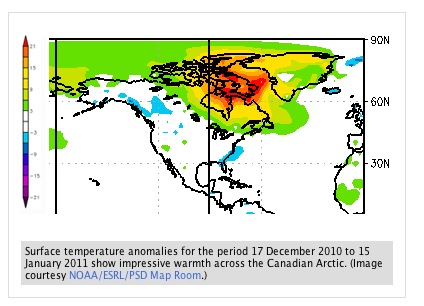
Northern Canada’s Winter Heat Wave

Canada’s average temperature for 2010 was 3.0°C above normal — the warmest year on record (source: Environment Canada)

Although cooler in the south where every one lives, Canada’s north has been breaking records for warmth in the middle of winter in a region where there is no sun until spring! I’ve covered this a couple of weeks ago and the reasons why Arctic Hothouse Turns Europe into an Icebox

This is a more recent report from the National Center for Atmospheric Research in Boulder by Bob Henson. — Stephen

“Just how mild has it been? The map at right shows departures from average surface temperatures for the period from 17 December 2010 to 15 January 2011, as calculated by NOAA’s Earth Systems Research Laboratory.

The blue blip along the southeast U.S. coast indicates readings between 3°C and 6°C (5.4–10.8°F) below average for the 30-day period as a whole…

What really jumps out, though, is a blob of green, yellow, orange, and red covering a major swath of northern and eastern Canada. The largest anomalies here exceed 21°C (37.8°F) above average, which are very large values to be sustained for an entire month.

To put this picture into even sharper focus, let’s take a look at Coral Harbour, located at the northwest corner of Hudson Bay in the province of Nunavut. On a typical mid-January day, the town drops to a low of –34°C (–29.2°F) and reaches a high of just -26°C (–14.8°F). Compare that to what Coral Harbour actually experienced:

  • On the 6th of the month, the low temperature was –3.7°C (25.3°F). That’s a remarkable 30°C (54°F) above average.
  • On both the 5th and 6th, Coral Harbor inched above the freezing mark. Before this year, temperatures above 0°C (32°F) had never been recorded in the entire three months of January, February, and March.

Related articles/posts:

Climate Change Could Be Worsening Effects of El Niño -La Niña

Ice-cold Atlanta (and eastern US) Is Likely Connected to Arctic Hothouse

The Yin and Yang of Climate Extremes We Will See More of

    Ice-cold Atlanta (and eastern US) Is Likely Connected to Arctic Hothouse

    But first…

    That’s a great cartoon.

    Climate change seems to be behind the shockingly warm temps across much of the eastern Arctic all winter and is likely responsible for the snow has fallen across much of the southern US. Much of Arctic ice sea melted last summer, allowing the Arctic ocean to warm up which then took longer to freeze i.e. late Dec/ Jan. And that changed the wind circulation patterns bringing polar air far south. (See my previous post that explains what is happening East Coast Blizzard and Europe’s Snowmaggddon Reveal Fingerprints of Climate Change

    And for a collection of global temp graphs see this post
    Arctic Hothouse Turns Europe into an Icebox )

    And finally here’s a short video by Peter Sinclair of Climate Denial Crock of the Week explaining this: Global Warming. Winter Weirding.

    ]

    This is part of Community Supported Environmental Journalism, independent reporting supported by citizens in several countries thru one-time, weekly or monthly or in-kind donations.

    CANADA: A Govt Versus Its People on Climate Change

    Stephen Harper, Canadian politician
    Image via Wikipedia

    By Stephen Leahy

    UXBRIDGE, Nov 19, 2010 (IPS)

    The Canadian public is completely at odds with its own government on climate change, a new survey revealed Friday.

    A large majority of Canadians want urgent action on climate, including redirecting military expenditures to reduce greenhouse gas emissions. In sharp contrast, the Stephen Harper-led Conservative minority government used parliamentary trickery to kill pending legislation to reduce emissions that had already been passed by the majority of Canada’s elected representatives.

    “This is a real low point in Canadian democracy,” said Andrew Weaver, a climate scientist at the University of Victoria.

    “It’s an abuse of democracy like we’ve never seen before in this country,” Weaver told IPS.

    Do consider making a small automatic monthly contribution as a fair exchange for these articles.

    Continue reading

    ‘Don’t Worry Be Happy’ Canada Sees Global Warming “Prosperity” Instead of Calamity

    By Stephen Leahy

    UXBRIDGE, Canada, Oct 8, 2010 (IPS)

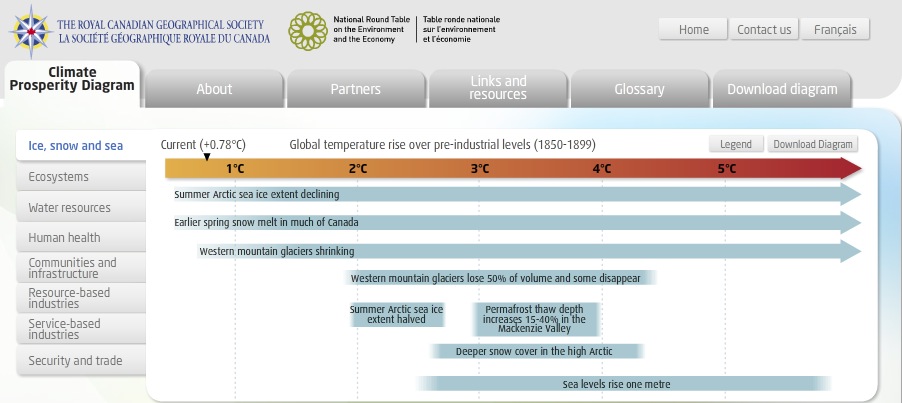
    The first comprehensive look at the expected impacts of climate change on Canada offers an embarrassing and misleading “don’t worry, be happy” vision, citing more golf days and better access to northern deposits of oil and gas courtesy of global warming, critics say.

    “The chart needs to be withdrawn,” said climate scientist Danny Harvey of the University of Toronto. “It is full of bad science and utterly downplays the serious impacts of climate change.”

    The chart Harvey referred to is the “Degrees of Change” interactive diagram released this week as part of a national educational initiative called “Climate Prosperity” by the prestigious Royal Canadian Geographical Society and the National Round Table on the Environment and the Economy (NRTEE).

    How can we (Canada) talk about profiting from climate change when most of the world will suffer devastating impacts, in part because of our emissions?” Harvey said.

    “It is disgusting.”

    In a release about the Climate Prosperity initiative, David McLaughlin, NRTEE president and CEO, said, “Adapt and prosper will be increasingly central to Canadian governments, communities, and businesses as these effects become more and more evident.”

    NRTEE officials did not respond to IPS requests for an interview.

    Is this article of interest? It exists thanks to contributions from readers. Please click here to learn more about Community Supported Journalism.

    Continue reading

    Canada’s “Mordor” Ensures Climate Treaty Failure in Copenhagen
    [Hello from snowy and cold Copenhagen. Tensions have ramped up as political leaders arrived but are mainly meeting in secret.

    Ashamed to say Canada is a widely acknowledged as a public embarrassment here. And called a climate criminal by some. Several protests like the one I covered below and a smaller one earlier have focused on the Athabasca Tar Sands perhaps the world’s biggest source of carbon emissions.

    Outside the artificial reality of the Bella Center ordinary people get it. Here is good video summary of what happened on Wed as civil society were gradually banned from the conference. It accords with my son’s version who was in the middle of all this as an observer. — Steve]


    By Stephen Leahy

    COPENHAGEN (IPS/TerraViva) Dec 14 2009

    Climate activists jammed a small square near the police-barricaded Canadian Embassy here Monday for the second day of protests over the country’s tar sands development.

    Simultaneous protests were held at the Canadian Embassy in London because British oil companies and financial institutions are deeply invested in the Canadian mega-project.

    “As indigenous people, we are here at the international climate negotiations to speak about threats to our cultural survival and the direct life-threatening impacts of climate change in our communities,” said Clayton Thomas Muller, tar sands campaigner for the Indigenous Environmental Network.

    “Canada has been blocking the climate negotiations and hasn’t kept Kyoto commitments…because of the tar sands,” he told a crowd of 75 to 100 people surrounded by four squads of riot police.

    Boreal forests and wetlands the size of Greece are been destroyed in northern Alberta in an industrial project that turns millions of tonnes of sand and earth into oil, mainly for the U.S. market he said.

    “All the efforts by Canadians to reduce their carbon emissions are undone by the tar sands,” said Canadian writer and activist Naomi Klein.

    The tar sands are Canada’s largest single source of carbon dioxide (CO2) emissions and the major reason why Canada has refused to live up to its commitments to reduce emissions and is blocking negotiations, Klein told protesters.

    “Canada is making a mockery of international law and of developing countries’ need for urgent emission reductions in rich countries,” she said.

    Canadian Prime Minister Stephen Harper is here at the Dec. 7-18 U.N.-sponsored climate summit under false pretences, Klein charged.

    Harper does not have the Canadian people’s permission to promote the tar sands or to favour Canadian interests over those of the planet,” she said.

    The tar sands are “Canada’s Mordor”, said Maude Barlow, head of the Council of Canadians, the largest citizens’ group in Canada. She was referring to the devastated land of rock and fire in the “Lord of the Rings” trilogy.

    “What else can you call a project that leaks 11 million litres of toxic waste a day into rivers and groundwater?” Barlow said in this very un-Mordor upscale shopping district of downtown Copenhagen.

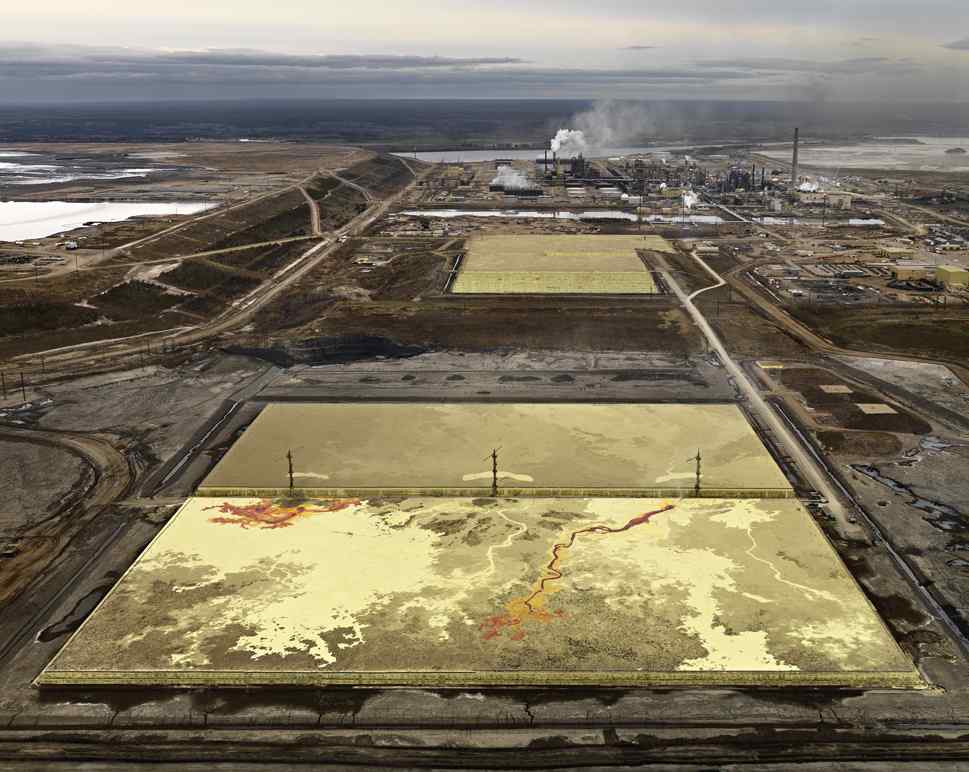
    The tar sands project has the largest toxic waste containment ponds on the planet – easily visible from space. Last week, a report revealed the extent of the leaks to be an estimated 11 million litres a day.

    Shockingly, this is based on the oil companies’ own self-reported data, says Environmental Defence, the Canadian advocacy, research and education group that compiled the report.

    It calculated that four billion litres of leakage a year will grow to 25 billion in a decade based on current growth of the tar sands and aging of the enormous dams that hold back the waste.

    “There is no question Harper will stand up for  the oil sector [in the climate talks here],” Barlow said.

    Their [oil industry] footprints are all over this negotiation and that is why it will fail.”

    -30-

    Corrected 2/2/12

    For more on the Tar Sands see:

    Oil Stains in the Boreal Forest: The Environmental Cost of Canada’s Oil Sands – Revised V2.1Oil Stains in the Boreal Forest: The Environmental Cost of Canada’s Oil Sands – Revised V2.1

    Canada’s Shocking Environmental Decline


    fall-colours-lakeridge-06.jpg

    By Stephen Leahy* – IPS/IFEJ

    In the past 15 years, all of Canada’s environmental indicators have suffered, say experts who distribute the blame among local and national governments, businesses and the public.

    TORONTO, Nov 5 2007 (Tierramérica).

    In the 1980s, Canada was a bright green engine of change, pushing the global community forward on sustainable development and global warming. But now it is falling behind in almost every environmental aspect.

    The lead author of the landmark 1987 Bruntland Report, “Our Common Future“, was Canadian Jim MacNeill. The very first international climate change meeting involving scientists and political leaders was held in Toronto in 1988.

    Canadian Maurice Strong organized the first World Conference on the Environment in Stockholm in 1972, was the first executive director of the United Nations Environment Program (UNEP), and was secretary-general of the 1992 Earth Summit in Rio de Janeiro.

    But after this flourish on the world stage, Canada sat back and did virtually nothing domestically. The country ranks 28th out of 30 high-income countries in terms of environmental sustainability, according to an independent Canadian study. The Organization for Economic Cooperation and Development ranked Canada 27th in terms of environmental performance. Continue reading

    Destroying Canada’s Forests for America’s Oil

    “Nowhere else in the world where this much money is being invested”

    cover 2.0**REVISED** Oil Stains in the Boreal Forest:

    The Environmental Cost of Canada’s Oil Sands

    An eBook by Stephen Leahy

    Oil Stains in the Boreal Forest is a 30-page eBook presenting a factual overview of the environmental impacts of pumping more than 1.1 million barrels of oil — 175 million litres (50 million gallons) — each day to thirsty US markets.

    Based on a 4-part investigative journalism series, leading scientific and environmental experts along with industry officials are interviewed.

    Recipe for making a make a gallon of gasoline from the oil sands:

    • burn 1500 cubic feet of natural gas
    • use up 700 litres of water
    • dig up two tonnes of earth and rock
    • dump 948 litres (250 gallons) of mine tailings

    And that’s just the beginning – now the crude has to be processed.

    Oil Stains in the Boreal Forest   includes pictures of the destruction of virgin boreal forest, links to access additional information, and a peek at a new economic study that shows oil company profits are subsidized by not having to pay for their pollution.

    Download your copy of the updated 2009 version 2.1 today for only $3.75
    Oil Stains in the Boreal Forest: The Environmental Cost of Canada’s Oil Sands 2.1

    eBook -Version 2.1 (2009) – full-color, 8 1/2 x 11″,  30 pages   (14 mb pdf download) 

    Learn more about the author