Global Forest Decline with Warming Temperatures Scientists Warn

Image

Forests diebacks are taking place all around the world. The evidence is quite sobering,” said tropical biologist Daniel Nepstad of IPAM in Belem, Brazil.

This reinforces the urgent need to reduce emissions of fossils fuels and to develop a global land strategy to turn sources of CO2 into sinks for CO2, he said.

“Most of the evidence shows climate change is speeding up. Meanwhile political action on climate is slowing down,” Nepstad added.

–From a previous post on how the loss of trees to deforestation, drought and disease is accelerating climate change.

Revealed: In Acidic Oceans Sunlight Kills Planet’s Most Important Organism — Marine Algae

A number of marine diatom cells (Pleurosigma), which are an important group of phytoplankton in the oceans.
Credit: Michael Stringer

“There’s a synergistic effect between increased ocean acidity and natural light”

“It’s clear we are conducting a giant experiment on the planet and we don’t know what we are doing.”

 By Stephen Leahy

UXBRIDGE, Canada, May 8, 2012 (IPS)

Without major reductions in the use of fossil fuels, sunlight will kill an unknown number of ocean phytoplankton, the planet’s most important organism, a new study reports this week.

Not only are phytoplankton, also known as marine algae, a vital component in the ocean’s food chain, they generate at least half of the oxygen we breathe.

In the not so distant future, sunlight, the very source of life for phytoplankton, will likely begin to kill them because of the ocean’s increasing acidity, researchers from China and Germany have learned.

“There’s a synergistic effect between increased ocean acidity and natural light,” says Ulf Riebesell of the Helmholtz Centre for Ocean Research in Kiel, Germany.

Riebesell added that it was also possible “phytoplankton could adapt”.

Researchers were surprised to discover that diatoms, one of the most important and abundant types of phytoplankton, fared very badly during shipboard experiments conducted by co-author Kunshan Gao, from the State Key Laboratory of Marine Environmental Science at Xiamen University, Xiamen China.

Previous experiments in labs like Riebesell’s found that diatoms actually did better in high-acid seawater, unlike most other shell- forming plankton. Burning fossil fuels has made the oceans about 30 percent more acidic researchers discovered less than 10 years ago. Oceans absorb one third of the carbon dioxide (CO2) emitted from using fossil fuels.

The good news is this has slowed the rate of global warming. The bad news is oceans are now more acidic and it will get worse as more CO2 is emitted. This is basic, well-understood ocean chemistry.  Continue reading

Imagination, Not Science, Is The Key To Solving Climate Change

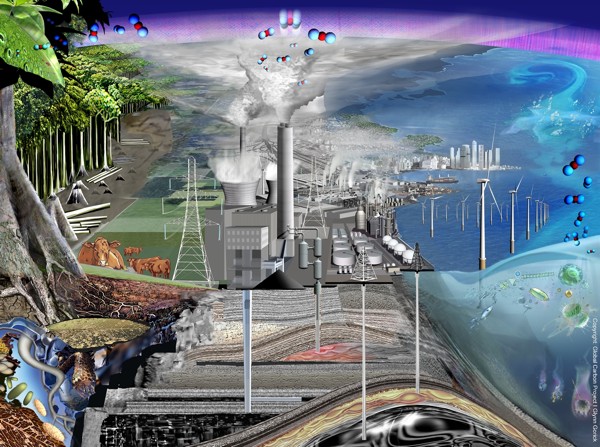
Artists Impressions- Human Perturbation Of Carbon Cycle. © Global Carbon Project I Glynn Gorick

This article has been picked up and widely reported around the web and that’s great as long as it continues to have my name on it with a link to my website.  (And if you like it, please help this work continue) — Stephen

By Stephen Leahy

VANCOUVER, Canada, Feb 20, 2012 (IPS)

Humanity’s failure to halt the deepening planetary emergency of climate change, extinctions of species and overconsumption of resources is a failure of imagination and mistaken beliefs that we act rationally.

The path to a truly sustainable future is through the muddy waters of emotions, values, ethics and most importantly, imagination, said artists and social scientists at the American Academy for the Advancement of Science (AAAS) conference here in Vancouver, British Columbia.

“We don’t live in the real world but live only in the world we imagine,” said David Maggs, a concert pianist and Phd student at the Institute for Resources, Environment and Sustainability at the University of British Columbia (UBC).

Our perception of reality is filtered by our personal experiences and values. That’s why the “if we only knew better, we’d do better” education and communication paradigm isn’t working, Maggs said. The underlying assumption that a failure to become more sustainable is the result of a lack of information is flawed, he told attendees at what is the world’s largest general science meeting.

“We live in our heads. We live in storyland,” agrees John Robinson of UBC’s Institute for Resources, Environment and Sustainability.

   Become a Partner in Independent Enviro Journalism

“When we talk about sustainability we are talking about the future, how things could be. This is the landscape of imagination,” Robinson told IPS. “If we can’t imagine a better world we won’t get it.”

This imagining will be complex and difficult. Sustainability encompasses far more than just scientific facts – it also incorporates the idea of how we relate to nature and to ourselves, he said.

“We haven’t yet grasped the depth of changes that are coming.” Continue reading

Extreme Weather is the New Normal with Climate Change

Aftermath of an early tornado in Lancaster, Texas. To join thousands of others connecting the dots between climate change and extreme weather, visit ClimateDots.org.

By Stephen Leahy

CAIRNS, Australia, Apr 3, 2012 (Tierramérica)

Extreme weather is fast becoming the new normal. Canada and much of the United States experienced summer temperatures during winter this year, confirming the findings of a new report on extreme weather.

For two weeks this March most of North America baked under extraordinarily warm temperatures that melted all the snow and ice and broke 150-year-old temperature records by large margins.

Last year the U.S. endured 14 separate billion-dollar-plus weather disasters including flooding, hurricanes and tornados.

A new report from the Intergovernmental Panel on Climate Change (IPCC), released Mar. 28, provides solid evidence that record-breaking weather events are increasing in number and becoming more extreme. And if current rates of greenhouse gas emissions are maintained, these events will reach dangerous new levels over the coming century.

Since 1950 there have been many more heat waves and record warm temperatures than in previous decades.

This will only increase in future decades, as will heavier rainfall events in tropical regions and the high latitudes, according to the Special Report on Managing the Risks of Extreme Events and Disasters to Advance Climate Change Adaptation (SREX). 

The hottest day that occurs once in 20 years is likely to become a one-in-two year event by the end of the century, except in the high latitudes of the Northern hemisphere, where it is likely to happen once every five years.

The average tropical cyclone maximum wind speed is likely to increase, but the global frequency of tropical cyclones is likely to decrease or remain unchanged.

Continue reading

Indigenous Peoples Can Show the Path to Low-Carbon Living If Their Land Rights Are Recognized

Youba Sokona of Mali is co-chair of the IPCC Working Group III. Photo: Citt Williams, OurWorld2.0

by Stephen Leahy

First published at National Geographic’s NewsWatch

Many indigenous peoples are living examples of societies thriving with sustainable, low-carbon lifestyles. Successfully meeting the global climate change challenge requires that much of the world shift from high carbon-living to low.

This shift is daunting. Current emissions for Australia and the United States average about 20 tonnes of carbon dioxide per person. In the coming decades that needs to fall to two tonnes per person as it is currently in Brazil or the Dominican Republic.

Emissions from most indigenous peoples are even lower and are amongst the lowest in the world.

All options for making the shift from high- to low-carbon living need to be explored and that’s why the United Nations University Traditional Knowledge Initiative (UNU) and  Intergovernmental Panel on Climate Change (IPCC) invited indigenous peoples to a special three-day workshop in Cairns, Australia last week.

“Climate change is the result of our behaviour,” said Youba Sokona, co-chair of the IPCC Working Group III that will report to governments in 2014 on ways carbon emissions can be reduced.

The IPCC is the world authority on climate, assessing the state of knowledge on the issue every five to six years. Traditional knowledge of local and indigenous peoples have been left out until now.

“One of the critical solutions is to change our behavior, to change our production and consumption systems,” said Sokona, a climate expert from the African nation of Mali.

The Climate Change Mitigation with Local Communities and Indigenous peoples workshop offered a number of “examples of local peoples in Siberia, in Australia, northern Canada and in some African countries demonstrating that it is possible to change our behavior,” he said.

Marilyn Wallace, a Kuku Nyungkal Aboriginal woman. Photo: Citt Williams, OneWorld 2.0

“I live in a shack but I love being on my ‘bubu’, my traditional land,” said Marilyn Wallace of the Kuku Nyungka ‘mob’ (tribe) in northern Queensland, Australia.

Wallace has lived in towns but fought for years to “return to country” and live in her tropical forest homeland 60 kilometers from Cooktown.

At the workshop Wallace and every other indigenous delegate focused on land rights. The simple truth is that if they can’t live on and manage their lands with time-tested traditional methods, they can’t be part of the solution to climate change.

For complete article see Nat Geo’s NewsWatch


The New Beast in the Forest Brings Hope and Threats to Indigenous Peoples

Deforestation for oil palm plantation West Kalimantan, Indonesia. Photo Karmele Llano SanchezInternational Animal Rescue

by Stephen Leahy

First published at National Geographic’s NewsWatch

“REDD is the new beast in the forest,” said Patrick Anderson of the Forest Peoples Programme in Indonesia here at Climate Change Mitigation with Local Communities and Indigenous peoples workshop in Cairns, Australia.

Deforestation gobbles up an area the size of Greece (13 million hectares) every year. As if that loss wasn’t bad enough, it also produces huge amounts of greenhouse gas emissions — a whopping 15 to 20 percent of all global emissions. That’s second only to the burning of fossil fuels.

Sadly, in our economic system, trees are worth far more dead as paper, lumber, furniture, etc., than alive.

In an attempt to reverse this, countries in the United Nations have agreed to create a financial value for the carbon stored in forests in a program called REDD: Reducing Emissions from Deforestation and Forest Degradation.

This is how it works. Trees take heat-trapping carbon out of the atmosphere as they grow and store it for as long as the trees live. Instead of cutting down trees and selling the wood, the carbon trapped in the living trees can be sold as “carbon credits” on an open market.

A steel, cement, or coal-fired power company in the U.S. or a European country can then buy those credits instead of reducing its carbon emissions. The current price is around $10 per tonne but this fluctuates.

For example, the newly established Carbon Tax in Australia sets the price at $23 per ton in the first year of operations. (One hectare of tropical forest stores between 250-500 tonnes of carbon but varies considerably. An average car emits 1.5 tonne of carbon per year.)


‘Abriculture’ Using Forests to Feed Indigenous Peoples and Fight Climate Change

Seith Fourmile of Gimuy-Walubarra Yidinji Nation of Cairns, Jenny Lynch Abriculture Development Officer in Cairns.  Photo: Stephen Leahy

Forests can not only suck climate-heating carbon out of the atmosphere, they are also an important source of food for many Indigenous peoples.

“Western food is making our people sick. Our bodies are adapted to eating bush foods,” said Seith Fourmile of the Gimuy-Walubarra Yidinji Nation of Cairns.

Australia’s Aboriginal or Torres Strait Islander peoples suffer from rates of diabetes three to four times greater than other Australians. Rates of high blood pressure, cardiovascular, and kidney diseases are also higher. Similar health problems have been found among Alaska’s Eskimo and Canada’s Inuit peoples.

The world’s forests “offer a cornucopia of 80,000 species of plants as foods,” writes botanist and medical biochemist Diana Beresford-Kroeger in her book The Global Forest. Western foods rely on just a few species, while oral knowledge of the other thousands of species is rapidly being lost, according to Beresford-Kroger.

Click for full story


Thought Bubbles: Who Will Stand Up For Our Future on 5th of May?

Here’s a thoughtful article written by my son who is working on a farm in Tasmania. Normally he is a historical tour guide in Europe. He’s not part of any organization but just decided to take action for sake of his generation’s future.  It is amazing what he and his friends are up to. — Stephen 

By Derek Leahy

FRANKLIN, TASMANIA

I sat down in a café in Franklin, Tasmania the other day trying to sort out all that has transpired these past few weeks. You see, May 5thcould very well become a massive day of action. A lot of people from all over the world want to make their voices heard the week of May 5thInternational Stop the Tar Sands Day’s circle of friends just got bigger.

Anyway, I sat down in an practically empty café (Franklin is a pretty small town), opened up my journal to a blank page and took out a pencil. With the pencil I drew four separate thought bubbles on the page for four different campaigns or movements or whatever you want to call them.

The first was for 350.org’s Climate Impacts Day, which will take place the exact same day as ISTSDay; May 5th. The second thought bubble was for the Occupy Movement because members of Occupy in Canada and the UK have stepped up recently to help us out.

The last two bubbles were for International Stop the Tar Sands Day and for Ecocide. I threw in Ecocide because of an email I had received earlier in the day (thank you Kirstie for the inspiration!).  We have not talked to these guys about working together on May 5th. Yet.

Continue reading

Indigenous Peoples Needed to Meet the Challenge of Climate Change

Gimuy Wallabarra Yidinji Dancers performing Welcome to the Country in Cairns, Australia .Photo: Gleb Raygorodetsky

By Stephen Leahy

First published at National Geographic NewsWatch

“Planning is not part of our culture. You just get up in the morning and do what you need to do for the day,” said Marilyn Wallace of the Kuku Nyungka ‘mob’ (aboriginal nation) in northern Queensland, Australia.

“Bama” or caring for their local territory is an important part of aboriginal culture and identity Wallace told participants at a mini-workshop in Cairns, Australia today Sunday March 25th prior to the start of the main workshop Climate Change Mitigation with Local Communities and Indigenous peoples on Monday.

Caring for the land includes monitoring the impacts of climate change and using traditional knowledge to keep or sequester carbon she said.

Click here for full article plus a video visit with Marilyn in her home country.

Climate Scientists to Attend Native Knowledge ‘Boot Camp’ in Australia

By Stephen Leahy

First published at National Geographic NewsWatch

In what may be a ‘clash of worldviews,’ representatives from indigenous and local communities are holding a climate workshop with physicists, computer modellers, and other climate scientists from the Intergovernmental Panel on Climate Change (IPCC) in Cairns, Australia 26-28 March.

This is a unique opportunity for Native peoples to discuss their traditional knowledge and experiences as it relates to climate change.

Indigenous peoples are amongst the most affected by current and future climate change but their experiences and knowledge have largely been ignored by science experts at the IPCC. The workshop, Climate Change Mitigation with Local Communities and Indigenous Peoples: Practices, Lessons Learned and Prospects, is a significant effort to change this.

There are an estimated 350 million indigenous peoples according to the United Nations. They legally own more than 11% of the world’s forests and those coincide with areas that hold up to 80% of the world’s terrestrial biodiversity. Traditional knowledge is a different but no less valid way of understanding the world. However, very few scientists of the thousands who have worked with the IPCC have any experience with traditional knowledge.

The IPCC is working on its next big report (to be released in 2014) and has acknowledged that its Fifth Assessment Report needs to look at how climate change will impact indigenous peoples, their role in reducing carbon emissions (mitigation) and what barriers they face in adapting to current and future climate impacts.

The Cairns workshop will focus on how indigenous peoples can help reduce global carbon emissions. It is being held in collaboration with the IPCC, indigenous organizations, the United Nations University (UNU), the Australian government and others.

Follow the workshop on Facebook or Twitter