Sandy Says: “Bigger Superstorms Coming Unless Dial Down Thermostat”

Alaska temps in degrees F

I was born just over a week ago and more than 100 people have died in the US and Caribbean region as a result. For the rest of today please take care as I will continue to bring strong winds, heavy rains and snowfall from North Carolina to well into Canada. Some of the worst flooding hit Haiti in the hours after I’d passed by.

Read full post at Hurricane Sandy Speaks (crosspost)

Global Temperatures Rising on a Devastating Trajectory

Global temperatures are only 0.7C warmer — on pace for +4C!

By Stephen Leahy

UXBRIDGE, Canada, May 25, 2012 (IPS)

Climate-heating carbon emissions set a record high in 2011, in a 3.2 percent increase over the previous year, the International Energy Agency reported this week. The main reason for this dangerous increase is that governments are failing to implement policies to prevent catastrophic increases of global temperatures.

A new report released on the last days of international climate talks in Bonn, Germany this week reveals that the planet is heading to a temperature rise of at least 3.5 degrees Celsius, and likely more, according to the Climate Action Tracker (CAT), despite an international agreement to keep global temperature rise below two degrees Celsius.

Not only are pledges inadequate, but countries are unable to fulfill even those pledges, a new CAT analysis shows. CAT is a joint project of Dutch energy consulting organisation Ecofys, Germany’s Climate Analytics, and the Potsdam Institute for Climate Impact Research.

“When we compared the emission reduction pledges of countries like Brazil, Mexico and the U.S., we found they did not have the policies in place to meet those pledges,” said Niklas Höhne, director of energy and climate policy at Ecofys.

Höhne told IPS that they looked only at the policies of a few countries, but no country’s policies were enough to meet their targets. Continue reading

Standing Up for the Planet and the Future: Time to Stop Using Fossil Fuels

Coal power plant – Alberta

+15,000 temperature records already broken in the US this year 

By Stephen Leahy

UXBRIDGE, Canada, May 4, 2012 (IPS)

What are you doing on Saturday? Peter Nix, a retiree, will be standing on a railway track on Canada’s west coast blocking a coal train destined to ship U.S. and Canadian coal to Asia.

Nix will be joined by dozens of people near White Rock, British Columbia on May 5. They will be in good company as tens of thousands of people around the world participate in global day of action to “connect the dots” between climate change and extreme weather.

“There will be at least 1,200 actions in more than 100 countries,” says Jamie Henn, communications director for 350.org, a U.S.-based environmental group.

Please throw something in the tip jar before reading on. This is how I make my living.
There’s been a general perception that climate change is a future problem but with all the extreme weather disasters and weather records the public is being to realise that climate change is here, says Henn.

“Recent opinion surveys show the more than 60 percent of the U.S. public are connecting extreme weather to climate change,” Henn told IPS.

The U.S. public is not wrong, say scientists. 

“All weather events are affected by climate change because the environment in which they occur is warmer and moister than it used to be,” Kevin Trenberth, senior scientist at the U.S. National Center for Atmospheric Research, told IPS previously.  Continue reading

Fracking and Shale Gas Accelerating Global Warming

UPDATE Jan 2013:

Yet another study reveals fracking has a huge problem of gas leaks. Up to  9% of the gas pumped out of the ground leaks into the atmosphere according to a study by National Oceanic and Atmospheric Administration (NOAA) published in Nature this week. Natural gas (methane) is a powerful greenhouse gas. If these leaks are widespread, fracking is worse than burning coal, accelerating global warming.

In Jan 2012 I detailed new research in the article below showing that replacing coal with natural gas from fracking does little to fight climate change (see below). Now two studies published that since then make an even stronger case that fracking for natural gas is a HUGE MISTAKE:

From Nature: Air sampling reveals high emissions from gas field. Methane leaks during production may offset climate benefits of natural gas.

From Environmental Research Letters: New study demonstrates switching to natural gas is the path to climate disaster. What’s needed is an aggressive deployment of zero-carbon technologies and conservation. Joe Romm explains. — Stephen

Shale Gas Worse Than Coal Study Finds

By Stephen Leahy

UXBRIDGE, Canada, Jan 24, 2012 (IPS)

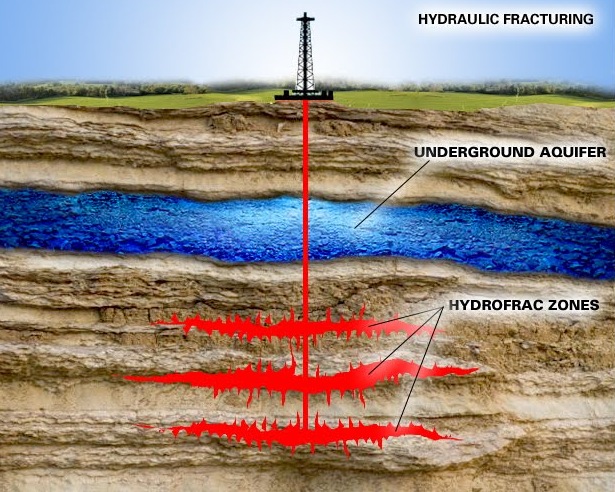
Hundreds of thousands of shale gas wells are being “fracked” in the United States and Canada, allowing large amounts of methane, a highly potent greenhouse gas, to escape into the atmosphere, new studies have shown.

Shale gas production results in 40 to 60 percent more global warming emissions than conventional gas, said Robert Howarth of Cornell University in New York State.

“Shale gas also has a larger greenhouse gas footprint than oil or coal over the short term,” said Howarth, co-author of a study called “Venting and Leaking of Methane from Shale Gas Development” to be published in the journal Climatic Change.

(Audio of news conference)http://of%20news%20conference

This latest study follows up on Howarth and colleagues’ controversial April 2011 paper that provided the first comprehensive analysis of greenhouse gas emissions from shale gas obtained by hydraulic fracturing. That study found that when gas wells are “fracked”, they leak large amounts of methane and pose a significant threat to the global climate.

“We stand by the conclusion of our 2011 research,” said Howarth.

That research undercuts the logic of energy sector claims that shale gas is a “bridge” to a low-carbon energy future. Those claims are based on the fact that natural gas (which is mainly methane) has half the carbon content of coal, and when burned for electricity it is more energy efficient than coal.

This independent  journalism depends on public support. Click here learn more.

However, those climate gains are more than negated by methane leaks both at the well during the fracking process (called flow-back), and through the gas delivery and distribution system. Howarth and colleagues estimate that between 3.6 and 7.9 percent of all shale gas produced leaks – called “fugitive emissions” – into the atmosphere, making it worse than burning coal or oil.

Please throw something in the tip jar before reading on.
This is how I make my living.

Continue reading

Europe to cook the world’s tropical forests for biofuels — British told to back off targets by its climate advisors

UPDATE 13 Sept: UK must cut biofuels target “so that tropical forests are not cut down to make way for biofuel crops, government climate advisors said last Friday.”

“Europe is going to cook the world’s tropical forests to fight climate change; it’s crazy” — Millions of Trees Burned for ‘Green Energy’ Burning trees for energy produces 1.5 times as much carbon as coal – study shows

By Stephen Leahy*

UXBRIDGE, Canada, Sep 24 ’09 (Tierramérica) (Revised Sept 1’10)

Millions of trees, especially from the developing countries of the South, are being shipped to Europe and burned in giant furnaces to meet “green energy” requirements … Read More

via Stephen Leahy, International Environmental Journalist

“Europe is going to cook the world’s tropical forests to fight climate change; it’s crazy” — Millions of Trees Burned for ‘Green Energy’

Burning trees for energy produces 1.5 times as much carbon as coal – study shows

By Stephen Leahy*

UXBRIDGE, Canada, Sep 24 ’09 (Tierramérica) (Revised Sept 1’10)

Millions of trees, especially from the developing countries of the South, are being shipped to Europe and burned in giant furnaces to meet “green energy” requirements that are supposed to combat climate change.

In the last two months alone, energy companies in Britain have announced the construction of at least six new biomass power generation plants to produce 1,200 megawatts of energy, primarily from burning woodchips.

At least another 1,200 megawatts of wood-fired energy plants, including the world’s largest, in Port Talbot, Wales, are already under construction.

Those energy plants will burn 20 to 30 million tonnes of wood annually, nearly all imported from other regions and equivalent to at least one million hectares of forest.

“Europe is going to cook the world’s tropical forests to fight climate change; it’s crazy,”Simone Lovera, of the non-governmental Global Forest Coalition, which has a southern officed in Asunción, Paraguay, told Tierramérica.

Do you find this article interesting? It exists thanks to contributions from readers. Please click here to learn more about Community Supported Journalism.

Europe has committed to reducing its carbon emissions 20 percent by 2020 in an effort to fight climate change. Biofuels and biomass energy will have key roles in achieving those goals, experts say.

[UPDATE: New story details regarding subsidies, increased air pollution from wood burning and the big lie that says ‘burning wood is carbon-neutral’: see Europe’s Green Energy Portfolio Up in Smoke?]

“Biomass is a very promising sector for energy companies,” says Jarret Adams, a spokesperson for Adage, a joint venture between French nuclear power giant Areva and the U.S.-based Duke Energy.

Adage is building a 50-megawatt, wood-burning power plant in the southeastern U.S. state of Florida, the first of 12 such “green energy” plants to be built over the next six years, Adams told Tierramérica.

“Burning wood for energy is considered carbon neutral by U.S. federal and state authorities,” he said. In other words, the process of generating electricity by burning wood emits an equal or lesser amount of carbon dioxide than the quantity absorbed by the trees through photosynthesis.

When Tierramérica questioned the assumption of carbon neutrality, Adams replied, “It is, but who knows for certain?”

See complete original story here.


Burning Oil, Gasoline, Coal Causes Heart Attacks – American Heart Association

Researchers have long proven emissions from cars, trucks, coal plants reduce air quality and affect our health. Yet another study documents the serious health impacts on all of us, specifically our heart and arteries.

Reuters take:

The evidence is stronger than ever that pollution from industry, traffic and power generation causes strokes and heart attacks, and people should avoid breathing in smog, the American Heart Association said on Monday. Continue reading

Arctic Melts As Banks Invest Billions in Coal

By Stephen Leahy


Credit:Ed Brown

Coal-fired power plant in central Virginia, U.S.

Oct 2 (IPS) – As global warming melts the Arctic, the United States’s biggest banks are investing billions of dollars in as many as 150 new coal-fired power plants around the country.

The obvious climatic and fiscal stupidity of such investments is staggering, say environmentalists.

“What are they (the banks) thinking?” asked Leslie Lowe, energy and environment programme director at the Interfaith Centre on Corporate Responsibility.

Carbon regulations are coming, and profiting from the destruction of nature and communities is immoral in any case, Lowe told IPS at a press conference. Carbon regulations are coming, and profiting from the destruction of nature and communities is immoral in any case, Lowe told IPS at a press conference.

“It is folly to build new coal-fired plants,” she said. Continue reading

New Era of Spin in the War to Save Ourselves From Global Warming

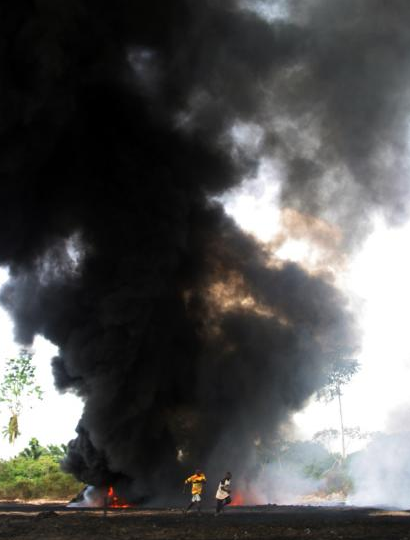
No Getting Around Emissions Caps, Experts Saynigerian oil field

By Stephen Leahy

Feb 5 (IPS) – With the stark realisation that global warming is transforming our world, there will be crazy new era of “greenwashing”, desperate “geo-engineering” schemes, “grandfathering” of newly-built coal power plants and carbon-credit “profiteering”, environmentalists warn.

Welcome to the battle to save ourselves and future generations from the worst impacts of climate change, like increased floods, droughts and storms.
Continue reading