2013 Carbon Emissions On Deadly Path to 5C

global-carbon-budget-2010-e1371236101998

By Stephen Leahy

WARSAW, Nov 19 2013 (IPS)

Burning of fossil fuels added a record 36 billion tonnes of CO2 to the atmosphere in 2013, locking in even more heating of the planet.

Global CO2 emissions are projected to rise 2.1 percent higher than 2012, the previous record high, according to a new report released Tuesday by the Global Carbon Project.

“Going beyond two degrees C is very risky, it’s completely unknown territory.” — Corinne Le Quéré

This increase is slightly less than the 2000-2013 average of 3.1 percent, said lead author Corinne Le Quéré of the Tyndall Centre for Climate Change Research in the UK.

“This is the second year in a row of below average emissions. Perhaps this represents cautious progress,” Le Quéré told IPS.

Still, these hard numbers demonstrate that the U.N. climate talks have failed to curb the growth in emissions. And there is little optimism that the latest talks known as COP19 here in Warsaw will change the situation even with the arrival of high-level ministers Wednesday.

Global emissions continue to be within the highest scenario of the Intergovernmental Panel on Climate Change (IPCC), she said.

“This is a five-degree C trajectory. It’s absolutely tragic for humanity to be on this pathway,” Le Quéré said.

For full story

Japan Bails Out on CO2 Emissions Target

cop presidentBy Stephen Leahy

WARSAW, Nov 15 2013 (IPS)   Japan announced Friday that it will renege on its carbon emissions pledge, likely ending any hope global warming can be kept to 2.0 degrees C.

The shocking announcement comes on the fifth day of the U.N. climate talks in Warsaw known as COP19, where more than 190 nations have agreed to a 2.0 C target and are trying to close the carbon emission gap to get there.

“It’s like a slap in the face of those suffering from the impacts of climate change such as the Philippines.” — Wael Hmaidan

Japan will increase that gap three to four percent with its new 2020 reduction target, according to the Climate Action Tracker (CAT). It amounts to a three-percent increase compared to a 1990 baseline. Japan’s 2009 Copenhagen Accord pledge was a 25 percent reduction by 2020.

“Japan is taking us in the opposite direction,” Marion Vieweg of Climate Analytics, a German climate research organisation, told IPS here in Warsaw.

“Their revision shows the bottom up approach is not working if countries can simply drop their pledges at any time,” Vieweg said.

Climate scientists have long maintained that the 2020 target for industrialised countries should be to reduce emissions 25-40 percent compared to a 1990 baseline. However, even if nations meet their current climate pledges under the Copenhagen Accord, CO2 emissions in 2020 are likely to be eight to 12 billion tonnes higher than what’s needed, according to the U.N. Environment Programme’sEmissions Gap Report 2013.

Japan, the fifth largest emitter of CO2, is just the latest to abandon its international commitments.

The Bigger Canada’s Energy Sector Gets the Poorer People Become

By Stephen Leahy

Thu, 2013-03-21 05:00 DeSmog Canada

Blame Canada is a four part series revealing how Canada has become a wealthy, fossil-fuelled energy superpower and an international climate pariah. For Part 1, click here. Part 2 here

Few are aware Canada’s GDP shot up from an average of $600 billion per year in the 1990s to more than $1.7 trillion in 2012. This near tripling of the GDP is largely due to fossil fuel investments and exports.

However not many Canadians are three times wealthier. For one thing GDP is only a measure economic activity. The other reason is that little of this new wealth stayed in Canada. And what did stay went to a small percentage of the population, worsening the gap between rich and poor.

One of the hallmarks of a “petro-state” is that while a country’s energy industry generates fantastic amounts of money, the bulk of its citizens remain poor. Nigeria is a good example. Canada’s poverty rates have skyrocketed in step with the growth of the energy sector. One Canadian child in seven now lives in poverty, according to the Conference Board of Canada, the country’s foremost independent research organization.

Income inequality increased faster than the US, with the rich getting richer and poor and middle class losing grounds over the past 15 to 20 years, the Conference Board also reported January 2013.

“Most of Canada’s increase in wealth went to the big shareholders in the resource industries,” says Daniel Drache, a political scientist at Toronto’s York University. “It mainly went to the elites.”

Full Story: http://desmog.ca/2013/03/20/blame-canada-part-3-bigger-canada-s-energy-sector-gets-poorer-people-become_

Canada’s Plan to Get Rich by Trashing the Climate

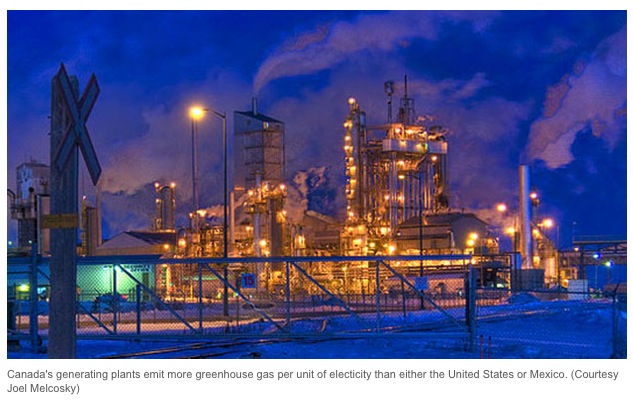
Canada's fossil fuel electricity has highest carbon emissions

By Stephen Leahy

Blame Canada is a four part series revealing how Canada has become a wealthy, fossil-fuelled energy superpower and an international climate pariah. For Part 1, click here.

Like every other country in the world, Canada has promised to help keep global warming to less than 2 degrees C. However Canada’s political and corporate leadership are committed to turning the country into a fossil-fuelled “energy superpower.”

With a drug lord’s just-providing-a-service hypocrisy Canada has openly declared it’s future is tied to the profits from dumping hundreds of millions of tonnes of climate-heating carbon into the atmosphere every year.

And the world’s new energy superpower plans to grow those annual emissions to 1.5 billion tonnes by 2020 giving one of the least populated countries a gigantic carbon bootprint.

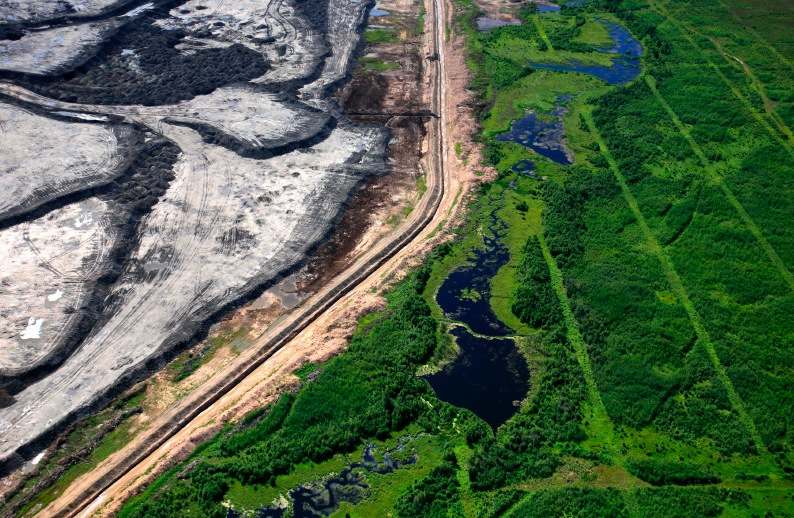
Most of this climate-wrecking carbon energy will come from Canada’s tar sands located just underneath the pristine boreal forest and wetlands of northern Alberta. The oil industry likes to call them “oil sands,” although there is no liquid oil only a tarry bitumen mixed deep in the sandy soil.

With an estimated 170 billion barrels, the tar sands are the third largest crude oil reserves. Extraordinary efforts involving colossal amounts of water, heat, chemicals and machinery are needed to get the bitumen out of the ground and into pipelines. This the world’s largest industrial project with more than $300 billion invested since 2001 by the oil industry.

Nowhere has fossil energy expansion or investment been faster or larger. Environmental activists call it “Canada’s Mordor.”

Canada Has Become a Petro-State, Happily Drilling for Profits as the World Warms

tar sands - visible from space,tarnished earth

Thu, 2013-03-07 08:00 STEPHEN LEAHY

What’s happened to Canada? To the dismay of many a country with an international reputation for relatively progressive environmental policies (at least compared to the United States) is rushing headlong to dig up all the oil, gas, and coal it can. The country’s leaders can scarcely muster the effort to pretend to want to limit climate-heating carbon emissions.

And the Canadian business establishment and media have largely gone along with the program. Put it all together, and you have a country that has become a full-blown “petrostate.”

People are starting to notice. Last December at the UN climate talks in Doha, Qatar, Canada beat out tough contenders like Saudi Arabia to be elected “Colossal Fossil” by environmental organizations from around the planet. Canada had the dishonor of being the most uncooperative country out of 193 nations at the climate summit. It was the sixth year in a row that international environmental groups gave Canada their ‘highest’ award for its persistent efforts to block any agreement on reducing carbon emissions.

What’s happened to Canada is that it has experienced a steady takeover by the fossil fuel industry.

Canada’s is now the world’s fifth largest crude oil producer and the biggest supplier of oil to the US. Canada is also the third largest producer of natural gas and one of the top ten miners of coal. This enormous boom in fossil fuel production has been underway since the late 1990s. Like Saudi Arabia, fossil energy is by far Canada’s biggest export and has become the dominant economic and political focus.

Full story click below:

Blame Canada is a four part series revealing how Canada has become a fossil-fuelled energy superpower that’s going to wreck its future and the global climate.

Critics Brand Climate Talks Another Lost Opportunity

findlay ohio flooding AP

By Stephen Leahy

DOHA, Qatar, Dec 11 2012 (IPS)

Rich countries came to the U.N. climate talks in Doha intent on delaying needed action on climate change for another three years and a still to be hammered out new global treaty.

This delay will be extraordinarily expensive and risky.

Every year that fossil fuel emissions fail to decline adds to the cost and reduces the odds that a global temperature rise can be kept below two degrees C.

“Science says emissions need to peak in 2015,” said Kumi Naidoo, executive director of Greenpeace International, as the final plenary of COP 18 concluded last Saturday night, a full day late.

The 195 parties to the U.N. Framework Convention on Climate Change (UNFCCC) approved a set of documents called “The Doha Climate Gateway” that does not increase emission reductions or guarantee much-needed financial help to poor countries suffering present and future impacts of climate change.

“Doha is a betrayal of people living with impacts now. And it is a sellout of our children and grandchildren’s future,” said Naidoo.

“The fossil fuel industry won,” said Alden Meyer, the Union of Concerned Scientists’ director of strategy and policy, who has attended nearly every one of these climate negotiations over the past 18 years.

“The science is clear that four-fifths of known fossil fuel reserves must stay in the ground but we continue to burn them like there is no tomorrow,” Meyer said.

“Doha became more of a trade fair…Negotiators protected the interests of corporations and not the needs of people,” he told IPS.

More than 16,000 delegates participated in the two-week conference of the parties (COP) in Doha, Qatar, a country rich in oil and gas in the heart of the Middle East fossil fuel empire.

Meyer, along with representatives from more than 700 civil society organisations, blamed the U.S. for blocking proposals for greater emissions cuts. The U.S. also refused to commit a singly penny to assisting countries hard hit by climate change. U.S. negotiators did acknowledge poor countries were suffering costly damages and losses.

The world has already warmed 0.8 degrees C, altering weather patterns and increasing extreme events which have led to nearly 400,000 deaths and more than 1.2 trillion dollars being lost every year, according a 2011 study.

A delegate from Bangladesh told IPS that climate-related damages cost his country three to four percent of its annual GDP. Climate change, which is also driven by deforestation and land conversion for agriculture, is undercutting development and will push his country’s and other countries’ economies into a steady decline, he said.

To help governments cope, industrialised nations promised to put 100 billion dollars a year into a Green Climate Fund by 2020. To bridge the gap until then, developing nations asked for 60 billion dollars in total by 2015. Britain, Germany and a few other countries promised to contribute six billion dollars.

But the U.S., Canada, Japan and others agreed only to more talks next year.

“The U.S. spends 60 billion dollars on its military marching bands,” said Naidoo.

The only hope is to build a robust grassroots movement to force countries to act in the interest of the public and future generations, he said.

“We have to build a new social movement like (the one) that overcame slavery,” agreed Oxfam International climate change policy advisor Tim Gore.

“We reject what our leaders are doing here. We are more angry, more impassioned to defeat this process,” said Gore.

The COP process is an obstacle because a few big countries can easily block the will of the majority, said Mohamed Aslam, former environment minister and chief negotiator for the Republic of the Maldives.

“The signs of global warming are obvious and we know that the safe limit is to stay below 1.5 C…and yet we are failing to act,” Aslam said in a press conference.

The U.N. spends millions of dollars on these negotiations and they are going nowhere, he said. “We are running out of time. (We) need to take this to another fora,” he said.

What is lacking is a real commitment to reduce global emissions, said Christina Figueres, executive secretary of the United Nations Framework Convention on Climate Change (UNFCCC).

“What needs to change most is political will,” Figueres told IPS.

In Doha, the U.N. secretary-general announced a world leaders’ summit in 2014 to hammer out emission reduction targets to keep warming below two degrees C. The Doha Climate Gateway confirmed details for a new negotiation track to have a new global climate treaty ready for ratification in 2015 and go into force in 2020.

Under this agreement all countries will likely be obligated to make emission cuts, varying in depth and timing. Without additional cuts before 2020, reductions afterwards will need to be rapid and massive, moving to a zero-fossil fuel emission society in a few decades based on the science.

The Doha agreement includes a second phase of the Kyoto Protocol with the European Union, Australia and a few other countries agreeing to cut fossil fuel emissions between 2013 and 2020. However, they did not set new targets, agreeing instead to a mandatory review of targets in 2014.

The nations involved only represent 12 percent of global emissions, and do not include large developing country emitters like China, India and Brazil. The U.S. has never participated, while Canada and Japan have opted out of the second phase but are supposed to make to make comparable cuts but offered nothing new.

“Rich countries think they can protect themselves from the impacts, leaving the poor with no clear pathway to the future,” said Mohamed Adow of Christian Aid.

“Our leaders have let us down. Civil society will have to lead to get the future we really want,” said Adow.

Original IPS story

“We’re all scared…But we must tell the truth” — Experts Fear Collapse of Global Civilisation

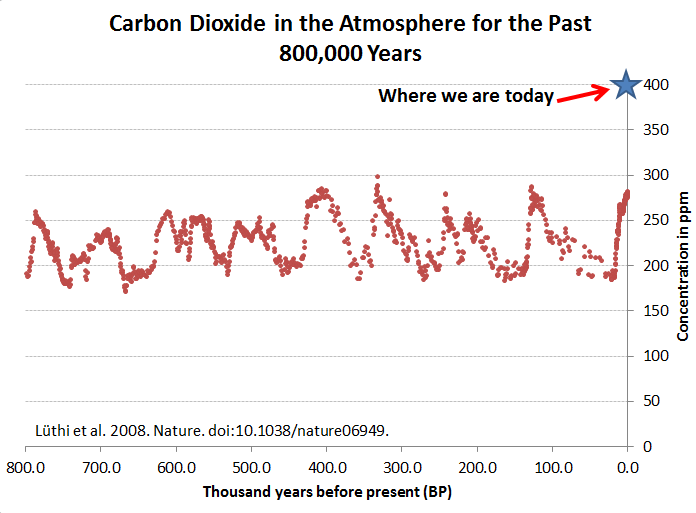
terrifying co2 graph

By Stephen Leahy

UXBRIDGE, Canada, Jan 11 2013 (IPS)

Experts on the health of our planet are terrified of the future. They can clearly see the coming collapse of global civilisation from an array of interconnected environmental problems.

“We’re all scared,” said Paul Ehrlich, president of the Center for Conservation Biology at Stanford University.

“But we must tell the truth about what’s happening and challenge people to do something to prevent it,” Ehrlich told IPS.

Global collapse of human civilisation seems likely, write Ehrlich and his partner Anne Ehrlich in the prestigious science journal, Proceedings of the Royal Society.

This collapse will take the form of a “…gradual breakdown because famines, epidemics and resource shortages cause a disintegration of central control within nations, in concert with disruptions of trade and conflicts over increasingly scarce necessities”, they write.

Already two billion people are hungry today. Food production is humanity’s biggest industry and is already being affected by climate and other environmental problems. “No civilisation can avoid collapse if it fails to feed its population,” the authors say.

Escalating climate disruption, ocean acidification, oceanic dead zones, depletion of groundwater and extinctions of plants and animals are the main drivers of the coming collapse, they write in their peer-reviewed article “Can a collapse of global civilisation be avoided?” published this week.

Dozens of earth systems experts were consulted in writing the 10-page paper that contains over 160 references.

“We talked to many of the world’s leading experts to reflect what is really happening,” said Ehrlich, who is an eminent biologist and winner of many scientific awards.

Our reality is that current overconsumption of natural resources and the resulting damage to life-sustaining services nature provides means we need another half of a planet to keeping going. And that’s if all seven billion remain at their current living standards, the Ehrlichs write.

If everyone lived like a U.S. citizen, another four or five planets would be needed. Continue reading

Fossil Energy Interests Buy Politicians – and they’re cheap says economist

[This interview with economist Robert Repetto (now at Yale) was published two years ago. It is more relevant than ever in showing how fossil fuel money influences politics and prevents real action on climate. — Stephen]

‘What else can you do with coal except burn it? Railways make a lot of money shipping coal’

By Stephen Leahy

UXBRIDGE, Canada, Mar 2, 2011 (IPS)

Powerful fossil energy interests are preventing the United States from making the necessary transition to 21st century energy sources, one of the country’s leading environmental economists documents in a just-published book.

Fossil energy interests are spending “hundreds of millions of dollars” lobbying U.S. politicians in Congress and funding groups to confuse the public about the serious risks climate change poses, says Robert Repetto, author of  “America’s Climate Problem: The Way Forward”.

IPS climate and environment correspondent Stephen Leahy spoke with Repetto about his new book.

Q: Why did you write this book?

A: We’re running out of time. The latest science shows that climate change is coming faster and posing greater risks than previously thought. We are at risk of triggering positive feedbacks that will lead to uncontrollable climate change.

Meanwhile, America is locked in a climate-policy stalemate, with very few in the public comprehending the real risks climate change poses. Most don’t understand that climate change is happening now. They don’t link extreme weather events we’ve been experiencing with climate change. As a result they are not demanding that politicians take action.

Q: Why don’t most Americans understand the fact that climate change is already underway and poses serious risks? Continue reading

Why Our Weather is Weird ‘n Wild and Why It Is Getting Worse

Repost from 2011: More and more science reveals the not surprising connection between a warming planet and extreme weather. Won’t stop unless emissions of fossil fuels stop — Stephen 

(Bonus: How we can kick the fossil fuel addiction)

By Stephen Leahy

UXBRIDGE, Canada, Feb 16, 2011 (IPS)

Human-induced heating of the planet has already made rainfall more intense, leading to more severe floods, researchers announced Wednesday.

Two new studies document significant impacts with just a fraction of the heating yet to come from the burning of fossil fuels. Fortunately, another new report shows the world can end its addiction to climate-wrecking fossil-fuel energy by 2050.

“Warmer air contains more moisture and leads to more extreme precipitation,” said Francis Zwiers of the University of Victoria.

Extreme precipitation and flooding over the entire northern hemisphere increased by seven percent between 1951 and 1999 as a result of anthropogenic global warming. That represents a “substantial change”, Zwiers told IPS, and more than twice the increase projected by climate modeling.

Zwiers and Xuebin Zhang of Environment Canada used observations from over 6,000 weather stations to measure the impact of climate warming on the intensity of extreme precipitation for the first time. The study was published Wednesday in the journal Nature.

This independent environmental journalism depends on public support. Click here learn more.

The planet is currently 0.8 degrees C hotter from the burning of fossil fuels. However, global temperatures had not yet started to increase in 1951, the first year of rainfall data Zwiers and Xuebin examined. By 1999, global temperatures had climbed by about 0.6 degrees C. The average temperature increase over that 50-year period is relatively small compared to the present but major impacts have been documented in terms of storm and flood damage even with this small increase in temperatures.

This suggests that the Earth’s climatic system may be more sensitive to small temperature increases than previously believed.

Continue reading

Killer Heat Waves and Floods Linked to Climate Change

More than 5 million affected by flooding in Pakistan Sept 2011 - a repeat of 2010.
More than 5 million affected by flooding in Pakistan Sept 2011 – a repeat of 2010.

“The first law of humanity is not to kill your children.”

By Stephen Leahy

UXBRIDGE, Canada, Feb 27 2013 (IPS)

Killer heat waves, floods and storms are increasingly caused by climate change, new research reveals.

Scientists in Germany say they have found how greenhouse gases from burning fossil fuels are helping to trap the jet stream, resulting in extraordinary weather such as the 2010 Pakistan flood and the 2011 heat wave in the United States.

Human-driven climate change repeatedly disturbs the flow of atmospheric waves around the globe’s Northern hemisphere, said lead author Vladimir Petoukhov of the Potsdam Institute for Climate Impact Research (PIK) in Germany.rossby.waves1_

Giant atmospheric waves called Rossby waves are meanders in the strong, high-altitude winds known as jet streams and have a major influence on weather. These wave movements are caused by the difference in temperatures between the cold air from the Arctic and hot air from the tropics.

When the waves shift north, they suck warm air from the tropics to Europe, Russia, or the U.S., and when they swing down, they do the same thing with cold air from the Arctic, said Petoukhov.

“During several recent extreme weather events, these planetary waves almost freeze in their tracks for weeks,” he said. “So instead of bringing in cool air after having brought warm air in before, the heat just stays.”

This unnatural pattern is due to human heating of the climate through emissions of greenhouse gases that result from burning fossil fuels, according to the study published this week in Proceedings of the National Academy of Sciences.

However, this heating of the atmosphere is wildly uneven. The Arctic is warming two to three times faster than the global temperature rise of 0.8C and that affects the Rossby waves and is slowing the jet stream.

“(Our research) complements previous research that already linked such phenomena to climate change,” said Hans Joachim Schellnhuber, a co-author of the study. Continue reading