Carbon Emissions: Most Important Number in Human History

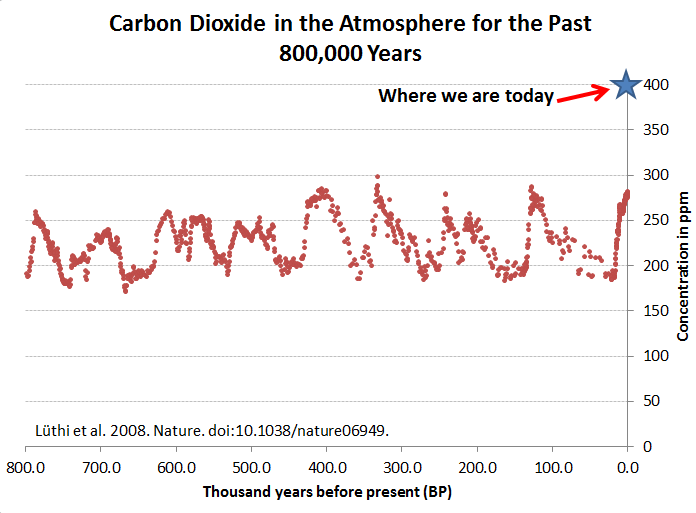
terrifying co2 graph

By Stephen Leahy

UXBRIDGE, Canada, Dec 17 2012 (IPS) (Re-posted)

The most important number in history is now the annual measure of carbon emissions. That number reveals humanity’s steady billion-tonne by billion-tonne march to the edge of the carbon cliff, beyond which scientists warn lies a fateful fall to catastrophic climate change.

With the global total of climate-disrupting emissions likely to come in at around 52 gigatonnes (billion metric tonnes) this year, we’re already at the edge, according to new research.

To have a good chance of staying below two degrees C of warming, global emissions should be between 41 and 47 gigatonnes (Gt) by 2020, said Joeri Rogelj, a climate scientist at Switzerland’s Institute for Atmospheric and Climate Science in Zurich.

Only when we see the annual global emissions total decline will we know we’re making the shift to climate protection,” Rogelj told IPS.

Making the shift to a future climate with less than two degrees C of warming is doable and not that expensive if total emissions peak in the next few years and fall into the 41-47 Gt “sweet spot” by 2020, Rogelj and colleagues show in their detailed analysis published Sunday in the journal Nature Climate Change.

The study is the first to comprehensively quantify the costs and risks of emissions surpassing critical thresholds by 2020.

This shift means 65 percent of existing coal power plants will have to be shut down in the next decade or two. Continue reading

Oil, Coal and Gas Industry Destroying Our Childrens’ Future

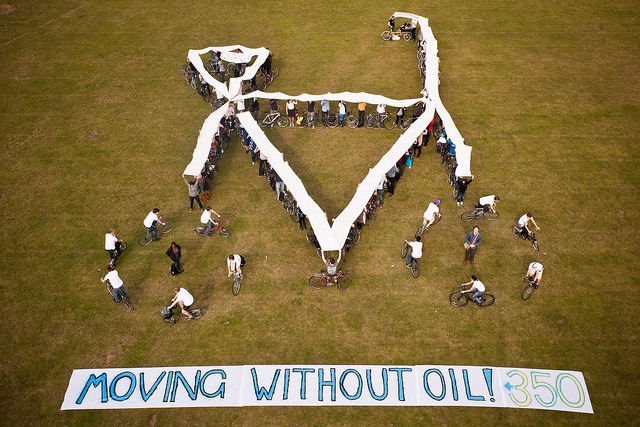
“moving aerial” of a bike sml

By Stephen Leahy

UXBRIDGE, Canada, Jan 4 2013 (IPS)

Around the world, 2012 was the year of extreme weather, when we unequivocally learned that the fossil fuel energy that powers our societies is destroying them. Accepting this reality is the biggest challenge of the brand new year.

Re-engineering our societies and lifestyles to prosper on green alternatives is the penultimate challenge of this decade. There is no more important task for all of us to engage in because climate change affects everything from food to water availability.

A number of scientific analyses have demonstrated we already have the technology to re-engineer our society to thrive on green alternative energy. The newest of these was published Wednesday in the prestigious journal Nature. It plainly states that politics is the real barrier, not technology nor cost. (It is far cheaper to act than not.)

Keeping global warming to less than two degrees C is mainly dependent on “when countries will begin to take serious action to reduce greenhouse gas emissions”, according to the study “Probabilistic cost estimates for climate change mitigation”.

Climate change has already pushed global temperatures up 0.8 degrees C, with significant consequences. No climate scientist thinks two degrees C will be “safe”. Many countries, especially least-developed countries and small island states, want the global target to be less than 1.5C of heating. Even then large portions of the Arctic and Antarctic will continue to melt raising sea levels, albeit at a slower rate.

Delay in making the shift to non-fossil fuel energy sources will be very costly. Waiting until 2020 to curb global emissions will cost twice as much compared with peaking emissions by 2015, the Nature analysis shows.

Serious action to reduce greenhouse gas emissions means 65 percent of current coal power plants will have to be shut down in the next decade or two, a previous Nature study reported by IPS shows.

US Fossil Emissions now and how much they need to decline

Instead of serious action, global emissions continue to break new records, rising about three percent per year. It appears 2012 will be about 52 gigatonnes (billion metric tonnes of CO2 equivalents). This is our annual climate scorecard, the most important number in human history. That number needs to fall to be between 41 and 47 gigatonnes (Gt) by 2020 to have a reasonable chance of staying below two degrees C of warming. Continue reading

Japan Bails Out on CO2 Emissions Target

cop presidentBy Stephen Leahy

WARSAW, Nov 15 2013 (IPS)   Japan announced Friday that it will renege on its carbon emissions pledge, likely ending any hope global warming can be kept to 2.0 degrees C.

The shocking announcement comes on the fifth day of the U.N. climate talks in Warsaw known as COP19, where more than 190 nations have agreed to a 2.0 C target and are trying to close the carbon emission gap to get there.

“It’s like a slap in the face of those suffering from the impacts of climate change such as the Philippines.” — Wael Hmaidan

Japan will increase that gap three to four percent with its new 2020 reduction target, according to the Climate Action Tracker (CAT). It amounts to a three-percent increase compared to a 1990 baseline. Japan’s 2009 Copenhagen Accord pledge was a 25 percent reduction by 2020.

“Japan is taking us in the opposite direction,” Marion Vieweg of Climate Analytics, a German climate research organisation, told IPS here in Warsaw.

“Their revision shows the bottom up approach is not working if countries can simply drop their pledges at any time,” Vieweg said.

Climate scientists have long maintained that the 2020 target for industrialised countries should be to reduce emissions 25-40 percent compared to a 1990 baseline. However, even if nations meet their current climate pledges under the Copenhagen Accord, CO2 emissions in 2020 are likely to be eight to 12 billion tonnes higher than what’s needed, according to the U.N. Environment Programme’sEmissions Gap Report 2013.

Japan, the fifth largest emitter of CO2, is just the latest to abandon its international commitments.

Canada’s Plan to Get Rich by Trashing the Climate

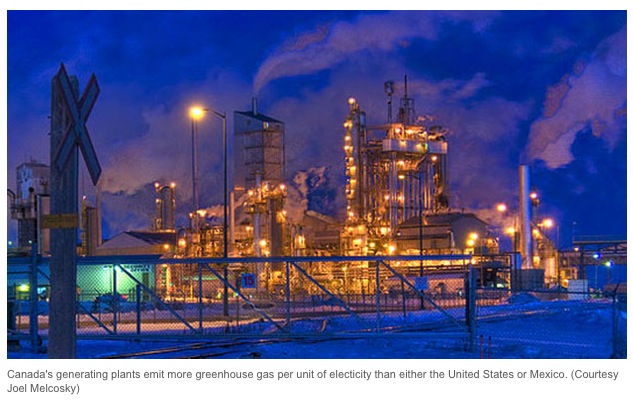
Canada's fossil fuel electricity has highest carbon emissions

By Stephen Leahy

Blame Canada is a four part series revealing how Canada has become a wealthy, fossil-fuelled energy superpower and an international climate pariah. For Part 1, click here.

Like every other country in the world, Canada has promised to help keep global warming to less than 2 degrees C. However Canada’s political and corporate leadership are committed to turning the country into a fossil-fuelled “energy superpower.”

With a drug lord’s just-providing-a-service hypocrisy Canada has openly declared it’s future is tied to the profits from dumping hundreds of millions of tonnes of climate-heating carbon into the atmosphere every year.

And the world’s new energy superpower plans to grow those annual emissions to 1.5 billion tonnes by 2020 giving one of the least populated countries a gigantic carbon bootprint.

Most of this climate-wrecking carbon energy will come from Canada’s tar sands located just underneath the pristine boreal forest and wetlands of northern Alberta. The oil industry likes to call them “oil sands,” although there is no liquid oil only a tarry bitumen mixed deep in the sandy soil.

With an estimated 170 billion barrels, the tar sands are the third largest crude oil reserves. Extraordinary efforts involving colossal amounts of water, heat, chemicals and machinery are needed to get the bitumen out of the ground and into pipelines. This the world’s largest industrial project with more than $300 billion invested since 2001 by the oil industry.

Nowhere has fossil energy expansion or investment been faster or larger. Environmental activists call it “Canada’s Mordor.”

Thawing Permafrost May Be “Huge Factor” in Global Warming

Siberian permafrost -- Ted Schuur
Siberian permafrost — Ted Schuur

UXBRIDGE, Canada, Feb 14 2013 (IPS)

Thawing permafrost is emitting more climate-heating carbon faster than previously realised. Scientists have now learned that when the ancient carbon locked in the ice thaws and is exposed to sunlight, it turns into carbon dioxide 40 percent faster.

“This really changes the trajectory of the debate” over when and how much carbon will be released as permafrost thaws due to ever warmer temperatures in the Arctic, says researcher Rose Cory of the University of North Carolina.

There are 13 million square kilometres of permafrost in Alaska, Canada, Siberia and parts of Europe. As previously reported by IPS, a 2011 study estimated that global warming could release enough permafrost carbon to raise global temperatures three degrees C on top of what will result from human emissions from oil, gas and coal.

Human emissions are headed for four degrees C of global heating,warned the International Energy Agency (IEA) this week. A rapid “decarbonization of electricity supply” is needed to avoid that future, the IEA said as it released a new book titled “Electricity in a Climate-Constrained World”.

“The solutions are well-known: increased energy efficiency, greater research and development of low-carbon energy production, and putting a realistic price on carbon,” the book says

Full story here

Critics Brand Climate Talks Another Lost Opportunity

findlay ohio flooding AP

By Stephen Leahy

DOHA, Qatar, Dec 11 2012 (IPS)

Rich countries came to the U.N. climate talks in Doha intent on delaying needed action on climate change for another three years and a still to be hammered out new global treaty.

This delay will be extraordinarily expensive and risky.

Every year that fossil fuel emissions fail to decline adds to the cost and reduces the odds that a global temperature rise can be kept below two degrees C.

“Science says emissions need to peak in 2015,” said Kumi Naidoo, executive director of Greenpeace International, as the final plenary of COP 18 concluded last Saturday night, a full day late.

The 195 parties to the U.N. Framework Convention on Climate Change (UNFCCC) approved a set of documents called “The Doha Climate Gateway” that does not increase emission reductions or guarantee much-needed financial help to poor countries suffering present and future impacts of climate change.

“Doha is a betrayal of people living with impacts now. And it is a sellout of our children and grandchildren’s future,” said Naidoo.

“The fossil fuel industry won,” said Alden Meyer, the Union of Concerned Scientists’ director of strategy and policy, who has attended nearly every one of these climate negotiations over the past 18 years.

“The science is clear that four-fifths of known fossil fuel reserves must stay in the ground but we continue to burn them like there is no tomorrow,” Meyer said.

“Doha became more of a trade fair…Negotiators protected the interests of corporations and not the needs of people,” he told IPS.

More than 16,000 delegates participated in the two-week conference of the parties (COP) in Doha, Qatar, a country rich in oil and gas in the heart of the Middle East fossil fuel empire.

Meyer, along with representatives from more than 700 civil society organisations, blamed the U.S. for blocking proposals for greater emissions cuts. The U.S. also refused to commit a singly penny to assisting countries hard hit by climate change. U.S. negotiators did acknowledge poor countries were suffering costly damages and losses.

The world has already warmed 0.8 degrees C, altering weather patterns and increasing extreme events which have led to nearly 400,000 deaths and more than 1.2 trillion dollars being lost every year, according a 2011 study.

A delegate from Bangladesh told IPS that climate-related damages cost his country three to four percent of its annual GDP. Climate change, which is also driven by deforestation and land conversion for agriculture, is undercutting development and will push his country’s and other countries’ economies into a steady decline, he said.

To help governments cope, industrialised nations promised to put 100 billion dollars a year into a Green Climate Fund by 2020. To bridge the gap until then, developing nations asked for 60 billion dollars in total by 2015. Britain, Germany and a few other countries promised to contribute six billion dollars.

But the U.S., Canada, Japan and others agreed only to more talks next year.

“The U.S. spends 60 billion dollars on its military marching bands,” said Naidoo.

The only hope is to build a robust grassroots movement to force countries to act in the interest of the public and future generations, he said.

“We have to build a new social movement like (the one) that overcame slavery,” agreed Oxfam International climate change policy advisor Tim Gore.

“We reject what our leaders are doing here. We are more angry, more impassioned to defeat this process,” said Gore.

The COP process is an obstacle because a few big countries can easily block the will of the majority, said Mohamed Aslam, former environment minister and chief negotiator for the Republic of the Maldives.

“The signs of global warming are obvious and we know that the safe limit is to stay below 1.5 C…and yet we are failing to act,” Aslam said in a press conference.

The U.N. spends millions of dollars on these negotiations and they are going nowhere, he said. “We are running out of time. (We) need to take this to another fora,” he said.

What is lacking is a real commitment to reduce global emissions, said Christina Figueres, executive secretary of the United Nations Framework Convention on Climate Change (UNFCCC).

“What needs to change most is political will,” Figueres told IPS.

In Doha, the U.N. secretary-general announced a world leaders’ summit in 2014 to hammer out emission reduction targets to keep warming below two degrees C. The Doha Climate Gateway confirmed details for a new negotiation track to have a new global climate treaty ready for ratification in 2015 and go into force in 2020.

Under this agreement all countries will likely be obligated to make emission cuts, varying in depth and timing. Without additional cuts before 2020, reductions afterwards will need to be rapid and massive, moving to a zero-fossil fuel emission society in a few decades based on the science.

The Doha agreement includes a second phase of the Kyoto Protocol with the European Union, Australia and a few other countries agreeing to cut fossil fuel emissions between 2013 and 2020. However, they did not set new targets, agreeing instead to a mandatory review of targets in 2014.

The nations involved only represent 12 percent of global emissions, and do not include large developing country emitters like China, India and Brazil. The U.S. has never participated, while Canada and Japan have opted out of the second phase but are supposed to make to make comparable cuts but offered nothing new.

“Rich countries think they can protect themselves from the impacts, leaving the poor with no clear pathway to the future,” said Mohamed Adow of Christian Aid.

“Our leaders have let us down. Civil society will have to lead to get the future we really want,” said Adow.

Original IPS story

Why Our Weather is Weird ‘n Wild and Why It Is Getting Worse

Repost from 2011: More and more science reveals the not surprising connection between a warming planet and extreme weather. Won’t stop unless emissions of fossil fuels stop — Stephen 

(Bonus: How we can kick the fossil fuel addiction)

By Stephen Leahy

UXBRIDGE, Canada, Feb 16, 2011 (IPS)

Human-induced heating of the planet has already made rainfall more intense, leading to more severe floods, researchers announced Wednesday.

Two new studies document significant impacts with just a fraction of the heating yet to come from the burning of fossil fuels. Fortunately, another new report shows the world can end its addiction to climate-wrecking fossil-fuel energy by 2050.

“Warmer air contains more moisture and leads to more extreme precipitation,” said Francis Zwiers of the University of Victoria.

Extreme precipitation and flooding over the entire northern hemisphere increased by seven percent between 1951 and 1999 as a result of anthropogenic global warming. That represents a “substantial change”, Zwiers told IPS, and more than twice the increase projected by climate modeling.

Zwiers and Xuebin Zhang of Environment Canada used observations from over 6,000 weather stations to measure the impact of climate warming on the intensity of extreme precipitation for the first time. The study was published Wednesday in the journal Nature.

This independent environmental journalism depends on public support. Click here learn more.

The planet is currently 0.8 degrees C hotter from the burning of fossil fuels. However, global temperatures had not yet started to increase in 1951, the first year of rainfall data Zwiers and Xuebin examined. By 1999, global temperatures had climbed by about 0.6 degrees C. The average temperature increase over that 50-year period is relatively small compared to the present but major impacts have been documented in terms of storm and flood damage even with this small increase in temperatures.

This suggests that the Earth’s climatic system may be more sensitive to small temperature increases than previously believed.

Continue reading

Climate Inaction Is a Clear Failure of Democracy

Jersey shore Superstorm Sandy flood

Re-engineering our societies to prosper on green alternatives is only option

By Stephen Leahy

UXBRIDGE, Canada, Jan 4 2013 (IPS)

Around the world, 2012 was the year of extreme weather, when we unequivocally learned that the fossil fuel energy that powers our societies is destroying them. Accepting this reality is the biggest challenge of the brand new year.

Re-engineering our societies and lifestyles to prosper on green alternatives is the penultimate challenge of this decade.There is no more important task for all of us to engage in because climate change affects everything from food to water availability.

A number of scientific analyses have demonstrated we already have the technology to re-engineer our society to thrive on green alternative energy. The newest of these was published Wednesday in the prestigious journal Nature. It plainly states that politics is the real barrier, not technology nor cost. (It is far cheaper to act than not.)

Keeping global warming to less than two degrees C is mainly dependent on “when countries will begin to take serious action to reduce greenhouse gas emissions”, according to the study “Probabilistic cost estimates for climate change mitigation”.

Climate change has already pushed global temperatures up 0.8 degrees C, with significant consequences. No climate scientist thinks two degrees C will be “safe”. Many countries, especially least-developed countries and small island states, want the global target to be less than 1.5C of heating. Even then large portions of the Arctic and Antarctic will continue to melt raising sea levels, albeit at a slower rate.

Delay in making the shift to non-fossil fuel energy sources will be very costly. Waiting until 2020 to curb global emissions will cost twice as much compared with peaking emissions by 2015, the Nature analysis shows.

Serious action to reduce greenhouse gas emissions means 65 percent of current coal power plants will have to be shut down in the next decade or two, a previous Nature study reported by IPS shows.

Continue reading

Wild and Weird Weather Getting Worse

New York City flooding
It doesn’t have to be this way – typical family could reduce their energy use 60 to 75 percent

By Stephen Leahy

UXBRIDGE, Canada, Jan 29 2013 (IPS)

Weird is the only way to describe January temperatures whipsawing between record warm and arctic cold over a span of a few days. Experts say that is what climate change looks like: weird, record-shattering weather.

Here’s a fact that goes beyond weird to astonishing. Anyone who is 27 years old or younger has never lived through a month that was colder than the global 20th century average. In other words, we’ve had 334 consecutive months with above average temperatures, according to the U.S. National Oceanic and Atmospheric Administration.

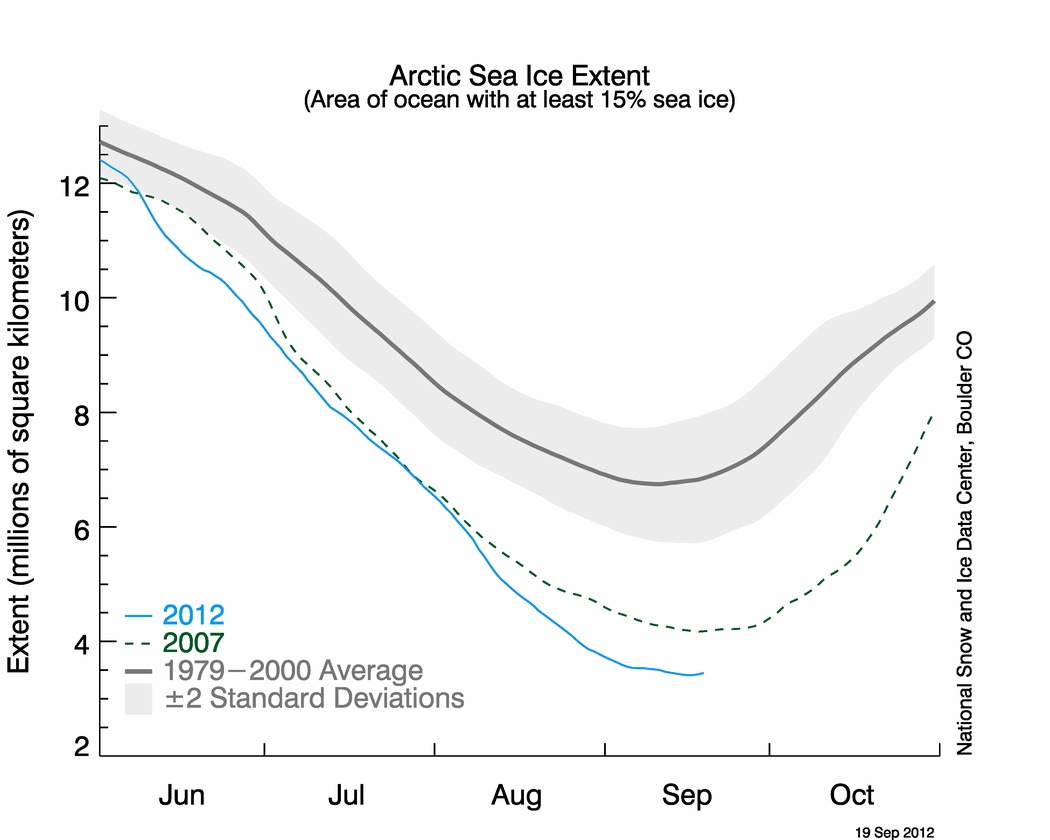
Arctic sea ice extent. Area of ocean with at least 15 percent sea ice as of Sept 12, 2012. Credit: National Snow and Ice Data Center.

Last summer, the Arctic sea ice shrunk to half of what it used to be during summers only three decades ago. Our planet’s weather is driven largely by the two cold polar regions and the warm tropics. With the Arctic defrosting, it should be no surprise our weather is getting weird. And that it’s not going to get better.

Our planet is heating up because we each year put thousands of millions of tonnes of carbon dioxide (CO2) into the atmosphere by burning coal, oil, and natural gas. CO2 acts as heating blanket keeping the planet warm by trapping some of the sun’s heat.

The amount of extra heat-energy being trapped is like exploding 400,000 Hiroshima atomic bombs per day 365 days per year, calculates James Hansen, a climate scientist who heads the NASA Goddard Institute for Space Studies.

Cautious scientists like Hansen are terrified of what’s coming. Conservative institutions like the World Bank and accounting giant Price Waterhouse Coopers (PwC) have warned we’re on a path to heating the entire surface of the planet by an average of four or five degrees C before 2100. That translates into eight to 12 degrees C hotter in places like Canada.

Continue reading

Black Carbon from Diesel, Industry and Cooking Fires Heating Planet

This is a re-post from June’11. A landmark study released Jan 15 2013 finds the direct influence of black carbon, or soot, on warming the climate could be about twice previous estimates. More information here  — Stephen

Stephen's avatarStephen Leahy, International Environmental Journalist

There is a quick way to buy more time to make the switch from fossil fuels to alternatives. Serious reductions in air pollutants like soot and smog bring cleaner air, less asthma/lung disease/heart attacks and could cut warming by 30 per cent.  No new technology needed as my article shows, just something like a Green Marshall Plan to bring simple things like $20 clean-burning cooking stove to hundreds of millions of people. (more at Global Alliance for Cookstoves) — Stephen

By Stephen Leahy

BONN, Jun 14, 2011 (IPS) – Clean the air, cool the planet and prevent millions of deaths with fast action on soot and smog, a new report urges.

Air pollutants like black carbon (soot) and ground-level ozone (smog) arise from incomplete combustion of fossil fuels and biomass like wood and charcoal.

Nations or regional blocks of nations could decide to put measures into place that…

View original post 835 more words