Thought Bubbles: Who Will Stand Up For Our Future on 5th of May?

Here’s a thoughtful article written by my son who is working on a farm in Tasmania. Normally he is a historical tour guide in Europe. He’s not part of any organization but just decided to take action for sake of his generation’s future.  It is amazing what he and his friends are up to. — Stephen 

By Derek Leahy

FRANKLIN, TASMANIA

I sat down in a café in Franklin, Tasmania the other day trying to sort out all that has transpired these past few weeks. You see, May 5thcould very well become a massive day of action. A lot of people from all over the world want to make their voices heard the week of May 5thInternational Stop the Tar Sands Day’s circle of friends just got bigger.

Anyway, I sat down in an practically empty café (Franklin is a pretty small town), opened up my journal to a blank page and took out a pencil. With the pencil I drew four separate thought bubbles on the page for four different campaigns or movements or whatever you want to call them.

The first was for 350.org’s Climate Impacts Day, which will take place the exact same day as ISTSDay; May 5th. The second thought bubble was for the Occupy Movement because members of Occupy in Canada and the UK have stepped up recently to help us out.

The last two bubbles were for International Stop the Tar Sands Day and for Ecocide. I threw in Ecocide because of an email I had received earlier in the day (thank you Kirstie for the inspiration!).  We have not talked to these guys about working together on May 5th. Yet.

Continue reading

Become a Partner in Independent Enviro Journalism

A personal message from Stephen Leahy

“Journalism and media are society’s mirror providing accurate and essential information.

That is no longer the case.

Media are now controlled by a few major corporations like Murdoch’s News Corp. Coverage of environment and science has been gutted. If there is coverage it rarely digs below the surface. It’s not just TV, it’s all media.

After 18 years of being published in major publications on two continents I now count myself lucky to get $150 to $200 for an in-depth article. The few independent media outlets are either non-profits or struggling.

Urgent environmental issues didn’t go away just because most media stopped covering them.

More than 20,000 people attended the international climate meeting in Cancun, Mexico and it received one ten second clip on US network TV according to a Drexel University media study. (Coverage was even worse at last climate meet in Durban)

Nearly every indicator proves things are getting worse but less and less people know about this.

Many people, including leading scientists, tell me: ‘we need people like you to write about these issues‘. I’d like to do far more but it is impossible to continue without your help in what I’m calling Community Supported Journalism. People directly support independent journalists who craft honest and thoughtful articles about important subjects the mainstream media ignores or gloss over.

Community Supported Environmental Journalism Works

In 2010 dozens of people offered their help, donating $5,750 which helped ensure many breaking international stories were covered including the first media reports on the global die-off of corals and how climate change may be bringing colder winters to Europe and eastern North America. Those donors — I prefer to call them partners — enabled me to cover important international meetings like the UN Convention on Biodiversity, UNFCCC climate change conference and much more.

Thanks for reading.” — Stephen

Please join us. Consider a donation of just $10 a month to support enviro journalism that serves the public interest.

Contributions can be made safely and easily via PayPal* or Credit Card*. [You can cancel at any time, automatically. No need to contact me] 

Monthly support options starting @ $10 a month

One-time donations are most welcome. Click and enter the amount.

*More than 100,000 non-profits safely use PayPal Donate service

If you’d like a mailing address or contact me with story ideas, please complete this comment form.

Letters of Support:

We need people like you. In tough economic times, where information flow is increasingly channeled and controlled, you perform a simply critical role. Hang in there. You are an admirable role model for the future.”

– E. Ann Clark, Associate Professor, University of Guelph.

“Stephen Leahy has done a superb job exposing the enormous sums the US government is spending on corporate welfare for big oil.”

Ross Gelbspan, Pulitzer-prize winning editor and author of The Heat is On

My continued appreciation to those who have contributed in the past.

Fracking and Shale Gas Accelerating Global Warming

UPDATE Jan 2013:

Yet another study reveals fracking has a huge problem of gas leaks. Up to  9% of the gas pumped out of the ground leaks into the atmosphere according to a study by National Oceanic and Atmospheric Administration (NOAA) published in Nature this week. Natural gas (methane) is a powerful greenhouse gas. If these leaks are widespread, fracking is worse than burning coal, accelerating global warming.

In Jan 2012 I detailed new research in the article below showing that replacing coal with natural gas from fracking does little to fight climate change (see below). Now two studies published that since then make an even stronger case that fracking for natural gas is a HUGE MISTAKE:

From Nature: Air sampling reveals high emissions from gas field. Methane leaks during production may offset climate benefits of natural gas.

From Environmental Research Letters: New study demonstrates switching to natural gas is the path to climate disaster. What’s needed is an aggressive deployment of zero-carbon technologies and conservation. Joe Romm explains. — Stephen

Shale Gas Worse Than Coal Study Finds

By Stephen Leahy

UXBRIDGE, Canada, Jan 24, 2012 (IPS)

Hundreds of thousands of shale gas wells are being “fracked” in the United States and Canada, allowing large amounts of methane, a highly potent greenhouse gas, to escape into the atmosphere, new studies have shown.

Shale gas production results in 40 to 60 percent more global warming emissions than conventional gas, said Robert Howarth of Cornell University in New York State.

“Shale gas also has a larger greenhouse gas footprint than oil or coal over the short term,” said Howarth, co-author of a study called “Venting and Leaking of Methane from Shale Gas Development” to be published in the journal Climatic Change.

(Audio of news conference)http://of%20news%20conference

This latest study follows up on Howarth and colleagues’ controversial April 2011 paper that provided the first comprehensive analysis of greenhouse gas emissions from shale gas obtained by hydraulic fracturing. That study found that when gas wells are “fracked”, they leak large amounts of methane and pose a significant threat to the global climate.

“We stand by the conclusion of our 2011 research,” said Howarth.

That research undercuts the logic of energy sector claims that shale gas is a “bridge” to a low-carbon energy future. Those claims are based on the fact that natural gas (which is mainly methane) has half the carbon content of coal, and when burned for electricity it is more energy efficient than coal.

This independent  journalism depends on public support. Click here learn more.

However, those climate gains are more than negated by methane leaks both at the well during the fracking process (called flow-back), and through the gas delivery and distribution system. Howarth and colleagues estimate that between 3.6 and 7.9 percent of all shale gas produced leaks – called “fugitive emissions” – into the atmosphere, making it worse than burning coal or oil.

Please throw something in the tip jar before reading on.
This is how I make my living.

Continue reading

Faith Groups Call for African Spirit of “Ubuntu”; End Sinful, American-style Greed

South African Bishop Geoff Davies (L) and Mardi Tindal, Moderator of the United Church of Canada

By Stephen Leahy

DURBAN, South Africa, Dec 9 (IPS)

African and international faith leaders urged governments attending the final day of climate change negotiations to do what is right and necessary to keep global temperature from rising no more than 1.5 degrees Celsius.

“The two degrees Celsius target is unacceptable because temperatures in much of Africa will be far higher,” said South African Bishop Geoff Davies.

Oil and coal companies along with other major polluting corporations are engaged in “crimes against humanity and the planet” because they continue to pollute the atmosphere when they have ability to do otherwise, said David Le Page of the Southern African Faith Communities’ Environment Institute (SAFCEI).

More than 130 African faith leaders have signed a declaration offering specific recommendations based science, honesty, morality and equity. They called on delegates negotiating a new climate treaty here at the 17th Conference of Parties to live up to the African spirit of “ubuntu” – a way of living focused on people’s allegiances and relations with each other.

The current economic system encourages “people to get as rich as they can and forget about anyone else,” said Davies. “It’s an immoral system.”

“Historic polluters like the United States have to reduce their emissions dramatically” and their position here is “shocking” and “reprehensible”, he said. The children and grandchildren of U.S. congressmen will ask what they were doing to be so selfish and irresponsible, Davies said.

The U.S is the most religious society in the world but their behaviour is “sinful” in their refusal to reduce emissions that causing so much suffering among people, he said.

“When lifestyles of the wealthy hurt the lives of the poor….and future generations it is wrong,” Mardi Tindal, Moderator of the United Church of Canada, the country’s largest Protestant denomination.

“Climate change is a moral, ethical and spiritual issue. We need moral leadership not political leadership,” Tindal told IPS.

“South Africa has had courageous, moral leaders like Ghandi and Mandela. If our leadership shows the same moral courage the people will follow them.” Continue reading

Shale Gas a Bridge to More Global Warming

Shale Gas Worse Than Coal Study Finds

By Stephen Leahy

UXBRIDGE, Canada, Jan 24, 2012 (IPS)

Hundreds of thousands of shale gas wells are being “fracked” in the United States and Canada, allowing large amounts of methane, a highly potent greenhouse gas, to escape into the atmosphere, new studies have shown.

Shale gas production results in 40 to 60 percent more global warming emissions than conventional gas, said Robert Howarth of Cornell University in New York State.

“Shale gas also has a larger greenhouse gas footprint than oil or coal over the short term,” said Howarth, co-author of a study called “Venting and Leaking of Methane from Shale Gas Development” to be published in the journal Climatic Change.

(Audio of news conference)http://of%20news%20conference

This latest study follows up on Howarth and colleagues’ controversial April 2011 paper that provided the first comprehensive analysis of greenhouse gas emissions from shale gas obtained by hydraulic fracturing. That study found that when gas wells are “fracked”, they leak large amounts of methane and pose a significant threat to the global climate.

“We stand by the conclusion of our 2011 research,” said Howarth.

That research undercuts the logic of energy sector claims that shale gas is a “bridge” to a low-carbon energy future. Those claims are based on the fact that natural gas (which is mainly methane) has half the carbon content of coal, and when burned for electricity it is more energy efficient than coal.

This independent  journalism depends on public support. Click here learn more.

However, those climate gains are more than negated by methane leaks both at the well during the fracking process (called flow-back), and through the gas delivery and distribution system. Howarth and colleagues estimate that between 3.6 and 7.9 percent of all shale gas produced leaks – called “fugitive emissions” – into the atmosphere, making it worse than burning coal or oil. Continue reading

No Time Left to Adapt to Melting Glaciers — Peak Water Has Already Come and Gone

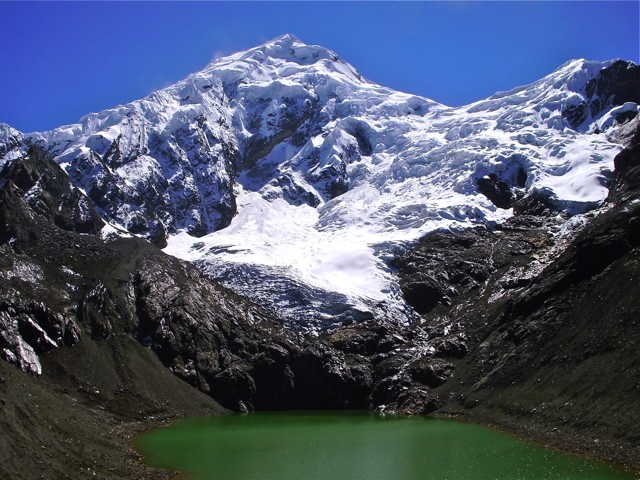
Melt water from the glaciers of the Cordillera Blanca forms lagoons that in turn feed rivers and streams. Credit:Courtesy of Michel Baraer

Without sharp reductions in the use of fossil fuels, the impacts of climate change could come faster and beyond what humanity can adapt to — Lonnie Thompson, glaciologist

By Stephen Leahy

UXBRIDGE, Canada, Dec 27, 2011 (Tierramérica)

The water supplied by the glaciers of the Cordillera Blanca, vital to a huge region of northwest Peru, is decreasing 20 years sooner than expected, according to a new study.

Water flows from the region’s melting glaciers have already peaked and are in decline, Michel Baraer, a glaciologist at Canada’s McGill University, told Tierramérica. This is happening 20 to 30 years earlier than forecasted.

“Our study reveals that the glaciers feeding the Río Santa watershed are now too small to maintain past water flows. There will be less water, as much as 30 percent less during the dry season,” said Baraer, lead author of the study “Glacier Recession and Water Resources in Peru’s Cordillera Blanca”, published Dec. 22 in the Journal of Glaciology.

When glaciers begin to shrink in size, they generate “a transitory increase in runoff as they lose mass,” the study notes.

However, Baraer explained, the water flowing from a glacier eventually hits a plateau and from this point onwards there is a decrease in the discharge of melt water. “The decline is permanent. There is no going back.” Continue reading

“Fracking” for Shale Gas: The Bridge to Global Warming Disaster

Switching from coal to gas can increase global warming – NCAR

[UPDATE JAN 20 2012: New study published in journal Climatic Change shows large volumes of methane released during fracking]

By Stephen Leahy 

DURBAN, South Africa, Dec 5, 2011 (Tierramérica)

Hydraulic fracturing or “fracking” is being used to tap the last remaining natural gas deposits across large areas of the United States and western Canada, fueling continued dependence on hydrocarbons instead of a shift to genuinely clean energy sources to cool the planet.

Called shale gas, these deposits represent a new and enormous source of fossil fuel.

“Fracking is driving exploration and drilling all over the United States,” said Gwen Lachelt of the non-governmental organisation Earthworks’ Oil & Gas Accountability Project.

“The oil and gas industry is marching across America from Texas to North Dakota and from the east coast to California,” Lachelt told Tierramérica.

There may be as much as 23,427 billion cubic metres (bcm) in recoverable gas from U.S. shale formations, according to the Annual Energy Outlook 2011, released in April by the U.S. Energy Information Administration (EIA).

The United States will consume 650 bcm of natural gas this year, the EIA projected. Globally, it estimates reserves of “unconventional gas” – the oil and gas industry term for shale gas and coal bed methane – at 915,000 bcm, with 100,000 bcm in Latin America.
However, that estimate is already out of date due to developments in fracking technology and exploration. The EIA estimate of shale gas in the United States in 2009 was less than half the 2011 estimate.

Fracking uses horizontal drilling and hydraulic fracturing with high pressure water and chemicals to fracture gas-bearing shale rock.

Holes are drilled vertically as little as 100 metres and as much as 3,000 metres into the shale, and then horizontally 1,000 metres along the shale formation. Chemicals and large amounts of water are pumped underground at high enough pressure to fracture the shale, releasing the gas into the pipeline.

The “dash for gas” as the industry pundits like to say is being driven by potential exports to Asia and the mistaken belief that natural gas is the “transition fuel” from coal to a low-carbon economy.

It is true that natural gas is “cleaner” in that it releases about 40 to 45 percent less carbon dioxide than coal does to produce the same amount of energy.
However, gas from fracking has a higher carbon footprint because more energy is needed to get the gas and because methane leaks out.

Methane has 25 times the warming impact of carbon dioxide.

Switching from coal to gas as an energy source could result in increased global warming, not less, according to the study “Coal to Gas: The Influence of Methane Leakage”, released in September by the U.S. National Center for Atmospheric Research (NCAR).

This is mainly due to the methane leakage problem, which is common but unregulated.

[UPDATE JAN 20 2012: New study published in journal Climatic Change shows large volumes of methane released during fracking]

In Unprecedented Move, Harper Government Pulls Canada out Kyoto Protocol

Stephen Harper called Kyoto a “socialist scheme to suck money out of wealth-producing nations

Wealth-producing Nations Condemn Canada’s Withdrawal

By STEPHEN LEAHY

CAPE TOWN, Dec 14, 2011 (IPS)

Barely 24 hours after it signed a new global climate change agreement in Durban, South Africa, Canada became on Monday the first country to formally withdraw from the Kyoto Protocol, the only legally binding treaty to reduce emissions causing climate change.

The 17th Conference of the Parties (COP17) concluded last Sunday with an agreement called the Durban Platform, which includes a consensus agreement for a second commitment period of the Kyoto Protocol after the first expires at the end of 2012.

Canada’s government under Stephen Harper essentially agreed to a continuation of Kyoto only to announce formal withdrawal after Canadian Environment Minister Peter Kent arrived back safely in Canada on Monday.

“Kyoto, for Canada, is in the past,” Kent said in Durban on Dec. 7. Still, he insisted in a statement on Monday, “Canada went to Durban in a spirit of good will.”

Despite the so-called good will, Canada is well known as a pariah on climate and environmental issues, having being judged as the most uncooperative country for the last five climate treaty COPs.

Kent brought a “reckless arrogance with him to Durban, where he’s maintained a hard line… and fought hard to put polluters before people”, according to Climate Action Network, an international coalition of environmental non-governmental organisations (NGOs) attending COP17.

Canada’s withdrawal comes as no surprise. Mirroring the views of the fossil fuel industry, the Harper government has expressed disdain for the Kyoto Protocol. In a fundraising letter prior to coming to power in 2006, Harper called it a “socialist scheme to suck money out of wealth-producing nations”.

Under the Kyoto Protocol, Canada agreed to reduce its carbon emissions by six percent by 2012 in comparison to its 1990 emissions.
In Durban Canada wins Fossil of Year for 5th Year
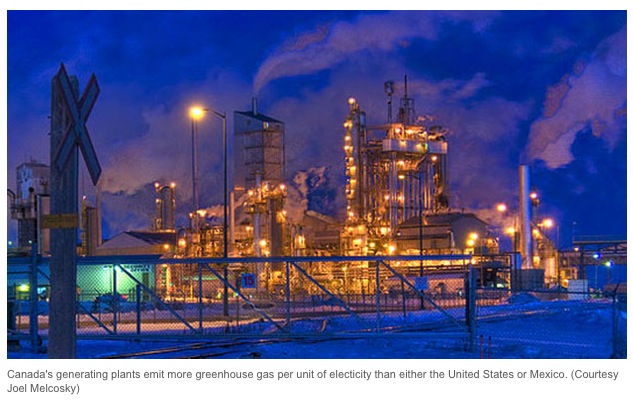
While Canadians individually cut emissions at the urging of previous governments, the enormous expansion of emission-laden tar sands operations inflated Canada’s emissions by 24 percent above 1990 emissions.

On Monday, Kent said that for Canada to meet emissions targets would entail taking every vehicle off the road and cutting the heat in every building in the country. He did not mention reducing emissions from the tar sands.

“I regret that Canada has announced it will withdraw and am surprised over its timing,” said Christiana Figueres, executive secretary of the U.N. Framework Convention on Climate Change (UNFCCC), under which climate negotiations like COP17 are held. Continue reading

Canada’s Harper Government Guts Environment, Science and Monitoring Programs

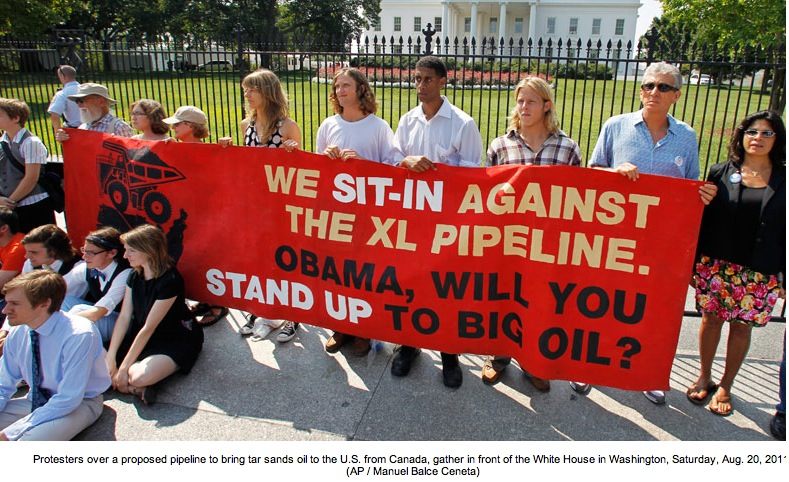
Man w picture of grandchild was arrested for protesting against tar sands expansion, Sept 2011 Ottawa, Canada - Pix by R Leahy

Environment budget slashed while PM Harper’s office places a gag order on government scientists. (And a $60 billion order for military equipment)

By Stephen Leahy

UXBRIDGE, Canada, Nov 9, 2011 (IPS)

Canada’s Stephen Harper government is spending more than 60 billion dollars on new military jets and warships while slashing more than 200 million dollars in funding for research and monitoring of the environment.

Amongst the programmes now crippled is Canada’s internationally renowned ozone monitoring network, which was instrumental in the discovery of the first-ever ozone hole over Canada last spring. Loss of ozone has been previously linked to increases in skin cancer.

“The proposed cuts go so far the network won’t be able to do serious science,” said Thomas Duck, an atmospheric scientist at Halifax’s Dalhousie University.

Canada was the pioneer in ozone monitoring, developing the first accurate ozone measuring tool that led to the discovery that the world’s ozone layer was dangerously thinning in the 1970s, which in turn led to the successful Montreal Protocol on Ozone Depleting Substances.

Canada has about one-third of the ozone monitoring stations in the Arctic region. It also hosts the world archive of ozone data, which is heavily relied on by scientists around the world.

“There’s only one guy running the entire archive, and he’s received a lay-off notice letter,” Duck told IPS.

Ozone monitoring and research is part of Environment Canada, the government department charged with protecting the environment, conservation and providing weather and meteorological information.

“Canada can’t afford to pay scientists but we can line the pockets of big oil?

That is totally backwards.”

Continue reading

Keystone Pipeline All About Exporting Oil Overseas – Report


 The United States is awash in oil with four times as many oil rigs pumping domestic oil today than eight years ago and declining  demand

Canada needs overseas markets for its dirty oil

[Excerpts from my September 2nd article on the proposed Keystone XL pipeline — Stephen]

The only reason U.S. citizens may be forced to endure a risky, Canadian-owned oil pipeline called Keystone XL is so oil companies with billion-dollar profits can get the dirty oil from Canada’s tar sands down to the Gulf of Mexico to export to Europe, Latin America or Asia, according to a new report by Oil Change International released Wednesday.

“Keystone XL will not lessen U.S. dependence on foreign oil, but rather transport Canadian oil to American refineries for export to overseas markets,” concludes the report, titled “Exporting Energy Security“.

….

“The oil industry would have done the Northern Gateway [pipeline] first but gambled that resistance to the [Keystone XL] pipeline would be far weaker in the mid-west,” he told IPS.

They were wrong.

Read full article:

U.S. Awash in Oil and Lies, Report Charges | More Oil Development Risks Catastrophe – Scientists Say