Who Controls the Nuclear Control Agencies?

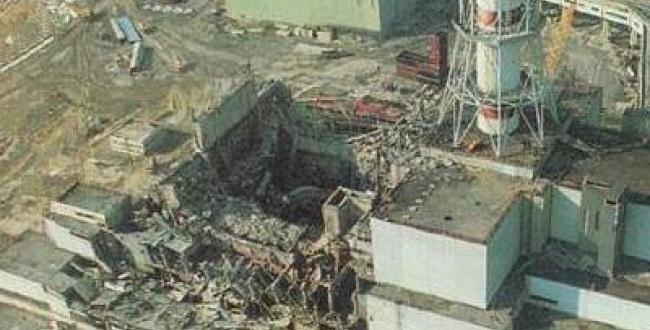
April 1986 disaster at the Chernobyla nuclear power plant in Ukraine

“There are few independent nuclear experts in the world. Everyone either works in the industry or used to and are now regulators.”

Canadian Government fired chief regulator for trying to improve safety standards — Greenpeace

By Stephen Leahy*

UXBRIDGE, Canada, Mar 23, 2011 (Tierramérica)

As Japan struggles to confront a nuclear disaster that could be the worst in history, it seems clear that any discussion about the safety of nuclear energy should address the independence of regulatory agencies.

On Apr. 26, 1986 a series of explosions and fires at the Chernobyl nuclear power plant in Ukraine released radioactive fallout that spread over eastern and western Europe, particularly affecting Ukraine itself, Byelorussia (now Belarus) and Russia, all Soviet republics at the time.

Twenty-five years later, Chernobyl’s reactor number 4 continues to emit high levels of radioactivity even though it is buried under a thick but decaying layer of concrete.

Europe and the United States are trying to raise more than two billion dollars to build a permanent sarcophagus to contain the radiation.

The Chernobyl disaster is usually attributed to obsolete technology and the secrecy characteristic of the Soviet regime.

The accident at the Tokyo Electric Power Co. (TEPCO) Fukushima I Nuclear Power Plant was triggered by the damage resulting from the 9.0-magnitude earthquake and subsequent tsunami on Mar. 11.

But “TEPCO doesn’t have the best record for safety or disclosure of information,” said Mycle Schneider, a Paris-based energy and nuclear policy analyst who also works in Japan.
Continue reading

Limited Liability – Nuclear Energy’s ‘Mother of all Subsidies’

By Stephen Leahy

UXBRIDGE, Canada, May 6, 2011 (IPS)

The nuclear energy industry only exists thanks to what insurance experts call the “mother of all subsidies”, and the public is largely unaware that every nuclear power plant in the world has a strict cap on how much the industry might have to pay out in case of an accident.

In Canada, this liability cap is an astonishingly low 75 million dollars. In India, it is 110 million dollars and in Britain 220 million dollars. If there is an accident, governments – i.e. the public – are on the hook for all costs exceeding those caps.

Japan has a higher liability cap of 1.2 billion dollars, but that is not nearly enough for the estimated 25 to 150 billion dollars in decommissioning and liability costs for what is still an ongoing disaster at its Fukushima Daiichi nuclear plant. Seven weeks after the tsunami caused the disaster, radiation levels continued to spike higher.

No one knows when the reactors will finally be in cold shutdown, or when the costs of theFukushima disaster will stop piling up. One report suggests decommissioning will take 30 years.

This independent environmental journalism depends on public support. Click here learn more.

Japan’s credit rating was downgraded because of the accident, noted Mycle Schneider, a Paris-based energy and nuclear policy analyst who has worked in Japan. “The Japanese know it’s just a matter of time before another large earthquake occurs,” Schneider told IPS.

“Japan will never build another nuclear plant.
Continue reading

Permafrost Melt Soon Irreversible Without Major Fossil Fuel Cuts

Thawing Permafrost Will Accelerate Climate Disruption

By Stephen Leahy

UXBRIDGE, Canada, Feb 17, 2011 (IPS)

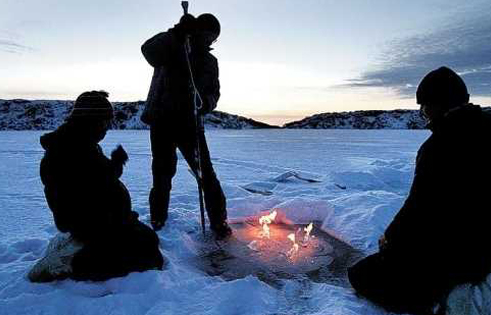
Thawing permafrost is threatening to overwhelm attempts to keep the planet from getting too hot for human survival.

Without major reductions in the use of fossil fuels, as much as two-thirds of the world’s gigantic storehouse of frozen carbon could be released, a new study reported. That would push global temperatures several degrees higher, making large parts of the planet uninhabitable.

Once the Arctic gets warm enough, the carbon and methane emissions from thawing permafrost will kick-start a feedback that will amplify the current warming rate, says Kevin Schaefer, a scientist at the National Snow and Ice Data Center (NSIDC) in Boulder, Colorado. That will likely be irreversible.

This independent environmental journalism depends on public support. Click here learn more.

And we’re less than 20 years from this tipping point. Schaefer prefers to use the term “starting point” for when the 13 million square kilometres of permafrost in Alaska, Canada, Siberia and parts of Europe becomes a major new source of carbon emissions.

“Our model projects a starting point 15 to 20 years from now,” Schaefer told IPS. Continue reading

Canada Slashes Charity’s Funding To Protect Giant Tar Sands Project P.S. Oil companies get $2+ billion in subsidies

Please read this eloquent piece from Toronto Star columnist Catherine Porter on how the Harper govt cut funding of Kairos, a renowned church charity for telling the truth about Canada’s tar sands.

How can Canadians in good conscience try to help African women get water when it is carbon emissions from the tar sands are part of the reason they face drought?

And then Harper and his Minister Bev Oda lied and tried to cover up their vindictive actions claiming they want to improve the lives of the poor “efficiently”. (This from a govt giving billions in public subsidies to oil companies)

Here’s the first paras of Porter’s column:

A few years back, the staff at Kairos planned a trip to Nigeria’s oilfields to examine environmental damage, corporate responsibility and human rights abuses.

The board of the faith-based development organization rejected the idea. It sent them to Alberta’s tar sands instead.

“I remember saying, ‘They’ll kill us — that will be considered very political,’ ” recalls Mary Corkery, Kairos’ passionate executive director. “The churches said, ‘This is our work. Our work is inspired by faith to tell the truth. It’s a development issue if it’s far away. It’s a political issue if it’s at home. Or if it offends anyone.’ ”

Think it’s a stretch to compare Canada to Nigeria? A government that forges documents, that makes things up, that smothers dissenting opinions, that accuses the media of lying.

via Porter: Kairos does important work; we should all support it – thestar.com.

About Subsidies:

Every Day Governments Give an Estimated $2 billion to Oil, Coal & Gas Industry

About the Tar Sands:

30 Page e-book:_Oil Stains in the Boreal Forest: The Environmental Cost of Canada’s Tar Sands

Europeans stopped Canada’s Slaughter of Baby Seals – Can They Stop Canada’s Tar Sands?

Canada’s “Mordor” Ensures Climate Treaty Failure in Copenhagen

Arctic Sea Ice Record – New Satellite Image

Temperatures of +21C above normal in Dec/Jan in the eastern Arctic. Parts of Hudson Bay remain unfrozen

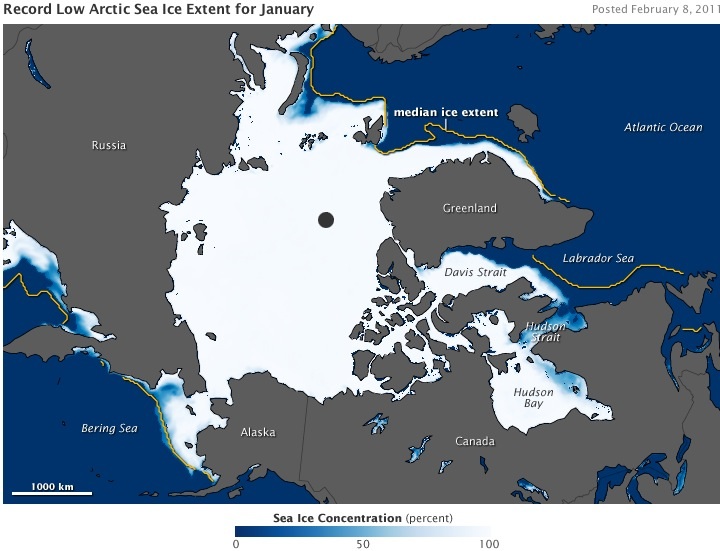
This NASA image shows average Arctic sea ice concentration for January 2011. Blue indicates open water; white indicates high sea ice concentrations; and turquoise indicates loosely packed sea ice. The yellow line shows the average sea ice extent for January from 1979 through 2000.

The U.S. National Snow and Ice Data Center (NSIDC) has reported that Arctic sea ice was at its lowest extent ever recorded for January (since satellite records began).

I’ve written about why this is happening and the consequences several times in recent weeks — Stephen

Arctic Defrost Dumping Snow on U.S. and Europe

Arctic Melt Down Is Bringing Harder Winters and Permanently Altering Weather Patterns

East Coast Blizzard and Europe’s Snowmaggddon Reveal Fingerprints of Climate Change

The Great Groundhog’s Day Blizzard – Worst Winter Storm in 60 Years

Images Modis sat - January 31 at 10:30 a.m., 12:05 p.m., and 1:45 p.m. Eastern Time

This is what climate change looks like

One of the largest winter storms since the 1950s has hit 30 U.S. states from New Mexico to Maine and now into central and eastern Canada — +100 million people affected, hundreds of thousands without power. Chicago could get buried by more than 60 centimeters (2-ft) of snow — hundreds stranded already.

Climate change is certainly playing a role in this massive storm.

1. Warmer global temps means there is now four per cent more water vapour in the atmosphere which means heavier snowfalls.

2. There is also more energy in the climate system which makes storms more powerful.

3. Finally the melting of the Arctic sea ice is changing wind patterns in the polar regions bring colder, wetter winters to the eastern US  and western Europe scientists told me several months ago. (See my previous post East Coast Blizzard and Europe’s Snowmaggddon Reveal Fingerprints of Climate Change

Climate change loads the dice in favour of extreme events.

My latest article on this The Yin and Yang of Climate Extremes We Will See More of. — Stephen

Recent related articles:

Climate Change Could Be Worsening Effects of El Niño, La Niña

Arctic Melt Down Is Bringing Harder Winters and Permanently Altering Weather Patterns

Arctic Ice in Death Spiral, Thaws Permafrost — Risks Climate Catastrophe

Northern Canada’s Winter Heat Wave

Canada’s average temperature for 2010 was 3.0°C above normal — the warmest year on record (source: Environment Canada)

Although cooler in the south where every one lives, Canada’s north has been breaking records for warmth in the middle of winter in a region where there is no sun until spring! I’ve covered this a couple of weeks ago and the reasons why Arctic Hothouse Turns Europe into an Icebox

This is a more recent report from the National Center for Atmospheric Research in Boulder by Bob Henson. — Stephen

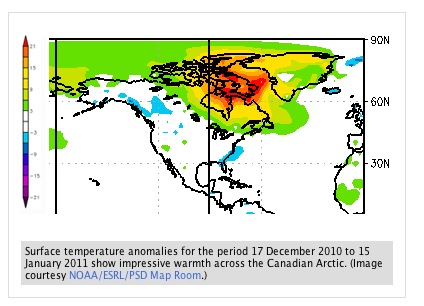
“Just how mild has it been? The map at right shows departures from average surface temperatures for the period from 17 December 2010 to 15 January 2011, as calculated by NOAA’s Earth Systems Research Laboratory.

The blue blip along the southeast U.S. coast indicates readings between 3°C and 6°C (5.4–10.8°F) below average for the 30-day period as a whole…

What really jumps out, though, is a blob of green, yellow, orange, and red covering a major swath of northern and eastern Canada. The largest anomalies here exceed 21°C (37.8°F) above average, which are very large values to be sustained for an entire month.

To put this picture into even sharper focus, let’s take a look at Coral Harbour, located at the northwest corner of Hudson Bay in the province of Nunavut. On a typical mid-January day, the town drops to a low of –34°C (–29.2°F) and reaches a high of just -26°C (–14.8°F). Compare that to what Coral Harbour actually experienced:

  • On the 6th of the month, the low temperature was –3.7°C (25.3°F). That’s a remarkable 30°C (54°F) above average.
  • On both the 5th and 6th, Coral Harbor inched above the freezing mark. Before this year, temperatures above 0°C (32°F) had never been recorded in the entire three months of January, February, and March.

Related articles/posts:

Climate Change Could Be Worsening Effects of El Niño -La Niña

Ice-cold Atlanta (and eastern US) Is Likely Connected to Arctic Hothouse

The Yin and Yang of Climate Extremes We Will See More of

    Record-breaking temps 20C above norm in Arctic in January

    Arctic Hothouse Turns UK, Europe, Eastern North America into an Icebox

    It remains shockingly warm in much of the eastern Arctic (See my previous post that explains what is happening Arctic Hothouse Turns Europe into an Icebox )

    Iqaluit one of the most northern communities in Canada is +2.1.C  (Jan 6) — a whopping 20C above normal as it has been for weeks. Normal night temps are -30C. This winter heat wave is creating havoc with rain instead of snow throughout much of the eastern Arctic.

    Part of the reason is the heat stored in the Arctic ocean from this summer’s ice melt has delayed the annual freeze up. Here is the very latest satellite measurements which show the Arctic sea ice extent for December as the lowest on record.

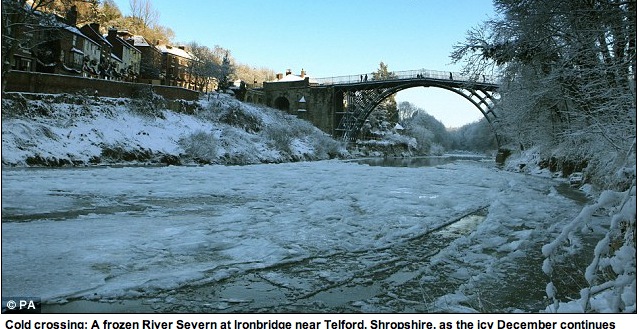
    This is affecting winter weather in many places such as Britain which had its coldest Dec in 100 years. And yes, climate change is a major player in all this.

    For more on this see Joe Romm’s take on Climate Progress.

    This is part of Community Supported Environmental Journalism, independent reporting supported by citizens in several countries thru one-time, weekly or monthly or in-kind donations.

    Be a Partner in Independent Enviro Journalism

    More than 20,000 people from 190 nations attended the international climate meeting in Cancun, Mexico and it received one ten second clip on US network TV 

    Coverage of environment and science has been gutted. If there is coverage it rarely digs below the surface. It’s not just TV, it’s all media. After 18 years of being published in major publications on two continents, I now count myself lucky to get $150 to $200 for an in-depth article. The few independent media outlets are either non-profits or struggling.

    Urgent environmental issues didn’t go away just because most media stopped covering them.

    Many, many people tell me:we need people like you to write about these issues”.

    I’d like to do more but it is impossible to continue without your support for what I call Community Supported Journalism. People directly support independent journalists who craft honest and thoughtful articles about important subjects the mainstream media ignores or gloss over.

    Community Supported Environmental Journalism Works

    In 2010 dozens of people offered their help, donating $5,750 which helped ensure many breaking international stories were covered including the first media reports on the global die-off of corals and how climate change may be bringing colder winters to Europe and eastern North America. Those donors — who are really partners — enabled me to cover important international meetings like the UN Convention on Biodiversity, UN climate change conference, scientific meetings and much more.

    Please join us. Consider a donation of just $10 a month to support enviro journalism that serves the public interest.

    Contributions can be made safely and easily via PayPal* or Credit Card*. [You can cancel at any time, automatically. No need to contact me] 

    Monthly support options starting @ $10 a month

    One-time donations are most welcome. Click and enter the amount.

    *More than 100,000 non-profits safely use PayPal Donate service

    If you’d like a mailing address or contact me with story ideas, please complete this comment form.

    Thanks for reading. — Stephen

    Letters of Support:

    We need people like you. In tough economic times, where information flow is increasingly channeled and controlled, you perform a simply critical role. Hang in there. You are an admirable role model for the future.”

    – E. Ann Clark, Associate Professor, University of Guelph.

    “Stephen Leahy has done a superb job exposing the enormous sums the US government is spending on corporate welfare for big oil.”

    Ross Gelbspan, Pulitzer-prize winning editor and author of The Heat is On

    My continued appreciation to those who have contributed in the past.

    East Coast Blizzard and Europe’s Snowmaggddon Reveal Fingerprints of Climate Change

    Coldest Christmas on Record on the UK -18C

    In Oslo last June climate researcher’s told me the melting Arctic ice will likely produce colder winters in the eastern United States and Europe. Looks like they were right. Winter freeze up in the sunless Arctic ocean was two months late this year because of a near record ice loss last summer that is expected to continue if not accelerate in future years.

    Several research programs have been studying the impacts of this huge loss in Arctic sea ice and presented their findings for first time at the International Polar Year Oslo Science Conference. My summary from 15 June:

    Climate change has warmed the entire Arctic region, melting 2.5 million square kilometres of sea ice, and that, paradoxically, is producing colder and snowier winters for Europe, Asia and parts of North America.

    “The exceptional cold and snowy winter of 2009-2010 in Europe, eastern Asia and eastern North America is connected to unique physical processes in the Arctic,” said James Overland of the NOAA/Pacific Marine Environmental Laboratory in the United States.

    In future, cold and snowy winters will be the rule rather than the exception” in these regions, Overland told IPS.

    Thanks to support from readers and the organizers of the conference I was able to attend that polar science conference. No media/publication would front any travel money to help me get there. I was one of a small handful of jurnos there and the first to write a piece documenting the link between global warming and bitter winter weather.

    This independent environmental journalism depends on public support. Click here learn how this works.

    My full article from Oslo is here: Arctic Melt Down Is Bringing Harder Winters and Permanently Altering Weather Patterns