24 Policies That Can End Our Earth Emergency

blue-marble-720x696-720x696

“Ecological literacy is vital for those in positions of power and influence”

Never vote for anyone who isn’t literate

By Stephen Leahy

UXBRIDGE, Canada, Jun 7 2012 (IPS)

Ecologically ignorant policies are largely responsible for the interlinked crises that are unraveling the planet’s life support system.

The unintended consequences of such policies are climate change, desertification, biodiversity decline, ocean pollution and the destruction of forests, according to the policy advocacy organisation World Future Council.

The solution is to eliminate “bad” policies and implement policies that ensure a healthy planet for future generations. On world environment Day, Jun. 5, the World Future Council will present an emergency policy agenda consisting of 24 tipping-point policies that need to be implemented globally to preserve a habitable planet.

“We are in an Earth Emergency. It’s an unbelievable crisis. Policies are the most important tool we have to change this,” Jakob von Uexkull, founder and chair of the World Future Council (WFC).

The five-year old WFC is based in Hamburg, Germany and comprised of 50 eminent individual from around the globe who have already successfully promoted change.

“Policy may be seen as dull and boring but they are the things that shape our societies,” von Uexkull told IPS.

In 2000, the German government created the now famous feed-in tariff policy launching a renewable energy revolution. That policy has enabled Germany to generate 22 percent of its electricity from renewables today and created a new business sector employing more people than its automotive industry.

“With the best laws and right policy incentives we can mobilise human inventiveness and entrepreneurship to safeguard a healthy planet for future generations,” he said.

On the other hand bad government policies allow 3,000 of the world’s biggest corporations to escape more than 2.2 trillion dollars in annual costs through their impacts on the natural environment, according to the U.N. Environment Programme. (A trillion is one thousand billion. A trillion seconds is nearly 32,000 years). Continue reading
“We’re all scared…But we must tell the truth” — Experts Fear Collapse of Global Civilisation

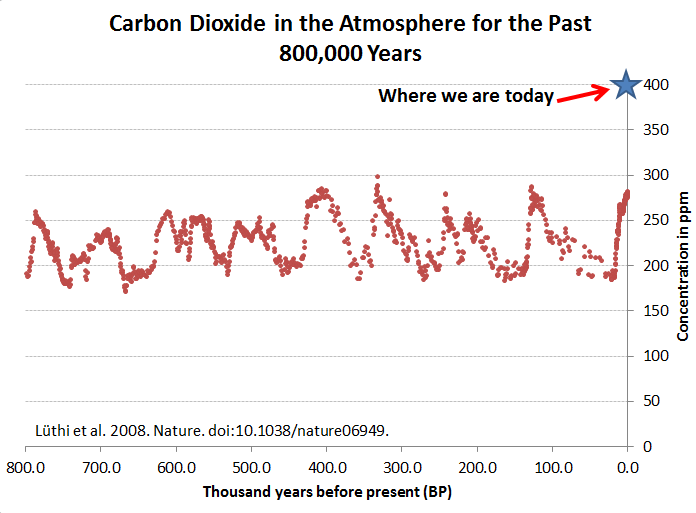
terrifying co2 graph

By Stephen Leahy

UXBRIDGE, Canada, Jan 11 2013 (IPS)

Experts on the health of our planet are terrified of the future. They can clearly see the coming collapse of global civilisation from an array of interconnected environmental problems.

“We’re all scared,” said Paul Ehrlich, president of the Center for Conservation Biology at Stanford University.

“But we must tell the truth about what’s happening and challenge people to do something to prevent it,” Ehrlich told IPS.

Global collapse of human civilisation seems likely, write Ehrlich and his partner Anne Ehrlich in the prestigious science journal, Proceedings of the Royal Society.

This collapse will take the form of a “…gradual breakdown because famines, epidemics and resource shortages cause a disintegration of central control within nations, in concert with disruptions of trade and conflicts over increasingly scarce necessities”, they write.

Already two billion people are hungry today. Food production is humanity’s biggest industry and is already being affected by climate and other environmental problems. “No civilisation can avoid collapse if it fails to feed its population,” the authors say.

Escalating climate disruption, ocean acidification, oceanic dead zones, depletion of groundwater and extinctions of plants and animals are the main drivers of the coming collapse, they write in their peer-reviewed article “Can a collapse of global civilisation be avoided?” published this week.

Dozens of earth systems experts were consulted in writing the 10-page paper that contains over 160 references.

“We talked to many of the world’s leading experts to reflect what is really happening,” said Ehrlich, who is an eminent biologist and winner of many scientific awards.

Our reality is that current overconsumption of natural resources and the resulting damage to life-sustaining services nature provides means we need another half of a planet to keeping going. And that’s if all seven billion remain at their current living standards, the Ehrlichs write.

If everyone lived like a U.S. citizen, another four or five planets would be needed. Continue reading

The Most Important Number in Human History

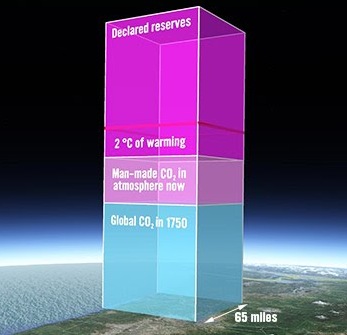
Carbon overload Carbon in atmosphere and amount in fossil fuel reserves

That number was 52 billion tonnes of CO2 in 2012

Only when this number declines will we know we’re making the shift to climate protection

By Stephen Leahy

UXBRIDGE, Canada, Dec 17 2012 (IPS) 

The most important number in history is now the annual measure of carbon emissions. That number reveals humanity’s steady billion-tonne by billion-tonne march to the edge of the carbon cliff, beyond which scientists warn lies a fateful fall to catastrophic climate change.

With the global total of climate-disrupting emissions likely to come in at around 52 gigatonnes (billion metric tonnes) this year, we’re already at the edge, according to new research.

To have a good chance of staying below two degrees C of warming, global emissions should be between 41 and 47 gigatonnes (Gt) by 2020, said Joeri Rogelj, a climate scientist at Switzerland’s Institute for Atmospheric and Climate Science in Zurich.

Only when we see the annual global emissions total decline will we know we’re making the shift to climate protection,” Rogelj told IPS.

Making the shift to a future climate with less than two degrees C of warming is doable and not that expensive if total emissions peak in the next few years and fall into the 41-47 Gt “sweet spot” by 2020, Rogelj and colleagues show in their detailed analysis published Sunday in the journal Nature Climate Change.

The study is the first to comprehensively quantify the costs and risks of emissions surpassing critical thresholds by 2020. Continue reading

80 percent of Arctic Ice Lost Compared to 30 Years Ago

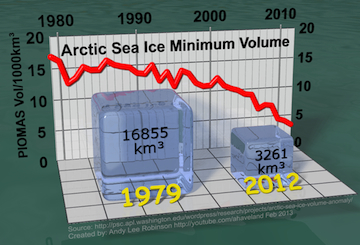
arctic-sea-ice-min-volume-comparison-1979-2012-small

[This is my first exclusive blog post – virtually everything else on this site are my published articles. Not sure if I’ll have time to do more. Let me know what you think – Stephen ]

A new study released Feb 13 revealed that the volume of Arctic sea ice is declining rapidly. Ice volume in September 2012 had fallen 80 percent compared with the volume of ice in September 1980 according to the latest data from European Space Agency satellite, CryoSat-2. As the Arctic heats up Most of the ice loss has been in recent years. Between 2003 and 2012 the volume declined a whopping 36 percent. Summers with a sea ice-free Arctic are only a few years away, scientists now agree. This will have significant and permanent impacts on weather patterns in the Northern Hemisphere.

My previous article  Ice-Free Arctic Is “Uncharted Territory” documented last September’s one year record area decline of 18 percent. Here’s what this means:

The impacts are already being felt across the entire northern hemisphere. The loss of sea ice in recent years has been affecting weather patterns, recent research has shown. The all-important jet stream – the west-to-east winds that are the boundary between the cold Arctic and the warm mid-latitudes – is slowing down, moving north and become more erratic.

When continent-sized areas of the Arctic Ocean flip from the all-white ice to dark blue, tremendous amounts of heat are absorbed from the 24-hour summer sun. When the bitter cold Arctic winter sets in over the next few weeks, all the heat in the ocean must be released into the atmosphere before ice can form again.

The Arctic will be ice-covered in winter for decades to come but what’s fundamentally changed is that every fall, unprecedented amounts of heat and water vapour will be released into the atmosphere.

“The polar meltdown shows we’re teetering on the brink of climate change catastrophe,” said Shaye Wolf, climate science director at the Center for Biological Diversity’s Climate Law Institute.

As the sea ice declines, Arctic temperatures increase, thawing more and more permafrost, which will release more climate-heating carbon and methane. Permafrost is frozen soil, sediment and rock spanning 13 million square kilometres of the land in Alaska, Canada, Siberia and parts of Europe. It has twice the carbon that the atmosphere currently holds.

A Swedish study released Feb 17 has found a link between sea ice declines and increases in methane emissions. Methane has 40x the warming of carbon. This is may lead to an even faster meltdown of the Arctic risking the release of huge amounts of permafrost carbon and methane.

Green Approaches to Water Safest and Cheapest Solution

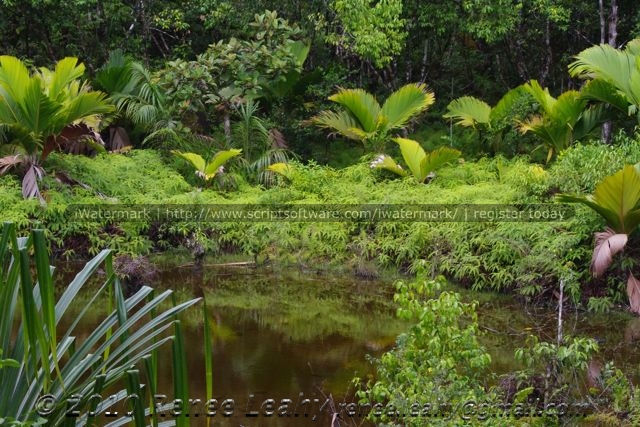
Wetlands regulate, clean and cool water. Mare Aux Cochons high-altitude wetlands, Seychelles Islands (ReneeLeahy copyright)

By Stephen Leahy

UXBRIDGE, Canada, Jan 18 2013 (IPS)

After Hurricane Sandy swept through the northeast of the United States late October 2012, millions of New Yorkers were left for days without electricity.  But they still had access to drinking water, thanks to New York City’s reliance on protected watershed areas for potable water.

Instead of using electric-powered water treatment plans, New York City brings its high-quality drinking water through aqueducts connected to protected areas in the nearby Catskill/Delaware forests and wetlands – just one example of how protecting watersheds can provide residential areas with drinking water and flood and pollution protection at bargain basement prices.

New York saved between four and six billion dollars on the cost of water treatment plants by protecting forests and compensating farmers in the Catskills for reducing pollution in lakes and streams.

In 2011, countries around the world invested more than eight billion dollars in similar watershed projects around the world, according to the State of Watershed Payments 2012 report released Thursday. That year, China led the way, accounting for 91 percent of watershed investment.

“Whether you need to save water-starved China from economic ruin or protect drinking water for New York City, investing in natural resources is emerging as the most cost-efficient and effective way to secure clean water and recharge our dangerously depleted streams and aquifers,” said Michael Jenkins, president of Forest Trends, a non-governmental organisation (NGO) in the United States, which compiled the report. Continue reading

Worlds’ Scientists Say Facing “Planetary Emergency”

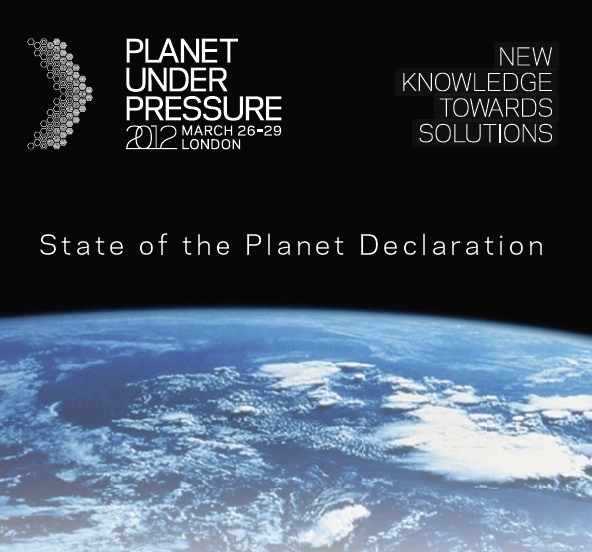
Planet Under Pressure – State of the Planet Declaration Mar 29 2012.

By Stephen Leahy

UXBRIDGE, Canada, (IPS)

[Based on my article Climate Summit: A Moment That Must Be Seized ]

Governments, the media and the public aren’t paying attention to the “planetary emergency” unfolding around them. The situation is like firefighters yelling “fire” in crowded room and still no listens.

“The situation is absolutely desperate and yet there’s nothing on the front pages or on the agenda of world leaders,” said Pat Mooney, executive director of the ETC Group, an international environmental organisation based in Ottawa.

“The lack of attention is a tragedy,” said Mooney, who has 40 years experience in international environment and development issues.

Humanity is failing in its stewardship of the planet. An incredible 85 percent of the world’s oceans are in trouble, said Susan Lieberman, director of international policy at the Pew Environment Group, a U.S. organisation.

“Planetary emergency” is how many in the world’s scientific community describe “the mess we are in“. They will detail their comprehensive state of the planet assessment at the “Planet Under Pressure” conference in London Mar. 26-29.

That assessment will summarise the overwhelming evidence that “the continued functioning of the Earth system as we know it is at risk,” conference organisers previously told IPS.

Climate change, which is overheating the planet and making the oceans more acidic, is just one of the major challenges. Another is the ongoing decline of biodiversity, where so many plants and animals are going extinct that the Earth’s living systems on which humanity depends are unraveling.

Fresh water is another “planetary boundary” humanity is pushing up against. Water use has increased six-fold in the past century and in many places the quality of water resources has been degraded. Other challenges include increasing poverty, food and energy security, and the current financial and economic instability.

A first and essential step in a green transition is for nations to commit to phasing out harmful and unsustainable subsidies for fossil fuels, fisheries and industrial agriculture.

According to Mooney, some countries and large corporations see the green economy in terms of a post-petroleum future where resources and energy for industrial production comes from biomass and other living things. Most of those “living resources” are in the global South and local people rightly fear a massive land grab, he said.

Foreign investors have already gained access to more than 35 million hectares in Africa, Asia and South America for food and biofuel production according to GRAIN, a small NGO working with small farmers and farming communities.


Radio EcoShock: Ravaging Tide or Renewable World?

Flooding of New Jersey shoreline

Can big cities like New York or Washington protect against storm surge and rising seas?


I highly recommend this excellent weekly radio show: RADIO ECOSHOCK  hosted by Alex Smith  — Stephen

Nov 7 Show:  

Mike Tidwell, author of “The Ravaging Tide: Strange Weather, Future Katrinas, and the Coming Death of America’s Coastal Cities.”

Professor J. Court Stevenson, University of Maryland, on city surge defenses around the world.

Daphne Wysham interviews German Green Parliamentarian Hermann Ott: leading the way to renewables before climate collapse.

Website: Radio Ecoshock 121107 1 hour

FREE DOWNLOAD: Download/listen to show in CD Quality (56 MB)

Plankton Death To Come with Acid Oceans and Sunlight

A number of marine diatom cells (Pleurosigma), which are an important group of phytoplankton in the oceans.
Credit: Michael Stringer

Global Warming has made oceans 30% more acidic already

“It’s clear we are conducting a giant experiment on the planet and we don’t know what we are doing.”

[This is a repost from my May 8 2012 article – see here for more on acid ocean impacts — Stephen]

 By Stephen Leahy

UXBRIDGE, Canada, May 8, 2012 (IPS)

Without major reductions in the use of fossil fuels, sunlight will kill an unknown number of ocean phytoplankton, the planet’s most important organism, a new study reports this week.

Not only are phytoplankton, also known as marine algae, a vital component in the ocean’s food chain, they generate at least half of the oxygen we breathe.

In the not so distant future, sunlight, the very source of life for phytoplankton, will likely begin to kill them because of the ocean’s increasing acidity, researchers from China and Germany have learned.

“There’s a synergistic effect between increased ocean acidity and natural light,” says Ulf Riebesell of the Helmholtz Centre for Ocean Research in Kiel, Germany.

Riebesell added that it was also possible “phytoplankton could adapt”.

Researchers were surprised to discover that diatoms, one of the most important and abundant types of phytoplankton, fared very badly during shipboard experiments conducted by co-author Kunshan Gao, from the State Key Laboratory of Marine Environmental Science at Xiamen University, Xiamen China.

Previous experiments in labs like Riebesell’s found that diatoms actually did better in high-acid seawater, unlike most other shell- forming plankton. Burning fossil fuels has made the oceans about 30 percent more acidic researchers discovered less than 10 years ago. Oceans absorb one third of the carbon dioxide (CO2) emitted from using fossil fuels.

The good news is this has slowed the rate of global warming. The bad news is oceans are now more acidic and it will get worse as more CO2 is emitted. This is basic, well-understood ocean chemistry.  Continue reading

Oceans Filled with Plastic Trash – Changing Marine Ecology

Tiny bits of plastic now found throughout the world’s oceans

Ban single-use plastic: bags, bottles, cups etc, scientists say

By Stephen Leahy

UXBRIDGE, Canada, May 10, 2012 (IPS)

Plastic trash is altering the very ecology of the world’s oceans. Insects called “sea skaters”, a relative of pond water striders, are now laying their eggs on the abundant fingernail-sized pieces of plastic floating in the middle of the North Pacific Ocean instead of relying on a passing seabird feather or bit of driftwood.

With an average of 10 bits of plastic per cubic metre of seawater, there are now plenty of places for sea skaters to lay eggs in a remote region known as the North Pacific Subtropical Gyre, 1,500 kilometres west of North America. Not surprisingly, egg densities have soared, a new study has found.

“We’re seeing changes in this marine insect that can be directly attributed to the plastic,” says Miriam Goldstein, study co-author and graduate student at the Scripps Institution of Oceanography at UC San Diego.

This is the first proof that plastics in the open ocean are affecting marine invertebrates (animals without a backbone), which will have consequences for the entire marine food web.

“We simply don’t have the data to know what those consequences will be. It is a very remote region of the ocean, hard to get to and expensive to conduct research,” Goldstein told IPS.

The North Pacific Gyre is one of five large systems of rotating currents in the world’s oceans. It has become better known in recent years as theGreat Pacific Garbage Patch”. It has at least 100 times more plastic today than it did in 1972, according to the study published this week in the journal Biology Letters.

“There were no hard surfaces before in the North Pacific Gyre other than the occasional feather and piece of wood,” says Miriam Goldstein, study co-author and a graduate student at the Scripps Institution of Oceanography at UC San Diego.

“The ocean looks pretty normal out there in the gyre. There is no floating island of trash as some people imagine,” Goldstein told IPS. Continue reading

Hurricane Sandy Speaks: “People call me Frankenstorm, SuperStorm, WeatherBomb…”

Hi, this is Sandy. People are calling me ‘Frankenstorm’, ‘Superstorm’ and even ‘Weatherbomb’.

I don’t mean to hurt anyone but the record moisture in the atmosphere and heat in the ocean has given me uncontrollable power. I probably will cause billions of dollars of damage in Washington, New York City Boston and other parts of the Northeast. And I will kill some people, I already have. At least 66 people died when I swept through Jamaica and Cuba a few days ago.

I am a force of nature but you have to understand this is not all my fault.

Read full post at Hurricane Sandy Speaks (crosspost)