Rio+20: The Moment in History to Ensure Our Future Survival?

Planet Under Pressure - State of the Planet Declaration Mar 29 2012.

Worlds’ Scientists Say Facing “Planetary Emergency”

By Stephen Leahy

UXBRIDGE, Canada, (IPS)

The upcoming Rio+20 conference has to be the moment in human history when the nations of the world come together to find ways to ensure the very survival of humanity, many science and environmental experts believe.

Except that governments, the media and the public aren’t paying attention to the “planetary emergency” unfolding around them. The situation is like firefighters yelling “fire” in crowded room and still no listens.

“The situation is absolutely desperate and yet there’s nothing on the front pages or on the agenda of world leaders,” said Pat Mooney, executive director of the ETC Group, an international environmental organisation based in Ottawa.

“The lack of attention is a tragedy,” said Mooney, who has 40 years experience in international environment and development issues.

Humanity is failing in its stewardship of the planet. An incredible 85 percent of the world’s oceans are in trouble, said Susan Lieberman, director of international policy at the Pew Environment Group, a U.S. organisation.

Rio+20 is a major opportunity to turn this around, Lieberman told IPS.

The Jun. 20-22 Rio+20 meet is timed to coincide with the 20th anniversary of 1992 Earth Summit in Rio de Janerio. The Earth Summit captured world attention, with leaders from most countries and some 10,000 media attending.

It gave birth to the most important environmental treaties on climate change, biodiversity and land degradation and desertification. World leaders also endorsed Agenda 21, a detailed blueprint on how nations can practice sustainable development.

Years of preparation went into the 1992 Summit, while only months have gone into Rio+20.

“There hasn’t been nearly enough preparation to be able to sign treaties,” said Lieberman. It’s been a struggle to get many governments like such as the US to focus on Rio+20 at all she said.

“Governments are not giving this opportunity enough importance given the mess we are in,” said Lisa Speer, director of the international oceans programme at the Natural Resources Defense Council, a U.S. NGO. Continue reading

Extreme Weather is the New Normal with Climate Change

Aftermath of an early tornado in Lancaster, Texas. To join thousands of others connecting the dots between climate change and extreme weather, visit ClimateDots.org.

By Stephen Leahy

CAIRNS, Australia, Apr 3, 2012 (Tierramérica)

Extreme weather is fast becoming the new normal. Canada and much of the United States experienced summer temperatures during winter this year, confirming the findings of a new report on extreme weather.

For two weeks this March most of North America baked under extraordinarily warm temperatures that melted all the snow and ice and broke 150-year-old temperature records by large margins.

Last year the U.S. endured 14 separate billion-dollar-plus weather disasters including flooding, hurricanes and tornados.

A new report from the Intergovernmental Panel on Climate Change (IPCC), released Mar. 28, provides solid evidence that record-breaking weather events are increasing in number and becoming more extreme. And if current rates of greenhouse gas emissions are maintained, these events will reach dangerous new levels over the coming century.

Since 1950 there have been many more heat waves and record warm temperatures than in previous decades.

This will only increase in future decades, as will heavier rainfall events in tropical regions and the high latitudes, according to the Special Report on Managing the Risks of Extreme Events and Disasters to Advance Climate Change Adaptation (SREX). 

The hottest day that occurs once in 20 years is likely to become a one-in-two year event by the end of the century, except in the high latitudes of the Northern hemisphere, where it is likely to happen once every five years.

The average tropical cyclone maximum wind speed is likely to increase, but the global frequency of tropical cyclones is likely to decrease or remain unchanged.

Continue reading

Indigenous Peoples Can Show the Path to Low-Carbon Living If Their Land Rights Are Recognized

Youba Sokona of Mali is co-chair of the IPCC Working Group III. Photo: Citt Williams, OurWorld2.0

by Stephen Leahy

First published at National Geographic’s NewsWatch

Many indigenous peoples are living examples of societies thriving with sustainable, low-carbon lifestyles. Successfully meeting the global climate change challenge requires that much of the world shift from high carbon-living to low.

This shift is daunting. Current emissions for Australia and the United States average about 20 tonnes of carbon dioxide per person. In the coming decades that needs to fall to two tonnes per person as it is currently in Brazil or the Dominican Republic.

Emissions from most indigenous peoples are even lower and are amongst the lowest in the world.

All options for making the shift from high- to low-carbon living need to be explored and that’s why the United Nations University Traditional Knowledge Initiative (UNU) and  Intergovernmental Panel on Climate Change (IPCC) invited indigenous peoples to a special three-day workshop in Cairns, Australia last week.

“Climate change is the result of our behaviour,” said Youba Sokona, co-chair of the IPCC Working Group III that will report to governments in 2014 on ways carbon emissions can be reduced.

The IPCC is the world authority on climate, assessing the state of knowledge on the issue every five to six years. Traditional knowledge of local and indigenous peoples have been left out until now.

“One of the critical solutions is to change our behavior, to change our production and consumption systems,” said Sokona, a climate expert from the African nation of Mali.

The Climate Change Mitigation with Local Communities and Indigenous peoples workshop offered a number of “examples of local peoples in Siberia, in Australia, northern Canada and in some African countries demonstrating that it is possible to change our behavior,” he said.

Marilyn Wallace, a Kuku Nyungkal Aboriginal woman. Photo: Citt Williams, OneWorld 2.0

“I live in a shack but I love being on my ‘bubu’, my traditional land,” said Marilyn Wallace of the Kuku Nyungka ‘mob’ (tribe) in northern Queensland, Australia.

Wallace has lived in towns but fought for years to “return to country” and live in her tropical forest homeland 60 kilometers from Cooktown.

At the workshop Wallace and every other indigenous delegate focused on land rights. The simple truth is that if they can’t live on and manage their lands with time-tested traditional methods, they can’t be part of the solution to climate change.

For complete article see Nat Geo’s NewsWatch


Wisdom of Elders Better Than Science or the Internet: “They Still Know How to Cook Mammoth”

Petr Kaurgin, a Chukchi reindeer herder from Siberia. Photo: Citt Williams

by Stephen Leahy

First published at National Geographic’s NewsWatch

 “Our elders are the best source of information. Better than science or the internet,” said Petr Kaurgin, a Chukchi reindeer herder from the remote Turvaurgin nomadic tribal community in north-eastern Siberia.

Kaurgin delivered his message to climate scientists from Intergovernmental Panel on Climate Change (IPCC) and other Indigenous peoples at the closing of the Climate Change Mitigation with Local Communities and Indigenous peoples workshop here in Cairns, Australia.

“We need to listen to the wisdom of the elders. We can use everything in nature. But we must not break or destroy things, ” he said through a translator.

It was -45C when Kaurgin left his home to bring his people’s message to climate experts here in the hot, wet tropical part of Australia. The IPCC is the world authority on the science of climate change. And along with the United Nations University (UNU) organized the workshop to figure out how to incorporate Indigenous peoples’ traditional knowledge.

“When we love the land where we live only then we are happy,” he said.

Kaurgin’s people and other local Siberian communities have been experiencing the impacts of climate change such as melting permafrost for the last 20 years said Tero Mustonen, Head of the Village of Selkie in North Karelia, Finland.

For complete article see Nat Geo’s NewsWatch

The New Beast in the Forest Brings Hope and Threats to Indigenous Peoples

Deforestation for oil palm plantation West Kalimantan, Indonesia. Photo Karmele Llano SanchezInternational Animal Rescue

by Stephen Leahy

First published at National Geographic’s NewsWatch

“REDD is the new beast in the forest,” said Patrick Anderson of the Forest Peoples Programme in Indonesia here at Climate Change Mitigation with Local Communities and Indigenous peoples workshop in Cairns, Australia.

Deforestation gobbles up an area the size of Greece (13 million hectares) every year. As if that loss wasn’t bad enough, it also produces huge amounts of greenhouse gas emissions — a whopping 15 to 20 percent of all global emissions. That’s second only to the burning of fossil fuels.

Sadly, in our economic system, trees are worth far more dead as paper, lumber, furniture, etc., than alive.

In an attempt to reverse this, countries in the United Nations have agreed to create a financial value for the carbon stored in forests in a program called REDD: Reducing Emissions from Deforestation and Forest Degradation.

This is how it works. Trees take heat-trapping carbon out of the atmosphere as they grow and store it for as long as the trees live. Instead of cutting down trees and selling the wood, the carbon trapped in the living trees can be sold as “carbon credits” on an open market.

A steel, cement, or coal-fired power company in the U.S. or a European country can then buy those credits instead of reducing its carbon emissions. The current price is around $10 per tonne but this fluctuates.

For example, the newly established Carbon Tax in Australia sets the price at $23 per ton in the first year of operations. (One hectare of tropical forest stores between 250-500 tonnes of carbon but varies considerably. An average car emits 1.5 tonne of carbon per year.)


‘Abriculture’ Using Forests to Feed Indigenous Peoples and Fight Climate Change

Seith Fourmile of Gimuy-Walubarra Yidinji Nation of Cairns, Jenny Lynch Abriculture Development Officer in Cairns.  Photo: Stephen Leahy

Forests can not only suck climate-heating carbon out of the atmosphere, they are also an important source of food for many Indigenous peoples.

“Western food is making our people sick. Our bodies are adapted to eating bush foods,” said Seith Fourmile of the Gimuy-Walubarra Yidinji Nation of Cairns.

Australia’s Aboriginal or Torres Strait Islander peoples suffer from rates of diabetes three to four times greater than other Australians. Rates of high blood pressure, cardiovascular, and kidney diseases are also higher. Similar health problems have been found among Alaska’s Eskimo and Canada’s Inuit peoples.

The world’s forests “offer a cornucopia of 80,000 species of plants as foods,” writes botanist and medical biochemist Diana Beresford-Kroeger in her book The Global Forest. Western foods rely on just a few species, while oral knowledge of the other thousands of species is rapidly being lost, according to Beresford-Kroger.

Click for full story


“We’re facing a planetary emergency” The Road to Rio (+20 years)

“Humanity is facing major challenges…urgent actions are needed”

Can we act as a true community?

By Stephen Leahy

UXBRIDGE, Canada, Jan 11, 2012 (IPS)

Humanity is driving Earth’s climate and ecosystems towards dangerous tipping points, requiring radical new forms of international cooperation and governance, experts say.

“We’re facing a planetary emergency,” said Owen Gaffney of the International Geosphere-Biosphere Programme based in Stockholm.

“We need to have a ‘constitutional moment’ in world politics, akin to the major transformative shift in governance after 1945 that led to the establishment of the United Nations and numerous other international organisations,” said Frank Biermann of VU University Amsterdam and director of the Earth System Governance Project.

“Humanity is facing major challenges…urgent actions are needed,” Biermann told IPS.

              Be a Partner in Independent Enviro Journalism

Those challenges include, but are not limited to, increasing poverty, food, water and energy security, the financial crisis, climate change, ocean acidification, the loss of biodiversity. All of these challenges and their solutions are interconnected.

Normally, the complex, mutually dependent systems of the Earth can self-correct and are remarkably stable. However, they can reach thresholds or tipping points and then unexpectedly and abruptly shift, Gaffney said in an interview.

“We need only recall how the U.S. sub-prime mortgage crisis nearly collapsed the global financial system,” he said.

The upcoming Rio+20 conference on sustainable development needs to be the moment in human history when the nations of the world come together to find ways to ensure “the very survival of humanity”, he said. Continue reading

Become a Partner in Independent Enviro Journalism

A personal message from Stephen Leahy

“Journalism and media are society’s mirror providing accurate and essential information.

That is no longer the case.

Media are now controlled by a few major corporations like Murdoch’s News Corp. Coverage of environment and science has been gutted. If there is coverage it rarely digs below the surface. It’s not just TV, it’s all media.

After 18 years of being published in major publications on two continents I now count myself lucky to get $150 to $200 for an in-depth article. The few independent media outlets are either non-profits or struggling.

Urgent environmental issues didn’t go away just because most media stopped covering them.

More than 20,000 people attended the international climate meeting in Cancun, Mexico and it received one ten second clip on US network TV according to a Drexel University media study. (Coverage was even worse at last climate meet in Durban)

Nearly every indicator proves things are getting worse but less and less people know about this.

Many people, including leading scientists, tell me: ‘we need people like you to write about these issues‘. I’d like to do far more but it is impossible to continue without your help in what I’m calling Community Supported Journalism. People directly support independent journalists who craft honest and thoughtful articles about important subjects the mainstream media ignores or gloss over.

Community Supported Environmental Journalism Works

In 2010 dozens of people offered their help, donating $5,750 which helped ensure many breaking international stories were covered including the first media reports on the global die-off of corals and how climate change may be bringing colder winters to Europe and eastern North America. Those donors — I prefer to call them partners — enabled me to cover important international meetings like the UN Convention on Biodiversity, UNFCCC climate change conference and much more.

Thanks for reading.” — Stephen

Please join us. Consider a donation of just $10 a month to support enviro journalism that serves the public interest.

Contributions can be made safely and easily via PayPal* or Credit Card*. [You can cancel at any time, automatically. No need to contact me] 

Monthly support options starting @ $10 a month

One-time donations are most welcome. Click and enter the amount.

*More than 100,000 non-profits safely use PayPal Donate service

If you’d like a mailing address or contact me with story ideas, please complete this comment form.

Letters of Support:

We need people like you. In tough economic times, where information flow is increasingly channeled and controlled, you perform a simply critical role. Hang in there. You are an admirable role model for the future.”

– E. Ann Clark, Associate Professor, University of Guelph.

“Stephen Leahy has done a superb job exposing the enormous sums the US government is spending on corporate welfare for big oil.”

Ross Gelbspan, Pulitzer-prize winning editor and author of The Heat is On

My continued appreciation to those who have contributed in the past.

Canada’s Harper Government Guts Environment, Science and Monitoring Programs

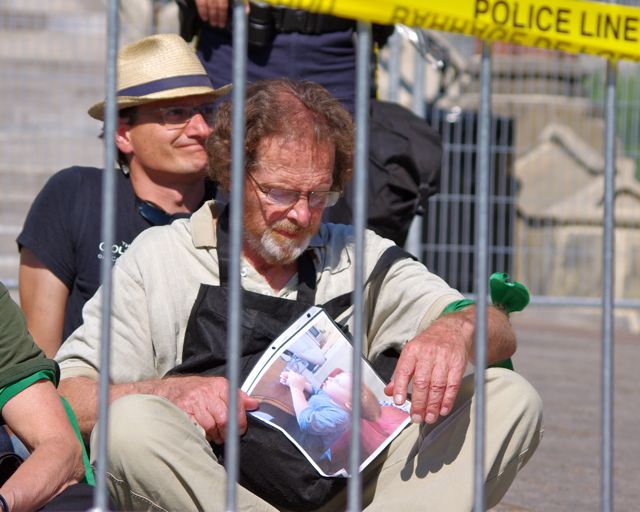
Man w picture of grandchild was arrested for protesting against tar sands expansion, Sept 2011 Ottawa, Canada - Pix by R Leahy

Environment budget slashed while PM Harper’s office places a gag order on government scientists. (And a $60 billion order for military equipment)

By Stephen Leahy

UXBRIDGE, Canada, Nov 9, 2011 (IPS)

Canada’s Stephen Harper government is spending more than 60 billion dollars on new military jets and warships while slashing more than 200 million dollars in funding for research and monitoring of the environment.

Amongst the programmes now crippled is Canada’s internationally renowned ozone monitoring network, which was instrumental in the discovery of the first-ever ozone hole over Canada last spring. Loss of ozone has been previously linked to increases in skin cancer.

“The proposed cuts go so far the network won’t be able to do serious science,” said Thomas Duck, an atmospheric scientist at Halifax’s Dalhousie University.

Canada was the pioneer in ozone monitoring, developing the first accurate ozone measuring tool that led to the discovery that the world’s ozone layer was dangerously thinning in the 1970s, which in turn led to the successful Montreal Protocol on Ozone Depleting Substances.

Canada has about one-third of the ozone monitoring stations in the Arctic region. It also hosts the world archive of ozone data, which is heavily relied on by scientists around the world.

“There’s only one guy running the entire archive, and he’s received a lay-off notice letter,” Duck told IPS.

Ozone monitoring and research is part of Environment Canada, the government department charged with protecting the environment, conservation and providing weather and meteorological information.

“Canada can’t afford to pay scientists but we can line the pockets of big oil?

That is totally backwards.”

Continue reading

The Quiet Crisis: Lost Foodlands Cover Area Larger Than Canada and China Combined – Two Billion People Affected

12 Million Hectares Lost Every Year to Desertification

Dealing with desertification has a long history of failure.

By Stephen Leahy

CHANGWON, South Korea, Oct 13, 2011 (IPS)

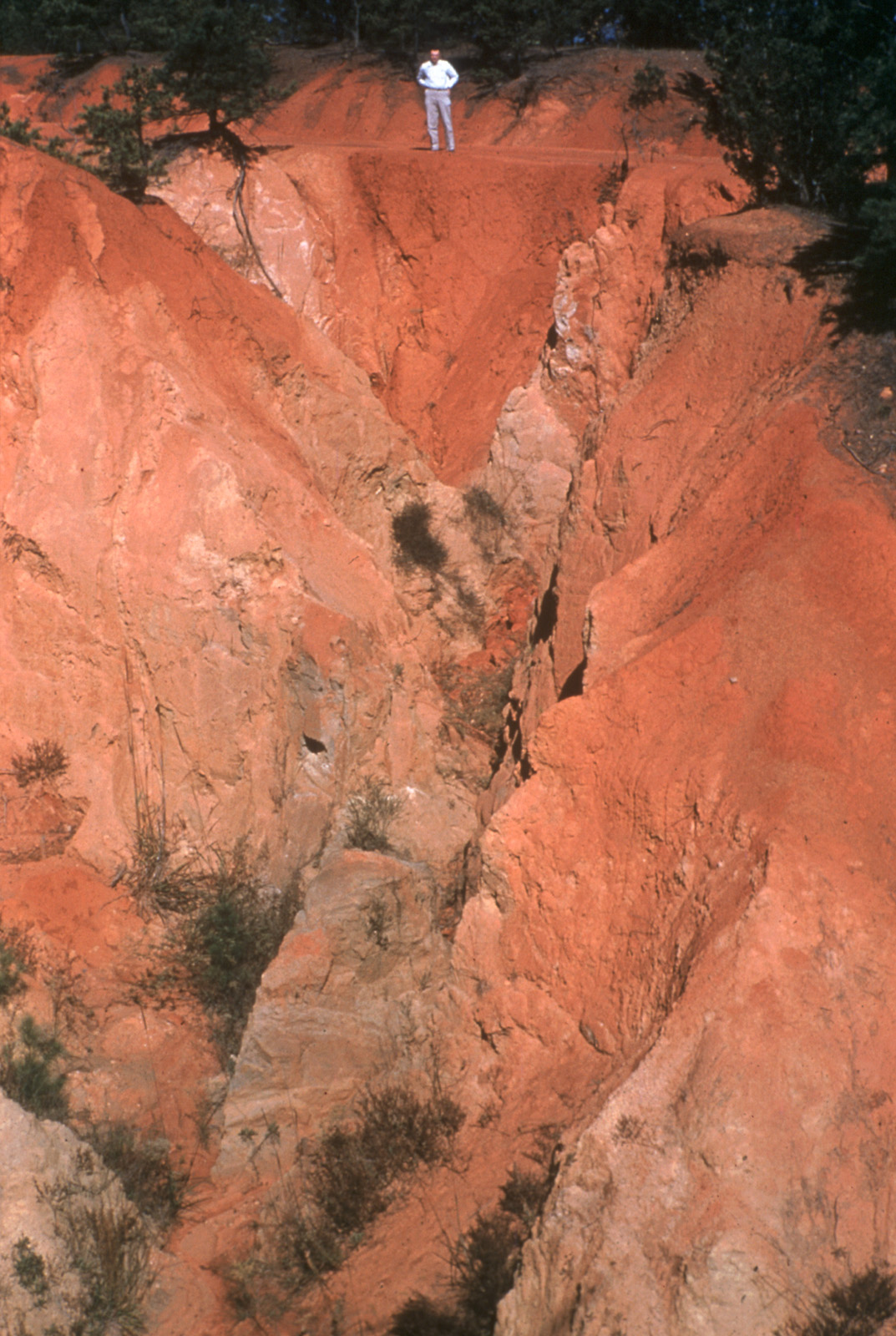
Degradation of land is the world’s quiet crisis, undercutting food production, increasing water scarcity, impoverishing hundreds of millions of people and affecting two billion overall. Nearly 20 million square kilometres of the earth’s arable lands – an area twice the size of Canada – have already been degraded.

Each year, 12 million hectares of land, where 20 million tons of grain could have been grown, are lost to desertification. Unless this trend is reversed soon, feeding the world’s growing population will be impossible, experts say. However, the global community has failed for over two decades to address this serious challenge.

Now, delegates from 193 countries are meeting in South Korea under the United Nations Convention to Combat Desertification (UNCCD) to review progress on a ten-year plan to reverse the ongoing decline in the quality and quantity of land in food-producing regions.

During the 10th Conference of the Parties (COP 10) under the UNCCD, delegates will also consider creating a scientific body like the Intergovernmental Panel on Climate Change to serve as the global authority on desertification and land degradation.

“The UNCCD will take bold steps towards delivering critical services to the two billion people that face negative impacts of desertification, land degradation and drought,” Luc Gnacadja, executive secretary of the UNCCD, told delegates during the opening session of COP 10 that began Oct. 10 and concludes Oct. 21.

Land degradation is mainly the consequence of poor land management in conjunction with changes in rainfall. Erosion and degradation most often result from ploughing fields, removing crop residues after harvest and overgrazing. It is akin to tire wear on cars – a gradual, less noticeable process with potentially catastrophic consequences if ignored for too long.

“People do not notice land degradation until there is a crisis,” said Pier Paolo Roggero, a scientist at University of Sassari in Italy. Continue reading