Sir Nicholas Stern: On Our Way to Calamitous +5

Hundreds of Millions of Climate Refugees
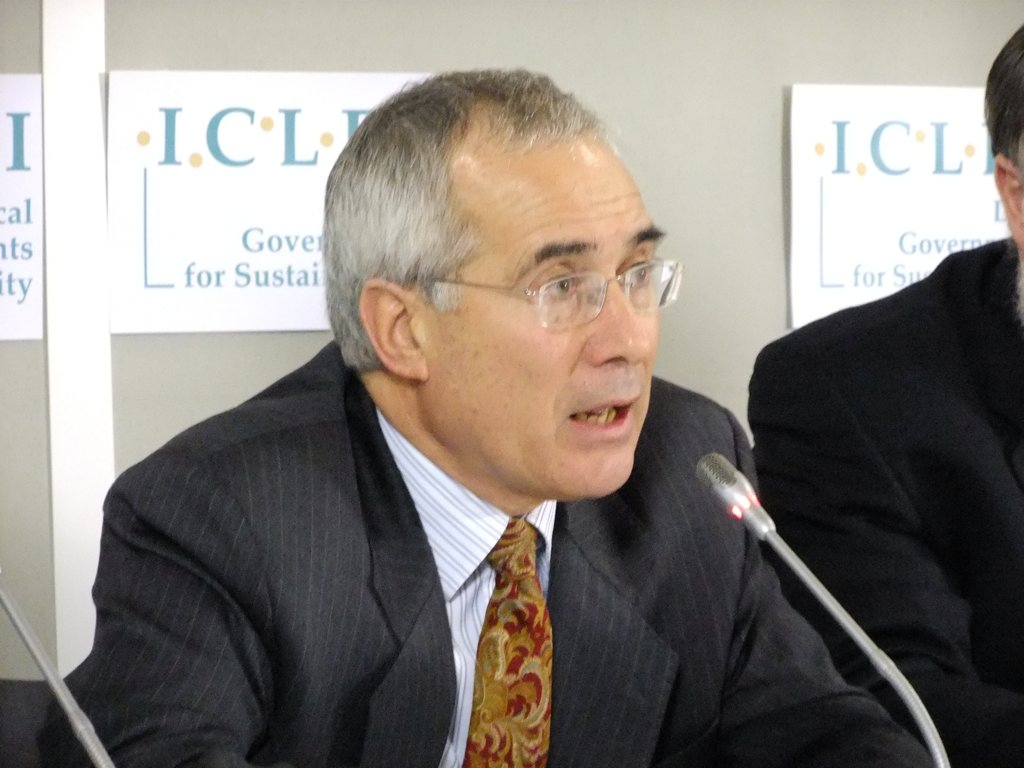
‘Governments Fail to Understand Gravity of the Situation’ – Stern

By Stephen Leahy

COPENHAGEN (IPS/TerraViva)

[I wrote this piece 16 December 2009 and it remains fully relevant today and is posted here for 1st time. And please note that the +5C cited here is the global average which means the warming could easily be 10 C warmer where you live. All of this is well beyond anything humanity has ever faced — Stephen]

On its current carbon emissions path, humanity faces a 50-percent chance of warming the planet a whopping 5.0 degrees C by the end of this century, warned Nicholas Stern, an economist who is chair of the Grantham Institute for Climate Change and the Environment at the London School of Economics.

“Hundreds of millions of people will be forced to move. It will be the most severe global conflict in human history. That is what the science is telling us,” said Stern, author of the well-known Stern Review, the 2006 report that documented the effect of global warming on the world economy.

Humanity’s other option is to embrace a new energy revolution unlike anything ever seen.
And cities will be on the leading edge of this revolution, he said.

Cities use 80 percent of all energy and are responsible for the bulk of emissions. The good news is that cities are also the easiest places to get major emissions reductions because energy services are centralised and collaboration is easier.

This independent environmental journalism depends on public support. Click here learn more.

“Local mayors and councils can more easily agree on policies and direct their administration to take action,” he said.

“Cities are already doing the work of national governments on climate,” said David Cadman, president of ICLEI – Local Governments for Sustainability, an international association of local governments that is hosting a mayors’ conference featuring mayors from more than 100 cities as part of the climate negotiations here.

Copenhagen to be carbon-neutral by 2025

Continue reading

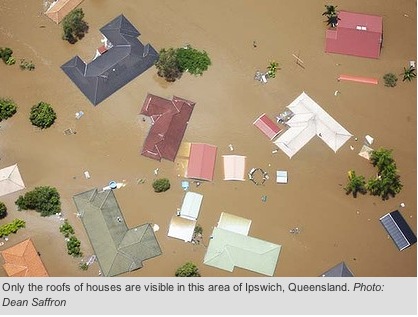
Now Historic Flooding Hits Southern Australia

[UPDATE 19 Jan – 25 % of state of Victoria underwater]

While flood levels drop in Queensland and Brisbane, Australia’s state of Victoria has now been hit with historic levels of flooding.

A strong La Nina enhanced by global warming seems to be behind the record flooding in Australia, Brazil, Sri Lanka and elsewhere as documented in my earlier article. Part of the reason for the severity of the flooding is that the atmosphere now contains 4 per cent more water vapour as a result of the increased global temperature of roughly 0.8C.

As the planet continues to warm from the burning of fossil fuels floods will get worse, but so will droughts.

Climate Change Could Be Worsening Effects of El Niño, La Niña

Global Warming Worsening Impacts; Creating New ENSO ‘Flavors’

By Stephen Leahy*

UXBRIDGE, Canada, Jan 11, 2011 (Tierramérica) 

The strongest La Niña weather system in 50 years has brought historic flooding to Australia and drought to Argentina, Brazil and Uruguay, driving up food prices.

Scientists now believe climate change is likely enhancing the impacts of the famous El Niño-Southern Oscillation (ENSO), a cyclical climate phenomenon that affects weather patterns around the world.

La Niña and El Niño are, respectively, the cold and warm phases of the ENSO cycle, and form part of the system that regulates heat in the eastern tropical Pacific Ocean.

Both accompany simultaneous changes in surface ocean temperature and air pressure.

In conditions defined by climatologists as “neutral,” high air pressure predominates in the eastern Pacific, while low pressure predominates in the west.

This independent environmental journalism depends on public support. Click here learn more.

The difference in pressure generates the trade winds, which blow east to west over the surface of the tropical Pacific, pushing the warm waters westward. The deeper, cooler waters then surface in the east, replacing the warm waters.

During episodes of La Niña, the differences in pressure are more marked, the trade winds blow more strongly, and the cold-water currents in the eastern Pacific intensify.

On the other hand, during El Niño, high surface air pressure in the western Pacific and lower pressure on the coasts of the Americas cause the trade winds to weaken or change direction, resulting in warmer water temperatures in the eastern Pacific.

“There has been a very rapid transition from El Niño to La Niña in 2010,” Kevin Trenberth, a senior climate scientist with the National Centre for Atmospheric Research (NCAR) in the central U.S. state of Colorado, told Tierramérica. Continue reading

Ice-cold Atlanta (and eastern US) Is Likely Connected to Arctic Hothouse

But first…

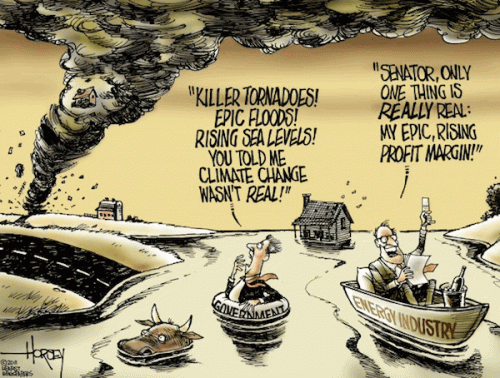
That’s a great cartoon.

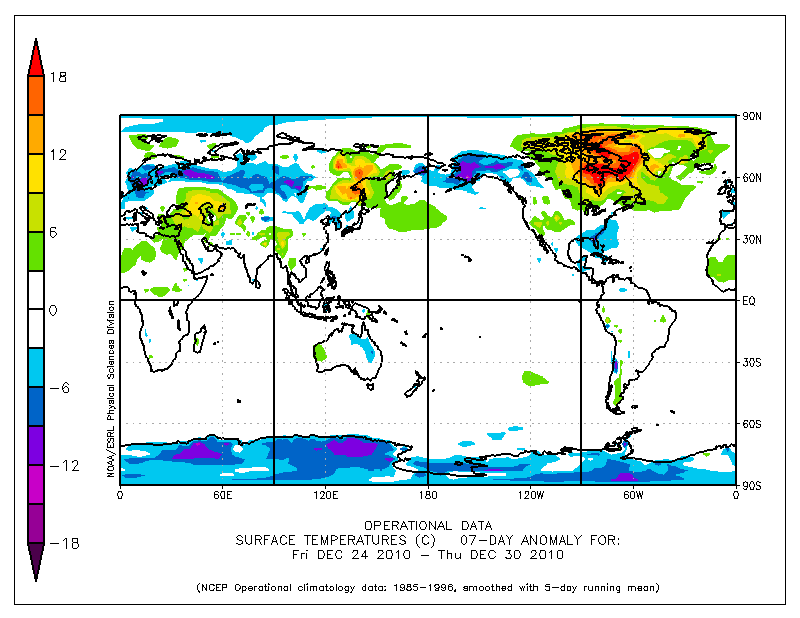
Climate change seems to be behind the shockingly warm temps across much of the eastern Arctic all winter and is likely responsible for the snow has fallen across much of the southern US. Much of Arctic ice sea melted last summer, allowing the Arctic ocean to warm up which then took longer to freeze i.e. late Dec/ Jan. And that changed the wind circulation patterns bringing polar air far south. (See my previous post that explains what is happening East Coast Blizzard and Europe’s Snowmaggddon Reveal Fingerprints of Climate Change

And for a collection of global temp graphs see this post
Arctic Hothouse Turns Europe into an Icebox )

And finally here’s a short video by Peter Sinclair of Climate Denial Crock of the Week explaining this: Global Warming. Winter Weirding.

]

This is part of Community Supported Environmental Journalism, independent reporting supported by citizens in several countries thru one-time, weekly or monthly or in-kind donations.

Africa’s Future Lies in a Green Energy Grid – Universal Access to Electricity Less Than Cost of Fossil Fuel Subsidies

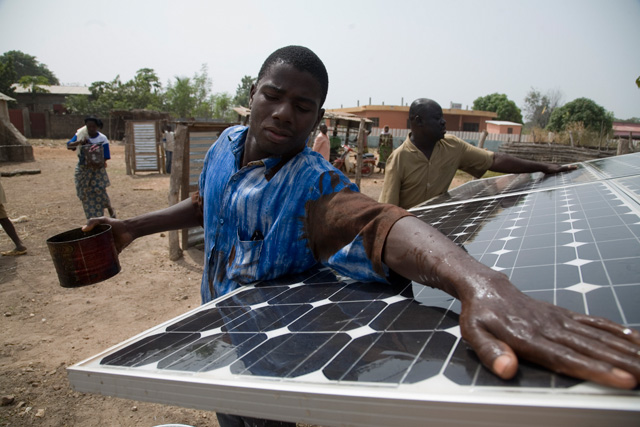
Kenya switched to green energy and now more people than ever have electricity

Universal access to modern electricity would cost much less than current subsidies to fossil fuel industry

By Stephen Leahy*

UXBRIDGE, Canada, Dec 14, 2010 (IPS)

Development in Africa could falter as climate change grips the continent, increasing the length and severity of droughts and floods by altering precipitation patterns, among other impacts.

The region needs a major shift in its economic development policies and thinking towards decentralised, green economic development, experts now say.

“The world’s big economies are largely living off financial transactions which are unconnected to development,” warns Supachai Panitchpakdi, secretary-general of United Nations Conference on Trade and Development.

“Export growth does not automatically result in green economic growth, we must look at trade for development,” said Panitchpakdi.

In a rejection of failed neoliberal economic policies, Panitchpakdi said strong national policies on investments, taxation, protection of local industries, including subsidies, and changes to less restrictive intellectual property regimes are what is needed to green economies in Africa and elsewhere.

“Green economic development underpins environmental protection, economic growth and development,” he said.

This independent environmental journalism depends on public support. Click here learn more.

Continue reading

The Yin and Yang of Climate Extremes We Will See More of

Extreme weather accounted for 76 percent of all disasters over the past 20 years. Recovery is often impossible even in the US, i.e. New Orleans 5 years after Hurricane Katrina where poor neighborhoods remain devastated

By Stephen Leahy

UXBRIDGE, Canada, Oct 13, 2010 (Tierramérica) 

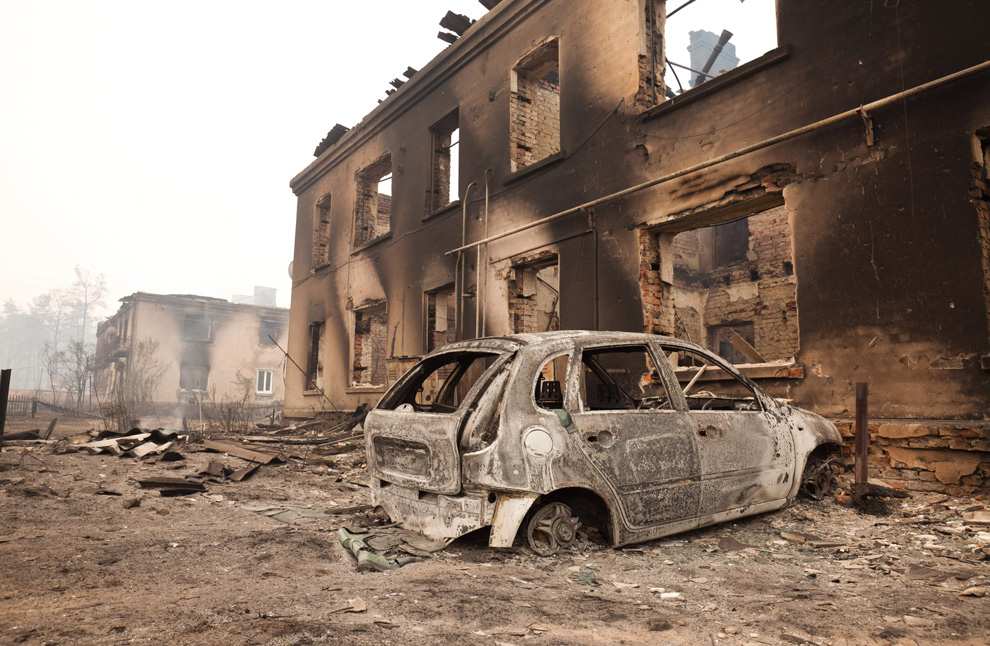
The floods that affected 20 million people in Pakistan and the devastating six-week heat wave in Russia in recent months are tragic climate events — and they’re closely linked.

“The Pakistan floods and Russia heat wave were directly connected, the atmospheric science makes that clear,” Kevin Trenberth, senior scientist at the U.S. National Centre for Atmospheric Research, told Tierramérica.

A long-lasting high pressure system called a “blocking high” essentially gave western Russia a dry Mediterranean summer, which in turn shifted more- than-normal moisture into the Indian monsoon, resulting in record-breaking rainfall in northern Pakistan and India, Trenberth explained.

Wildfires burned many russian villages Aug 2010

It is difficult to determine whether climate change caused this extraordinary event, but it certainly made it much worse, according to Trenberth. “Without global warming these extremes are unlikely to have occurred,” he added.

The drought in Russian and the heavy rains in Pakistan are exactly what are expected to happen with climate change, said the expert.

“Changes in extreme weather events are the main way climate change is manifested,” he said, noting that the storms or floods that used to occur once every 200 years may now occur every 30 years.

This independent environmental journalism depends on public support. Click here learn more.

Continue reading

Record-breaking temps 20C above norm in Arctic in January

Arctic Hothouse Turns UK, Europe, Eastern North America into an Icebox

It remains shockingly warm in much of the eastern Arctic (See my previous post that explains what is happening Arctic Hothouse Turns Europe into an Icebox )

Iqaluit one of the most northern communities in Canada is +2.1.C  (Jan 6) — a whopping 20C above normal as it has been for weeks. Normal night temps are -30C. This winter heat wave is creating havoc with rain instead of snow throughout much of the eastern Arctic.

Part of the reason is the heat stored in the Arctic ocean from this summer’s ice melt has delayed the annual freeze up. Here is the very latest satellite measurements which show the Arctic sea ice extent for December as the lowest on record.

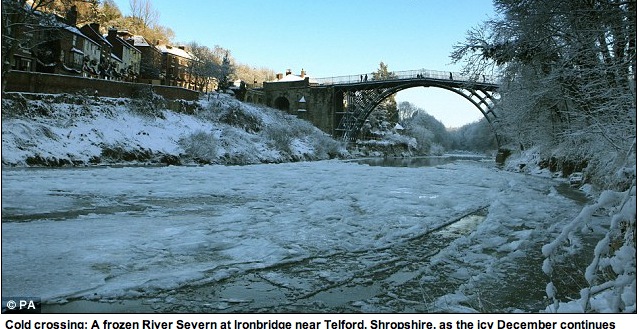
This is affecting winter weather in many places such as Britain which had its coldest Dec in 100 years. And yes, climate change is a major player in all this.

For more on this see Joe Romm’s take on Climate Progress.

This is part of Community Supported Environmental Journalism, independent reporting supported by citizens in several countries thru one-time, weekly or monthly or in-kind donations.

Be a Partner in Independent Enviro Journalism

More than 20,000 people from 190 nations attended the international climate meeting in Cancun, Mexico and it received one ten second clip on US network TV 

Coverage of environment and science has been gutted. If there is coverage it rarely digs below the surface. It’s not just TV, it’s all media. After 18 years of being published in major publications on two continents, I now count myself lucky to get $150 to $200 for an in-depth article. The few independent media outlets are either non-profits or struggling.

Urgent environmental issues didn’t go away just because most media stopped covering them.

Many, many people tell me:we need people like you to write about these issues”.

I’d like to do more but it is impossible to continue without your support for what I call Community Supported Journalism. People directly support independent journalists who craft honest and thoughtful articles about important subjects the mainstream media ignores or gloss over.

Community Supported Environmental Journalism Works

In 2010 dozens of people offered their help, donating $5,750 which helped ensure many breaking international stories were covered including the first media reports on the global die-off of corals and how climate change may be bringing colder winters to Europe and eastern North America. Those donors — who are really partners — enabled me to cover important international meetings like the UN Convention on Biodiversity, UN climate change conference, scientific meetings and much more.

Please join us. Consider a donation of just $10 a month to support enviro journalism that serves the public interest.

Contributions can be made safely and easily via PayPal* or Credit Card*. [You can cancel at any time, automatically. No need to contact me] 

Monthly support options starting @ $10 a month

One-time donations are most welcome. Click and enter the amount.

*More than 100,000 non-profits safely use PayPal Donate service

If you’d like a mailing address or contact me with story ideas, please complete this comment form.

Thanks for reading. — Stephen

Letters of Support:

We need people like you. In tough economic times, where information flow is increasingly channeled and controlled, you perform a simply critical role. Hang in there. You are an admirable role model for the future.”

– E. Ann Clark, Associate Professor, University of Guelph.

“Stephen Leahy has done a superb job exposing the enormous sums the US government is spending on corporate welfare for big oil.”

Ross Gelbspan, Pulitzer-prize winning editor and author of The Heat is On

My continued appreciation to those who have contributed in the past.

Arctic Hothouse Turns Europe into an Icebox

Here’s a temperature map from mid December illustrating the super warm Arctic region and the icy cold Europe in the mid-latitudes. [[ see also temp anomaly chart showing Hudson Bay to Greenland is 18C above normal this week]]

My previous post explains what is going on: East Coast Blizzard and Europe’s Snowmaggddon Reveal Fingerprints of Climate Change

— Stephen

And here is the Arctic sea ice extent – lowest ever for December.

As of Jan 2 Canada’s Hudson Bay is still not completely frozen over – likely the latest freeze up in a very long time. (10,000s of years?)


East Coast Blizzard and Europe’s Snowmaggddon Reveal Fingerprints of Climate Change

Coldest Christmas on Record on the UK -18C

In Oslo last June climate researcher’s told me the melting Arctic ice will likely produce colder winters in the eastern United States and Europe. Looks like they were right. Winter freeze up in the sunless Arctic ocean was two months late this year because of a near record ice loss last summer that is expected to continue if not accelerate in future years.

Several research programs have been studying the impacts of this huge loss in Arctic sea ice and presented their findings for first time at the International Polar Year Oslo Science Conference. My summary from 15 June:

Climate change has warmed the entire Arctic region, melting 2.5 million square kilometres of sea ice, and that, paradoxically, is producing colder and snowier winters for Europe, Asia and parts of North America.

“The exceptional cold and snowy winter of 2009-2010 in Europe, eastern Asia and eastern North America is connected to unique physical processes in the Arctic,” said James Overland of the NOAA/Pacific Marine Environmental Laboratory in the United States.

In future, cold and snowy winters will be the rule rather than the exception” in these regions, Overland told IPS.

Thanks to support from readers and the organizers of the conference I was able to attend that polar science conference. No media/publication would front any travel money to help me get there. I was one of a small handful of jurnos there and the first to write a piece documenting the link between global warming and bitter winter weather.

This independent environmental journalism depends on public support. Click here learn how this works.

My full article from Oslo is here: Arctic Melt Down Is Bringing Harder Winters and Permanently Altering Weather Patterns