“We Should be Shaking in Our Boots” – UN Environment Official

Construction of the Trans-Amazonian Highway, Brazil -- sml Photo by Hans Silvester

Earth’s Ability to Support Us At Risk – An Indictment of Governments We Elected

By Stephen Leahy

RIO DE JANEIRO, Jun 19 2012 (IPS)

The science is crystal clear: humans are threatening Earth’s ability to support mankind, and a new world economy is urgently needed to prevent irreversible decline, said scientists and other experts at an event on the sidelines of the Rio+20 Earth Summit.

Yet the Global Environment Outlook report, or GEO 5, which was launched on June 6 and assessed 90 of the most important environmental objectives, found that significant progress had been made only in four in the 20 years since the first landmark summit in Rio in 1992.

Achim Steiner, the executive director of the United Nations Environment Programme (UNEP) said the results of GEO 5 were “depressing, even to me”.

“This ought to have us shaking in our boots,” Steiner told TerraViva at the Fair Ideas conference that concluded Sunday. ”It is an indictment of our behaviour over the past 20 years and of the governments we elected. We need an honest conversation about why we are not turning things around.”rio banner sml

Instead, “what’s happening right now in the RioCentro (Rio+20 official site) is that science is being picked out of the text of the final agreement,” Johan Rockström, executive director of the Stockholm Resilience Centre in Sweden, told the conference.

Rockström said he had received updates from the negotiations that the United States and some of the world’s least developed countries were attacking the science showing humanity is pushing up against “planetary boundaries”.

Climate is only one of those “planetary boundaries”. Another is the ongoing decline of biodiversity, where so many plants and animals are going extinct that the Earth’s living systems, upon which humanity depends, are unravelling. Fresh water is another planetary boundary. Water is a limited resource, yet water use has increased six-fold in the past century.

“The science is absolutely clear: we are up against the edges of the planet’s ability to support us and approaching irreversible tipping points,” Rockström said. Continue reading
“We’re all scared…But we must tell the truth” — Experts Fear Collapse of Global Civilisation

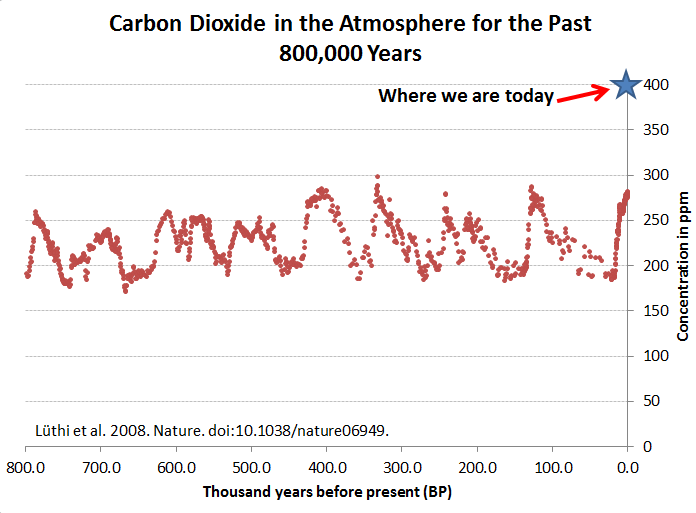
terrifying co2 graph

By Stephen Leahy

UXBRIDGE, Canada, Jan 11 2013 (IPS)

Experts on the health of our planet are terrified of the future. They can clearly see the coming collapse of global civilisation from an array of interconnected environmental problems.

“We’re all scared,” said Paul Ehrlich, president of the Center for Conservation Biology at Stanford University.

“But we must tell the truth about what’s happening and challenge people to do something to prevent it,” Ehrlich told IPS.

Global collapse of human civilisation seems likely, write Ehrlich and his partner Anne Ehrlich in the prestigious science journal, Proceedings of the Royal Society.

This collapse will take the form of a “…gradual breakdown because famines, epidemics and resource shortages cause a disintegration of central control within nations, in concert with disruptions of trade and conflicts over increasingly scarce necessities”, they write.

Already two billion people are hungry today. Food production is humanity’s biggest industry and is already being affected by climate and other environmental problems. “No civilisation can avoid collapse if it fails to feed its population,” the authors say.

Escalating climate disruption, ocean acidification, oceanic dead zones, depletion of groundwater and extinctions of plants and animals are the main drivers of the coming collapse, they write in their peer-reviewed article “Can a collapse of global civilisation be avoided?” published this week.

Dozens of earth systems experts were consulted in writing the 10-page paper that contains over 160 references.

“We talked to many of the world’s leading experts to reflect what is really happening,” said Ehrlich, who is an eminent biologist and winner of many scientific awards.

Our reality is that current overconsumption of natural resources and the resulting damage to life-sustaining services nature provides means we need another half of a planet to keeping going. And that’s if all seven billion remain at their current living standards, the Ehrlichs write.

If everyone lived like a U.S. citizen, another four or five planets would be needed. Continue reading

Killer Heat Waves and Floods Linked to Climate Change

More than 5 million affected by flooding in Pakistan Sept 2011 - a repeat of 2010.
More than 5 million affected by flooding in Pakistan Sept 2011 – a repeat of 2010.

“The first law of humanity is not to kill your children.”

By Stephen Leahy

UXBRIDGE, Canada, Feb 27 2013 (IPS)

Killer heat waves, floods and storms are increasingly caused by climate change, new research reveals.

Scientists in Germany say they have found how greenhouse gases from burning fossil fuels are helping to trap the jet stream, resulting in extraordinary weather such as the 2010 Pakistan flood and the 2011 heat wave in the United States.

Human-driven climate change repeatedly disturbs the flow of atmospheric waves around the globe’s Northern hemisphere, said lead author Vladimir Petoukhov of the Potsdam Institute for Climate Impact Research (PIK) in Germany.rossby.waves1_

Giant atmospheric waves called Rossby waves are meanders in the strong, high-altitude winds known as jet streams and have a major influence on weather. These wave movements are caused by the difference in temperatures between the cold air from the Arctic and hot air from the tropics.

When the waves shift north, they suck warm air from the tropics to Europe, Russia, or the U.S., and when they swing down, they do the same thing with cold air from the Arctic, said Petoukhov.

“During several recent extreme weather events, these planetary waves almost freeze in their tracks for weeks,” he said. “So instead of bringing in cool air after having brought warm air in before, the heat just stays.”

This unnatural pattern is due to human heating of the climate through emissions of greenhouse gases that result from burning fossil fuels, according to the study published this week in Proceedings of the National Academy of Sciences.

However, this heating of the atmosphere is wildly uneven. The Arctic is warming two to three times faster than the global temperature rise of 0.8C and that affects the Rossby waves and is slowing the jet stream.

“(Our research) complements previous research that already linked such phenomena to climate change,” said Hans Joachim Schellnhuber, a co-author of the study. Continue reading

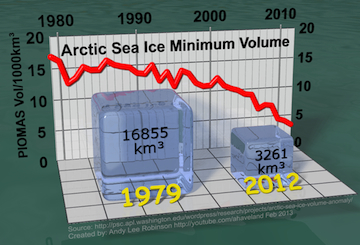
80 percent of Arctic Ice Lost Compared to 30 Years Ago

arctic-sea-ice-min-volume-comparison-1979-2012-small

[This is my first exclusive blog post – virtually everything else on this site are my published articles. Not sure if I’ll have time to do more. Let me know what you think – Stephen ]

A new study released Feb 13 revealed that the volume of Arctic sea ice is declining rapidly. Ice volume in September 2012 had fallen 80 percent compared with the volume of ice in September 1980 according to the latest data from European Space Agency satellite, CryoSat-2. As the Arctic heats up Most of the ice loss has been in recent years. Between 2003 and 2012 the volume declined a whopping 36 percent. Summers with a sea ice-free Arctic are only a few years away, scientists now agree. This will have significant and permanent impacts on weather patterns in the Northern Hemisphere.

My previous article  Ice-Free Arctic Is “Uncharted Territory” documented last September’s one year record area decline of 18 percent. Here’s what this means:

The impacts are already being felt across the entire northern hemisphere. The loss of sea ice in recent years has been affecting weather patterns, recent research has shown. The all-important jet stream – the west-to-east winds that are the boundary between the cold Arctic and the warm mid-latitudes – is slowing down, moving north and become more erratic.

When continent-sized areas of the Arctic Ocean flip from the all-white ice to dark blue, tremendous amounts of heat are absorbed from the 24-hour summer sun. When the bitter cold Arctic winter sets in over the next few weeks, all the heat in the ocean must be released into the atmosphere before ice can form again.

The Arctic will be ice-covered in winter for decades to come but what’s fundamentally changed is that every fall, unprecedented amounts of heat and water vapour will be released into the atmosphere.

“The polar meltdown shows we’re teetering on the brink of climate change catastrophe,” said Shaye Wolf, climate science director at the Center for Biological Diversity’s Climate Law Institute.

As the sea ice declines, Arctic temperatures increase, thawing more and more permafrost, which will release more climate-heating carbon and methane. Permafrost is frozen soil, sediment and rock spanning 13 million square kilometres of the land in Alaska, Canada, Siberia and parts of Europe. It has twice the carbon that the atmosphere currently holds.

A Swedish study released Feb 17 has found a link between sea ice declines and increases in methane emissions. Methane has 40x the warming of carbon. This is may lead to an even faster meltdown of the Arctic risking the release of huge amounts of permafrost carbon and methane.

US Climate Rally Draws “Line in the Sand” on Keystone Pipeline

The tar sands in Alberta, Canada. Credit: howlmonteal/cc by 2.0The tar sands in Alberta, Canada. Credit: howlmonteal/cc by 2.0
By Stephen Leahy

UXBRIDGE, Canada, Feb 16 2013 (IPS)

The largest climate rally in U.S. history is expected Sunday in Washington DC with the aim of pressuring President Barack Obama to reject the Keystone XL tar sands pipeline.

Activists are calling Keystone “the line in the sand” regarding dangerous climate change, prompting the Sierra Club to suspend its 120-year ban on civil disobedience. The group’s executive director, Michael Brune, was arrested in front of the White House during a small protest against Keystone on Wednesday.

“The Keystone XL pipeline is part of the carbon infrastructure that will take us to dangerous levels of climate change,” said Simon Donner, a climate scientist at the University of British Columbia.

To permit the pipeline would represent a heartbreaking acquiescence to climate change on the part of President Obama and our national leaders.

“By itself, Keystone won’t have much of an impact on the climate, but it is not happening on its own,” Donner told IPS.

Carbon emissions are increasing elsewhere, and the International Energy Agency recently warned humanity is on a dangerous path to four degrees C of warming before the end of this century. Children born today will experience this. Preventing that dire future is inconsistent with expanding tar sands production, Donner said.

arctic-sea-ice-min-volume-comparison-1979-2012-smallA new study released this week revealed that the volume of Arctic sea ice is declining rapidly. Ice volume has fallen 80 percent since 1980, according to the latest data from European Space Agency satellite, CryoSat-2. Summers with a sea ice-free Arctic are only a few years away, scientists now agree. This will have significant and permanent impacts on weather patterns in the Northern Hemisphere.

“Keystone XL is the key to opening up the expansion of the tar sands industry,” said Jim Murphy, senior counsel with the National Wildlife Federation.

“By rejecting the Keystone XL tar sands pipeline, we can keep this toxic oil in the ground,” Murphy said in a statement.

Continue reading

Worlds’ Scientists Say Facing “Planetary Emergency”

Planet Under Pressure – State of the Planet Declaration Mar 29 2012.

By Stephen Leahy

UXBRIDGE, Canada, (IPS)

[Based on my article Climate Summit: A Moment That Must Be Seized ]

Governments, the media and the public aren’t paying attention to the “planetary emergency” unfolding around them. The situation is like firefighters yelling “fire” in crowded room and still no listens.

“The situation is absolutely desperate and yet there’s nothing on the front pages or on the agenda of world leaders,” said Pat Mooney, executive director of the ETC Group, an international environmental organisation based in Ottawa.

“The lack of attention is a tragedy,” said Mooney, who has 40 years experience in international environment and development issues.

Humanity is failing in its stewardship of the planet. An incredible 85 percent of the world’s oceans are in trouble, said Susan Lieberman, director of international policy at the Pew Environment Group, a U.S. organisation.

“Planetary emergency” is how many in the world’s scientific community describe “the mess we are in“. They will detail their comprehensive state of the planet assessment at the “Planet Under Pressure” conference in London Mar. 26-29.

That assessment will summarise the overwhelming evidence that “the continued functioning of the Earth system as we know it is at risk,” conference organisers previously told IPS.

Climate change, which is overheating the planet and making the oceans more acidic, is just one of the major challenges. Another is the ongoing decline of biodiversity, where so many plants and animals are going extinct that the Earth’s living systems on which humanity depends are unraveling.

Fresh water is another “planetary boundary” humanity is pushing up against. Water use has increased six-fold in the past century and in many places the quality of water resources has been degraded. Other challenges include increasing poverty, food and energy security, and the current financial and economic instability.

A first and essential step in a green transition is for nations to commit to phasing out harmful and unsustainable subsidies for fossil fuels, fisheries and industrial agriculture.

According to Mooney, some countries and large corporations see the green economy in terms of a post-petroleum future where resources and energy for industrial production comes from biomass and other living things. Most of those “living resources” are in the global South and local people rightly fear a massive land grab, he said.

Foreign investors have already gained access to more than 35 million hectares in Africa, Asia and South America for food and biofuel production according to GRAIN, a small NGO working with small farmers and farming communities.


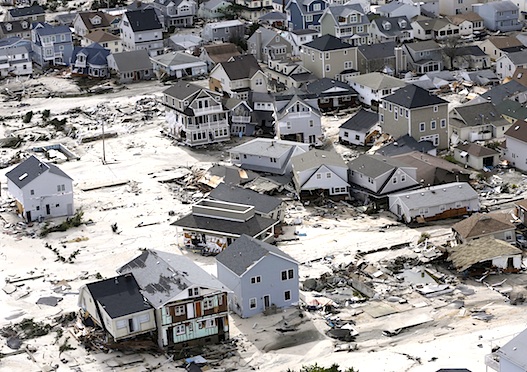
Superstorm Sandy Was Really an “Anthrostorm”

Hurricane Sandy Speaks:

Image

Earlier I called myself a hybrid storm: part nature, part human. That’s not quite right. Humans and Hurricanes are part of nature. We both thrive on this planet thanks to sunlight, water and carbon dioxide (CO2). Hurricanes and tropical storms have been around for millions of years. In the last 50 years things have changed. The oceans are warmer. This week the waters off the US east coast were 3 degrees C warmer than normal.

Read full post at Hurricane Sandy Speaks 

Plankton Death To Come with Acid Oceans and Sunlight

A number of marine diatom cells (Pleurosigma), which are an important group of phytoplankton in the oceans.
Credit: Michael Stringer

Global Warming has made oceans 30% more acidic already

“It’s clear we are conducting a giant experiment on the planet and we don’t know what we are doing.”

[This is a repost from my May 8 2012 article – see here for more on acid ocean impacts — Stephen]

 By Stephen Leahy

UXBRIDGE, Canada, May 8, 2012 (IPS)

Without major reductions in the use of fossil fuels, sunlight will kill an unknown number of ocean phytoplankton, the planet’s most important organism, a new study reports this week.

Not only are phytoplankton, also known as marine algae, a vital component in the ocean’s food chain, they generate at least half of the oxygen we breathe.

In the not so distant future, sunlight, the very source of life for phytoplankton, will likely begin to kill them because of the ocean’s increasing acidity, researchers from China and Germany have learned.

“There’s a synergistic effect between increased ocean acidity and natural light,” says Ulf Riebesell of the Helmholtz Centre for Ocean Research in Kiel, Germany.

Riebesell added that it was also possible “phytoplankton could adapt”.

Researchers were surprised to discover that diatoms, one of the most important and abundant types of phytoplankton, fared very badly during shipboard experiments conducted by co-author Kunshan Gao, from the State Key Laboratory of Marine Environmental Science at Xiamen University, Xiamen China.

Previous experiments in labs like Riebesell’s found that diatoms actually did better in high-acid seawater, unlike most other shell- forming plankton. Burning fossil fuels has made the oceans about 30 percent more acidic researchers discovered less than 10 years ago. Oceans absorb one third of the carbon dioxide (CO2) emitted from using fossil fuels.

The good news is this has slowed the rate of global warming. The bad news is oceans are now more acidic and it will get worse as more CO2 is emitted. This is basic, well-understood ocean chemistry.  Continue reading

Sandy says: “Childhood is Over: We’re All in this Together”

As the last of my winds and rains ebb I wish you a complete and climate-wise recovery. Our planet is not as it once was. You have seen some of the changes in your lifetime: the superstorms, floods, drought, heat waves, and the melting of the Arctic.

Other changes are invisible such as the 30 percent increase in the acidity of the oceans. This rising acidity is harming coral reefs, fish and many other inhabitants of the oceans. One third of the carbon dioxide (CO2) emitted from burning fossil fuels has been absorbed by the oceans. When CO2 dissolves in seawater it makes them more acidic.

All of these changes and far more with only 0.8C (1F) rise in global temperature. You want to believe all of this is natural. It is true I am part of nature but I have felt and fed off the extra heat energy in the oceans and additional moisture in the air you have unintentionally put there. The air, oceans, landscape have changed. Some call this time of major human impacts on the planet “The Anthropocene”. A big word to describe a big change: the era when humanity is influencing every aspect of life on the planet.

Read full post at Hurricane Sandy Speaks (crosspost)

Oceans Filled with Plastic Trash – Changing Marine Ecology

Tiny bits of plastic now found throughout the world’s oceans

Ban single-use plastic: bags, bottles, cups etc, scientists say

By Stephen Leahy

UXBRIDGE, Canada, May 10, 2012 (IPS)

Plastic trash is altering the very ecology of the world’s oceans. Insects called “sea skaters”, a relative of pond water striders, are now laying their eggs on the abundant fingernail-sized pieces of plastic floating in the middle of the North Pacific Ocean instead of relying on a passing seabird feather or bit of driftwood.

With an average of 10 bits of plastic per cubic metre of seawater, there are now plenty of places for sea skaters to lay eggs in a remote region known as the North Pacific Subtropical Gyre, 1,500 kilometres west of North America. Not surprisingly, egg densities have soared, a new study has found.

“We’re seeing changes in this marine insect that can be directly attributed to the plastic,” says Miriam Goldstein, study co-author and graduate student at the Scripps Institution of Oceanography at UC San Diego.

This is the first proof that plastics in the open ocean are affecting marine invertebrates (animals without a backbone), which will have consequences for the entire marine food web.

“We simply don’t have the data to know what those consequences will be. It is a very remote region of the ocean, hard to get to and expensive to conduct research,” Goldstein told IPS.

The North Pacific Gyre is one of five large systems of rotating currents in the world’s oceans. It has become better known in recent years as theGreat Pacific Garbage Patch”. It has at least 100 times more plastic today than it did in 1972, according to the study published this week in the journal Biology Letters.

“There were no hard surfaces before in the North Pacific Gyre other than the occasional feather and piece of wood,” says Miriam Goldstein, study co-author and a graduate student at the Scripps Institution of Oceanography at UC San Diego.

“The ocean looks pretty normal out there in the gyre. There is no floating island of trash as some people imagine,” Goldstein told IPS. Continue reading