“It is unacceptable that the Canadian public sits back and allows access to the science they’re funding to be denied them,” said Andrew Weaver, a climate scientist.

Stephen's avatarStephen Leahy, International Environmental Journalist

Canadian media coverage of climate change has fallen by 80 percent

By Stephen Leahy

VANCOUVER, Canada, Feb 21, 2012 (IPS)

Amid revelations of a well-funded U.S. organisation’s plans to deliberately distort climate science, scientists and journalists at a major scientific conference called on the Canadian government to stop its muzzling of scientists.

For the past four years, the Canadian government has been denying timely access to government scientists even when their findings are published in leading scientific journals, said scientists and journalists in a special session of the American Academy for the Advancement of Science meeting here in Vancouver, British Columbia.

“The Canadian public doesn’t know as much as they could about science and climate change,” said Margaret Munro, who is a science writer for Postmedia News, based in Vancouver.

“The more controversial the story, the less likely you are to talk to the scientists,” Munro told IPS.

Last…

View original post 582 more words

Rio+20: The Moment in History to Ensure Our Future Survival?

Planet Under Pressure - State of the Planet Declaration Mar 29 2012.

Worlds’ Scientists Say Facing “Planetary Emergency”

By Stephen Leahy

UXBRIDGE, Canada, (IPS)

The upcoming Rio+20 conference has to be the moment in human history when the nations of the world come together to find ways to ensure the very survival of humanity, many science and environmental experts believe.

Except that governments, the media and the public aren’t paying attention to the “planetary emergency” unfolding around them. The situation is like firefighters yelling “fire” in crowded room and still no listens.

“The situation is absolutely desperate and yet there’s nothing on the front pages or on the agenda of world leaders,” said Pat Mooney, executive director of the ETC Group, an international environmental organisation based in Ottawa.

“The lack of attention is a tragedy,” said Mooney, who has 40 years experience in international environment and development issues.

Humanity is failing in its stewardship of the planet. An incredible 85 percent of the world’s oceans are in trouble, said Susan Lieberman, director of international policy at the Pew Environment Group, a U.S. organisation.

Rio+20 is a major opportunity to turn this around, Lieberman told IPS.

The Jun. 20-22 Rio+20 meet is timed to coincide with the 20th anniversary of 1992 Earth Summit in Rio de Janerio. The Earth Summit captured world attention, with leaders from most countries and some 10,000 media attending.

It gave birth to the most important environmental treaties on climate change, biodiversity and land degradation and desertification. World leaders also endorsed Agenda 21, a detailed blueprint on how nations can practice sustainable development.

Years of preparation went into the 1992 Summit, while only months have gone into Rio+20.

“There hasn’t been nearly enough preparation to be able to sign treaties,” said Lieberman. It’s been a struggle to get many governments like such as the US to focus on Rio+20 at all she said.

“Governments are not giving this opportunity enough importance given the mess we are in,” said Lisa Speer, director of the international oceans programme at the Natural Resources Defense Council, a U.S. NGO. Continue reading

Extreme Weather is the New Normal with Climate Change

Aftermath of an early tornado in Lancaster, Texas. To join thousands of others connecting the dots between climate change and extreme weather, visit ClimateDots.org.

By Stephen Leahy

CAIRNS, Australia, Apr 3, 2012 (Tierramérica)

Extreme weather is fast becoming the new normal. Canada and much of the United States experienced summer temperatures during winter this year, confirming the findings of a new report on extreme weather.

For two weeks this March most of North America baked under extraordinarily warm temperatures that melted all the snow and ice and broke 150-year-old temperature records by large margins.

Last year the U.S. endured 14 separate billion-dollar-plus weather disasters including flooding, hurricanes and tornados.

A new report from the Intergovernmental Panel on Climate Change (IPCC), released Mar. 28, provides solid evidence that record-breaking weather events are increasing in number and becoming more extreme. And if current rates of greenhouse gas emissions are maintained, these events will reach dangerous new levels over the coming century.

Since 1950 there have been many more heat waves and record warm temperatures than in previous decades.

This will only increase in future decades, as will heavier rainfall events in tropical regions and the high latitudes, according to the Special Report on Managing the Risks of Extreme Events and Disasters to Advance Climate Change Adaptation (SREX). 

The hottest day that occurs once in 20 years is likely to become a one-in-two year event by the end of the century, except in the high latitudes of the Northern hemisphere, where it is likely to happen once every five years.

The average tropical cyclone maximum wind speed is likely to increase, but the global frequency of tropical cyclones is likely to decrease or remain unchanged.

Continue reading

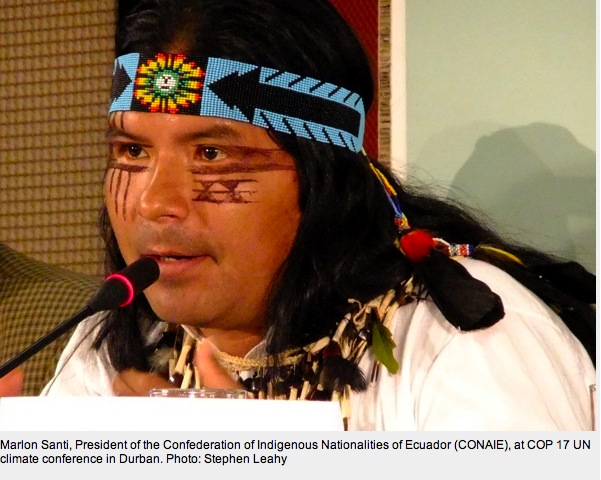
Indigenous Peoples Can Show the Path to Low-Carbon Living If Their Land Rights Are Recognized

Youba Sokona of Mali is co-chair of the IPCC Working Group III. Photo: Citt Williams, OurWorld2.0

by Stephen Leahy

First published at National Geographic’s NewsWatch

Many indigenous peoples are living examples of societies thriving with sustainable, low-carbon lifestyles. Successfully meeting the global climate change challenge requires that much of the world shift from high carbon-living to low.

This shift is daunting. Current emissions for Australia and the United States average about 20 tonnes of carbon dioxide per person. In the coming decades that needs to fall to two tonnes per person as it is currently in Brazil or the Dominican Republic.

Emissions from most indigenous peoples are even lower and are amongst the lowest in the world.

All options for making the shift from high- to low-carbon living need to be explored and that’s why the United Nations University Traditional Knowledge Initiative (UNU) and  Intergovernmental Panel on Climate Change (IPCC) invited indigenous peoples to a special three-day workshop in Cairns, Australia last week.

“Climate change is the result of our behaviour,” said Youba Sokona, co-chair of the IPCC Working Group III that will report to governments in 2014 on ways carbon emissions can be reduced.

The IPCC is the world authority on climate, assessing the state of knowledge on the issue every five to six years. Traditional knowledge of local and indigenous peoples have been left out until now.

“One of the critical solutions is to change our behavior, to change our production and consumption systems,” said Sokona, a climate expert from the African nation of Mali.

The Climate Change Mitigation with Local Communities and Indigenous peoples workshop offered a number of “examples of local peoples in Siberia, in Australia, northern Canada and in some African countries demonstrating that it is possible to change our behavior,” he said.

Marilyn Wallace, a Kuku Nyungkal Aboriginal woman. Photo: Citt Williams, OneWorld 2.0

“I live in a shack but I love being on my ‘bubu’, my traditional land,” said Marilyn Wallace of the Kuku Nyungka ‘mob’ (tribe) in northern Queensland, Australia.

Wallace has lived in towns but fought for years to “return to country” and live in her tropical forest homeland 60 kilometers from Cooktown.

At the workshop Wallace and every other indigenous delegate focused on land rights. The simple truth is that if they can’t live on and manage their lands with time-tested traditional methods, they can’t be part of the solution to climate change.

For complete article see Nat Geo’s NewsWatch


Climate Scientists to Attend Native Knowledge ‘Boot Camp’ in Australia

By Stephen Leahy

First published at National Geographic NewsWatch

In what may be a ‘clash of worldviews,’ representatives from indigenous and local communities are holding a climate workshop with physicists, computer modellers, and other climate scientists from the Intergovernmental Panel on Climate Change (IPCC) in Cairns, Australia 26-28 March.

This is a unique opportunity for Native peoples to discuss their traditional knowledge and experiences as it relates to climate change.

Indigenous peoples are amongst the most affected by current and future climate change but their experiences and knowledge have largely been ignored by science experts at the IPCC. The workshop, Climate Change Mitigation with Local Communities and Indigenous Peoples: Practices, Lessons Learned and Prospects, is a significant effort to change this.

There are an estimated 350 million indigenous peoples according to the United Nations. They legally own more than 11% of the world’s forests and those coincide with areas that hold up to 80% of the world’s terrestrial biodiversity. Traditional knowledge is a different but no less valid way of understanding the world. However, very few scientists of the thousands who have worked with the IPCC have any experience with traditional knowledge.

The IPCC is working on its next big report (to be released in 2014) and has acknowledged that its Fifth Assessment Report needs to look at how climate change will impact indigenous peoples, their role in reducing carbon emissions (mitigation) and what barriers they face in adapting to current and future climate impacts.

The Cairns workshop will focus on how indigenous peoples can help reduce global carbon emissions. It is being held in collaboration with the IPCC, indigenous organizations, the United Nations University (UNU), the Australian government and others.

Follow the workshop on Facebook or Twitter

Global Warming to Ignite the Carbon Bomb in Northern Forests

Anaktuvuk River peat fire 2007

“In a warmer world, there will be more fire”

Fires already burn an area larger than India every year.

By Stephen Leahy

VANCOUVER, Feb 29, 2012 (IPS)

Rising temperatures are drying out northern forests and peatlands, producing bigger and more intense fires. And this will only get much worse as the planet heats up from the use of ever larger amounts of fossil fuels, scientists warned last week at the end of the major science meeting in Vancouver.

“In a warmer world, there will be more fire. That’s a virtual certainty,” said Mike Flannigan, a forest researcher at the University of Alberta, Canada.

“I’d say a doubling or even tripling of fire events is a conservative estimate,” Flannigan told IPS.

While Flannigan’s research reveals forest fire risk may triple in future, a similar increase in peat fires will be far more dangerous. There are millions of square kilometres of tundra and peatlands in the northern hemisphere and they hold more than enough carbon to ramp up global temperatures high enough to render most of the planet uninhabitable if they burn.

A forest fire in Indonesia that ignited peatlands in 1997 smouldered for months, releasing the equivalent of 20 to 40 percent of the worldwide fossil fuel emissions for the entire year, he said.

“There is the potential for significant releases of carbon and other greenhouse gases (from future peat fires),” Flannigan said.

If peat fires release large amounts of carbon, then temperatures will rise faster and higher, leading to further drying of forests and peat, and increasing the likelihood of fires in what is called a positive feedback, he said.

When the increased fire from global warming was first detected in 2006, Johann Goldammer of the Global Fire Monitoring Center at Germany’s Freiburg University called the northern forest a “carbon bomb”. 

“It’s sitting there waiting to be ignited, and there is already ignition going on,” Goldammer said according to media reports in 2006.

Please put something in the tip jar before reading on.
This is how I make my living.

Continue reading

Canadian Scientists Denounce Climate Change Denial, Government Censorship

read the report here

Canadian media coverage of climate change has fallen by 80 percent

By Stephen Leahy

VANCOUVER, Canada, Feb 21, 2012 (IPS)

Amid revelations of a well-funded U.S. organisation’s plans to deliberately distort climate science, scientists and journalists at a major scientific conference called on the Canadian government to stop its muzzling of scientists.

For the past four years, the Canadian government has been denying timely access to government scientists even when their findings are published in leading scientific journals, said scientists and journalists in a special session of the American Academy for the Advancement of Science meeting here in Vancouver, British Columbia.

“The Canadian public doesn’t know as much as they could about science and climate change,” said Margaret Munro, who is a science writer for Postmedia News, based in Vancouver.

“The more controversial the story, the less likely you are to talk to the scientists,” Munro told IPS.

Last year, journalists from around the world were denied access to Canadian government scientist Kristi Miller, who had published a groundbreaking paper on the decline of salmon populations in western Canada in the journal Science.

However, lobbyists for the oil and gas industry appear to have direct access to scientists, according to emails obtained under access to information legislation. Internal government documents reported an 80-percent decline in Canadian media coverage of climate change since 2007 when the new Stephen Harper Conservative government put restrictive policies into place.

“It is unacceptable that the Canadian public sits back and allows access to the science they’re funding to be denied them,” said Andrew Weaver, a climate scientist at the University of Victoria.
Continue reading

“We’re facing a planetary emergency” The Road to Rio (+20 years)

“Humanity is facing major challenges…urgent actions are needed”

Can we act as a true community?

By Stephen Leahy

UXBRIDGE, Canada, Jan 11, 2012 (IPS)

Humanity is driving Earth’s climate and ecosystems towards dangerous tipping points, requiring radical new forms of international cooperation and governance, experts say.

“We’re facing a planetary emergency,” said Owen Gaffney of the International Geosphere-Biosphere Programme based in Stockholm.

“We need to have a ‘constitutional moment’ in world politics, akin to the major transformative shift in governance after 1945 that led to the establishment of the United Nations and numerous other international organisations,” said Frank Biermann of VU University Amsterdam and director of the Earth System Governance Project.

“Humanity is facing major challenges…urgent actions are needed,” Biermann told IPS.

              Be a Partner in Independent Enviro Journalism

Those challenges include, but are not limited to, increasing poverty, food, water and energy security, the financial crisis, climate change, ocean acidification, the loss of biodiversity. All of these challenges and their solutions are interconnected.

Normally, the complex, mutually dependent systems of the Earth can self-correct and are remarkably stable. However, they can reach thresholds or tipping points and then unexpectedly and abruptly shift, Gaffney said in an interview.

“We need only recall how the U.S. sub-prime mortgage crisis nearly collapsed the global financial system,” he said.

The upcoming Rio+20 conference on sustainable development needs to be the moment in human history when the nations of the world come together to find ways to ensure “the very survival of humanity”, he said. Continue reading

Become a Partner in Independent Enviro Journalism

A personal message from Stephen Leahy

“Journalism and media are society’s mirror providing accurate and essential information.

That is no longer the case.

Media are now controlled by a few major corporations like Murdoch’s News Corp. Coverage of environment and science has been gutted. If there is coverage it rarely digs below the surface. It’s not just TV, it’s all media.

After 18 years of being published in major publications on two continents I now count myself lucky to get $150 to $200 for an in-depth article. The few independent media outlets are either non-profits or struggling.

Urgent environmental issues didn’t go away just because most media stopped covering them.

More than 20,000 people attended the international climate meeting in Cancun, Mexico and it received one ten second clip on US network TV according to a Drexel University media study. (Coverage was even worse at last climate meet in Durban)

Nearly every indicator proves things are getting worse but less and less people know about this.

Many people, including leading scientists, tell me: ‘we need people like you to write about these issues‘. I’d like to do far more but it is impossible to continue without your help in what I’m calling Community Supported Journalism. People directly support independent journalists who craft honest and thoughtful articles about important subjects the mainstream media ignores or gloss over.

Community Supported Environmental Journalism Works

In 2010 dozens of people offered their help, donating $5,750 which helped ensure many breaking international stories were covered including the first media reports on the global die-off of corals and how climate change may be bringing colder winters to Europe and eastern North America. Those donors — I prefer to call them partners — enabled me to cover important international meetings like the UN Convention on Biodiversity, UNFCCC climate change conference and much more.

Thanks for reading.” — Stephen

Please join us. Consider a donation of just $10 a month to support enviro journalism that serves the public interest.

Contributions can be made safely and easily via PayPal* or Credit Card*. [You can cancel at any time, automatically. No need to contact me] 

Monthly support options starting @ $10 a month

One-time donations are most welcome. Click and enter the amount.

*More than 100,000 non-profits safely use PayPal Donate service

If you’d like a mailing address or contact me with story ideas, please complete this comment form.

Letters of Support:

We need people like you. In tough economic times, where information flow is increasingly channeled and controlled, you perform a simply critical role. Hang in there. You are an admirable role model for the future.”

– E. Ann Clark, Associate Professor, University of Guelph.

“Stephen Leahy has done a superb job exposing the enormous sums the US government is spending on corporate welfare for big oil.”

Ross Gelbspan, Pulitzer-prize winning editor and author of The Heat is On

My continued appreciation to those who have contributed in the past.

Wrote this nearly fours year ago, can’t believe it is more relevant than ever.

Stephen's avatarStephen Leahy, International Environmental Journalist

truth-over-fear.jpg

100,000 repetitions of a lie is still a lie

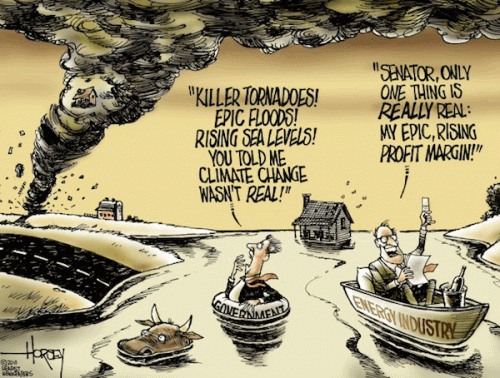
Many of those who deny that burning fossil fuels is altering the climate work diligently to confuse and delay action that would in reality benefit nearly all of us. These professional deniers and their followers can be convincing, citing well-known experts and twisting their views and findings.

So here’s a couple of common sense tips to add to your BS detection system.

Denier Tip #1:Check out suspect claims/sources with a simple Google search

100,000 repetitions or variations of a lie is still a lie. A reader recently told me global warming is really caused by variations in the sun’s activity. His proof was a “science” article from Investor’s Business Daily that said this was the conclusion of the Max Planck Institute for Solar System Research, a well-known research centre in Germany. A quick check of the Institute’s website…

View original post 216 more words