Hundreds of Millions May Soon Be Fleeing the Floodwaters

More than 5 million affected by flooding in Pakistan Sept 2011 - a repeat of 2010.

Climate disruption shrinking areas where people can live.

Mexico faces $10 billion in storm/flood damage to roads, schools, clinics, etc every year

By Stephen Leahy

OSLO, Jun 9, 2011 (IPS)

Mass migration will inevitably be part of human adaptation to climate change, experts agree, since parts of the world will become uninhabitable in the coming decades.

Last year, 38 million people were displaced by climate-related disasters such as the flooding in Pakistan and China.

“Human displacement due to climate change is happening now. There is no need to debate it,” Jonas Gahr Støre, Norway’s minister of foreign affairs, told over 200 delegates attending the Nansen Conference on Climate Change and Displacement in the 21st Century in Oslo Jun. 6-7.

Governments and the humanitarian community need to understand this fact – and that it will get much worse in the coming decades, Støre said.

This independent environmental journalism depends on public support. Click here learn more.

Without major emissions reductions, climate change could get far worse than anyone is prepared to think about.

“It may be more realistic to consider four degrees C of warming rather than two degrees C,” suggested Harald Dovland, former head of the Norwegian Delegation to the United Nations climate change negotiations.

The world has already warmed 0.8C and will rise to least 1.6 C even if all emissions of carbon and other greenhouse gases ended today, James Hansen, head of NASA’s Goddard Institute for Space Studies, told the conference.

A four-degree C warmer world is a very different planet and risks runaway climate change. Even two degrees C is not safe, Hansen said. 

“The last time the planet was two degrees C warmer was during the Pliocene (five to 2.4 million years ago) and sea levels were 25 metres higher,” he said. “If we burn all the fossil fuels (coal, oil, natural gas) we’re creating conditions that future generations will be unable to cope with.”

Even though a four-degree C warmer world “is choosing the suicidal path”, experts must avoid fuelling xenophobia with predictions of mass migrations and conflicts, says Francois Gemenne, research fellow at the Institute for Sustainable Development and International Relations in Paris.

“This also feeds into a security agenda of panic and paranoia,” Gemenne said.

At least 20 percent of humanity will be at high risk of severe flooding due to sea level rise and extreme rainfall events in the coming decades.

“Too many people live in low-lying deltas and other parts of the world that are becoming too dangerous to live in,” said Gemenne. They will be forced to move and often this movement will be permanent.

Rather than building walls and barriers, countries and the international community need to encourage people to move to safer ground. “Lift the barriers so that people can use migration to adapt to climate change,” he urged delegates.  Continue reading
Europe Works to End Oil Addiction and Reap Financial, Social and Environment Advantages – Officials say

Developed World Must Agree to Greater Emission Reductions – 40 per cent cuts by 2020, experts say

Stephen Leahy

BONN, Jun 20, 2011 (IPS)

If we’re lucky, by the time a tough but fair international treaty to meet the climate change challenge is finalised, it will be largely unnecessary. The snail’s pace of negotiations certainly gives countries plenty of time to understand the financial, social and environmental advantages of kicking their dangerous addiction to fossil fuels.

That may be a cynical optimist’s hope, but the European Union is already moving in that direction.

Climate change is now seen as an opportunity to deal with the economic downturn in Europe,” said Jürgen Lefevere, a European Commission negotiator at the United Nations Framework Convention on Climate Change (UNFCCC) negotiating session that ended late Friday in Bonn.

“It is no longer just an environmental issue for us,” Lefevere said at a final press conference.

China also understands the opportunity.

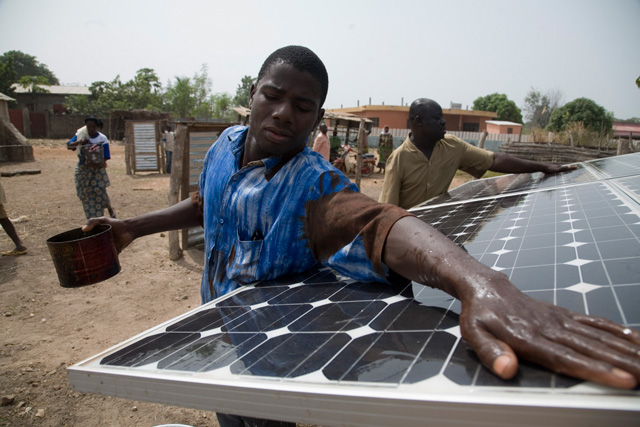
Renewable energy sources like wind and solar now account for 11.4 percent of China’s electricity, and that figure will be 20 percent by 2020, says Liu Qiang, a researcher at the Energy Research Institute of the National Development Reform Commission, China.

“China takes this very seriously,” Qiang said, noting that there are significant investments and research in smarter electrical grids and energy storage in China.  Continue reading

Keystone XL: A Pipeline to Europe?

By Stephen Leahy *

UXBRIDGE, Canada, Aug 23, 2011 (Tierramérica)

The promoters of Keystone XL, a huge new oil pipeline from northern Canada to the U.S. Gulf Coast, claim that it will reduce U.S. reliance on oil imports from unfriendly countries.

But based on falling U.S. oil demand, the controversial Keystone XL pipeline may simply allow tar sands oil currently landlocked in Alberta, Canada to be exported to Europe, say U.S. and Canadian environmental activists.

The proposed pipeline could also be used to pump water from the Ogallala aquifer in the U.S. Midwest, one of the world’s largest, to the badly parched states in the arid southwest such as Texas, currently suffering its worst drought in history.

Pipeline industry officials often say pipelines like Keystone can be easily used to transport water, said Maude Barlow, chairperson of the Council of Canadians, a large environmental NGO.

Therefore, “Keystone XL poses a double threat to the Ogallala through contamination from a pipeline leak or by pumping water that is already being overdrawn,” Barlow said in an interview with Tierramérica. Continue reading

Geoengineering for a Desperate Planet — UN Declares Global Moratorium

By Stephen Leahy*

NAGOYA, Japan, Oct 25, 2010 (Tierramérica)

[Update from Nagoya 30 October 2010. Global moratorium passes.]

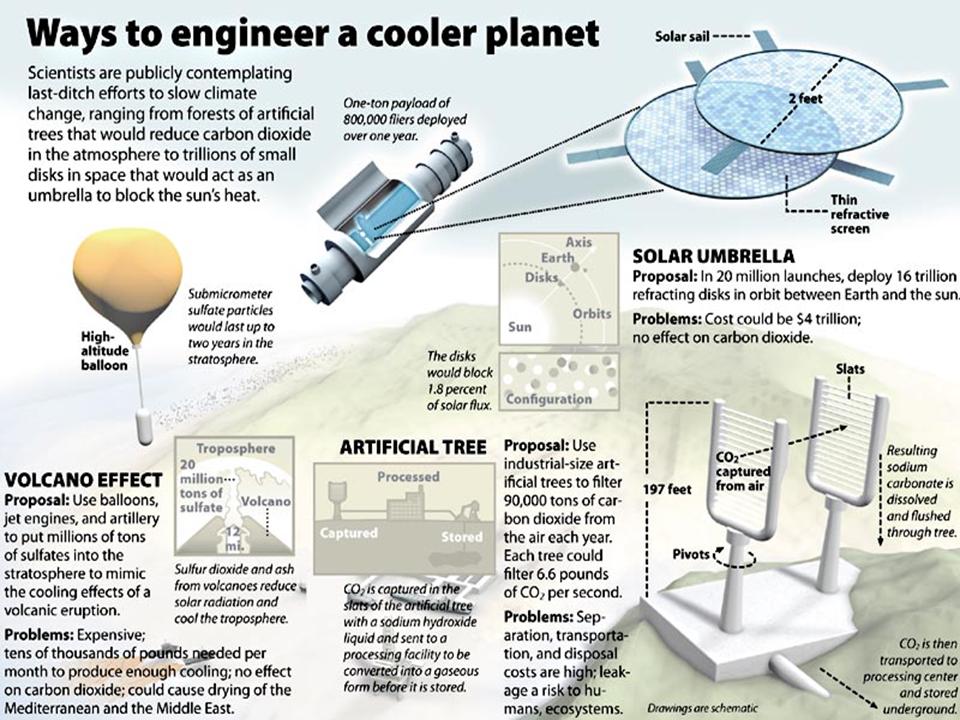
Delegates to the world summit on biodiversity here are calling for a moratorium on climate engineering research, like the idea of putting huge mirrors in outer space to reflect some of the sun’s heating rays away from the planet.

Climate engineering or geoengineering refers to any large-scale, human- made effort to manipulate the planet to adapt to climate change.

Representatives from Africa and Asia expressed concern about the negative impacts of geoengineering during the opening week of the 10th Conference of Parties (COP 10) to the United Nations Convention on Biological Diversity (CBD), Oct. 18-29. They were joined by civil society organisations in calling for a moratorium on geoengineering experiments.

The geoengineering proposals include installing giant vertical pipes in the ocean to bring cold water to the surface, pumping vast amounts of sulphates into the stratosphere to block sunlight, or blowing ocean salt spray into clouds to increase their reflectivity.

[Previously posted – Full Story here] 

Reducing Soot and Smog Would Help Stabilise Climate and Save Millions of Lives

Picture of smog in Cairo.
Image via Wikipedia

By Stephen Leahy

BONN, Jun 14, 2011 (IPS)

Clean the air, cool the planet and prevent millions of deaths with fast action on soot and smog, a new report urges.

Air pollutants like black carbon (soot) and ground-level ozone (smog) arise from incomplete combustion of fossil fuels and biomass like wood and charcoal.

Nations or regional blocks of nations could decide to put measures into place that quickly improve their air quality, reduce crop losses and shorten lives. And, almost as a side benefit, those efforts would do much to slow the rate of global warming, says the scientific assessment report released at the United Nations Framework Convention on Climate Change (UNFCCC) negotiating session here in Bonn.

Continue reading

Colombian Forest Project Reaps Credits… and Criticism

Procuenca reforestation

By Stephen Leahy*

UXBRIDGE, Canada, May 6, 2010 (Tierramérica)

The “Procuenca Initiative” in the Andes region of western Colombia may be the first in the world to sell certified forest carbon credits with a biodiversity protection component. But alarms are sounding about the potential negative social and environmental consequences.

Under way since 2001, the programme will begin to operate in the international market next year, having received official registration Apr. 16 under the Clean Development Mechanism (CDM).

Part of the Kyoto Protocol on Climate Change, in force since 2005, the CDM allows industrialised countries to earn credits for reducing emissions of greenhouse gases by investing in projects in developing countries that expand their capacity to absorb the carbon emissions.

Procuenca is expected to auction credits for some 350,000 tonnes of carbon that has been sequestered since the project began, initiative director Francisco Ocampo told Tierramérica through a translator.

At the current market value of 20 dollars per tonne, the total would be 7 million dollars for a struggling community, one that is still suffering from the collapse of coffee prices more than a decade ago.

“This project demonstrates the international importance of these forests for carbon storage,” said Ocampo. Continue reading

Tips for Climate-Safe Living on Earth Day

Take time to be outside today and think about everything that nature provides:  air, water, plants and animals that sustain us. Such gifts should not be taken lightly because with our numbers and powerful technologies we are ‘the bull in nature’s china shop’.

We need to take great care and practice Climate-safe Living.

1. Reduce.

Reduce fossil fuel consumption everywhere.

2. Eliminate.

Eliminate all non-essential activities and products that involve burning fossil fuels.

3. Demand.

Demand that business and government provide transport, activities and products that use minimize fossil fuel use.

Reduce. Eliminate. Demand. R.E.D.

May you always cherish this Earth and share in her joys.

Stephen

Cut Climate Damaging Emissions in Half and Double Food Production With Eco-Farming

45- 50% of global warming emissions from industrial agriculture

By Stephen Leahy

UXBRIDGE, Feb 8, 2011 (IPS)

Eco-farming could double food production in entire regions within 10 years while mitigating climate change, according to a new U.N. report released Tuesday in Geneva.

An urgent transformation to ‘eco-farming’ is the only way to end hunger and face the challenges of climate change and rural poverty, said Olivier De Schutter, U.N. Special Rapporteur on the right to food, following the presentation of his annual report focusing on agroecology and the right to food to the U.N. Human Rights Council.

“Agroecology mimics nature not industrial processes. It replaces the external inputs like fertiliser with knowledge of how a combination of plants, trees and animals can enhance productivity of the land,” De Schutter told IPS, stressing that, “Yields went up 214 percent in 44 projects in 20 countries in sub-Saharan Africa using agro-ecological farming techniques over a period of 3 to 10 years… far more than any GM [genetically modified] crop has ever done.”

Other recent scientific assessments have shown that small farmers in 57 countries using agro-ecological techniques obtained average yield increases of 80 percent. Africans’ average increases were 116 percent.

“Today’s scientific evidence demonstrates that agroecological methods outperform the use of chemical fertilisers in boosting food production in regions where the hungry live,” De Schutter said. [Video Interviews with De Schutter]

Continue reading

Fossil Fuel Lobby Following the Playbook of Big Tobacco Confusing the Public on Dangers of Climate Disruption

Fossil Energy Interests Sowing Confusion and Buying Legislative Delay on America’s Biggest Threat: Climate Change says Environmental Economist

Robert Repetto

UXBRIDGE, Canada, Mar 2, 2011 (IPS)

Powerful fossil energy interests are preventing the United States from making the necessary transition to 21st century energy sources, one of the country’s leading environmental economists documents in a just-published book.

Fossil energy interests are spending “hundreds of millions of dollars” lobbying U.S. politicians in Congress and funding groups to confuse the public about the serious risks climate change poses, says Robert Repetto, author of “America’s Climate Problem: The Way Forward” published by Earthscan.

IPS climate and environment correspondent Stephen Leahy spoke with Repetto about his new book.

Q: Why did you write this book?

A: We’re running out of time. The latest science shows that climate change is coming faster and posing greater risks than previously thought. We are at risk of triggering positive feedbacks that will lead to uncontrollable climate change.

This independent environmental journalism depends on public support. Click here learn more.

Meanwhile, America is locked in a climate-policy stalemate, with very few in the public comprehending the real risks climate change poses. Most don’t understand that climate change is happening now. They don’t link extreme weather events we’ve been experiencing with climate change. As a result they are not demanding that politicians take action.

Q: Why don’t most Americans understand the fact that climate change is already underway and poses serious risks?

A: Fossil (oil, coal, natural gas) energy interests are pouring hundreds of millions of dollars into sowing doubt and uncertainty to blunt public concern and to provide political cover to those politicians they are funding. In America, there is a very concerted effort by fossil energy interests that bankroll right-wing and libertarian “think tanks” like the Competitive Enterprise Institute to create an atmosphere of doubt and uncertainty, just like the tobacco companies did regarding the health effects of smoking. Continue reading

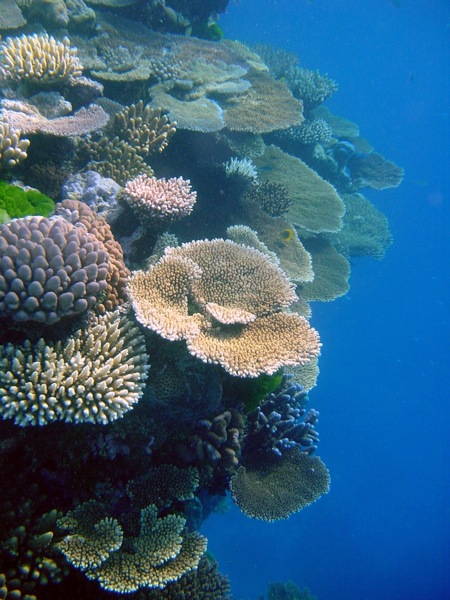
Coral Reefs In Dire Peril – 75% May Die In Coming Years

One of the most incredible natural wonders of our world is being decimated by our actions: burning fossil fuel, pollution of land and sea, overfishing. The most recent estimate shows 75% of the world’s coral reefs are threatened according to new report by the World Resources Institute (WRI) and 24 other organizations. The report is “Reefs at Risk Revisited“.

Here’s one thing you can do to help. Follow and encourage others to live by these Three Simple Rules:

1. Reduce.

Reduce fossil fuel consumption everywhere.

2. Eliminate.

Eliminate all non-essential activities and products that involve burning fossil fuel.

3. Demand.

Demand that business and government provide transport, activities and products that minimize fossil fuel use.

Reduce. Eliminate. Demand. R.E.D.

More on the Corals, Ocean Acidification, Bleaching, Overfishing.

I have written more than 15 articles in last few years about the serious threats corals face:

Record Heat Killing Caribbean and Indian Ocean Corals

What if our air was 30% more acidic like the Oceans? May be 120% more acidic by 2060

Coral Reefs and Acid Oceans Series

Reefs and Forests Burn as Climate Disruption Takes Hold NOW