“Fracking” for Shale Gas: The Bridge to Global Warming Disaster

Switching from coal to gas can increase global warming – NCAR

[UPDATE JAN 20 2012: New study published in journal Climatic Change shows large volumes of methane released during fracking]

By Stephen Leahy 

DURBAN, South Africa, Dec 5, 2011 (Tierramérica)

Hydraulic fracturing or “fracking” is being used to tap the last remaining natural gas deposits across large areas of the United States and western Canada, fueling continued dependence on hydrocarbons instead of a shift to genuinely clean energy sources to cool the planet.

Called shale gas, these deposits represent a new and enormous source of fossil fuel.

“Fracking is driving exploration and drilling all over the United States,” said Gwen Lachelt of the non-governmental organisation Earthworks’ Oil & Gas Accountability Project.

“The oil and gas industry is marching across America from Texas to North Dakota and from the east coast to California,” Lachelt told Tierramérica.

There may be as much as 23,427 billion cubic metres (bcm) in recoverable gas from U.S. shale formations, according to the Annual Energy Outlook 2011, released in April by the U.S. Energy Information Administration (EIA).

The United States will consume 650 bcm of natural gas this year, the EIA projected. Globally, it estimates reserves of “unconventional gas” – the oil and gas industry term for shale gas and coal bed methane – at 915,000 bcm, with 100,000 bcm in Latin America.
However, that estimate is already out of date due to developments in fracking technology and exploration. The EIA estimate of shale gas in the United States in 2009 was less than half the 2011 estimate.

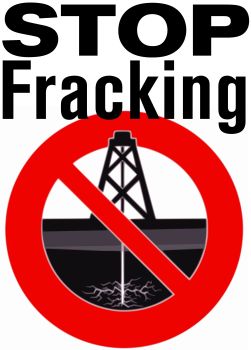
Fracking uses horizontal drilling and hydraulic fracturing with high pressure water and chemicals to fracture gas-bearing shale rock.

Holes are drilled vertically as little as 100 metres and as much as 3,000 metres into the shale, and then horizontally 1,000 metres along the shale formation. Chemicals and large amounts of water are pumped underground at high enough pressure to fracture the shale, releasing the gas into the pipeline.

The “dash for gas” as the industry pundits like to say is being driven by potential exports to Asia and the mistaken belief that natural gas is the “transition fuel” from coal to a low-carbon economy.

It is true that natural gas is “cleaner” in that it releases about 40 to 45 percent less carbon dioxide than coal does to produce the same amount of energy.
However, gas from fracking has a higher carbon footprint because more energy is needed to get the gas and because methane leaks out.

Methane has 25 times the warming impact of carbon dioxide.

Switching from coal to gas as an energy source could result in increased global warming, not less, according to the study “Coal to Gas: The Influence of Methane Leakage”, released in September by the U.S. National Center for Atmospheric Research (NCAR).

This is mainly due to the methane leakage problem, which is common but unregulated.

[UPDATE JAN 20 2012: New study published in journal Climatic Change shows large volumes of methane released during fracking]

Limited Liability – Nuclear Energy’s ‘Mother of all Subsidies’

By Stephen Leahy

UXBRIDGE, Canada, May 6, 2011 (IPS)

The nuclear energy industry only exists thanks to what insurance experts call the “mother of all subsidies”, and the public is largely unaware that every nuclear power plant in the world has a strict cap on how much the industry might have to pay out in case of an accident.

In Canada, this liability cap is an astonishingly low 75 million dollars. In India, it is 110 million dollars and in Britain 220 million dollars. If there is an accident, governments – i.e. the public – are on the hook for all costs exceeding those caps.

Japan has a higher liability cap of 1.2 billion dollars, but that is not nearly enough for the estimated 25 to 150 billion dollars in decommissioning and liability costs for what is still an ongoing disaster at its Fukushima Daiichi nuclear plant. Seven weeks after the tsunami caused the disaster, radiation levels continued to spike higher.

No one knows when the reactors will finally be in cold shutdown, or when the costs of theFukushima disaster will stop piling up. One report suggests decommissioning will take 30 years.

This independent environmental journalism depends on public support. Click here learn more.

Japan’s credit rating was downgraded because of the accident, noted Mycle Schneider, a Paris-based energy and nuclear policy analyst who has worked in Japan. “The Japanese know it’s just a matter of time before another large earthquake occurs,” Schneider told IPS.

“Japan will never build another nuclear plant.
Continue reading

Tips for Climate-Safe Living on Earth Day

Take time to be outside today and think about everything that nature provides:  air, water, plants and animals that sustain us. Such gifts should not be taken lightly because with our numbers and powerful technologies we are ‘the bull in nature’s china shop’.

We need to take great care and practice Climate-safe Living.

1. Reduce.

Reduce fossil fuel consumption everywhere.

2. Eliminate.

Eliminate all non-essential activities and products that involve burning fossil fuels.

3. Demand.

Demand that business and government provide transport, activities and products that use minimize fossil fuel use.

Reduce. Eliminate. Demand. R.E.D.

May you always cherish this Earth and share in her joys.

Stephen

Nuclear Power Costs Skyrocket, Cost of Renewables Plummet

[This is a repost about the financial costs and risks of nuclear technology. If a country is going to spend $10 billion to generate energy and reduce carbon emissions what technology truly offers the best return on a full cost-accounting basis? The latter calculation is not simple or uncontroversial – here is an attempt to get at it.– Stephen ]

By Stephen Leahy*

Costs of nuclear skyrocket while costs of renewables falling quickly say energy experts

BERLIN, Jul 31, 2009 (IPS)

Why is nuclear energy back on the table?

One reason is a powerful U.S. lobby where 14 energy companies spent 48 million dollars in 2007 alone to convince American politicians to give the industry huge loan guarantees because they cannot get financing anywhere else, says Ellen Vancko, a nuclear energy analyst at the Union of Concerned Scientists, a U.S.-based non governmental organisation (NGO).

This lavish lobbying effort by the energy and nuclear power sector has been ongoing since the mid-1990s, according to the Center for Responsive Politics, a U.S. NGO and now totals at least 953 million dollars.

Even more has been spent to convince the public that nuclear is one of the keys to energy security so that there is significant public support for new reactors, a Gallup Environment Poll reported this year.

“There are lots of senators and members of congress talking about nuclear as a clean, renewable energy resource,” Vancko says.

The other reason is the French. Continue reading

Two Percent Price-Tag for a Green Economy – Time to end Growth-obsessed Markets pillaging the planet

No future in the “brown” economic system driven by fossil fuel energy and the serial depletion and degradation of natural resources and ecosystems

By Stephen Leahy

UXBRIDGE, Canada, Feb 23, 2011 (IPS)

Growth-obsessed markets and governments are pillaging the planet and it must stop, a new U.N. report warns.

The present “brown” economic system driven by fossil fuel energy and the serial depletion and degradation of natural resources and ecosystems has no future and must be replaced by a green economy, says the Green Economy report launched in Nairobi, Kenya this week by the United Nations Environment Programme (UNEP).

Investing just two percent of the global economy into a few key sectors will kick-start a transition towards a low- carbon, resource-efficient economy, the report says. With that relatively small investment, many of the world’s biggest challenges – climate change, poverty, hunger, jobs, sanitation, energy, food – could be successfully met within two generations.

This independent environmental journalism depends on public support. Click here learn more.

“The Green Economy provides a vital part of the answer of how to keep humanity’s ecological footprint within planetary boundaries,” said Achim Steiner, UNEP executive director.

“It aims to link the environmental imperatives for changing course to economic and social outcomes,” Steiner said.

The report documents that a green, low-carbon, resource- efficient economy will be at least as prosperous as the old brown economy. Better still, a green economy will not have the inherent risks, shocks, scarcities and crises of the resource-depleting, high carbon ‘brown’ economy, it says. Continue reading

Oil Companies and Special Interests Spend Half a Billion Dollars to Defeat US Clean Energy – Study

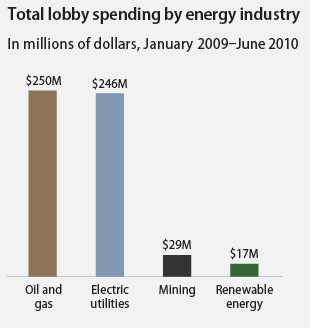
“Big oil companies and other special interests have spent millions of dollars in lobbying and campaign contributions to defeat clean energy and global warming legislation, according to a new analysis released today by the Center for American Progress Action Fund.

The study “Dirty Money” found that the top 35 spending companies and trade associations invested more than $500 million in lobbying and campaign contributions from January 2009 to June 2010 to defeat clean energy legislation. This political pressure spending convinced enough senators to oppose clean energy measures that would have created jobs, reduced oil use, and cut global warming pollution.”

[Source: The Center for American Progress Action Fund is the sister advocacy organization of the Center for American Progress. ]

My Articles on same topic:


Oily Politics of Influence: 3 of 4 oil and gas lobbyists used to work for US govt

Every Day Governments Give an Estimated $2 billion to Oil, Coal & Gas Industry

Fossil Fuel Subsidies Are 12X (more like 20X) Support for Renewables, Study Shows

New $Billion Cash Hand Out To Fossil Fuel Companies Under ‘Green’ Economic Stimulus Plans

Ethanol and Biofuels: Almost Everything You Need to Know

“The U.S. has led the fight to stem global hunger, now we are creating hunger,” said Lester Brown, president of the Earth Policy Institute.

Series of the latest articles that provide almost everything you need to know about why ethanol and biofuels will not reduce global warming but simply drive up fuel and food costs.

maize - mexicoEthanol Worse Than Gasoline

Only Green Part of Most Biofuels is the Wealth (Subsidies) They Generate

Ethanol: The Great Big Green Fraud

International Enviro Standards Needed for Biofuels

Six Experts On Why Ethanol is a Dumb Idea

Food & Fuel: Can Sorghum Be The New Magic Bullet Biofuel??

Biofuels: Another Good Reason to Hate American Policy

(Cellulosic) Greenest Ethanol Still Unproven

Cut Energy Costs 70%: Save Money, Live Better, Help the Climate – Greener Buildings

f10-house-chicago-sml.jpgBy Stephen Leahy

Mar 13’08 (IPS)

Making buildings more environmentally friendly is the easiest and most effective way to cut climate-changing carbon emissions, often slashing energy costs by up to 70 percent.

So why isn’t there a massive effort to “green up” existing buildings and set green standards for all new construction?

North America’s buildings are responsible for a staggering 2,200 megatonnes of carbon dioxide (CO2) emissions — 35 percent of the continent’s annual total. A new report released Thursday says a rapid uptake of currently available and emerging advanced energy-saving technologies could slash emissions by 1,700 megatonnes (MT) of CO2 emissions by 2030.

A cut of that size would nearly equal the CO2 emitted by the entire U.S. transportation sector in 2000.

“Improving our built environment is probably the single greatest opportunity to protect and enhance the natural environment,” said Adrián Vázquez, executive director of the tri-national Commission for Environmental Cooperation (CEC) that produced the report, “Green Building in North America: Opportunities and Challenges”.

Continue reading

Ethanol: The Great Big Green Fraud

gsi-biofuel.jpg

Subsidising biofuels is just about the dumbest way to go.” – Todd Litman, director of the Victoria Transport Policy Institute — Subsidies for 2007 est $13-$15 billion

…increasing biofuel production is a “total disaster” for starving people Jean Ziegler, the United Nations Special Rapporteur on the Right to Food

By Stephen Leahy

Oct 20 2007 (IPS)

A raft of new studies reveal European and American multibillion dollar support for biofuels is unsustainable, environmentally destructive and much more about subsidising agri-business corporations than combating global warming.

Not only do most forms of biofuel production do little to reduce greenhouse gas emissions, growing biofuel crops uses up precious water resources, increasing the size and extent of dead zones in the oceans, boosting use of toxic pesticides and deforestation in tropical countries, such studies say.

And biofuel, powered by billions of dollars in government subsidies, will drive food prices 20-40 percent higher between now and 2020, predicts the Washington-based International Food Policy Research Institute.

“Fuel made from food is a dumb idea to put it succinctly,” says Ronald Steenblik, research director at the International Institute for Sustainable Development’s Global Subsidies Initiative (GSI) in Geneva, Switzerland.

Biofuel production in the U.S. and Europe is just another way of subsidising big agri-business corporations, Steenblik told IPS.

“It’s (biofuel) also a distraction from dealing with the real problem of reducing greenhouse gas emissions,” he asserts. Continue reading

Destroying Canada’s Forests for America’s Oil

“Nowhere else in the world where this much money is being invested”

cover 2.0**REVISED** Oil Stains in the Boreal Forest:

The Environmental Cost of Canada’s Oil Sands

An eBook by Stephen Leahy

Oil Stains in the Boreal Forest is a 30-page eBook presenting a factual overview of the environmental impacts of pumping more than 1.1 million barrels of oil — 175 million litres (50 million gallons) — each day to thirsty US markets.

Based on a 4-part investigative journalism series, leading scientific and environmental experts along with industry officials are interviewed.

Recipe for making a make a gallon of gasoline from the oil sands:

  • burn 1500 cubic feet of natural gas
  • use up 700 litres of water
  • dig up two tonnes of earth and rock
  • dump 948 litres (250 gallons) of mine tailings

And that’s just the beginning – now the crude has to be processed.

Oil Stains in the Boreal Forest   includes pictures of the destruction of virgin boreal forest, links to access additional information, and a peek at a new economic study that shows oil company profits are subsidized by not having to pay for their pollution.

Download your copy of the updated 2009 version 2.1 today for only $3.75
Oil Stains in the Boreal Forest: The Environmental Cost of Canada’s Oil Sands 2.1

eBook -Version 2.1 (2009) – full-color, 8 1/2 x 11″,  30 pages   (14 mb pdf download) 

Learn more about the author