Wild and Weird Weather Getting Worse

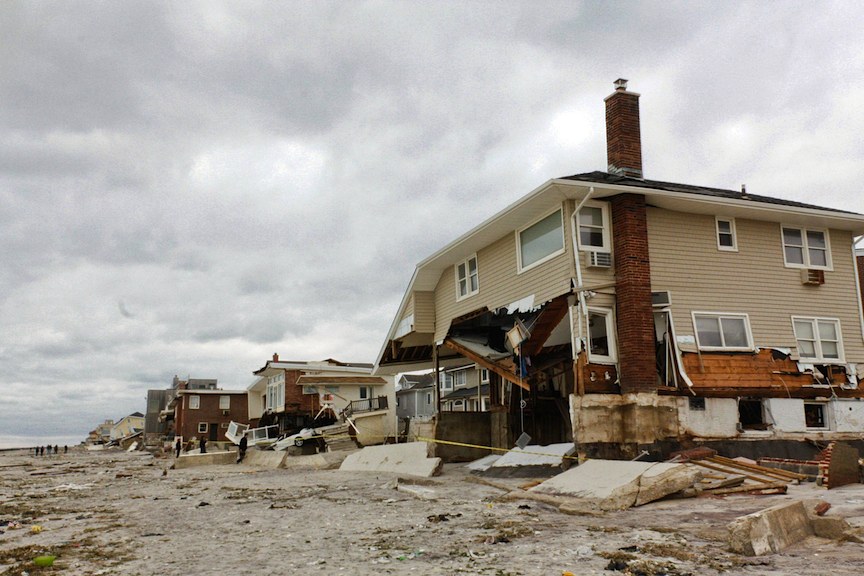
New York City flooding
It doesn’t have to be this way – typical family could reduce their energy use 60 to 75 percent

By Stephen Leahy

UXBRIDGE, Canada, Jan 29 2013 (IPS)

Weird is the only way to describe January temperatures whipsawing between record warm and arctic cold over a span of a few days. Experts say that is what climate change looks like: weird, record-shattering weather.

Here’s a fact that goes beyond weird to astonishing. Anyone who is 27 years old or younger has never lived through a month that was colder than the global 20th century average. In other words, we’ve had 334 consecutive months with above average temperatures, according to the U.S. National Oceanic and Atmospheric Administration.
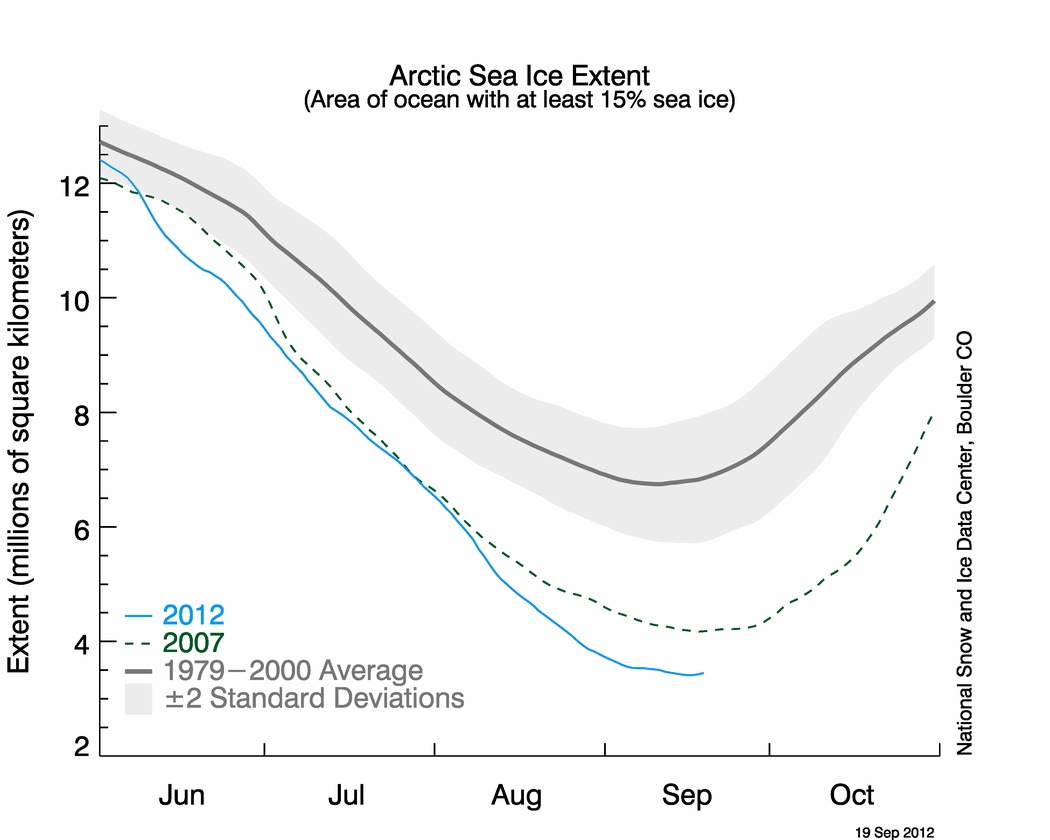
Arctic sea ice extent. Area of ocean with at least 15 percent sea ice as of Sept 12, 2012. Credit: National Snow and Ice Data Center.

Last summer, the Arctic sea ice shrunk to half of what it used to be during summers only three decades ago. Our planet’s weather is driven largely by the two cold polar regions and the warm tropics. With the Arctic defrosting, it should be no surprise our weather is getting weird. And that it’s not going to get better.

Our planet is heating up because we each year put thousands of millions of tonnes of carbon dioxide (CO2) into the atmosphere by burning coal, oil, and natural gas. CO2 acts as heating blanket keeping the planet warm by trapping some of the sun’s heat.

The amount of extra heat-energy being trapped is like exploding 400,000 Hiroshima atomic bombs per day 365 days per year, calculates James Hansen, a climate scientist who heads the NASA Goddard Institute for Space Studies.

Cautious scientists like Hansen are terrified of what’s coming. Conservative institutions like the World Bank and accounting giant Price Waterhouse Coopers (PwC) have warned we’re on a path to heating the entire surface of the planet by an average of four or five degrees C before 2100. That translates into eight to 12 degrees C hotter in places like Canada.
Continue reading

Hurricane Sandy a Taste of More Extreme Weather to Come

By Stephen Leahy

UXBRIDGE, Canada, Nov 2 2012 (IPS)

Killing nearly 200 people in the United States, Canada and the Caribbean and crippling much of New York City and surrounding areas earlier this week, Hurricane Sandy was the kind of extreme weather event scientists have long predicted will occur with global warming.

“Climate change is a reality,” said New York Governor Andrew Cuomo after Sandy swept through his state.

Sandy was twice the size of an average hurricane, and it hit the eastern coast of the United States, where sea levels have been rising the fastest, said Kevin Trenberth, senior scientist at the National Center for Atmospheric Researchin Boulder, Colorado.

“All weather events are affected by climate change because the environment in which they occur is warmer and moister than it used to be,” Trenberth, an expert on extreme events, told IPS.

Whether climate change caused Hurricane Sandy is the wrong question to ask, added Trenberth. He explained that climate change helped make Hurricane Sandy more destructive than it otherwise would have been.

“This is the new normal,” Trenberth said. “It doesn’t make sense to rebuild in some regions – they’ll just be swept away again.”

From Sandy: ‘Saddened by Damages; Surprised You are Shocked’

I am saddened by the damage and loss of life but am truly surprised you are so shocked by the extent and severity.

Haven’t you noticed hurricanes, cyclones and other storms have become more powerful in recent years?  And that extreme weather events like record flooding, droughts and heat waves are happening more frequently? In 2012 extreme weather records were broken all over the US. In 2011 there were 14 separate billion-dollar-plus weather disasters in the US including flooding, hurricanes and tornados.

Read full post at Hurricane Sandy Speaks (crosspost)

Sandy Says: “Bigger Superstorms Coming Unless Dial Down Thermostat”

Alaska temps in degrees F

I was born just over a week ago and more than 100 people have died in the US and Caribbean region as a result. For the rest of today please take care as I will continue to bring strong winds, heavy rains and snowfall from North Carolina to well into Canada. Some of the worst flooding hit Haiti in the hours after I’d passed by.

Read full post at Hurricane Sandy Speaks (crosspost)

Sandy: Don’t Curse Me, I Have Been Pumped Full of Fossil-fuel Steroids

There are estimates that I might cause $20 billion in damages in the US in addition to the $2+ billion in costs in the Caribbean. That’s a lot of money — enough to give every human on the planet $3. But it is only a fraction of the $600 billion the oil and gas industry is spending this year alone [2012 Harvard study, pg 8] in exploration and new production. That $600 billion investment in fossil fuels will bring far greater storms than I.

Read full post at Hurricane Sandy Speaks (crosspost)

Extreme weather new normal with Climate Change

Climate change plays a role in all extreme weather now – atmosphere is 0.8C hotter and 4-6% wetter – turns out small increases can have big impacts. — Stephen

Stephen's avatarStephen Leahy, International Environmental Journalist

By Stephen Leahy

CAIRNS, Australia, Apr 3, 2012 (Tierramérica)

Extreme weather is fast becoming the new normal. Canada and much of the United States experienced summer temperatures during winter this year, confirming the findings of a new report on extreme weather.

For two weeks this March most of North America baked under extraordinarily warm temperatures that melted all the snow and ice and broke 150-year-old temperature records by large margins.

Last year the U.S. endured 14 separate billion-dollar-plus weather disasters including flooding, hurricanes and tornados.

A new report from the Intergovernmental Panel on Climate Change (IPCC), released Mar. 28, provides solid evidence that record-breaking weather events are increasing in number and becoming more extreme. And if current rates of greenhouse gas emissions are maintained, these events will reach dangerous new levels over the coming century.

Since 1950 there have been many more heat waves and record warm temperatures than in…

View original post 768 more words

Global Temperatures Rising on a Devastating Trajectory

Global temperatures are only 0.7C warmer — on pace for +4C!

By Stephen Leahy

UXBRIDGE, Canada, May 25, 2012 (IPS)

Climate-heating carbon emissions set a record high in 2011, in a 3.2 percent increase over the previous year, the International Energy Agency reported this week. The main reason for this dangerous increase is that governments are failing to implement policies to prevent catastrophic increases of global temperatures.

A new report released on the last days of international climate talks in Bonn, Germany this week reveals that the planet is heading to a temperature rise of at least 3.5 degrees Celsius, and likely more, according to the Climate Action Tracker (CAT), despite an international agreement to keep global temperature rise below two degrees Celsius.

Not only are pledges inadequate, but countries are unable to fulfill even those pledges, a new CAT analysis shows. CAT is a joint project of Dutch energy consulting organisation Ecofys, Germany’s Climate Analytics, and the Potsdam Institute for Climate Impact Research.

“When we compared the emission reduction pledges of countries like Brazil, Mexico and the U.S., we found they did not have the policies in place to meet those pledges,” said Niklas Höhne, director of energy and climate policy at Ecofys.

Höhne told IPS that they looked only at the policies of a few countries, but no country’s policies were enough to meet their targets. Continue reading

There will be 3x more forest fires with global warming and that’s conservative estimate say fire scientists.

Stephen's avatarStephen Leahy, International Environmental Journalist

“In a warmer world, there will be more fire”

Fires already burn an area larger than India every year.

By Stephen Leahy

VANCOUVER, Feb 29, 2012 (IPS)

Rising temperatures are drying out northern forests and peatlands, producing bigger and more intense fires. And this will only get much worse as the planet heats up from the use of ever larger amounts of fossil fuels, scientists warned last week at the end of the major science meeting in Vancouver.

“In a warmer world, there will be more fire. That’s a virtual certainty,” said Mike Flannigan, a forest researcher at the University of Alberta, Canada.

“I’d say a doubling or even tripling of fire events is a conservative estimate,” Flannigan told IPS.

While Flannigan’s research reveals forest fire risk may triple in future, a similar increase in peat fires will be far more dangerous. There are millions of square kilometres of tundra…

View original post 780 more words

Standing Up for the Planet and the Future: Time to Stop Using Fossil Fuels

Coal power plant – Alberta

+15,000 temperature records already broken in the US this year 

By Stephen Leahy

UXBRIDGE, Canada, May 4, 2012 (IPS)

What are you doing on Saturday? Peter Nix, a retiree, will be standing on a railway track on Canada’s west coast blocking a coal train destined to ship U.S. and Canadian coal to Asia.

Nix will be joined by dozens of people near White Rock, British Columbia on May 5. They will be in good company as tens of thousands of people around the world participate in global day of action to “connect the dots” between climate change and extreme weather.

“There will be at least 1,200 actions in more than 100 countries,” says Jamie Henn, communications director for 350.org, a U.S.-based environmental group.

Please throw something in the tip jar before reading on. This is how I make my living.
There’s been a general perception that climate change is a future problem but with all the extreme weather disasters and weather records the public is being to realise that climate change is here, says Henn.

“Recent opinion surveys show the more than 60 percent of the U.S. public are connecting extreme weather to climate change,” Henn told IPS.

The U.S. public is not wrong, say scientists. 

“All weather events are affected by climate change because the environment in which they occur is warmer and moister than it used to be,” Kevin Trenberth, senior scientist at the U.S. National Center for Atmospheric Research, told IPS previously.  Continue reading

Extreme Weather is the New Normal with Climate Change

Aftermath of an early tornado in Lancaster, Texas. To join thousands of others connecting the dots between climate change and extreme weather, visit ClimateDots.org.

By Stephen Leahy

CAIRNS, Australia, Apr 3, 2012 (Tierramérica)

Extreme weather is fast becoming the new normal. Canada and much of the United States experienced summer temperatures during winter this year, confirming the findings of a new report on extreme weather.

For two weeks this March most of North America baked under extraordinarily warm temperatures that melted all the snow and ice and broke 150-year-old temperature records by large margins.

Last year the U.S. endured 14 separate billion-dollar-plus weather disasters including flooding, hurricanes and tornados.

A new report from the Intergovernmental Panel on Climate Change (IPCC), released Mar. 28, provides solid evidence that record-breaking weather events are increasing in number and becoming more extreme. And if current rates of greenhouse gas emissions are maintained, these events will reach dangerous new levels over the coming century.

Since 1950 there have been many more heat waves and record warm temperatures than in previous decades.

This will only increase in future decades, as will heavier rainfall events in tropical regions and the high latitudes, according to the Special Report on Managing the Risks of Extreme Events and Disasters to Advance Climate Change Adaptation (SREX). 

The hottest day that occurs once in 20 years is likely to become a one-in-two year event by the end of the century, except in the high latitudes of the Northern hemisphere, where it is likely to happen once every five years.

The average tropical cyclone maximum wind speed is likely to increase, but the global frequency of tropical cyclones is likely to decrease or remain unchanged.

Continue reading