Ice-Free Arctic Is “Uncharted Territory”

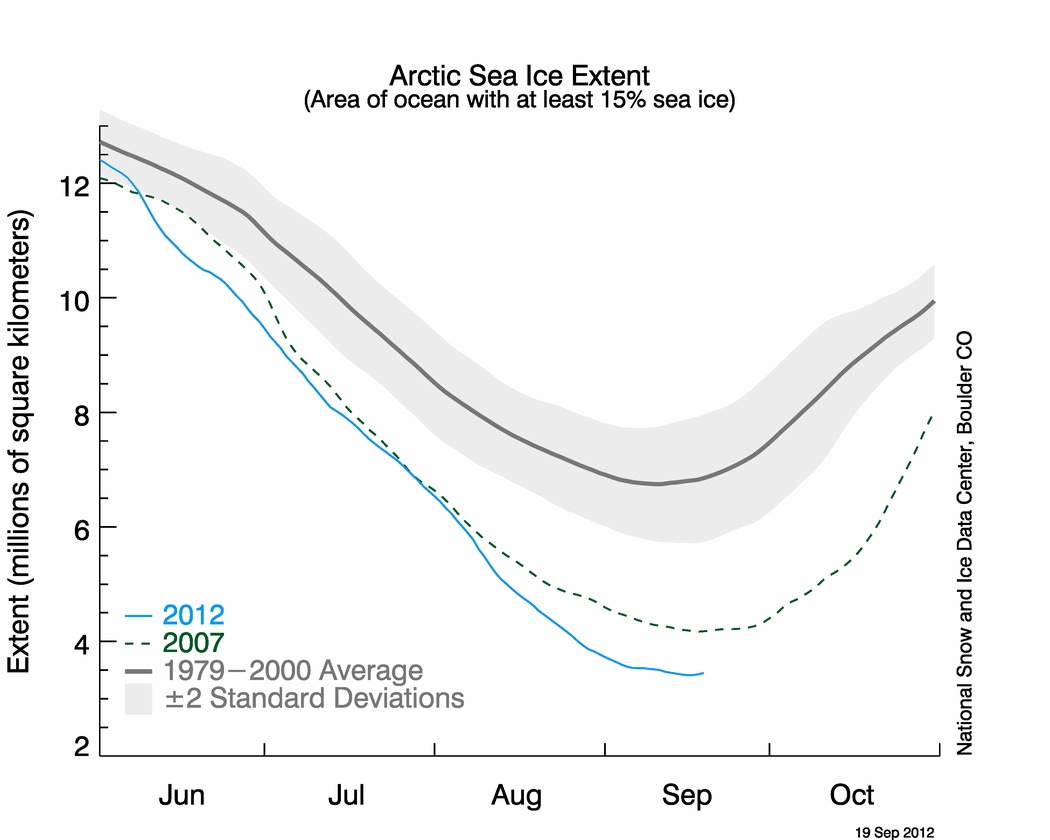
Arctic sea ice extent. Area of ocean with at least 15 percent sea ice as of Sept 12, 2012. Credit: National Snow and Ice Data Center.

Arctic ice half of what it was 30 years ago. Now affecting weather patterns

Heading for +4C and catastrophe – CBD

By Stephen Leahy

UXBRIDGE, Canada, Sep 20 2012 (IPS)

The melt of Arctic sea ice has reached its lowest point this year, shrinking 18 percent from last year’s near-record low.

Summer ice this year is half what it was 30 years ago and is now affecting weather patterns. The massive declines in ice in recent summers have shocked scientists and Arctic experts. Some predict that in just a few years we will witness an event that hasn’t happened in millions of years: the complete loss of summer ice.

“We are now in uncharted territory,” said Mark Serreze, director of the National Snow and Ice Data Center (NSIDC) in Colorado.

“Few of us were prepared for how rapidly the changes would actually occur” as a result of the burning fossil fuels that are warming the planet, said Serreze.

“We could see an essentially ice-free Arctic ocean in late summer by the year 2030,” he told IPS.

Not long ago experts thought the soonest the Arctic would be ice-free was 2070. Now it’s anywhere from four to 18 years away.

The impacts are already being felt across the entire northern hemisphere. The loss of sea ice in recent years has been affecting weather patterns, recent research has shown. The all-important jet stream – the west-to-east winds that are the boundary between the cold Arctic and the warm mid-latitudes – is slowing down, moving north and become more erratic.Measurement of CO2 levels in atmosphere

“Europe, eastern Asia and eastern North America is connected to unique physical processes in the Arctic,” said James Overland of the NOAA/Pacific Marine Environmental Laboratory in the United States.

“In future, cold and snowy winters will be the rule rather than the exception” in these regions, Overland told IPS in Oslo in 2010.

The summer’s record loss of Arctic sea ice may mean a cold winter for the UK and northern Europe, Jennifer Francis, a researcher at Rutgers University, told the Guardian last week.

The region has been prone to bad winters after summers with very low sea ice, such as 2011 and 2007, Francis said. Continue reading

Double Food Production in 10 Years AND Reduce Global Warming

Greening of the Sahel desert region with eco-ag

Yields went up 214 percent in 44 projects in 20 countries in sub-Saharan Africa

“If we don’t radically transform the direction of the global food system we will never feed the billion who are hungry,” De Shutter warns.

“Nor will we be able to feed ourselves in the future.”

By Stephen Leahy

UXBRIDGE, Feb 8, 2011 (IPS)

Eco-farming could double food production in entire regions within 10 years while mitigating climate change, according to a new U.N. report released Tuesday in Geneva.

An urgent transformation to ‘eco-farming’ is the only way to end hunger and face the challenges of climate change and rural poverty, said Olivier De Schutter, U.N. Special Rapporteur on the right to food, following the presentation of his annual report focusing on agroecology and the right to food to the U.N. Human Rights Council.

“Agroecology mimics nature not industrial processes. It replaces the external inputs like fertiliser with knowledge of how a combination of plants, trees and animals can enhance productivity of the land,” De Schutter told IPS.

“Yields went up 214 percent in 44 projects in 20 countries in sub-Saharan Africa using agro-ecological farming techniques over a period of 3 to 10 years… far more than any GM [genetically modified] crop has ever done.”

Other recent scientific assessments have shown that small farmers in 57 countries using agro-ecological techniques obtained average yield increases of 80 percent. Africans’ average increases were 116 percent.

“Today’s scientific evidence demonstrates that agroecological methods outperform the use of chemical fertilisers in boosting food production in regions where the hungry live,” De Schutter said. [Video Interviews with De Schutter]


Agroecology applies ecological science to the design of agricultural systems. It enhances soil productivity and protects crops against pests by relying on the natural elements. Continue reading

Global Temperatures Rising on a Devastating Trajectory

Global temperatures are only 0.7C warmer — on pace for +4C!

By Stephen Leahy

UXBRIDGE, Canada, May 25, 2012 (IPS)

Climate-heating carbon emissions set a record high in 2011, in a 3.2 percent increase over the previous year, the International Energy Agency reported this week. The main reason for this dangerous increase is that governments are failing to implement policies to prevent catastrophic increases of global temperatures.

A new report released on the last days of international climate talks in Bonn, Germany this week reveals that the planet is heading to a temperature rise of at least 3.5 degrees Celsius, and likely more, according to the Climate Action Tracker (CAT), despite an international agreement to keep global temperature rise below two degrees Celsius.

Not only are pledges inadequate, but countries are unable to fulfill even those pledges, a new CAT analysis shows. CAT is a joint project of Dutch energy consulting organisation Ecofys, Germany’s Climate Analytics, and the Potsdam Institute for Climate Impact Research.

“When we compared the emission reduction pledges of countries like Brazil, Mexico and the U.S., we found they did not have the policies in place to meet those pledges,” said Niklas Höhne, director of energy and climate policy at Ecofys.

Höhne told IPS that they looked only at the policies of a few countries, but no country’s policies were enough to meet their targets. Continue reading

Standing Up for the Planet and the Future: Time to Stop Using Fossil Fuels

Coal power plant – Alberta

+15,000 temperature records already broken in the US this year 

By Stephen Leahy

UXBRIDGE, Canada, May 4, 2012 (IPS)

What are you doing on Saturday? Peter Nix, a retiree, will be standing on a railway track on Canada’s west coast blocking a coal train destined to ship U.S. and Canadian coal to Asia.

Nix will be joined by dozens of people near White Rock, British Columbia on May 5. They will be in good company as tens of thousands of people around the world participate in global day of action to “connect the dots” between climate change and extreme weather.

“There will be at least 1,200 actions in more than 100 countries,” says Jamie Henn, communications director for 350.org, a U.S.-based environmental group.

Please throw something in the tip jar before reading on. This is how I make my living.
There’s been a general perception that climate change is a future problem but with all the extreme weather disasters and weather records the public is being to realise that climate change is here, says Henn.

“Recent opinion surveys show the more than 60 percent of the U.S. public are connecting extreme weather to climate change,” Henn told IPS.

The U.S. public is not wrong, say scientists. 

“All weather events are affected by climate change because the environment in which they occur is warmer and moister than it used to be,” Kevin Trenberth, senior scientist at the U.S. National Center for Atmospheric Research, told IPS previously.  Continue reading

The Oxymoron of Political Leadership and Political Will

Analysis by Stephen Leahy

VIENNA, Jun 29, 2011 (IPS)

Political will is all that’s needed to bring electricity to the 2.5 billion people with no or unreliable access to power, or to feed the one billion who go hungry every day, or to finally begin to slash carbon emissions to avoid dangerous climate change, or just about any other global problem.

Humanity has the technology, resources and even the money to solve these problems, agree scientists, corporate business leaders, heads of civil society organisations and United Nations agencies and government ministers. “All that is lacking is political will,” they almost always declare at the dozens of international conferences, summits and forums this reporter has attended for the past five years. And then everyone goes home.

What is this magical “political will” that can solve any problem?

via The Oxymoron of Political Leadership – IPS ipsnews.net.

Fossil Fuel Industry Kings of Corporate Welfare

This graphic from GOOD magazine shows who gets the bulk of the enormous US energy subsidies. Many subsidies are hidden and difficult to estimate and this attempt looks to be low according to the experts I’ve interviewed for various articles (cited below). The graphic also doesn’t include subsidies for nuclear which are equally enormous.  — Stephen

The enormous fossil fuel subsidies are rarely acknowledged when complaints are raised about costs of renewable energy. This report shown below says subsidies for fossil fuel are 12X that for green energy but this is a gross underestimate based on the experts I’ve interviewed in June for this article Free Ride for Oil and Coal Industry May Be Over.

Subsidies experts in Switzerland told me that “two-billion-dollars-a-day public subsidy for carbon-based fuels is a very conservative estimate..”

In reality big oil and coal get more like 20X the money green energy. So let’s do some real pricing: electricity from coal 5 cents kWh X 20 for subsidies (not to mention free use of the atmosphere /environment for its CO2, mercury etc waste products.) Corporate welfare at its best.

A few of the many articles I’ve written on the subject of energy subsidies:

Fossil Fuel Subsidies Are 12X (more like 20X) Support for Renewables, Study Shows

Every Day Governments Give an Estimated $2 billion to Oil, Coal & Gas Industry

Oil Companies and Special Interests Spend Half a Billion Dollars to Defeat US Clean Energy – Study

Nuclear Power Costs Skyrocket, Cost of Renewables Plummet

Tips for Climate-Safe Living on Earth Day

Take time to be outside today and think about everything that nature provides:  air, water, plants and animals that sustain us. Such gifts should not be taken lightly because with our numbers and powerful technologies we are ‘the bull in nature’s china shop’.

We need to take great care and practice Climate-safe Living.

1. Reduce.

Reduce fossil fuel consumption everywhere.

2. Eliminate.

Eliminate all non-essential activities and products that involve burning fossil fuels.

3. Demand.

Demand that business and government provide transport, activities and products that use minimize fossil fuel use.

Reduce. Eliminate. Demand. R.E.D.

May you always cherish this Earth and share in her joys.

Stephen

Fossil Fuel Lobby Following the Playbook of Big Tobacco Confusing the Public on Dangers of Climate Disruption

Fossil Energy Interests Sowing Confusion and Buying Legislative Delay on America’s Biggest Threat: Climate Change says Environmental Economist

Robert Repetto

UXBRIDGE, Canada, Mar 2, 2011 (IPS)

Powerful fossil energy interests are preventing the United States from making the necessary transition to 21st century energy sources, one of the country’s leading environmental economists documents in a just-published book.

Fossil energy interests are spending “hundreds of millions of dollars” lobbying U.S. politicians in Congress and funding groups to confuse the public about the serious risks climate change poses, says Robert Repetto, author of “America’s Climate Problem: The Way Forward” published by Earthscan.

IPS climate and environment correspondent Stephen Leahy spoke with Repetto about his new book.

Q: Why did you write this book?

A: We’re running out of time. The latest science shows that climate change is coming faster and posing greater risks than previously thought. We are at risk of triggering positive feedbacks that will lead to uncontrollable climate change.

This independent environmental journalism depends on public support. Click here learn more.

Meanwhile, America is locked in a climate-policy stalemate, with very few in the public comprehending the real risks climate change poses. Most don’t understand that climate change is happening now. They don’t link extreme weather events we’ve been experiencing with climate change. As a result they are not demanding that politicians take action.

Q: Why don’t most Americans understand the fact that climate change is already underway and poses serious risks?

A: Fossil (oil, coal, natural gas) energy interests are pouring hundreds of millions of dollars into sowing doubt and uncertainty to blunt public concern and to provide political cover to those politicians they are funding. In America, there is a very concerted effort by fossil energy interests that bankroll right-wing and libertarian “think tanks” like the Competitive Enterprise Institute to create an atmosphere of doubt and uncertainty, just like the tobacco companies did regarding the health effects of smoking. Continue reading

Two Percent Price-Tag for a Green Economy – Time to end Growth-obsessed Markets pillaging the planet

No future in the “brown” economic system driven by fossil fuel energy and the serial depletion and degradation of natural resources and ecosystems

By Stephen Leahy

UXBRIDGE, Canada, Feb 23, 2011 (IPS)

Growth-obsessed markets and governments are pillaging the planet and it must stop, a new U.N. report warns.

The present “brown” economic system driven by fossil fuel energy and the serial depletion and degradation of natural resources and ecosystems has no future and must be replaced by a green economy, says the Green Economy report launched in Nairobi, Kenya this week by the United Nations Environment Programme (UNEP).

Investing just two percent of the global economy into a few key sectors will kick-start a transition towards a low- carbon, resource-efficient economy, the report says. With that relatively small investment, many of the world’s biggest challenges – climate change, poverty, hunger, jobs, sanitation, energy, food – could be successfully met within two generations.

This independent environmental journalism depends on public support. Click here learn more.

“The Green Economy provides a vital part of the answer of how to keep humanity’s ecological footprint within planetary boundaries,” said Achim Steiner, UNEP executive director.

“It aims to link the environmental imperatives for changing course to economic and social outcomes,” Steiner said.

The report documents that a green, low-carbon, resource- efficient economy will be at least as prosperous as the old brown economy. Better still, a green economy will not have the inherent risks, shocks, scarcities and crises of the resource-depleting, high carbon ‘brown’ economy, it says. Continue reading

Why Are We Looking for More Oil & Coal? We Already Have Enough to Cook the Planet 4X

Proven reserves of oil, gas and coal represent four times the amount of carbon that would blow through the 2-degree C climate target (which no one really thinks is ‘safe’).  Burning just one quarter of those proven reserves will bring humanity to the 50-50 point of tipping into dangerous climate change said leading climate scientists in 2009. We need a plan to phase out emissions of carbon entirely they said in my article for IPS. — Stephen

“Only a fast switch away from fossil fuels will give us a reasonable chance to avoid considerable warming,” said Malte Meinshausen, climate researcher at the Potsdam Institute for Climate Impact Research.

See full article based on studies published in Nature:

Heading for +2 degrees C (3.6 degrees F) Carbon Use Must Peak by 2015 Scientists Warn