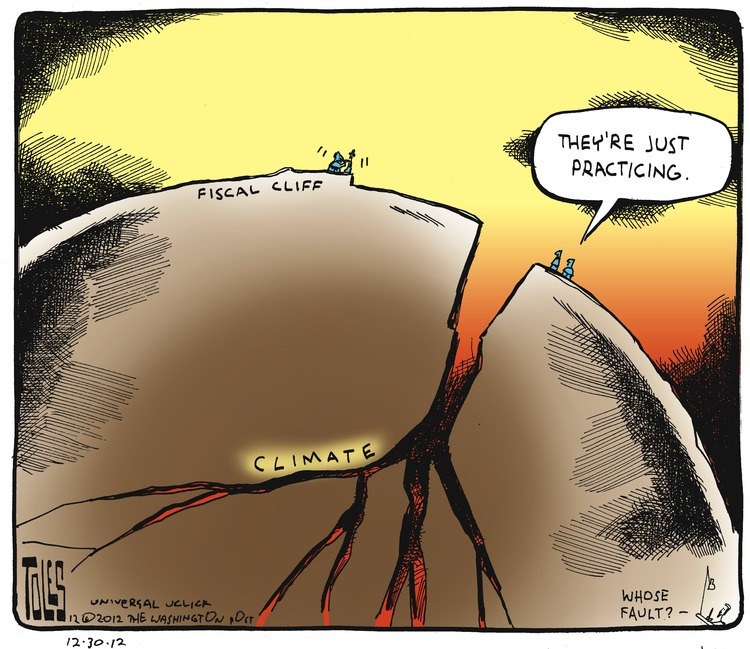
Governments Fail to Take Steps to Steer Away From Looming Crisis

ttfiscal carbon cliff

Rio+20 should have been about life, about the future of our children”

By Stephen Leahy

RIO DE JANEIRO, Jun 19 2012 (IPS)

“Very disappointing.” That was the term business and non-governmental organisations used to describe the formal intergovernmental negotiations at the Rio+20 Earth Summit as of Tuesday.

With overwhelming scientific evidence showing that the Earth’s ability to support human life is at serious risk, the Rio+20 summit is being held to help chart a safe course that will steer away from disaster and bring a better future people around the globe.

After two years, negotiators from more than 190 nations agreed Tuesday to a 49-page draft of the document “The Future We Want”, intended to be the roadmap for this transformation. This document will be presented to heads of states in Rio de Janeiro to revise and finalise by the summit’s conclusion on Friday.

Yet the draft document leaves out a 30-billion-dollar fund proposed by a group of developing countries known as the G77 to finance the transition to a green economy. Nor does it define tangible Sustainable Development Goals (SDGs), which will be substituted for the Millennium Development Goals, which expire in 2015.

“This (the revised text) is extremely disappointing….There is no vision, no money and really no commitments here,” said Lasse Gustavsson, head of the Rio+20 delegation from WWF International, which works to stop environmental degradation worldwide.

Rio+20 should have been about life, about the future of our children, of our grandchildren. It should have been about forest, rivers, lakes, oceans that we are all depending on for our food, water and energy security,” Gustavsson told TerraViva.

Instead, two years of work have resulted in merely a long document that commits to virtually nothing but more meetings, he said.Rio+20 logo

“This document is a great disappointment. There’s no ambition and little reference to the planetary boundaries we face,” said Kiara Worth, representing the U.N.’s Major Group on Children and Youth at Rio+20.

“The voices of civil society and future generations is going unheard. We ought to call this Rio minus 20 because we are going backwards,” Worth told TerraViva. Continue reading

“We Should be Shaking in Our Boots” – UN Environment Official

Construction of the Trans-Amazonian Highway, Brazil -- sml Photo by Hans Silvester

Earth’s Ability to Support Us At Risk – An Indictment of Governments We Elected

By Stephen Leahy

RIO DE JANEIRO, Jun 19 2012 (IPS)

The science is crystal clear: humans are threatening Earth’s ability to support mankind, and a new world economy is urgently needed to prevent irreversible decline, said scientists and other experts at an event on the sidelines of the Rio+20 Earth Summit.

Yet the Global Environment Outlook report, or GEO 5, which was launched on June 6 and assessed 90 of the most important environmental objectives, found that significant progress had been made only in four in the 20 years since the first landmark summit in Rio in 1992.

Achim Steiner, the executive director of the United Nations Environment Programme (UNEP) said the results of GEO 5 were “depressing, even to me”.

“This ought to have us shaking in our boots,” Steiner told TerraViva at the Fair Ideas conference that concluded Sunday. ”It is an indictment of our behaviour over the past 20 years and of the governments we elected. We need an honest conversation about why we are not turning things around.”rio banner sml

Instead, “what’s happening right now in the RioCentro (Rio+20 official site) is that science is being picked out of the text of the final agreement,” Johan Rockström, executive director of the Stockholm Resilience Centre in Sweden, told the conference.

Rockström said he had received updates from the negotiations that the United States and some of the world’s least developed countries were attacking the science showing humanity is pushing up against “planetary boundaries”.

Climate is only one of those “planetary boundaries”. Another is the ongoing decline of biodiversity, where so many plants and animals are going extinct that the Earth’s living systems, upon which humanity depends, are unravelling. Fresh water is another planetary boundary. Water is a limited resource, yet water use has increased six-fold in the past century.

“The science is absolutely clear: we are up against the edges of the planet’s ability to support us and approaching irreversible tipping points,” Rockström said. Continue reading

24 Policies That Can End Our Earth Emergency

blue-marble-720x696-720x696

“Ecological literacy is vital for those in positions of power and influence”

Never vote for anyone who isn’t literate

By Stephen Leahy

UXBRIDGE, Canada, Jun 7 2012 (IPS)

Ecologically ignorant policies are largely responsible for the interlinked crises that are unraveling the planet’s life support system.

The unintended consequences of such policies are climate change, desertification, biodiversity decline, ocean pollution and the destruction of forests, according to the policy advocacy organisation World Future Council.

The solution is to eliminate “bad” policies and implement policies that ensure a healthy planet for future generations. On world environment Day, Jun. 5, the World Future Council will present an emergency policy agenda consisting of 24 tipping-point policies that need to be implemented globally to preserve a habitable planet.

“We are in an Earth Emergency. It’s an unbelievable crisis. Policies are the most important tool we have to change this,” Jakob von Uexkull, founder and chair of the World Future Council (WFC).

The five-year old WFC is based in Hamburg, Germany and comprised of 50 eminent individual from around the globe who have already successfully promoted change.

“Policy may be seen as dull and boring but they are the things that shape our societies,” von Uexkull told IPS.

In 2000, the German government created the now famous feed-in tariff policy launching a renewable energy revolution. That policy has enabled Germany to generate 22 percent of its electricity from renewables today and created a new business sector employing more people than its automotive industry.

“With the best laws and right policy incentives we can mobilise human inventiveness and entrepreneurship to safeguard a healthy planet for future generations,” he said.

On the other hand bad government policies allow 3,000 of the world’s biggest corporations to escape more than 2.2 trillion dollars in annual costs through their impacts on the natural environment, according to the U.N. Environment Programme. (A trillion is one thousand billion. A trillion seconds is nearly 32,000 years). Continue reading

Green Approaches to Water Safest and Cheapest Solution

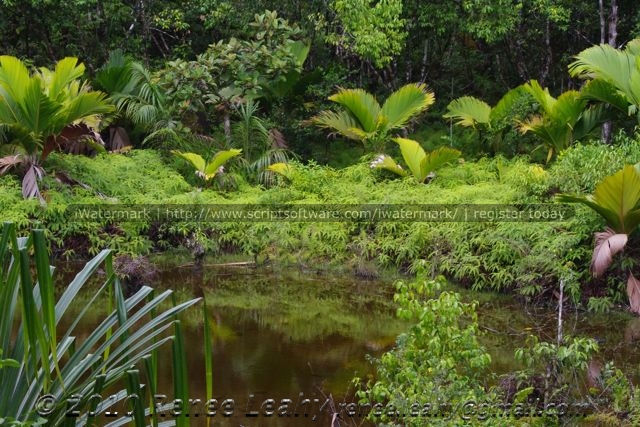
Wetlands regulate, clean and cool water. Mare Aux Cochons high-altitude wetlands, Seychelles Islands (ReneeLeahy copyright)

By Stephen Leahy

UXBRIDGE, Canada, Jan 18 2013 (IPS)

After Hurricane Sandy swept through the northeast of the United States late October 2012, millions of New Yorkers were left for days without electricity.  But they still had access to drinking water, thanks to New York City’s reliance on protected watershed areas for potable water.

Instead of using electric-powered water treatment plans, New York City brings its high-quality drinking water through aqueducts connected to protected areas in the nearby Catskill/Delaware forests and wetlands – just one example of how protecting watersheds can provide residential areas with drinking water and flood and pollution protection at bargain basement prices.

New York saved between four and six billion dollars on the cost of water treatment plants by protecting forests and compensating farmers in the Catskills for reducing pollution in lakes and streams.

In 2011, countries around the world invested more than eight billion dollars in similar watershed projects around the world, according to the State of Watershed Payments 2012 report released Thursday. That year, China led the way, accounting for 91 percent of watershed investment.

“Whether you need to save water-starved China from economic ruin or protect drinking water for New York City, investing in natural resources is emerging as the most cost-efficient and effective way to secure clean water and recharge our dangerously depleted streams and aquifers,” said Michael Jenkins, president of Forest Trends, a non-governmental organisation (NGO) in the United States, which compiled the report. Continue reading

Worlds’ Scientists Say Facing “Planetary Emergency”

Planet Under Pressure – State of the Planet Declaration Mar 29 2012.

By Stephen Leahy

UXBRIDGE, Canada, (IPS)

[Based on my article Climate Summit: A Moment That Must Be Seized ]

Governments, the media and the public aren’t paying attention to the “planetary emergency” unfolding around them. The situation is like firefighters yelling “fire” in crowded room and still no listens.

“The situation is absolutely desperate and yet there’s nothing on the front pages or on the agenda of world leaders,” said Pat Mooney, executive director of the ETC Group, an international environmental organisation based in Ottawa.

“The lack of attention is a tragedy,” said Mooney, who has 40 years experience in international environment and development issues.

Humanity is failing in its stewardship of the planet. An incredible 85 percent of the world’s oceans are in trouble, said Susan Lieberman, director of international policy at the Pew Environment Group, a U.S. organisation.

“Planetary emergency” is how many in the world’s scientific community describe “the mess we are in“. They will detail their comprehensive state of the planet assessment at the “Planet Under Pressure” conference in London Mar. 26-29.

That assessment will summarise the overwhelming evidence that “the continued functioning of the Earth system as we know it is at risk,” conference organisers previously told IPS.

Climate change, which is overheating the planet and making the oceans more acidic, is just one of the major challenges. Another is the ongoing decline of biodiversity, where so many plants and animals are going extinct that the Earth’s living systems on which humanity depends are unraveling.

Fresh water is another “planetary boundary” humanity is pushing up against. Water use has increased six-fold in the past century and in many places the quality of water resources has been degraded. Other challenges include increasing poverty, food and energy security, and the current financial and economic instability.

A first and essential step in a green transition is for nations to commit to phasing out harmful and unsustainable subsidies for fossil fuels, fisheries and industrial agriculture.

According to Mooney, some countries and large corporations see the green economy in terms of a post-petroleum future where resources and energy for industrial production comes from biomass and other living things. Most of those “living resources” are in the global South and local people rightly fear a massive land grab, he said.

Foreign investors have already gained access to more than 35 million hectares in Africa, Asia and South America for food and biofuel production according to GRAIN, a small NGO working with small farmers and farming communities.


Plankton Death To Come with Acid Oceans and Sunlight

A number of marine diatom cells (Pleurosigma), which are an important group of phytoplankton in the oceans.
Credit: Michael Stringer

Global Warming has made oceans 30% more acidic already

“It’s clear we are conducting a giant experiment on the planet and we don’t know what we are doing.”

[This is a repost from my May 8 2012 article – see here for more on acid ocean impacts — Stephen]

 By Stephen Leahy

UXBRIDGE, Canada, May 8, 2012 (IPS)

Without major reductions in the use of fossil fuels, sunlight will kill an unknown number of ocean phytoplankton, the planet’s most important organism, a new study reports this week.

Not only are phytoplankton, also known as marine algae, a vital component in the ocean’s food chain, they generate at least half of the oxygen we breathe.

In the not so distant future, sunlight, the very source of life for phytoplankton, will likely begin to kill them because of the ocean’s increasing acidity, researchers from China and Germany have learned.

“There’s a synergistic effect between increased ocean acidity and natural light,” says Ulf Riebesell of the Helmholtz Centre for Ocean Research in Kiel, Germany.

Riebesell added that it was also possible “phytoplankton could adapt”.

Researchers were surprised to discover that diatoms, one of the most important and abundant types of phytoplankton, fared very badly during shipboard experiments conducted by co-author Kunshan Gao, from the State Key Laboratory of Marine Environmental Science at Xiamen University, Xiamen China.

Previous experiments in labs like Riebesell’s found that diatoms actually did better in high-acid seawater, unlike most other shell- forming plankton. Burning fossil fuels has made the oceans about 30 percent more acidic researchers discovered less than 10 years ago. Oceans absorb one third of the carbon dioxide (CO2) emitted from using fossil fuels.

The good news is this has slowed the rate of global warming. The bad news is oceans are now more acidic and it will get worse as more CO2 is emitted. This is basic, well-understood ocean chemistry.  Continue reading

Drought and New Deserts by 2060: Most of Mexico, Central America and half of US

Projected drought and dry regions in 2060-2069

By Stephen Leahy

UXBRIDGE, Canada, May 22, 2012 (Tierramérica)

Mexico and Central America look like they are covered in dried blood on maps projecting future soil moisture conditions.

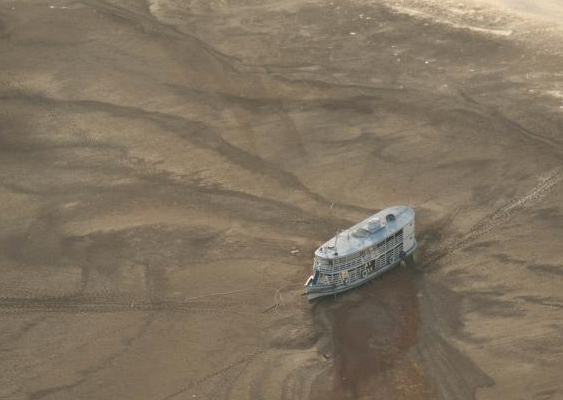
The results from 19 different state-of-the-art climate models project extreme and persistent drought conditions (colored dark red-brown on the maps) for almost all of Mexico, the midwestern United States and most of Central America.

If climate change pushes the global average temperature to 2.5 degrees Celsius above pre-industrial era levels, as many experts now expect, these regions will be under severe and permanent drought conditions.

Future conditions are projected to be worse than Mexico’s current drought or the U.S. Dust Bowl era of the 1930s that forced hundreds of thousands of people to migrate.

These are some of the conclusions of the study “Projections of Future Drought in the Continental United States and Mexico”, which was published in the December 2011 issue of the American Meteorological Society’s Journal of Hydrometeorology and has gone largely unnoticed.

“Drought conditions will prevail no matter what precipitation rates are in the future,” said co-author Michael Wehner, a climate scientist at the Lawrence Berkeley National Laboratory, a U.S. government research centre in California.

“Even in regions where rainfall increases, the soils will get drier. This is a very robust finding,” Wehner told Tierramérica.

Without major reductions in carbon emissions from the burning of fossil fuels, global temperatures will increase to at least 2.5 degrees of warming between 2050 and 2090, depending on rates of emissions of greenhouse gases, climate sensitivity and feedbacks. Continue reading

Ocean Acidification Leaves Mollusks Naked and Confused

Chilean intertidal carnivorous crab (Acanthocyclus hassleri)

Climate change is making oceans warmer and more acidic…expect the worst

By Stephen Leahy

When the carbon dioxide absorbed by the oceans dissolves in seawater, carbonic acid is formed and calcium carbonate, vital for the formation of the skeletons and shells of many marine organisms, becomes scarcer.

MONTEREY, California, Oct 2 2012 (IPS)

Climate change will ruin Chilean sea snails’ ability to sniff out and avoid their archenemy, a predatory crab, according to Chilean scientists who presented their findings at an international science symposium here.

Researchers from Australia also revealed that as the oceans become more and more acidic, some fish become hyperactive and confused, and move towards their predators instead of trying to escape.

“The conditions in oceans are changing 100 times faster than at any time in the past,” said Jean-Pierre Gattuso, a marine biologist with CNRS-INSU and the Laboratoire d’Océanographie de Villefranche in France.

Climate change is making oceans warmer and more acidic. “We are beginning to understand what will happen. I think we can expect the worst,” Gattuso told Tierramérica*.

Gattuso is one of nearly 600 scientists from around the world who presented their research on Sep. 24-27 at the Third International Symposium on the Ocean in a High-CO2 World: Ocean Acidification in Monterey, California.

Researchers discovered only 10 years ago that burning fossil fuels like coal, oil and gas has made the oceans about 30 percent more acidic since the beginning of the Industrial Revolution. Continue reading

Double Food Production in 10 Years AND Reduce Global Warming

Greening of the Sahel desert region with eco-ag

Yields went up 214 percent in 44 projects in 20 countries in sub-Saharan Africa

“If we don’t radically transform the direction of the global food system we will never feed the billion who are hungry,” De Shutter warns.

“Nor will we be able to feed ourselves in the future.”

By Stephen Leahy

UXBRIDGE, Feb 8, 2011 (IPS)

Eco-farming could double food production in entire regions within 10 years while mitigating climate change, according to a new U.N. report released Tuesday in Geneva.

An urgent transformation to ‘eco-farming’ is the only way to end hunger and face the challenges of climate change and rural poverty, said Olivier De Schutter, U.N. Special Rapporteur on the right to food, following the presentation of his annual report focusing on agroecology and the right to food to the U.N. Human Rights Council.

“Agroecology mimics nature not industrial processes. It replaces the external inputs like fertiliser with knowledge of how a combination of plants, trees and animals can enhance productivity of the land,” De Schutter told IPS.

“Yields went up 214 percent in 44 projects in 20 countries in sub-Saharan Africa using agro-ecological farming techniques over a period of 3 to 10 years… far more than any GM [genetically modified] crop has ever done.”

Other recent scientific assessments have shown that small farmers in 57 countries using agro-ecological techniques obtained average yield increases of 80 percent. Africans’ average increases were 116 percent.

“Today’s scientific evidence demonstrates that agroecological methods outperform the use of chemical fertilisers in boosting food production in regions where the hungry live,” De Schutter said. [Video Interviews with De Schutter]


Agroecology applies ecological science to the design of agricultural systems. It enhances soil productivity and protects crops against pests by relying on the natural elements. Continue reading

Ocean Acidification Leaves Mollusks Naked and Confused

By Stephen Leahy

When the carbon dioxide absorbed by the oceans dissolves in seawater, carbonic acid is formed and calcium carbonate, vital for the formation of the skeletons and shells of many marine organisms, becomes scarcer.

MONTEREY, California, Oct 2 2012 (IPS) –

Climate change will ruin Chilean sea snails’ ability to sniff out and avoid their archenemy, a predatory crab, according to Chilean scientists who presented their findings at an international science symposium here.

Researchers from Australia also revealed that as the oceans become more and more acidic, some fish become hyperactive and confused, and move towards their predators instead of trying to escape.

“The conditions in oceans are changing 100 times faster than at any time in the past,” said Jean-Pierre Gattuso, a marine biologist with CNRS-INSU and the Laboratoire d’Océanographie de Villefranche in France.

Climate change is making oceans warmer and more acidic. “We are beginning to understand what will happen. I think we can expect the worst,” Gattuso told Tierramérica*.

via IPS – Ocean Acidification Leaves Mollusks Naked and Confused | Inter Press Service.