Extreme weather new normal with Climate Change

Climate change plays a role in all extreme weather now – atmosphere is 0.8C hotter and 4-6% wetter – turns out small increases can have big impacts. — Stephen

Stephen's avatarStephen Leahy, International Environmental Journalist

By Stephen Leahy

CAIRNS, Australia, Apr 3, 2012 (Tierramérica)

Extreme weather is fast becoming the new normal. Canada and much of the United States experienced summer temperatures during winter this year, confirming the findings of a new report on extreme weather.

For two weeks this March most of North America baked under extraordinarily warm temperatures that melted all the snow and ice and broke 150-year-old temperature records by large margins.

Last year the U.S. endured 14 separate billion-dollar-plus weather disasters including flooding, hurricanes and tornados.

A new report from the Intergovernmental Panel on Climate Change (IPCC), released Mar. 28, provides solid evidence that record-breaking weather events are increasing in number and becoming more extreme. And if current rates of greenhouse gas emissions are maintained, these events will reach dangerous new levels over the coming century.

Since 1950 there have been many more heat waves and record warm temperatures than in…

View original post 768 more words

We all have responsibility to ensure our stuff if properly disposed of.

Stephen's avatarStephen Leahy, International Environmental Journalist

‘Public largely unaware of the e-waste impacts on human health and environment’

By Stephen Leahy

UXBRIDGE, Canada, Nov 1, 2011 (IPS)

Mountains of hazardous waste grow by about 40 million tons every year. This waste, mostly from Europe and North America, is burned in developing countries like Ghana in a hazardous effort to recover valuable metals.

A children’s school in Accra, Ghana’s capital, was recently found to be contaminated by lead, cadmium and other health-threatening pollutants at levels over 50 times higher than risk-free levels. The school is located directly beside an informal electronic waste salvage site.

“Poor people in Africa cannot afford to process Europe’s or America’s electronic wastes,” said Ghanaian researcher Atiemo Sampson.

“Those wastes are poisoning our children,” Sampson told IPS from Accra.

Ghana does not regulate the importation and management of electronic waste, or e-waste. The government hopes to have rules in place next year, he…

View original post 778 more words

Ocean Acidification Leaves Mollusks Naked and Confused

Chilean intertidal carnivorous crab (Acanthocyclus hassleri)

Climate change is making oceans warmer and more acidic…expect the worst

By Stephen Leahy

When the carbon dioxide absorbed by the oceans dissolves in seawater, carbonic acid is formed and calcium carbonate, vital for the formation of the skeletons and shells of many marine organisms, becomes scarcer.

MONTEREY, California, Oct 2 2012 (IPS)

Climate change will ruin Chilean sea snails’ ability to sniff out and avoid their archenemy, a predatory crab, according to Chilean scientists who presented their findings at an international science symposium here.

Researchers from Australia also revealed that as the oceans become more and more acidic, some fish become hyperactive and confused, and move towards their predators instead of trying to escape.

“The conditions in oceans are changing 100 times faster than at any time in the past,” said Jean-Pierre Gattuso, a marine biologist with CNRS-INSU and the Laboratoire d’Océanographie de Villefranche in France.

Climate change is making oceans warmer and more acidic. “We are beginning to understand what will happen. I think we can expect the worst,” Gattuso told Tierramérica*.

Gattuso is one of nearly 600 scientists from around the world who presented their research on Sep. 24-27 at the Third International Symposium on the Ocean in a High-CO2 World: Ocean Acidification in Monterey, California.

Researchers discovered only 10 years ago that burning fossil fuels like coal, oil and gas has made the oceans about 30 percent more acidic since the beginning of the Industrial Revolution. Continue reading

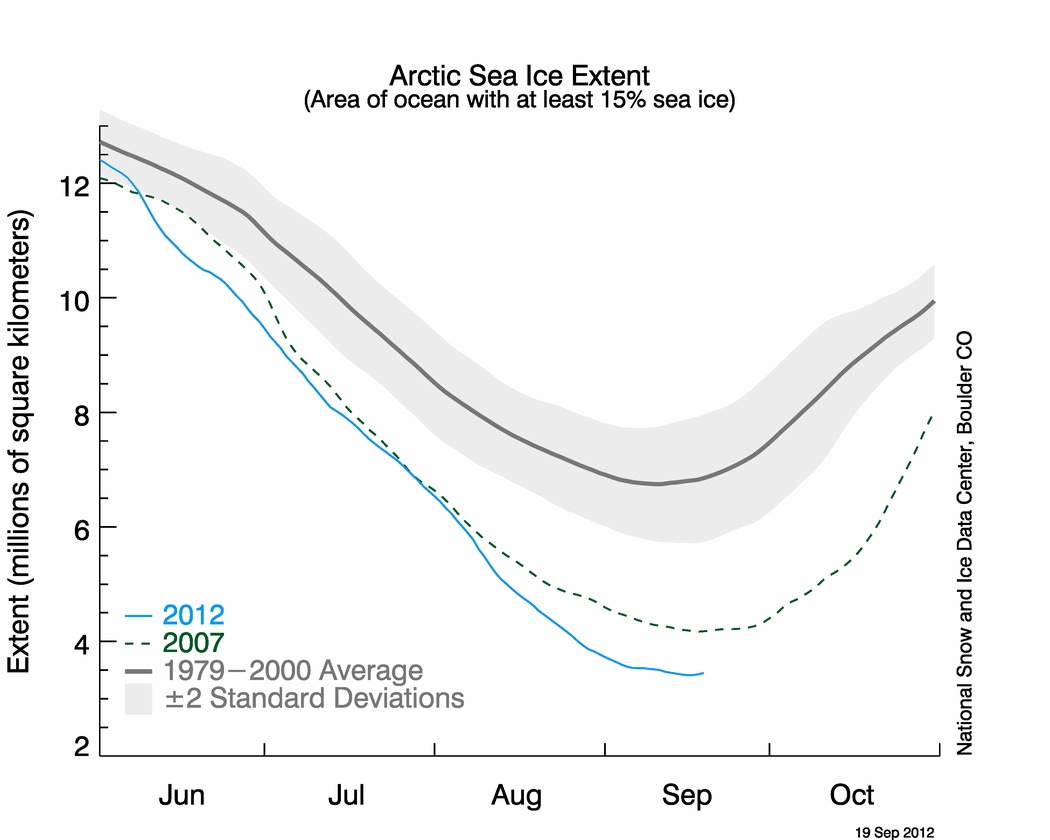
Ice-Free Arctic Is “Uncharted Territory”

Arctic sea ice extent. Area of ocean with at least 15 percent sea ice as of Sept 12, 2012. Credit: National Snow and Ice Data Center.

Arctic ice half of what it was 30 years ago. Now affecting weather patterns

Heading for +4C and catastrophe – CBD

By Stephen Leahy

UXBRIDGE, Canada, Sep 20 2012 (IPS)

The melt of Arctic sea ice has reached its lowest point this year, shrinking 18 percent from last year’s near-record low.

Summer ice this year is half what it was 30 years ago and is now affecting weather patterns. The massive declines in ice in recent summers have shocked scientists and Arctic experts. Some predict that in just a few years we will witness an event that hasn’t happened in millions of years: the complete loss of summer ice.

“We are now in uncharted territory,” said Mark Serreze, director of the National Snow and Ice Data Center (NSIDC) in Colorado.

“Few of us were prepared for how rapidly the changes would actually occur” as a result of the burning fossil fuels that are warming the planet, said Serreze.

“We could see an essentially ice-free Arctic ocean in late summer by the year 2030,” he told IPS.

Not long ago experts thought the soonest the Arctic would be ice-free was 2070. Now it’s anywhere from four to 18 years away.

The impacts are already being felt across the entire northern hemisphere. The loss of sea ice in recent years has been affecting weather patterns, recent research has shown. The all-important jet stream – the west-to-east winds that are the boundary between the cold Arctic and the warm mid-latitudes – is slowing down, moving north and become more erratic.Measurement of CO2 levels in atmosphere

“Europe, eastern Asia and eastern North America is connected to unique physical processes in the Arctic,” said James Overland of the NOAA/Pacific Marine Environmental Laboratory in the United States.

“In future, cold and snowy winters will be the rule rather than the exception” in these regions, Overland told IPS in Oslo in 2010.

The summer’s record loss of Arctic sea ice may mean a cold winter for the UK and northern Europe, Jennifer Francis, a researcher at Rutgers University, told the Guardian last week.

The region has been prone to bad winters after summers with very low sea ice, such as 2011 and 2007, Francis said. Continue reading

Exposure to air pollution from traffic damages Swedish children’s lungs

Source:  American Journal of Respiratory and Critical Care Medicine. 13 Oct 2012

Exposure to air pollution from traffic during infancy is associated with lung function deficits in children up to eight years of age, particularly among children sensitized to common allergens, according to a new study.

“Earlier studies have shown that children are highly susceptible to the adverse effects of air pollution and suggest that exposure early in life may be particularly harmful,” said researcher Göran Pershagen, MD, PhD, professor at the Karolinska Institutet Institute of Environmental Medicine in Stockholm, Sweden.

“In our prospective birth cohort study in a large population of Swedish children, exposure to traffic-related air pollution during infancy was associated with decreases in lung function at age eight, with stronger effects indicated in boys, children with asthma and particularly in children sensitized to allergens.”

The findings were published online ahead of print publication in the American Thoracic Society’s American Journal of Respiratory and Critical Care Medicine.

The study included more than 1,900 children who were followed from birth through age eight. ….

[edit]

“Our study shows that early exposure to traffic-related air pollution has long-term adverse effects on respiratory health in children, particularly among atopic children,” concluded Dr. Pershagen.

“These results add to a large body of evidence demonstrating the detrimental effects of air pollution on human health.”

via Exposure to traffic air pollution in infancy impairs lung function in children.

RELATED ARTICLES

Reducing Soot and Smog from Air Pollution Would Help Stabilise Climate

Urban Air Pollution from Burning Fossil Fuels Reduces Children’s Intelligence

Low Levels of Air Pollution Dangerous For Your Heart

Double Food Production in 10 Years AND Reduce Global Warming

Greening of the Sahel desert region with eco-ag

Yields went up 214 percent in 44 projects in 20 countries in sub-Saharan Africa

“If we don’t radically transform the direction of the global food system we will never feed the billion who are hungry,” De Shutter warns.

“Nor will we be able to feed ourselves in the future.”

By Stephen Leahy

UXBRIDGE, Feb 8, 2011 (IPS)

Eco-farming could double food production in entire regions within 10 years while mitigating climate change, according to a new U.N. report released Tuesday in Geneva.

An urgent transformation to ‘eco-farming’ is the only way to end hunger and face the challenges of climate change and rural poverty, said Olivier De Schutter, U.N. Special Rapporteur on the right to food, following the presentation of his annual report focusing on agroecology and the right to food to the U.N. Human Rights Council.

“Agroecology mimics nature not industrial processes. It replaces the external inputs like fertiliser with knowledge of how a combination of plants, trees and animals can enhance productivity of the land,” De Schutter told IPS.

“Yields went up 214 percent in 44 projects in 20 countries in sub-Saharan Africa using agro-ecological farming techniques over a period of 3 to 10 years… far more than any GM [genetically modified] crop has ever done.”

Other recent scientific assessments have shown that small farmers in 57 countries using agro-ecological techniques obtained average yield increases of 80 percent. Africans’ average increases were 116 percent.

“Today’s scientific evidence demonstrates that agroecological methods outperform the use of chemical fertilisers in boosting food production in regions where the hungry live,” De Schutter said. [Video Interviews with De Schutter]


Agroecology applies ecological science to the design of agricultural systems. It enhances soil productivity and protects crops against pests by relying on the natural elements. Continue reading

My recent articles only touch on some of the significant problems with fracking. There’s more to come. (And check out trailer for the new fracking movie starring Matt Damon http://bit.ly/TC8qNB) —  Stephen

Stephen's avatarStephen Leahy, International Environmental Journalist

UPDATE Jan 2013:

Yet another study reveals fracking has a huge problem of gas leaks. Up to  9% of the gas pumped out of the ground leaks into the atmosphere according to a study by National Oceanic and Atmospheric Administration (NOAA) published in Nature this week. Natural gas (methane) is a powerful greenhouse gas. If these leaks are widespread, fracking is worse than burning coal, accelerating global warming.

In Jan 2012 I detailed new research in the article below showing that replacing coal with natural gas from fracking does little to fight climate change (see below). Now two studies published that since then make an even stronger case that fracking for natural gas is a HUGE MISTAKE:

From Nature: Air sampling reveals high emissions from gas field. Methane leaks during production may offset climate benefits of natural gas.

From Environmental Research Letters: New study demonstrates switching to natural…

View original post 1,145 more words

This is an analysis piece from 2011. I will be interviewing experts around the world for a new article on this year’s record breaking melt of Arctic ice. — Stephen

Stephen's avatarStephen Leahy, International Environmental Journalist

Rapidly warming planet biggest threat to all nations

Military budget more than enough to convert USA to 100% renewable energy

Analysis by Stephen Leahy

UXBRIDGE, Canada, Sep 15, 2011 (IPS)

All the analysis and commentary about safety and security on the tenth anniversary of 9/11 ignored by far the biggest ongoing threat to global security: climate change.

Just days before Sunday’s commemoration of the attacks, German scientists pointed to yet another smoking gun of climate change: the Arctic sea ice reached a new historic minimum ice extent.

The rapidity with which the planet is losing its northern ice cap continues to astonish experts. The defrosting northern pole is one of the prime drivers of Earth’s climate system and is changing global weather patterns in unpredictable ways.

The Arctic ice melt is also accelerating the rate of climate change beyond what humanity is doing with every barrel of oil, tonne of…

View original post 843 more words

Global Temperatures Rising on a Devastating Trajectory

Global temperatures are only 0.7C warmer — on pace for +4C!

By Stephen Leahy

UXBRIDGE, Canada, May 25, 2012 (IPS)

Climate-heating carbon emissions set a record high in 2011, in a 3.2 percent increase over the previous year, the International Energy Agency reported this week. The main reason for this dangerous increase is that governments are failing to implement policies to prevent catastrophic increases of global temperatures.

A new report released on the last days of international climate talks in Bonn, Germany this week reveals that the planet is heading to a temperature rise of at least 3.5 degrees Celsius, and likely more, according to the Climate Action Tracker (CAT), despite an international agreement to keep global temperature rise below two degrees Celsius.

Not only are pledges inadequate, but countries are unable to fulfill even those pledges, a new CAT analysis shows. CAT is a joint project of Dutch energy consulting organisation Ecofys, Germany’s Climate Analytics, and the Potsdam Institute for Climate Impact Research.

“When we compared the emission reduction pledges of countries like Brazil, Mexico and the U.S., we found they did not have the policies in place to meet those pledges,” said Niklas Höhne, director of energy and climate policy at Ecofys.

Höhne told IPS that they looked only at the policies of a few countries, but no country’s policies were enough to meet their targets. Continue reading

Last week the Japanese govt injected $billions into Tepco, owners of the damaged Fukushima nuke plant that still poses a huge threat. Many more billions are needed to make it safe.

Stephen's avatarStephen Leahy, International Environmental Journalist

By Stephen Leahy

UXBRIDGE, Canada, May 6, 2011 (IPS)

The nuclear energy industry only exists thanks to what insurance experts call the “mother of all subsidies”, and the public is largely unaware that every nuclear power plant in the world has a strict cap on how much the industry might have to pay out in case of an accident.

In Canada, this liability cap is an astonishingly low 75 million dollars. In India, it is 110 million dollars and in Britain 220 million dollars. If there is an accident, governments – i.e. the public – are on the hook for all costs exceeding those caps.

Japan has a higher liability cap of 1.2 billion dollars, but that is not nearly enough for the estimated 25 to 150 billion dollars in decommissioning and liability costs for what is still an ongoing disaster at its Fukushima Daiichi nuclear plant. Seven weeks…

View original post 913 more words