Europeans stopped Canada’s Slaughter of Baby Seals – Can They Stop Canada’s Tar Sands?

On July 17th Berliners and other Europeans will take to the streets to stop the worst environmental disaster on the planet:

Canada’s “Dirty Oil” Tar Sands

[UPDATE: See pix and story on the Stop Tar Sands “demo-fest”]

“The tar sands of Canada constitute one of our planet’s greatest threats” — James Hansen, Director of NASA’s Goddard Institute for Space Studies

“Extracting oil from Alberta’s tar sands jeopardizes the survival of our species” — Al Gore

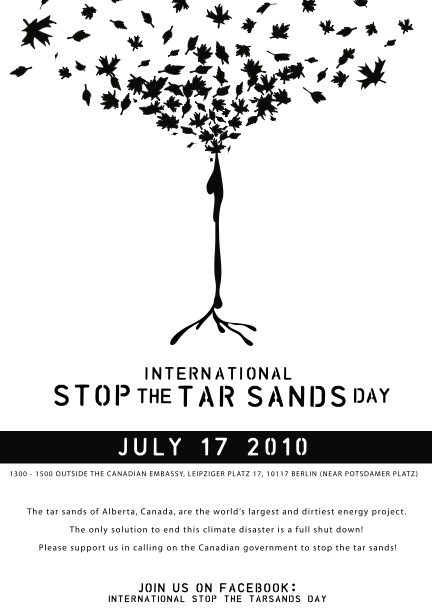
Warning of the global environmental disaster represented by Canada’s production of oil from its western tar sands, protesters will gather in front of the Canadian Embassies in Berlin, London and Copenhagen on Saturday, July 17 to mark International Stop the Tar Sands Day.

[Download poster international tar sands day A3]

The goal of International Stop the Tar Sands Day is to raise awareness in Europe that oil made from Canada’s tar sands has “two-to-three times the global warming pollution of conventional oil,” according to eminent scientist James Hansen, Director of NASA’s Goddard Institute for Space Studies. “But the process also diminishes one of the best carbon-reduction tools on the planet: Canada’s Boreal Forest.”

Similar protests are planned at Canadian embassies in London, Paris and Vienna.

“Ultimately only Canadian people can stop the expansion of the tar sands. Through our demonstrations we want to show Canadians there is international support for a moratorium,” says first-time organizer Derek Leahy, a Canadian living in Berlin.

“We believe Canadians will make the right decision,” Leahy said

“Although European companies and banks are profiting from Canada’s tar sands few Europeans have heard about the tar sands. We intend to change that ,” he said

[Full disclosure: this is copied from a press release and Derek is my son — Steve] Continue reading

‘Tourists Please Don’t Go To Home of Canada’s Dirty Oil Sands’ Ad Campaign

Beautiful Alberta, Canada??

US enviro group is putting up billboards in four U.S. cities urging Americans to exclude Alberta from their travel plans, saying it is “one of the world’s dirtiest destinations”.

Let’s be clear here: I am not a supporter of this use of  a big “economic” club to hit govt over the head to get their attention. It will hurt many Albertans who are in the tourist biz where many likely support a moratorium on new tar sands development. Indeed most Albertans have said they want a “time out” in the tar sands. But big oil says no way and are pushing for faster approvals of new projects with “streamlined environmental reviews” of course.

In their  Re-Think Alberta Campaign enviro groups say they are trying to counter Alberta and Canadian government propaganda. Canada is lobbying the US  to prevent any cleaner-fuel regulations because the tar sands has the world’s highest CO2 levels and is the most destructive form of oil production. Yes worse, than off shore drilling – see here for more

And they are also down here lobbying for infrastructure, new pipelines, refineries, which would keep us addicted to high-carbon oil for another 50 years.” Corporate Ethics International Executive Director Michael Marx told Reuters.

1.3 million barrels of dirty oil is shipped  from tar sands region  to the US every day

Corporate Ethics also has a powerful video about the ongoing environmental mess that can easily be seen from space it is so big.

See also International Stop the Tar Sands Day commencing July 17 (more on this later).

You can learn more on enviro impacts of the tar sands in my short ebook:

Oil Stains in the Boreal Forest: The Environmental Cost of Canada’s Oil Sands

And from my recent articles:

Canada’s “Mordor” Ensures Climate Treaty Failure in Copenhagen

Tar Sands, Riot Police & Hope in Copenhagen

— Green wishes, Steve

Biggest Conservation Agreement Ever — 2X the Size of Germany

By Stephen Leahy

UXBRIDGE, Canada, May 18, 2010 (IPS)

The decades-long war in Canada’s northwoods appears to be over. Environmental groups and Canadian logging companies linked arms Tuesday morning and agreed to work together to sustainably manage and protect 720,000 square kilometres of Canada’s boreal forest – an area twice the size of Germany.

“This is the biggest conservation agreement on the entire planet,” said Richard Brooks, spokesperson for participating environmental organisations and forest campaign coordinator of Greenpeace Canada.

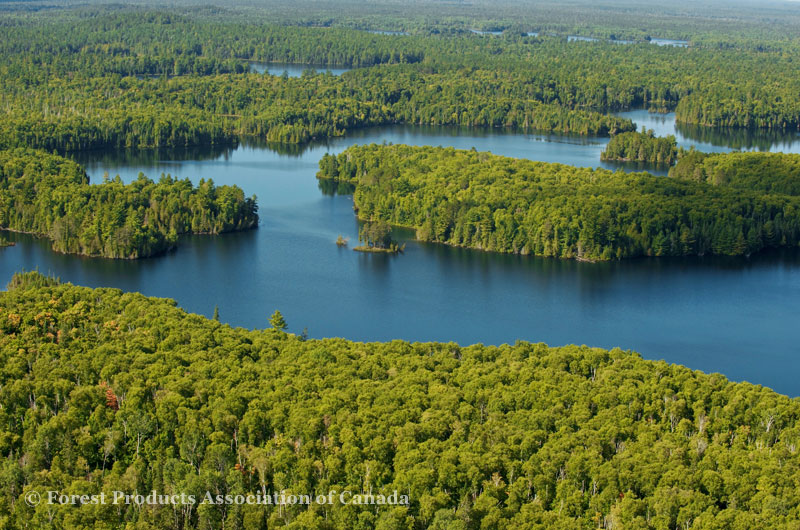
The vast northern boreal forest is a broad band that circles the top of the world below the Arctic. It is the last great forest ecosystem – larger even than the Amazon – and the largest terrestrial storehouse of carbon. Made up primarily of pine and spruce trees, Canada’s boreal covers more than five million square kilometers, representing more than a quarter of the remaining intact forest on the planet. Just eight to 10 percent is currently protected.

“This is our best and last chance to save woodland caribou, permanently protect vast areas of the boreal forest and put in place sustainable forestry practices,” Brooks said in a press conference.

“We estimate there is roughly 20 billion tonnes of carbon in the trees and soils that are part of this agreement.”

That is equivalent to the annual emissions from 18 billion cars, he estimated. Continue reading

Carbon Capture Fraud: The $1.6 billion (and counting) Taxpayer Gift to Coal and Oil Industry

Could carbon capture and sequestration save the world?

Canadian taxpayers are putting $1.6 billion into the experiment

Desperate Times, Desperate Measures

by Stephen Leahy

Published in Nov/Dec’09 issue of Watershed Sentinel

Like a reckless gambler, the federal government’s plan to deal with our emissions of climate-altering carbon dioxide is to put most of our money on an unproven, risky and expensive long shot called “carbon capture and sequestration,” CCS for short. In a pair of October announcements, the Alberta and federal governments committed $1.6 billion to use this untested technology to reduce carbon emissions from an Alberta coal plant and a Shell Oil tar sands upgrader. Billions more are promised.

Canada puts 600 million tonnes of carbon dioxide into the atmosphere every year. That has to stop. This generation, you and me, must determine what methods and technologies offer permanent CO2 reduction at the scale we need, and do so quickly, safely and at the lowest cost. And we must act on that knowledge as if the future of children’s lives depend it because we are shaping the world they will inherit.

We cannot rely on political and business leaders to make these decisions on their own, as will become evident.

What other ways could we reduce our CO2 emissions with $1.6 billion of public money – $200 per Canadian family of four?

Replace 3.2 million older inefficient refrigerators with high-efficiency ones, thus reducing carbon emissions by 2-3 million tonnes annually. Continue reading

Fish Companies Push Hard to Halt Tuna Collapse

By Stephen Leahy*

VICTORIA, Seychelles, Feb 8, 2010 (IPS)

In the Seychelles’ only cannery, the din of thousands of empty tuna cans rattling on narrow metal troughs is incredible as they bustle along, soon to be filled with Skipjack tuna that only days ago were swimming freely in the inky blue Indian Ocean.

At one end of the Indian Ocean Tuna Limited processing plant – the world’s second largest – cranes offload nets full of frozen tuna from huge international fishing boats called purse seiners while at the other end of the plant, 5,000 cans of tuna roll off the line every minute.

That’s a lot of tuna – roughly 400 metric tonnes a day. Can the Indian Ocean tuna bounty, which amounts to more than 20 percent of the world’s tuna, be sustained?

That was the key question at the first-ever Seychelles Tuna Conference that ended last weekend. It brought together nearly 200 scientists, fishers, environmentalists and policy makers here in Victoria, Africa’s smallest capital city, located 1,800 km east of Somalia and practically in the middle of the Indian Ocean.

“The boats are much more efficient today and the tuna stocks are declining and there is much less tuna than before, ” said Alain Fonteneau, a scientist with the L’Institut de recherche pour le développement, in Montpellier, France, who opened the conference. Continue reading

U.N. Climate Chief Quits Post — Says Business Must Lead the Way on Climate

By Stephen Leahy*

UXBRIDGE, Canada, Feb 18, 2010 (Tierramérica)

Countries have largely failed to endorse the Copenhagen Climate accord by the Jan. 31 deadline. On Thursday, the key official in the United Nations climate treaty process announced his resignation.

There is no effective global climate treaty and the well-respected Yvo de Boer, executive secretary of the United Nations Framework Convention on Climate Change, who worked tirelessly for four years to facilitate an agreement, has had enough.

“Copenhagen did not provide us with a clear agreement in legal terms, but the political commitment and sense of direction toward a low-emissions world are overwhelming,” de Boer said in a statement.

“I have always maintained that while governments provide the necessary policy framework, the real solutions must come from business,” he said.

De Boer will be joining the consultancy group KPMG as Global Adviser on Climate and Sustainability, as well as working with a number of universities.

The much-hyped “seal-the-deal” Copenhagen climate talks ended last December with the U.S., India, South Africa, China and Brazil hatching a backroom agreement called the Copenhagen Accord.

The three-page document was not legally binding and had no long-term global targets for emissions cuts. Countries were asked to support the accord by signing on by Jan 31. Less than 60 out of the 190 plus countries signed by the deadline.

via POLITICS: U.N. Climate Chief Quits Post

Copenhagen: Rich Nations Betraying Poor In Climate Talks (surprised?)

By Stephen Leahy

COPENHAGEN, Dec 7 (IPS/TerraViva)

Betrayal and backsliding by rich countries marks the beginning of the final negotiations for a global climate treaty, according to many developing world participants at the U.N.-sponsored talks here.

“Developed countries express deep concern and commitment to action in their public statements, but it is completely different in the negotiating rooms,” said Algerian negotiator Kamel Djemouai, chair of the Africa group, which represents more than 50 African countries.

“What you hear in public is not what is being done,” Djemouai told delegates at a side meeting at the COP 15 climate meetings here.

At the last round of climate talks in Barcelona, African countries boycotted the meetings, saying that industrialised countries had set carbon-cutting targets too low to substantially reduce global greenhouse gas emissions. Climate change is already having significant impact on Africa and those impacts are a form of discrimination, Djemouai said.

“Science tells us that when the global average temperature is one degree C. higher, it will be two degrees C. hotter in Africa,” he added. Continue reading

The simple truth: “The whole thing unravels without protecting at least half of the planet”

Job #1. end government subsidies that drive economic activity that damages the environment

By Stephen Leahy

MÉRIDA, Mexico, Nov 17 IPS

At least half the planet must be protected if humanity is to survive the next century, declared conservationists at the conclusion of 9th World Wilderness Congress on Friday, Nov. 13.

“That is what the science said, this is what many aboriginal people say,” said Harvey Locke, the Wild Foundation's vice president of conservation strategy.

“It’s time to speak the simple truth: The whole thing unravels without protecting at least half of the planet,” said Locke.

A leading economic report released in Brussels also on Nov. 13 pegged the cost of the ongoing loss and degradation of nature’s “infrastructure” at a staggering 2.5 trillion to 4.5 trillion dollars a year.

The enormous challenges humanity faces this century – like a warming planet, freshwater shortages, pollution, declining fisheries, desertification and unsustainable food production – cannot be solved without protecting more than 50 percent of Earth’s land and oceans, Locke told IPS.

Protection doesn’t necessarily mean more national parks, but a ban on resource extraction and all forms of development.

Is this article of interest? It exists thanks to contributions from readers. Please click here to learn more about Community Supported Journalism.

“We all know we aren’t sustainably managing the Earth,” he told participants at the WILD9 congress, a partnership between the WILD Foundation, an international, non-governmental non-profit based in the United States, and Unidos para la Conservación, a conservation organisation in Mexico.

“It is time for us to state clearly the scale of conservation intervention needed to make the 21st century one of hope instead of despair,” he said. Continue reading

Study: ‘Biotech Crops Bring Big Jump in Pesticide Use But Not Yields’ — hmm what would Monsanto say?

Report Failure to Yield: Evaluating the Performance of Genetically Engineered Crops reveals North America’s use of genetically engineered crops has promoted increased use of pesticides, an epidemic of herbicide-resistant weeds and more chemical residues in foods. Despite the biotechnology’s loud and well advertised claims they are the only hope for feeding the world and protect the environment.

Despite 20 years of research and 13 years of commercialization, genetic engineering has failed to significantly increase U.S. crop yields.

[Originally released April 2009 I did not get a chance to write about it then.]

It reviewed two dozen academic studies and is the first report to closely evaluate the overall effect genetic engineering has had on crop yields in relation to other agricultural technologies.

The report was released by nonprofits The Organic Center (TOC), the Union for Concerned Scientists (UCS) and the Center for Food Safety (CFS

My related articles:

Monsanto, Dow Stacking the Deck, Critics Say

The most complex genetically engineered corn (maize) yet has been approved for use next year in Canada and the United States without its potential health and environmental risks being investigated,

Organic farming more profitable and better than conventional systems – U of Wisconsin

Study concludes: governmental policy that supports mono-culture systems is outdated and support should be shifted to programs that promote crop rotations and organic farming practices.

Organic Agriculture Reduces Climate Change, Poverty and Hunger

Organic Provides 3X More Food Per Acre in Poor Countries – podcast

Overweight? Hungry? Blame “Hollow Food”

Organic Cure for Brain-damaging Pesticides Found in US Children

Male Infertility Linked to Pesticides

GM Crops Creating Pest Problems Around World

Global Day of Action Against Monsanto

maize - mexicoCanadians are calling and writing the Minister of Health to ask that she immediately halt the introduction of Monsanto’s new eight-trait GM (genetically modified) corn called “SmartStax” because it was not assessed for safety by Health Canada.

“SmartStax” corn was authorized this summer by the Canadian Food Inspection Agency for planting next year but was not examined by Health Canada for human health safety.

This is part of a global action opposing Monsanto’s genetically modified (GM) crops under the first “International Day of Action Against Multinational Corporations” initiated by the global farmers’ movement called La Via Campesina.

“Its extremely significant that La Via Campesina is focusing their World Food Day action on Monsanto and GM crops. It shows us that farmers around the world see GM crops as a major threat to their survival,” said Devlin Kuyek, a Montreal-based researcher for the international group GRAIN.

[Here’s my full story on SmartStax corn variety that could be planted next spring in US/Canada]

Monsanto, Dow Stacking the Deck, Critics Say
By Stephen Leahy

BERLIN, Jul 29 (IPS) – The most complex genetically engineered corn (maize) yet has been approved for use next year in Canada and the United States without its potential health and environmental risks being investigated, anti-biotech activists charged Wednesday. Continue reading