Why Our Weather is Weird ‘n Wild and Why It Is Getting Worse

Repost from 2011: More and more science reveals the not surprising connection between a warming planet and extreme weather. Won’t stop unless emissions of fossil fuels stop — Stephen 

(Bonus: How we can kick the fossil fuel addiction)

By Stephen Leahy

UXBRIDGE, Canada, Feb 16, 2011 (IPS)

Human-induced heating of the planet has already made rainfall more intense, leading to more severe floods, researchers announced Wednesday.

Two new studies document significant impacts with just a fraction of the heating yet to come from the burning of fossil fuels. Fortunately, another new report shows the world can end its addiction to climate-wrecking fossil-fuel energy by 2050.

“Warmer air contains more moisture and leads to more extreme precipitation,” said Francis Zwiers of the University of Victoria.

Extreme precipitation and flooding over the entire northern hemisphere increased by seven percent between 1951 and 1999 as a result of anthropogenic global warming. That represents a “substantial change”, Zwiers told IPS, and more than twice the increase projected by climate modeling.

Zwiers and Xuebin Zhang of Environment Canada used observations from over 6,000 weather stations to measure the impact of climate warming on the intensity of extreme precipitation for the first time. The study was published Wednesday in the journal Nature.

This independent environmental journalism depends on public support. Click here learn more.

The planet is currently 0.8 degrees C hotter from the burning of fossil fuels. However, global temperatures had not yet started to increase in 1951, the first year of rainfall data Zwiers and Xuebin examined. By 1999, global temperatures had climbed by about 0.6 degrees C. The average temperature increase over that 50-year period is relatively small compared to the present but major impacts have been documented in terms of storm and flood damage even with this small increase in temperatures.

This suggests that the Earth’s climatic system may be more sensitive to small temperature increases than previously believed.

Continue reading

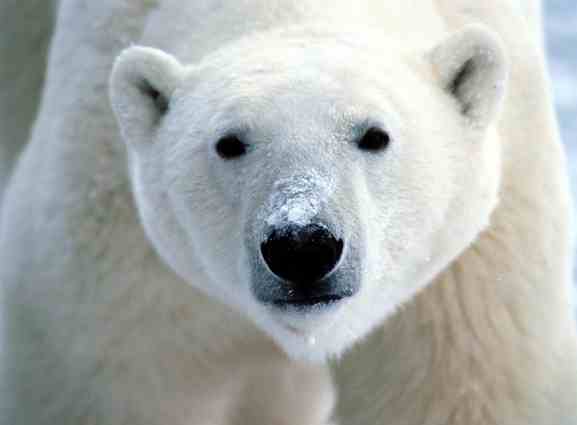
At international wildlife meeting today Canada is fighting to continue to trophy hunt endangered polar bears: Russia says NYET! Here’s what’s going in the Arctic – Stephen

Stephen's avatarStephen Leahy, International Environmental Journalist

polar-bear-snout-wwwfirstpeopleus-smlIce-free summer in the Arctic is just a matter of time – mostly likely within the next 5 years. Here’s a “six-pack” of my recent articles on how global warming is transforming the Arctic:

The Arctic — The Earth’s Freezer — Is Defrosting With Dire Results

The rapidly warming Arctic region is destabilising Earth’s climate in ways science is just beginning to comprehend.

Arctic Leaking Methane a Super-Potent Global Warming Gas — Reaching Feared Tipping Point?“The way we’re going right now, I’m not optimistic that we will avoid some kind of tipping point.ceberg-in-glacier-strait-nunavut-canada-image-credit-sandy-briggs

Arctic Ice Gone in 5 Years – First Time in One Million Years– “We’re going to see huge changes in the Arctic ecosystem”

Things Happen Much Faster in the Arctic — “Things are happening much faster in the Arctic. I think it will be summer ice-free by 2015,” said David Barber, an…

View original post 174 more words

Killer Heat Waves and Floods Linked to Climate Change

More than 5 million affected by flooding in Pakistan Sept 2011 - a repeat of 2010.
More than 5 million affected by flooding in Pakistan Sept 2011 – a repeat of 2010.

“The first law of humanity is not to kill your children.”

By Stephen Leahy

UXBRIDGE, Canada, Feb 27 2013 (IPS)

Killer heat waves, floods and storms are increasingly caused by climate change, new research reveals.

Scientists in Germany say they have found how greenhouse gases from burning fossil fuels are helping to trap the jet stream, resulting in extraordinary weather such as the 2010 Pakistan flood and the 2011 heat wave in the United States.

Human-driven climate change repeatedly disturbs the flow of atmospheric waves around the globe’s Northern hemisphere, said lead author Vladimir Petoukhov of the Potsdam Institute for Climate Impact Research (PIK) in Germany.rossby.waves1_

Giant atmospheric waves called Rossby waves are meanders in the strong, high-altitude winds known as jet streams and have a major influence on weather. These wave movements are caused by the difference in temperatures between the cold air from the Arctic and hot air from the tropics.

When the waves shift north, they suck warm air from the tropics to Europe, Russia, or the U.S., and when they swing down, they do the same thing with cold air from the Arctic, said Petoukhov.

“During several recent extreme weather events, these planetary waves almost freeze in their tracks for weeks,” he said. “So instead of bringing in cool air after having brought warm air in before, the heat just stays.”

This unnatural pattern is due to human heating of the climate through emissions of greenhouse gases that result from burning fossil fuels, according to the study published this week in Proceedings of the National Academy of Sciences.

However, this heating of the atmosphere is wildly uneven. The Arctic is warming two to three times faster than the global temperature rise of 0.8C and that affects the Rossby waves and is slowing the jet stream.

“(Our research) complements previous research that already linked such phenomena to climate change,” said Hans Joachim Schellnhuber, a co-author of the study. Continue reading

80 percent of Arctic Ice Lost Compared to 30 Years Ago

arctic-sea-ice-min-volume-comparison-1979-2012-small

[This is my first exclusive blog post – virtually everything else on this site are my published articles. Not sure if I’ll have time to do more. Let me know what you think – Stephen ]

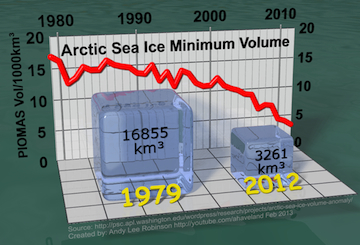
A new study released Feb 13 revealed that the volume of Arctic sea ice is declining rapidly. Ice volume in September 2012 had fallen 80 percent compared with the volume of ice in September 1980 according to the latest data from European Space Agency satellite, CryoSat-2. As the Arctic heats up Most of the ice loss has been in recent years. Between 2003 and 2012 the volume declined a whopping 36 percent. Summers with a sea ice-free Arctic are only a few years away, scientists now agree. This will have significant and permanent impacts on weather patterns in the Northern Hemisphere.

My previous article  Ice-Free Arctic Is “Uncharted Territory” documented last September’s one year record area decline of 18 percent. Here’s what this means:

The impacts are already being felt across the entire northern hemisphere. The loss of sea ice in recent years has been affecting weather patterns, recent research has shown. The all-important jet stream – the west-to-east winds that are the boundary between the cold Arctic and the warm mid-latitudes – is slowing down, moving north and become more erratic.

When continent-sized areas of the Arctic Ocean flip from the all-white ice to dark blue, tremendous amounts of heat are absorbed from the 24-hour summer sun. When the bitter cold Arctic winter sets in over the next few weeks, all the heat in the ocean must be released into the atmosphere before ice can form again.

The Arctic will be ice-covered in winter for decades to come but what’s fundamentally changed is that every fall, unprecedented amounts of heat and water vapour will be released into the atmosphere.

“The polar meltdown shows we’re teetering on the brink of climate change catastrophe,” said Shaye Wolf, climate science director at the Center for Biological Diversity’s Climate Law Institute.

As the sea ice declines, Arctic temperatures increase, thawing more and more permafrost, which will release more climate-heating carbon and methane. Permafrost is frozen soil, sediment and rock spanning 13 million square kilometres of the land in Alaska, Canada, Siberia and parts of Europe. It has twice the carbon that the atmosphere currently holds.

A Swedish study released Feb 17 has found a link between sea ice declines and increases in methane emissions. Methane has 40x the warming of carbon. This is may lead to an even faster meltdown of the Arctic risking the release of huge amounts of permafrost carbon and methane.

Climate Inaction Is a Clear Failure of Democracy

Jersey shore Superstorm Sandy flood

Re-engineering our societies to prosper on green alternatives is only option

By Stephen Leahy

UXBRIDGE, Canada, Jan 4 2013 (IPS)

Around the world, 2012 was the year of extreme weather, when we unequivocally learned that the fossil fuel energy that powers our societies is destroying them. Accepting this reality is the biggest challenge of the brand new year.

Re-engineering our societies and lifestyles to prosper on green alternatives is the penultimate challenge of this decade.There is no more important task for all of us to engage in because climate change affects everything from food to water availability.

A number of scientific analyses have demonstrated we already have the technology to re-engineer our society to thrive on green alternative energy. The newest of these was published Wednesday in the prestigious journal Nature. It plainly states that politics is the real barrier, not technology nor cost. (It is far cheaper to act than not.)

Keeping global warming to less than two degrees C is mainly dependent on “when countries will begin to take serious action to reduce greenhouse gas emissions”, according to the study “Probabilistic cost estimates for climate change mitigation”.

Climate change has already pushed global temperatures up 0.8 degrees C, with significant consequences. No climate scientist thinks two degrees C will be “safe”. Many countries, especially least-developed countries and small island states, want the global target to be less than 1.5C of heating. Even then large portions of the Arctic and Antarctic will continue to melt raising sea levels, albeit at a slower rate.

Delay in making the shift to non-fossil fuel energy sources will be very costly. Waiting until 2020 to curb global emissions will cost twice as much compared with peaking emissions by 2015, the Nature analysis shows.

Serious action to reduce greenhouse gas emissions means 65 percent of current coal power plants will have to be shut down in the next decade or two, a previous Nature study reported by IPS shows.

Continue reading

Worlds’ Scientists Say Facing “Planetary Emergency”

Planet Under Pressure – State of the Planet Declaration Mar 29 2012.

By Stephen Leahy

UXBRIDGE, Canada, (IPS)

[Based on my article Climate Summit: A Moment That Must Be Seized ]

Governments, the media and the public aren’t paying attention to the “planetary emergency” unfolding around them. The situation is like firefighters yelling “fire” in crowded room and still no listens.

“The situation is absolutely desperate and yet there’s nothing on the front pages or on the agenda of world leaders,” said Pat Mooney, executive director of the ETC Group, an international environmental organisation based in Ottawa.

“The lack of attention is a tragedy,” said Mooney, who has 40 years experience in international environment and development issues.

Humanity is failing in its stewardship of the planet. An incredible 85 percent of the world’s oceans are in trouble, said Susan Lieberman, director of international policy at the Pew Environment Group, a U.S. organisation.

“Planetary emergency” is how many in the world’s scientific community describe “the mess we are in“. They will detail their comprehensive state of the planet assessment at the “Planet Under Pressure” conference in London Mar. 26-29.

That assessment will summarise the overwhelming evidence that “the continued functioning of the Earth system as we know it is at risk,” conference organisers previously told IPS.

Climate change, which is overheating the planet and making the oceans more acidic, is just one of the major challenges. Another is the ongoing decline of biodiversity, where so many plants and animals are going extinct that the Earth’s living systems on which humanity depends are unraveling.

Fresh water is another “planetary boundary” humanity is pushing up against. Water use has increased six-fold in the past century and in many places the quality of water resources has been degraded. Other challenges include increasing poverty, food and energy security, and the current financial and economic instability.

A first and essential step in a green transition is for nations to commit to phasing out harmful and unsustainable subsidies for fossil fuels, fisheries and industrial agriculture.

According to Mooney, some countries and large corporations see the green economy in terms of a post-petroleum future where resources and energy for industrial production comes from biomass and other living things. Most of those “living resources” are in the global South and local people rightly fear a massive land grab, he said.

Foreign investors have already gained access to more than 35 million hectares in Africa, Asia and South America for food and biofuel production according to GRAIN, a small NGO working with small farmers and farming communities.


Plankton Death To Come with Acid Oceans and Sunlight

A number of marine diatom cells (Pleurosigma), which are an important group of phytoplankton in the oceans.
Credit: Michael Stringer

Global Warming has made oceans 30% more acidic already

“It’s clear we are conducting a giant experiment on the planet and we don’t know what we are doing.”

[This is a repost from my May 8 2012 article – see here for more on acid ocean impacts — Stephen]

 By Stephen Leahy

UXBRIDGE, Canada, May 8, 2012 (IPS)

Without major reductions in the use of fossil fuels, sunlight will kill an unknown number of ocean phytoplankton, the planet’s most important organism, a new study reports this week.

Not only are phytoplankton, also known as marine algae, a vital component in the ocean’s food chain, they generate at least half of the oxygen we breathe.

In the not so distant future, sunlight, the very source of life for phytoplankton, will likely begin to kill them because of the ocean’s increasing acidity, researchers from China and Germany have learned.

“There’s a synergistic effect between increased ocean acidity and natural light,” says Ulf Riebesell of the Helmholtz Centre for Ocean Research in Kiel, Germany.

Riebesell added that it was also possible “phytoplankton could adapt”.

Researchers were surprised to discover that diatoms, one of the most important and abundant types of phytoplankton, fared very badly during shipboard experiments conducted by co-author Kunshan Gao, from the State Key Laboratory of Marine Environmental Science at Xiamen University, Xiamen China.

Previous experiments in labs like Riebesell’s found that diatoms actually did better in high-acid seawater, unlike most other shell- forming plankton. Burning fossil fuels has made the oceans about 30 percent more acidic researchers discovered less than 10 years ago. Oceans absorb one third of the carbon dioxide (CO2) emitted from using fossil fuels.

The good news is this has slowed the rate of global warming. The bad news is oceans are now more acidic and it will get worse as more CO2 is emitted. This is basic, well-understood ocean chemistry.  Continue reading

Drought and New Deserts by 2060: Most of Mexico, Central America and half of US

Projected drought and dry regions in 2060-2069

By Stephen Leahy

UXBRIDGE, Canada, May 22, 2012 (Tierramérica)

Mexico and Central America look like they are covered in dried blood on maps projecting future soil moisture conditions.

The results from 19 different state-of-the-art climate models project extreme and persistent drought conditions (colored dark red-brown on the maps) for almost all of Mexico, the midwestern United States and most of Central America.

If climate change pushes the global average temperature to 2.5 degrees Celsius above pre-industrial era levels, as many experts now expect, these regions will be under severe and permanent drought conditions.

Future conditions are projected to be worse than Mexico’s current drought or the U.S. Dust Bowl era of the 1930s that forced hundreds of thousands of people to migrate.

These are some of the conclusions of the study “Projections of Future Drought in the Continental United States and Mexico”, which was published in the December 2011 issue of the American Meteorological Society’s Journal of Hydrometeorology and has gone largely unnoticed.

“Drought conditions will prevail no matter what precipitation rates are in the future,” said co-author Michael Wehner, a climate scientist at the Lawrence Berkeley National Laboratory, a U.S. government research centre in California.

“Even in regions where rainfall increases, the soils will get drier. This is a very robust finding,” Wehner told Tierramérica.

Without major reductions in carbon emissions from the burning of fossil fuels, global temperatures will increase to at least 2.5 degrees of warming between 2050 and 2090, depending on rates of emissions of greenhouse gases, climate sensitivity and feedbacks. Continue reading

Sandy Says: Not “Targeting” New York or Anywhere Else

To be absolutely clear: I am not “targeting” New York City or anywhere else. I am pushed and pulled by temperature and pressure differences. My winds are powered by warm water and moisture. And there is enough heat and moisture for my winds to make 12-foot high waves over a 3 million sq km area – one third the size of the US.

Read full post at Hurricane Sandy Speaks (crosspost)

Hurricane Sandy Speaks: “People call me Frankenstorm, SuperStorm, WeatherBomb…”

Hi, this is Sandy. People are calling me ‘Frankenstorm’, ‘Superstorm’ and even ‘Weatherbomb’.

I don’t mean to hurt anyone but the record moisture in the atmosphere and heat in the ocean has given me uncontrollable power. I probably will cause billions of dollars of damage in Washington, New York City Boston and other parts of the Northeast. And I will kill some people, I already have. At least 66 people died when I swept through Jamaica and Cuba a few days ago.

I am a force of nature but you have to understand this is not all my fault.

Read full post at Hurricane Sandy Speaks (crosspost)