The Most Important Number in Human History

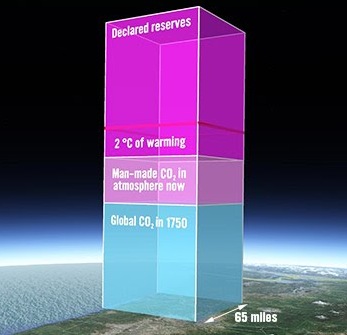
Carbon overload Carbon in atmosphere and amount in fossil fuel reserves

That number was 52 billion tonnes of CO2 in 2012

Only when this number declines will we know we’re making the shift to climate protection

By Stephen Leahy

UXBRIDGE, Canada, Dec 17 2012 (IPS) 

The most important number in history is now the annual measure of carbon emissions. That number reveals humanity’s steady billion-tonne by billion-tonne march to the edge of the carbon cliff, beyond which scientists warn lies a fateful fall to catastrophic climate change.

With the global total of climate-disrupting emissions likely to come in at around 52 gigatonnes (billion metric tonnes) this year, we’re already at the edge, according to new research.

To have a good chance of staying below two degrees C of warming, global emissions should be between 41 and 47 gigatonnes (Gt) by 2020, said Joeri Rogelj, a climate scientist at Switzerland’s Institute for Atmospheric and Climate Science in Zurich.

Only when we see the annual global emissions total decline will we know we’re making the shift to climate protection,” Rogelj told IPS.

Making the shift to a future climate with less than two degrees C of warming is doable and not that expensive if total emissions peak in the next few years and fall into the 41-47 Gt “sweet spot” by 2020, Rogelj and colleagues show in their detailed analysis published Sunday in the journal Nature Climate Change.

The study is the first to comprehensively quantify the costs and risks of emissions surpassing critical thresholds by 2020. Continue reading

Green Energy Solves Dual Crises of Poverty and Climate

native-windmill-art1Dirty fossil fuel energy leads to 350,000 premature deaths in Europe

By Stephen Leahy

UXBRIDGE, Canada, Feb 25 2013 (IPS)

Green energy is the only way to bring billions of people out of energy poverty and prevent a climate disaster, a new study reveals.

Conservative institutions like the World Bank, the International Energy Agency and accounting giant Price Waterhouse Coopers (PwC) all warn humanity is on a path to climate catastrophe unless fossil fuel energy is replaced by green energy.

The U.N.’s Sustainable Energy for All initiative intends to bring universal access to modern energy, doubling the share of renewable energy globally, and doubling the rate of improvement in energy efficiency by 2030.

If those targets are met and similar efforts undertaken to reduce deforestation, then climate disaster can be avoided, said Joeri Rogelj of the Institute for Atmospheric and Climate Science in Zurich  who headed the analysis published Sunday in the journal Nature Climate Change.

“Poverty eradication, sustainable development and the transition away from fossil fuel energy go hand in hand,” Rogelj told IPS. Continue reading

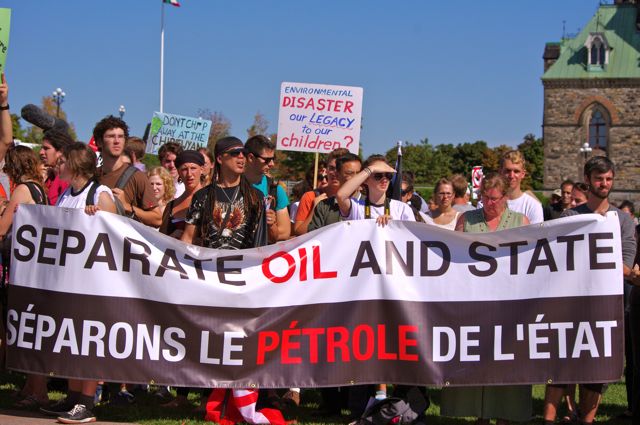
Jail Before Climate-Wrecking Tar Sands, Canadians Say

Tar sands protest Sept 2011, Ottawa Pic by R Leahy

[Repost: After the rally against Keystone XL in Washington last Sunday, a reminder that Canadians are willing to be arrested to stop growth of climate-destroying tar sands. — Stephen ]

By Stephen Leahy

OTTAWA, Sep 27, 2011 (IPS)

More than 200 Canadians engaged in civil disobedience, with 117 arrested in Canada’s quiet capital city on Monday. The reason? To protest the Stephen Harper right-wing government’s open support for the oil industry and expanding production in the climate-disrupting tar sands.

The normally placid and polite Canadians shouted, waved banners and demanded the closure of the multi-billion-dollar tar sands oil extraction projects in northern Alberta to protect the global climate and the health of local people and environment.

“People are here because they know that if we don’t turn away from the tar sands and fossil fuels soon it will be too late,” Peter McHugh, a spokesperson for Greenpeace Canada, told IPS.

“The tar sands are unsustainable. Canadians are willing to shift away from fossil fuels but our government isn’t,” Gabby Ackett a university student and protester, told IPS as she stood in front of a long line of police.

In what was proudly touted as “civil” civil disobedience, protesters aged 19 to 84 were arrested for using a step-stool to climb a low barrier separating them from the House of Commons, the seat of Canadian government. The police were friendly and accommodating because the organisers had promised there would be no violence.

“We live downstream and see the affects of tar sands pollution on the fish and the birds,” said George Poitras, a former chief of the Mikisew Cree First Nation in northern Alberta.

“Some our young people have rare forms of cancer,” Poitras told more than 500 protesters.

“Expanding the tar sands is not the way to go in a world struggling with climate change,” he said. Continue reading

Climate Inaction Is a Clear Failure of Democracy

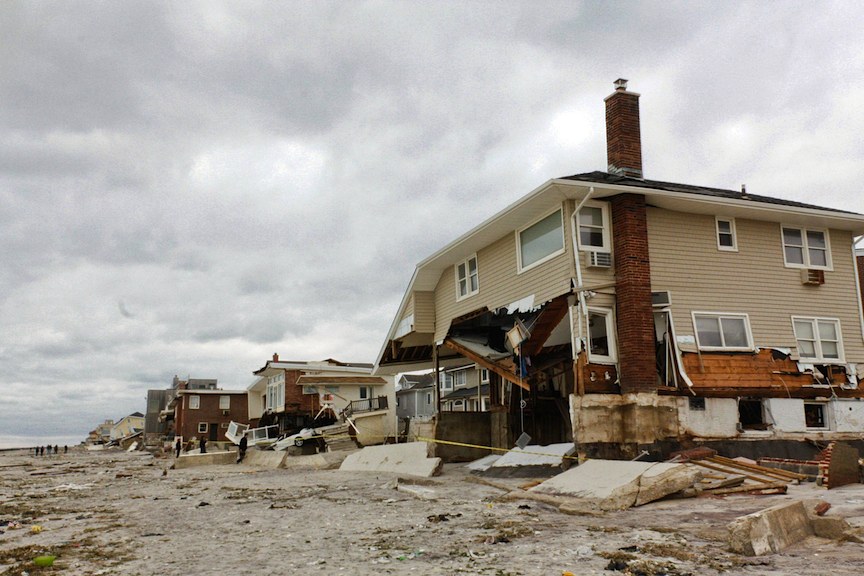
Jersey shore Superstorm Sandy flood

Re-engineering our societies to prosper on green alternatives is only option

By Stephen Leahy

UXBRIDGE, Canada, Jan 4 2013 (IPS)

Around the world, 2012 was the year of extreme weather, when we unequivocally learned that the fossil fuel energy that powers our societies is destroying them. Accepting this reality is the biggest challenge of the brand new year.

Re-engineering our societies and lifestyles to prosper on green alternatives is the penultimate challenge of this decade.There is no more important task for all of us to engage in because climate change affects everything from food to water availability.

A number of scientific analyses have demonstrated we already have the technology to re-engineer our society to thrive on green alternative energy. The newest of these was published Wednesday in the prestigious journal Nature. It plainly states that politics is the real barrier, not technology nor cost. (It is far cheaper to act than not.)

Keeping global warming to less than two degrees C is mainly dependent on “when countries will begin to take serious action to reduce greenhouse gas emissions”, according to the study “Probabilistic cost estimates for climate change mitigation”.

Climate change has already pushed global temperatures up 0.8 degrees C, with significant consequences. No climate scientist thinks two degrees C will be “safe”. Many countries, especially least-developed countries and small island states, want the global target to be less than 1.5C of heating. Even then large portions of the Arctic and Antarctic will continue to melt raising sea levels, albeit at a slower rate.

Delay in making the shift to non-fossil fuel energy sources will be very costly. Waiting until 2020 to curb global emissions will cost twice as much compared with peaking emissions by 2015, the Nature analysis shows.

Serious action to reduce greenhouse gas emissions means 65 percent of current coal power plants will have to be shut down in the next decade or two, a previous Nature study reported by IPS shows.

Continue reading

Wild and Weird Weather Getting Worse

New York City flooding
It doesn’t have to be this way – typical family could reduce their energy use 60 to 75 percent

By Stephen Leahy

UXBRIDGE, Canada, Jan 29 2013 (IPS)

Weird is the only way to describe January temperatures whipsawing between record warm and arctic cold over a span of a few days. Experts say that is what climate change looks like: weird, record-shattering weather.

Here’s a fact that goes beyond weird to astonishing. Anyone who is 27 years old or younger has never lived through a month that was colder than the global 20th century average. In other words, we’ve had 334 consecutive months with above average temperatures, according to the U.S. National Oceanic and Atmospheric Administration.

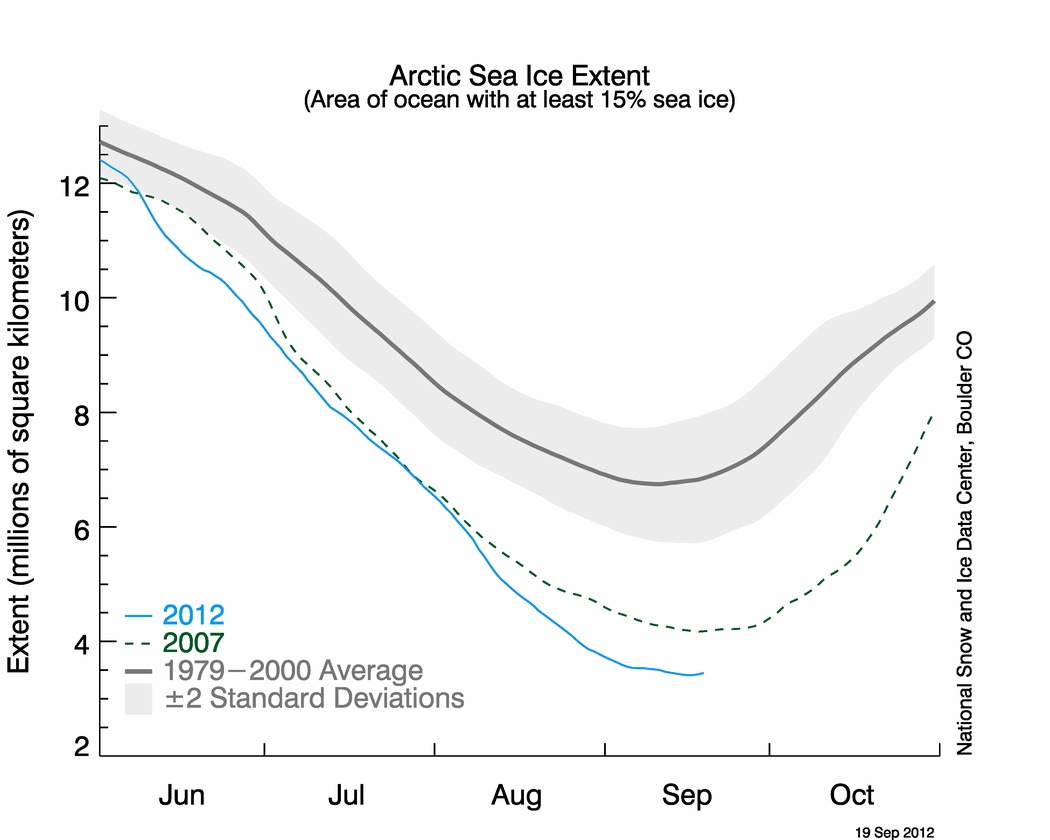
Arctic sea ice extent. Area of ocean with at least 15 percent sea ice as of Sept 12, 2012. Credit: National Snow and Ice Data Center.

Last summer, the Arctic sea ice shrunk to half of what it used to be during summers only three decades ago. Our planet’s weather is driven largely by the two cold polar regions and the warm tropics. With the Arctic defrosting, it should be no surprise our weather is getting weird. And that it’s not going to get better.

Our planet is heating up because we each year put thousands of millions of tonnes of carbon dioxide (CO2) into the atmosphere by burning coal, oil, and natural gas. CO2 acts as heating blanket keeping the planet warm by trapping some of the sun’s heat.

The amount of extra heat-energy being trapped is like exploding 400,000 Hiroshima atomic bombs per day 365 days per year, calculates James Hansen, a climate scientist who heads the NASA Goddard Institute for Space Studies.

Cautious scientists like Hansen are terrified of what’s coming. Conservative institutions like the World Bank and accounting giant Price Waterhouse Coopers (PwC) have warned we’re on a path to heating the entire surface of the planet by an average of four or five degrees C before 2100. That translates into eight to 12 degrees C hotter in places like Canada.

Continue reading

Majority of Oil, Gas and Coal Reserves Too Dangerous To Use – International Energy Agency (IEA)

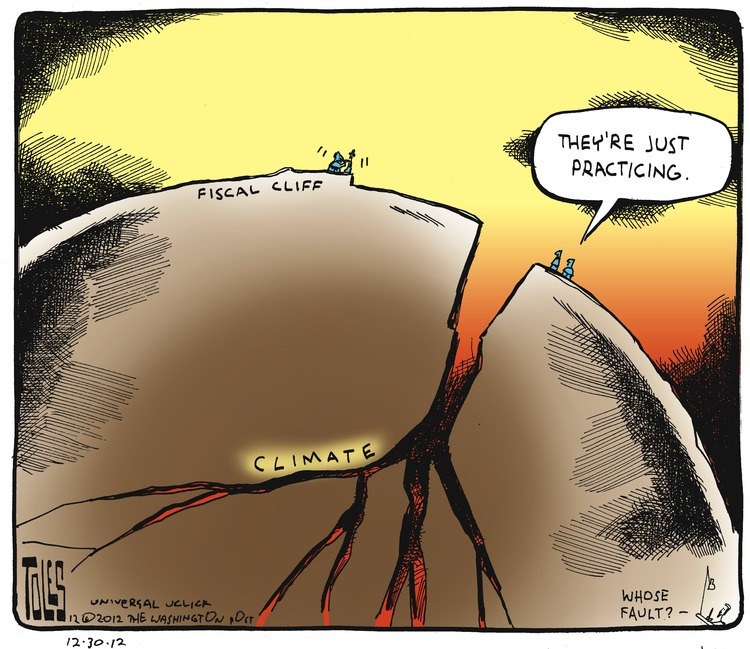
ttfiscal carbon cliff

Industry spent more than $600 billion on new exploration and production in 2012 

By Stephen Leahy

UXBRIDGE, Canada, Nov 15 2012 (IPS)

Two-thirds of the world’s proven fossil fuel reserves cannot be used without risking dangerous climate change, the International Energy Agency (IEA) warned this week.

Preventing the consumption of those two-thirds will be the primary task of the annual U.N. climate negotiations that resume at the end of this month.

Late Wednesday, U.S. President Barack Obama surprised many by saying climate change will be a personal mission in his second term.

“The re-election of President Obama guarantees continuity of the U.S. pledge of reducing emissions 17 percent below its carbon emissions in 2005 by 2020,” said Christina Figueres, executive secretary of the United Nations Framework Convention on Climate Change (UNFCCC).

“The U.S. is fully aware of the need to increase its ambition in terms of mitigation (emissions reduction) and finance to help developing countries adapt,” Figueres told IPS.

The U.S. emission reduction target is equivalent to a three-percent reduction compared to 1990 levels – a baseline most countries use. Global emissions need to be 25 to 40 percent below 1990 levels in the year 2020 to keep temperatures from rising beyond two degrees C, climate scientists have said.

By contrast, the United Kingdom is already 18 percent below its 1990s level and plans to be 34 percent below in 2020.

In 2010, there was a binding agreement to limit global warming to two degrees C at the U.N. climate conference in Cancun, Mexico, said Andrew Steer, president of the World Resources Institute, a Washington-based NGO.

“We are nowhere near to getting there. The situation is urgent. Climate change is not tomorrow’s problem, it is today’s problem. Superstorm Sandy was a wake-up call to the people of the United States,” Steer said at a press conference. Continue reading

Hurricane Sandy a Taste of More Extreme Weather to Come

By Stephen Leahy

UXBRIDGE, Canada, Nov 2 2012 (IPS)

Killing nearly 200 people in the United States, Canada and the Caribbean and crippling much of New York City and surrounding areas earlier this week, Hurricane Sandy was the kind of extreme weather event scientists have long predicted will occur with global warming.

“Climate change is a reality,” said New York Governor Andrew Cuomo after Sandy swept through his state.

Sandy was twice the size of an average hurricane, and it hit the eastern coast of the United States, where sea levels have been rising the fastest, said Kevin Trenberth, senior scientist at the National Center for Atmospheric Researchin Boulder, Colorado.

“All weather events are affected by climate change because the environment in which they occur is warmer and moister than it used to be,” Trenberth, an expert on extreme events, told IPS.

Whether climate change caused Hurricane Sandy is the wrong question to ask, added Trenberth. He explained that climate change helped make Hurricane Sandy more destructive than it otherwise would have been.

“This is the new normal,” Trenberth said. “It doesn’t make sense to rebuild in some regions – they’ll just be swept away again.”

Plankton Death To Come with Acid Oceans and Sunlight

A number of marine diatom cells (Pleurosigma), which are an important group of phytoplankton in the oceans.
Credit: Michael Stringer

Global Warming has made oceans 30% more acidic already

“It’s clear we are conducting a giant experiment on the planet and we don’t know what we are doing.”

[This is a repost from my May 8 2012 article – see here for more on acid ocean impacts — Stephen]

 By Stephen Leahy

UXBRIDGE, Canada, May 8, 2012 (IPS)

Without major reductions in the use of fossil fuels, sunlight will kill an unknown number of ocean phytoplankton, the planet’s most important organism, a new study reports this week.

Not only are phytoplankton, also known as marine algae, a vital component in the ocean’s food chain, they generate at least half of the oxygen we breathe.

In the not so distant future, sunlight, the very source of life for phytoplankton, will likely begin to kill them because of the ocean’s increasing acidity, researchers from China and Germany have learned.

“There’s a synergistic effect between increased ocean acidity and natural light,” says Ulf Riebesell of the Helmholtz Centre for Ocean Research in Kiel, Germany.

Riebesell added that it was also possible “phytoplankton could adapt”.

Researchers were surprised to discover that diatoms, one of the most important and abundant types of phytoplankton, fared very badly during shipboard experiments conducted by co-author Kunshan Gao, from the State Key Laboratory of Marine Environmental Science at Xiamen University, Xiamen China.

Previous experiments in labs like Riebesell’s found that diatoms actually did better in high-acid seawater, unlike most other shell- forming plankton. Burning fossil fuels has made the oceans about 30 percent more acidic researchers discovered less than 10 years ago. Oceans absorb one third of the carbon dioxide (CO2) emitted from using fossil fuels.

The good news is this has slowed the rate of global warming. The bad news is oceans are now more acidic and it will get worse as more CO2 is emitted. This is basic, well-understood ocean chemistry.  Continue reading

Sandy Says: “Bigger Superstorms Coming Unless Dial Down Thermostat”

Alaska temps in degrees F

I was born just over a week ago and more than 100 people have died in the US and Caribbean region as a result. For the rest of today please take care as I will continue to bring strong winds, heavy rains and snowfall from North Carolina to well into Canada. Some of the worst flooding hit Haiti in the hours after I’d passed by.

Read full post at Hurricane Sandy Speaks (crosspost)

Global Temperatures Rising on a Devastating Trajectory

Global temperatures are only 0.7C warmer — on pace for +4C!

By Stephen Leahy

UXBRIDGE, Canada, May 25, 2012 (IPS)

Climate-heating carbon emissions set a record high in 2011, in a 3.2 percent increase over the previous year, the International Energy Agency reported this week. The main reason for this dangerous increase is that governments are failing to implement policies to prevent catastrophic increases of global temperatures.

A new report released on the last days of international climate talks in Bonn, Germany this week reveals that the planet is heading to a temperature rise of at least 3.5 degrees Celsius, and likely more, according to the Climate Action Tracker (CAT), despite an international agreement to keep global temperature rise below two degrees Celsius.

Not only are pledges inadequate, but countries are unable to fulfill even those pledges, a new CAT analysis shows. CAT is a joint project of Dutch energy consulting organisation Ecofys, Germany’s Climate Analytics, and the Potsdam Institute for Climate Impact Research.

“When we compared the emission reduction pledges of countries like Brazil, Mexico and the U.S., we found they did not have the policies in place to meet those pledges,” said Niklas Höhne, director of energy and climate policy at Ecofys.

Höhne told IPS that they looked only at the policies of a few countries, but no country’s policies were enough to meet their targets. Continue reading