Global Land Grabbing by Speculators, Investment banks, Pension funds

Kenya green hills CIAT Neil Palmer sml

By Stephen Leahy

UXBRIDGE, Canada, May 10, 2012 (IPS)

Land is the missing element at next month’s big U.N. sustainable development summit known as Rio+20, where nations of the world will meet Jun. 20-22 with the goal of setting a new course to ensure the survival and flourishing of humanity.

However, governments are apparently unaware that a reversal of decades of land reform is underway with speculators, investment banks, pension funds and other powerful financial interests taking control of perhaps 200 million hectares of land from poor farmers in Africa, Latin America and Asia in recent years. Speculators and investors know land is the key to three necessities of life: food, water and energy. But neither land nor community land rights are on the summit agenda.

“Rural people are losing control over land and water because of this global land grab,” said Honduran farmer leader Rafael Alegria of the international farmers’ movement La Via Campesina.

Anywhere from 80 to 227 million hectares of rural, often agrarian land have been taken over by private and corporate interests in recent years, according to an April report released by Friends of the Earth International.

Many small land holders are being displaced in Central America and up to 40 percent of Honduran small farmers live in extreme poverty, according to the U.N. Food and Agriculture Organisation, Alegria told IPS through a translator.
Continue reading

Unseen World of Water and the Water Crisis

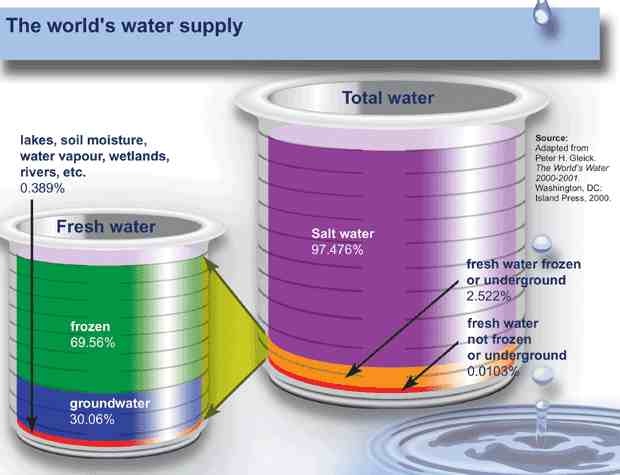
world water supply

By Stephen Leahy

UXBRIDGE, Canada, Mar 22 2013 (IPS)

How much water does it take to turn on a light? It took 10,000 litres to make your jeans. Another three big bathtubs of water was needed for your two-eggs-toast-coffee breakfast this morning.

We are surrounded by an unseen world of water: furniture, houses, cars, roads, buildings – practically everything we use and make needs water.

“There is no way to generate energy without water,” said Zafar Adeel, co-chair of the UN-Water Task Force on Water Security and director of the Institute for Water, Environment and Health in Canada.

Even solar panels need regular washing to perform well. Wind energy might be an exception, Adeel told IPS from a water conference in Beijing being held during World Water Week.

There is growing recognition that peak oil is nowhere near as important as peak water because there is no substitute for water. The growing shortage of water — 1.2 to 1.7 billion people face scarcity — has alarmed many. Water has been identified as an “urgent security issue”, by a group that last year included both former U.S. Secretary of State Hillary Clinton and the InterAction Council, an association of 37 former heads of state and government.

It’s important that “water security” be recognised by the U.N. Security Council as either as a trigger, a potential target, or a contributing factor to insecurity and potential conflict in many parts of the world, said Adeel.

Killer Heat Waves and Floods Linked to Climate Change

Projected drought and dry regions in 2060-2069

By Stephen Leahy

UXBRIDGE, Canada, Feb 27 2013 (IPS) 

Killer heat waves, floods and storms are increasingly caused by climate change, new research reveals.

Scientists in Germany say they have found how greenhouse gases from burning fossil fuels are helping to trap the jet stream, resulting in extraordinary weather such as the 2010 Pakistan flood and the 2011 heat wave in the United States.

Human-driven climate change repeatedly disturbs the flow of atmospheric waves around the globe’s Northern hemisphere, said lead author Vladimir Petoukhov of the Potsdam Institute for Climate Impact Research (PIK) in Germany.

Giant atmospheric waves called Rossby waves are meanders in the strong, high-altitude winds known as jet streams and have a major influence on weather. These wave movements are caused by the difference in temperatures between the cold air from the Arctic and hot air from the tropics. 

When the waves shift north, they suck warm air from the tropics to Europe, Russia, or the U.S., and when they swing down, they do the same thing with cold air from the Arctic, said Petoukhov.

“During several recent extreme weather events, these planetary waves almost freeze in their tracks for weeks,” he said. “So instead of bringing in cool air after having brought warm air in before, the heat just stays.”

Help Wanted: 27 Planet Earths

This story was featured on the IPS wire and on the Al Jazeera network in 2011. It shows that national parks, conservation and protected areas do not and cannot halt the decline in biodiversity that is humanity’s life support system. It is hopeless without addressing the root causes: too many of us, taking too much and having too big of an impact. On our present course we’ll need 27 planet Earths by 2050 experts conclude. — Stephen 

By Stephen Leahy

UXBRIDGE, Canada, Jul 29, 2011 (IPS)

Protecting bits of nature here and there will not prevent humanity from losing our life support system. Even if areas dedicated to conserving plants, animals, and other species that provide Earth’s life support system increased tenfold, it would not be enough without dealing with the big issues of the 21st century: population, overconsumption and inefficient resource use.

Without dealing with those big issues, humanity will need 27 planet Earths by 2050, a new study estimates.

The size and number of protected areas on land and sea has increased dramatically since the 1980s, now totaling over 100,000 in number and covering 17 million square kilometres of land and two million square kilometres of oceans, a new study reported Thursday.

This independent environmental journalism depends on public support. Click here learn more.

But impressive as those numbers look, all indicators reveal species going extinct faster than ever before, despite all the additions of new parks, reserves and other conservation measures, according to the studypublished in the journal Marine Ecology Progress Series.

“It is amazing to me that we haven’t dealt with this failure of protected areas to slow biodiversity losses,” said lead author Camilo Mora of University of Hawaii at Manoa.

“We were surprised the evidence from the past 30 years was so clear,” Mora told IPS. Continue reading

Governments Fail to Take Steps to Steer Away From Looming Crisis

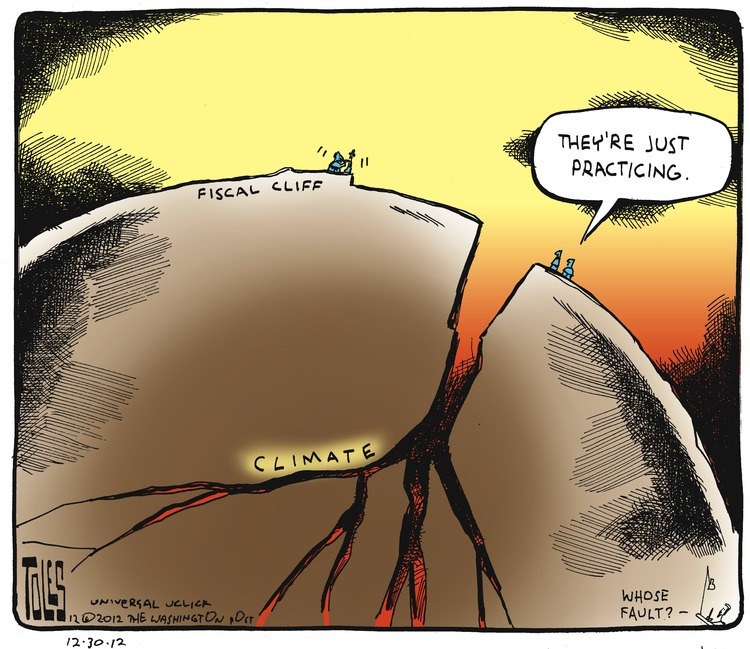
ttfiscal carbon cliff

Rio+20 should have been about life, about the future of our children”

By Stephen Leahy

RIO DE JANEIRO, Jun 19 2012 (IPS)

“Very disappointing.” That was the term business and non-governmental organisations used to describe the formal intergovernmental negotiations at the Rio+20 Earth Summit as of Tuesday.

With overwhelming scientific evidence showing that the Earth’s ability to support human life is at serious risk, the Rio+20 summit is being held to help chart a safe course that will steer away from disaster and bring a better future people around the globe.

After two years, negotiators from more than 190 nations agreed Tuesday to a 49-page draft of the document “The Future We Want”, intended to be the roadmap for this transformation. This document will be presented to heads of states in Rio de Janeiro to revise and finalise by the summit’s conclusion on Friday.

Yet the draft document leaves out a 30-billion-dollar fund proposed by a group of developing countries known as the G77 to finance the transition to a green economy. Nor does it define tangible Sustainable Development Goals (SDGs), which will be substituted for the Millennium Development Goals, which expire in 2015.

“This (the revised text) is extremely disappointing….There is no vision, no money and really no commitments here,” said Lasse Gustavsson, head of the Rio+20 delegation from WWF International, which works to stop environmental degradation worldwide.

Rio+20 should have been about life, about the future of our children, of our grandchildren. It should have been about forest, rivers, lakes, oceans that we are all depending on for our food, water and energy security,” Gustavsson told TerraViva.

Instead, two years of work have resulted in merely a long document that commits to virtually nothing but more meetings, he said.Rio+20 logo

“This document is a great disappointment. There’s no ambition and little reference to the planetary boundaries we face,” said Kiara Worth, representing the U.N.’s Major Group on Children and Youth at Rio+20.

“The voices of civil society and future generations is going unheard. We ought to call this Rio minus 20 because we are going backwards,” Worth told TerraViva. Continue reading

“We Should be Shaking in Our Boots” – UN Environment Official

Construction of the Trans-Amazonian Highway, Brazil -- sml Photo by Hans Silvester

Earth’s Ability to Support Us At Risk – An Indictment of Governments We Elected

By Stephen Leahy

RIO DE JANEIRO, Jun 19 2012 (IPS)

The science is crystal clear: humans are threatening Earth’s ability to support mankind, and a new world economy is urgently needed to prevent irreversible decline, said scientists and other experts at an event on the sidelines of the Rio+20 Earth Summit.

Yet the Global Environment Outlook report, or GEO 5, which was launched on June 6 and assessed 90 of the most important environmental objectives, found that significant progress had been made only in four in the 20 years since the first landmark summit in Rio in 1992.

Achim Steiner, the executive director of the United Nations Environment Programme (UNEP) said the results of GEO 5 were “depressing, even to me”.

“This ought to have us shaking in our boots,” Steiner told TerraViva at the Fair Ideas conference that concluded Sunday. ”It is an indictment of our behaviour over the past 20 years and of the governments we elected. We need an honest conversation about why we are not turning things around.”rio banner sml

Instead, “what’s happening right now in the RioCentro (Rio+20 official site) is that science is being picked out of the text of the final agreement,” Johan Rockström, executive director of the Stockholm Resilience Centre in Sweden, told the conference.

Rockström said he had received updates from the negotiations that the United States and some of the world’s least developed countries were attacking the science showing humanity is pushing up against “planetary boundaries”.

Climate is only one of those “planetary boundaries”. Another is the ongoing decline of biodiversity, where so many plants and animals are going extinct that the Earth’s living systems, upon which humanity depends, are unravelling. Fresh water is another planetary boundary. Water is a limited resource, yet water use has increased six-fold in the past century.

“The science is absolutely clear: we are up against the edges of the planet’s ability to support us and approaching irreversible tipping points,” Rockström said. Continue reading

24 Policies That Can End Our Earth Emergency

blue-marble-720x696-720x696

“Ecological literacy is vital for those in positions of power and influence”

Never vote for anyone who isn’t literate

By Stephen Leahy

UXBRIDGE, Canada, Jun 7 2012 (IPS)

Ecologically ignorant policies are largely responsible for the interlinked crises that are unraveling the planet’s life support system.

The unintended consequences of such policies are climate change, desertification, biodiversity decline, ocean pollution and the destruction of forests, according to the policy advocacy organisation World Future Council.

The solution is to eliminate “bad” policies and implement policies that ensure a healthy planet for future generations. On world environment Day, Jun. 5, the World Future Council will present an emergency policy agenda consisting of 24 tipping-point policies that need to be implemented globally to preserve a habitable planet.

“We are in an Earth Emergency. It’s an unbelievable crisis. Policies are the most important tool we have to change this,” Jakob von Uexkull, founder and chair of the World Future Council (WFC).

The five-year old WFC is based in Hamburg, Germany and comprised of 50 eminent individual from around the globe who have already successfully promoted change.

“Policy may be seen as dull and boring but they are the things that shape our societies,” von Uexkull told IPS.

In 2000, the German government created the now famous feed-in tariff policy launching a renewable energy revolution. That policy has enabled Germany to generate 22 percent of its electricity from renewables today and created a new business sector employing more people than its automotive industry.

“With the best laws and right policy incentives we can mobilise human inventiveness and entrepreneurship to safeguard a healthy planet for future generations,” he said.

On the other hand bad government policies allow 3,000 of the world’s biggest corporations to escape more than 2.2 trillion dollars in annual costs through their impacts on the natural environment, according to the U.N. Environment Programme. (A trillion is one thousand billion. A trillion seconds is nearly 32,000 years). Continue reading

Drought and New Deserts by 2060: Most of Mexico, Central America and half of US

Projected drought and dry regions in 2060-2069

By Stephen Leahy

UXBRIDGE, Canada, May 22, 2012 (Tierramérica)

Mexico and Central America look like they are covered in dried blood on maps projecting future soil moisture conditions.

The results from 19 different state-of-the-art climate models project extreme and persistent drought conditions (colored dark red-brown on the maps) for almost all of Mexico, the midwestern United States and most of Central America.

If climate change pushes the global average temperature to 2.5 degrees Celsius above pre-industrial era levels, as many experts now expect, these regions will be under severe and permanent drought conditions.

Future conditions are projected to be worse than Mexico’s current drought or the U.S. Dust Bowl era of the 1930s that forced hundreds of thousands of people to migrate.

These are some of the conclusions of the study “Projections of Future Drought in the Continental United States and Mexico”, which was published in the December 2011 issue of the American Meteorological Society’s Journal of Hydrometeorology and has gone largely unnoticed.

“Drought conditions will prevail no matter what precipitation rates are in the future,” said co-author Michael Wehner, a climate scientist at the Lawrence Berkeley National Laboratory, a U.S. government research centre in California.

“Even in regions where rainfall increases, the soils will get drier. This is a very robust finding,” Wehner told Tierramérica.

Without major reductions in carbon emissions from the burning of fossil fuels, global temperatures will increase to at least 2.5 degrees of warming between 2050 and 2090, depending on rates of emissions of greenhouse gases, climate sensitivity and feedbacks. Continue reading

Ocean Acidification Leaves Mollusks Naked and Confused

Chilean intertidal carnivorous crab (Acanthocyclus hassleri)

Climate change is making oceans warmer and more acidic…expect the worst

By Stephen Leahy

When the carbon dioxide absorbed by the oceans dissolves in seawater, carbonic acid is formed and calcium carbonate, vital for the formation of the skeletons and shells of many marine organisms, becomes scarcer.

MONTEREY, California, Oct 2 2012 (IPS)

Climate change will ruin Chilean sea snails’ ability to sniff out and avoid their archenemy, a predatory crab, according to Chilean scientists who presented their findings at an international science symposium here.

Researchers from Australia also revealed that as the oceans become more and more acidic, some fish become hyperactive and confused, and move towards their predators instead of trying to escape.

“The conditions in oceans are changing 100 times faster than at any time in the past,” said Jean-Pierre Gattuso, a marine biologist with CNRS-INSU and the Laboratoire d’Océanographie de Villefranche in France.

Climate change is making oceans warmer and more acidic. “We are beginning to understand what will happen. I think we can expect the worst,” Gattuso told Tierramérica*.

Gattuso is one of nearly 600 scientists from around the world who presented their research on Sep. 24-27 at the Third International Symposium on the Ocean in a High-CO2 World: Ocean Acidification in Monterey, California.

Researchers discovered only 10 years ago that burning fossil fuels like coal, oil and gas has made the oceans about 30 percent more acidic since the beginning of the Industrial Revolution. Continue reading

Double Food Production in 10 Years AND Reduce Global Warming

Greening of the Sahel desert region with eco-ag

Yields went up 214 percent in 44 projects in 20 countries in sub-Saharan Africa

“If we don’t radically transform the direction of the global food system we will never feed the billion who are hungry,” De Shutter warns.

“Nor will we be able to feed ourselves in the future.”

By Stephen Leahy

UXBRIDGE, Feb 8, 2011 (IPS)

Eco-farming could double food production in entire regions within 10 years while mitigating climate change, according to a new U.N. report released Tuesday in Geneva.

An urgent transformation to ‘eco-farming’ is the only way to end hunger and face the challenges of climate change and rural poverty, said Olivier De Schutter, U.N. Special Rapporteur on the right to food, following the presentation of his annual report focusing on agroecology and the right to food to the U.N. Human Rights Council.

“Agroecology mimics nature not industrial processes. It replaces the external inputs like fertiliser with knowledge of how a combination of plants, trees and animals can enhance productivity of the land,” De Schutter told IPS.

“Yields went up 214 percent in 44 projects in 20 countries in sub-Saharan Africa using agro-ecological farming techniques over a period of 3 to 10 years… far more than any GM [genetically modified] crop has ever done.”

Other recent scientific assessments have shown that small farmers in 57 countries using agro-ecological techniques obtained average yield increases of 80 percent. Africans’ average increases were 116 percent.

“Today’s scientific evidence demonstrates that agroecological methods outperform the use of chemical fertilisers in boosting food production in regions where the hungry live,” De Schutter said. [Video Interviews with De Schutter]


Agroecology applies ecological science to the design of agricultural systems. It enhances soil productivity and protects crops against pests by relying on the natural elements. Continue reading