Japan Nuke Disaster Could Be Worse Than Chernobyl

By Stephen Leahy

UXBRIDGE, Canada, Mar 17, 2011 (IPS)

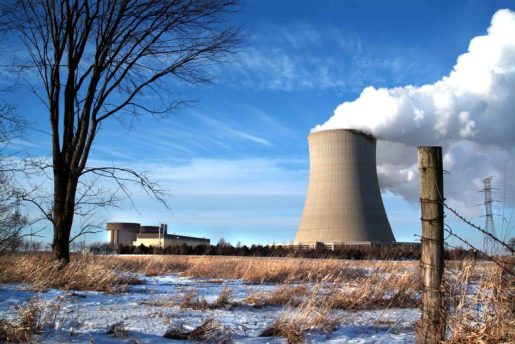
A global nuclear disaster potentially worse than Chernobyl may be under way in Japan as hundreds of tonnes of highly radioactive spent nuclear fuel are open to the sky, and may be on fire and emitting radioactive particles into the atmosphere.

Many countries have advised their citizens in Japan to leave the country.

“This is uncharted territory. There is a 50-percent chance they could lose all six reactors and their storage pools,” said Jan Beyea, a nuclear physicist with a New Jersey consulting firm called Consulting in the Public Interest.

“I’m surprised the situation hasn’t gotten worse faster… But without a breakthrough it’s only a matter of days before spent fuels will melt down,” said Ed Lyman, a physicist at the Union of Concerned Scientists and an expert on nuclear plant design.

Japan’s Fukushima Daiichi plant was damaged by a powerful earthquake and tsunami on Mar. 11. It has an estimated 1,700 tonnes of used or spent but still dangerous nuclear fuel in storage pools next to its six nuclear reactors, according to Kevin Kamps, a radioactive waste specialist at Beyond Nuclear, a U.S. anti-nuclear environmental group.

The storage pools holding 30 to 35 years worth of spent fuel at reactors No. 3 and No. 4 have lost containment and most if not all of their coolant water. They may be on fire, venting radioactive particles into the atmosphere, Kamps told IPS.

On Thursday, Japanese military helicopters protected by lead shielding managed to dump some seawater on the damaged reactors No. 3 and No. 4 in a desperate and very risky last- ditch effort at the highly radioactive site.

via Japan Nuke Disaster Could Be Worse Than Chernobyl – IPS ipsnews.net.

Cut Climate Damaging Emissions in Half and Double Food Production With Eco-Farming

45- 50% of global warming emissions from industrial agriculture

By Stephen Leahy

UXBRIDGE, Feb 8, 2011 (IPS)

Eco-farming could double food production in entire regions within 10 years while mitigating climate change, according to a new U.N. report released Tuesday in Geneva.

An urgent transformation to ‘eco-farming’ is the only way to end hunger and face the challenges of climate change and rural poverty, said Olivier De Schutter, U.N. Special Rapporteur on the right to food, following the presentation of his annual report focusing on agroecology and the right to food to the U.N. Human Rights Council.

“Agroecology mimics nature not industrial processes. It replaces the external inputs like fertiliser with knowledge of how a combination of plants, trees and animals can enhance productivity of the land,” De Schutter told IPS, stressing that, “Yields went up 214 percent in 44 projects in 20 countries in sub-Saharan Africa using agro-ecological farming techniques over a period of 3 to 10 years… far more than any GM [genetically modified] crop has ever done.”

Other recent scientific assessments have shown that small farmers in 57 countries using agro-ecological techniques obtained average yield increases of 80 percent. Africans’ average increases were 116 percent.

“Today’s scientific evidence demonstrates that agroecological methods outperform the use of chemical fertilisers in boosting food production in regions where the hungry live,” De Schutter said. [Video Interviews with De Schutter]

Continue reading

Nuclear Power Costs Skyrocket, Cost of Renewables Plummet

[This is a repost about the financial costs and risks of nuclear technology. If a country is going to spend $10 billion to generate energy and reduce carbon emissions what technology truly offers the best return on a full cost-accounting basis? The latter calculation is not simple or uncontroversial – here is an attempt to get at it.– Stephen ]

By Stephen Leahy*

Costs of nuclear skyrocket while costs of renewables falling quickly say energy experts

BERLIN, Jul 31, 2009 (IPS)

Why is nuclear energy back on the table?

One reason is a powerful U.S. lobby where 14 energy companies spent 48 million dollars in 2007 alone to convince American politicians to give the industry huge loan guarantees because they cannot get financing anywhere else, says Ellen Vancko, a nuclear energy analyst at the Union of Concerned Scientists, a U.S.-based non governmental organisation (NGO).

This lavish lobbying effort by the energy and nuclear power sector has been ongoing since the mid-1990s, according to the Center for Responsive Politics, a U.S. NGO and now totals at least 953 million dollars.

Even more has been spent to convince the public that nuclear is one of the keys to energy security so that there is significant public support for new reactors, a Gallup Environment Poll reported this year.

“There are lots of senators and members of congress talking about nuclear as a clean, renewable energy resource,” Vancko says.

The other reason is the French. Continue reading

Fossil Fuel Lobby Following the Playbook of Big Tobacco Confusing the Public on Dangers of Climate Disruption

Fossil Energy Interests Sowing Confusion and Buying Legislative Delay on America’s Biggest Threat: Climate Change says Environmental Economist

Robert Repetto

UXBRIDGE, Canada, Mar 2, 2011 (IPS)

Powerful fossil energy interests are preventing the United States from making the necessary transition to 21st century energy sources, one of the country’s leading environmental economists documents in a just-published book.

Fossil energy interests are spending “hundreds of millions of dollars” lobbying U.S. politicians in Congress and funding groups to confuse the public about the serious risks climate change poses, says Robert Repetto, author of “America’s Climate Problem: The Way Forward” published by Earthscan.

IPS climate and environment correspondent Stephen Leahy spoke with Repetto about his new book.

Q: Why did you write this book?

A: We’re running out of time. The latest science shows that climate change is coming faster and posing greater risks than previously thought. We are at risk of triggering positive feedbacks that will lead to uncontrollable climate change.

This independent environmental journalism depends on public support. Click here learn more.

Meanwhile, America is locked in a climate-policy stalemate, with very few in the public comprehending the real risks climate change poses. Most don’t understand that climate change is happening now. They don’t link extreme weather events we’ve been experiencing with climate change. As a result they are not demanding that politicians take action.

Q: Why don’t most Americans understand the fact that climate change is already underway and poses serious risks?

A: Fossil (oil, coal, natural gas) energy interests are pouring hundreds of millions of dollars into sowing doubt and uncertainty to blunt public concern and to provide political cover to those politicians they are funding. In America, there is a very concerted effort by fossil energy interests that bankroll right-wing and libertarian “think tanks” like the Competitive Enterprise Institute to create an atmosphere of doubt and uncertainty, just like the tobacco companies did regarding the health effects of smoking. Continue reading

Two Percent Price-Tag for a Green Economy – Time to end Growth-obsessed Markets pillaging the planet

No future in the “brown” economic system driven by fossil fuel energy and the serial depletion and degradation of natural resources and ecosystems

By Stephen Leahy

UXBRIDGE, Canada, Feb 23, 2011 (IPS)

Growth-obsessed markets and governments are pillaging the planet and it must stop, a new U.N. report warns.

The present “brown” economic system driven by fossil fuel energy and the serial depletion and degradation of natural resources and ecosystems has no future and must be replaced by a green economy, says the Green Economy report launched in Nairobi, Kenya this week by the United Nations Environment Programme (UNEP).

Investing just two percent of the global economy into a few key sectors will kick-start a transition towards a low- carbon, resource-efficient economy, the report says. With that relatively small investment, many of the world’s biggest challenges – climate change, poverty, hunger, jobs, sanitation, energy, food – could be successfully met within two generations.

This independent environmental journalism depends on public support. Click here learn more.

“The Green Economy provides a vital part of the answer of how to keep humanity’s ecological footprint within planetary boundaries,” said Achim Steiner, UNEP executive director.

“It aims to link the environmental imperatives for changing course to economic and social outcomes,” Steiner said.

The report documents that a green, low-carbon, resource- efficient economy will be at least as prosperous as the old brown economy. Better still, a green economy will not have the inherent risks, shocks, scarcities and crises of the resource-depleting, high carbon ‘brown’ economy, it says. Continue reading

Arctic Ice Busts Yet Another Record – Lowest Ever For February

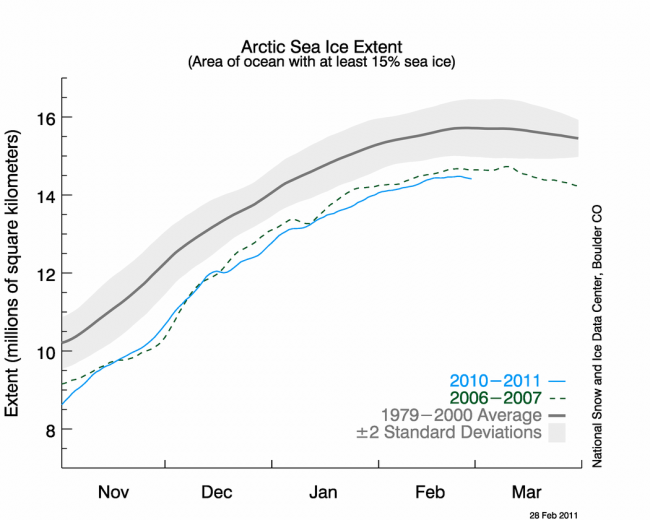
Since December of last year the Arctic sea ice has been breaking records with the lowest ever ice cover – lower than the shocker melt down of ice in 2007. This is the latest update from NOAA’s National Snow and Ice Data Center. It shows that the seasonal extant of Arctic sea ice at the end of February, 2011, stood at a record low, well below the prior record set in 2007 and almost 3 million square kilometers below the average for that winter date, when sea ice is usually within days of its greatest seasonal extant for the year.

I’ve written several articles on the latest arctic science and how the decline in sea ice affects weather in the northern hemisphere:

Arctic Melt Down Is Bringing Harder Winters and Permanently Altering Weather Patterns

Arctic Defrost Dumping Snow on U.S. and Europe

Arctic Sea Ice Record – New Satellite Image

Arctic Ice in Death Spiral, Thaws Permafrost — Risks Climate Catastrophe


Coral Reefs In Dire Peril – 75% May Die In Coming Years

One of the most incredible natural wonders of our world is being decimated by our actions: burning fossil fuel, pollution of land and sea, overfishing. The most recent estimate shows 75% of the world’s coral reefs are threatened according to new report by the World Resources Institute (WRI) and 24 other organizations. The report is “Reefs at Risk Revisited“.

Here’s one thing you can do to help. Follow and encourage others to live by these Three Simple Rules:

1. Reduce.

Reduce fossil fuel consumption everywhere.

2. Eliminate.

Eliminate all non-essential activities and products that involve burning fossil fuel.

3. Demand.

Demand that business and government provide transport, activities and products that minimize fossil fuel use.

Reduce. Eliminate. Demand. R.E.D.

More on the Corals, Ocean Acidification, Bleaching, Overfishing.

I have written more than 15 articles in last few years about the serious threats corals face:

Record Heat Killing Caribbean and Indian Ocean Corals

What if our air was 30% more acidic like the Oceans? May be 120% more acidic by 2060

Coral Reefs and Acid Oceans Series

Reefs and Forests Burn as Climate Disruption Takes Hold NOW

Permafrost Melt Soon Irreversible Without Major Fossil Fuel Cuts

Thawing Permafrost Will Accelerate Climate Disruption

By Stephen Leahy

UXBRIDGE, Canada, Feb 17, 2011 (IPS)

Thawing permafrost is threatening to overwhelm attempts to keep the planet from getting too hot for human survival.

Without major reductions in the use of fossil fuels, as much as two-thirds of the world’s gigantic storehouse of frozen carbon could be released, a new study reported. That would push global temperatures several degrees higher, making large parts of the planet uninhabitable.

Once the Arctic gets warm enough, the carbon and methane emissions from thawing permafrost will kick-start a feedback that will amplify the current warming rate, says Kevin Schaefer, a scientist at the National Snow and Ice Data Center (NSIDC) in Boulder, Colorado. That will likely be irreversible.

This independent environmental journalism depends on public support. Click here learn more.

And we’re less than 20 years from this tipping point. Schaefer prefers to use the term “starting point” for when the 13 million square kilometres of permafrost in Alaska, Canada, Siberia and parts of Europe becomes a major new source of carbon emissions.

“Our model projects a starting point 15 to 20 years from now,” Schaefer told IPS. Continue reading

Factory Farms Spawn Climate Disruption and Disease

60 percent of factory farms in poor countries

[This is a re-post from 2007. Meat production in factory farms are major animal health and welfare issues, they also produce more emissions than cars and trucks. Not to mention creating perfect conditions for diseases like bird flu and swine flu and who knows what else. — Stephen]

Cramming 100,000 chickens into a single facility to produce low-cost meat also creates the perfect atmosphere for the spread of disease

By Stephen Leahy

Feb 20 (IPS) 2007

Factory farms are responsible for both the bird flu and emissions of greenhouse gases top those of cars and sport utility vehicles (SUVs), according to a report released Monday.

Sixty percent of global livestock production, including chicken and pig “confined animal feedlot operations” (CAFOs), now occur in the developing world. Unregulated zoning and subsidies that encourage these CAFOs or factory farms are moving closer to major urban areas in China, Bangladesh, India, and many countries in Africa, said the report, “Vital Signs 2007-2008” by the Worldwatch Institute.

Although there is no definitive scientific proof, those farms are very likely where avian or bird flu started and will continue to be responsible for new outbreaks, said the author of the report, Danielle Nierenberg, a Worldwatch research associate. Continue reading

Why Our Weather is Weird ‘n Wild and Why It Is Getting Worse

Burning Fossil Fuels Bringing Heavy Rains and Flooding

(Bonus: How we can kick the fossil fuel addiction)


By Stephen Leahy

UXBRIDGE, Canada, Feb 16, 2011 (IPS)

Human-induced heating of the planet has already made rainfall more intense, leading to more severe floods, researchers announced Wednesday.

Two new studies document significant impacts with just a fraction of the heating yet to come from the burning of fossil fuels. Fortunately, another new report shows the world can end its addiction to climate-wrecking fossil-fuel energy by 2050.

“Warmer air contains more moisture and leads to more extreme precipitation,” said Francis Zwiers of the University of Victoria.

Extreme precipitation and flooding over the entire northern hemisphere increased by seven percent between 1951 and 1999 as a result of anthropogenic global warming. That represents a “substantial change”, Zwiers told IPS, and more than twice the increase projected by climate modeling.

Zwiers and Xuebin Zhang of Environment Canada used observations from over 6,000 weather stations to measure the impact of climate warming on the intensity of extreme precipitation for the first time. The study was published Wednesday in the journal Nature.

This independent environmental journalism depends on public support. Click here learn more.

The planet is currently 0.8 degrees C hotter from the burning of fossil fuels. However, global temperatures had not yet started to increase in 1951, the first year of rainfall data Zwiers and Xuebin examined. By 1999, global temperatures had climbed by about 0.6 degrees C. The average temperature increase over that 50-year period is relatively small compared to the present but major impacts have been documented in terms of storm and flood damage even with this small increase in temperatures.

This suggests that the Earth’s climatic system may be more sensitive to small temperature increases than previously believed.

Continue reading