Canada Has Become a Petro-State, Happily Drilling for Profits as the World Warms

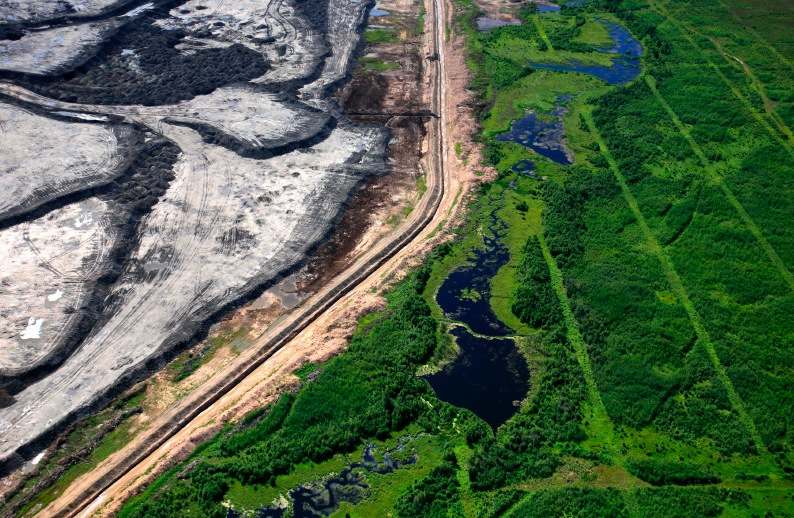
tar sands - visible from space,tarnished earth

Thu, 2013-03-07 08:00 STEPHEN LEAHY

What’s happened to Canada? To the dismay of many a country with an international reputation for relatively progressive environmental policies (at least compared to the United States) is rushing headlong to dig up all the oil, gas, and coal it can. The country’s leaders can scarcely muster the effort to pretend to want to limit climate-heating carbon emissions.

And the Canadian business establishment and media have largely gone along with the program. Put it all together, and you have a country that has become a full-blown “petrostate.”

People are starting to notice. Last December at the UN climate talks in Doha, Qatar, Canada beat out tough contenders like Saudi Arabia to be elected “Colossal Fossil” by environmental organizations from around the planet. Canada had the dishonor of being the most uncooperative country out of 193 nations at the climate summit. It was the sixth year in a row that international environmental groups gave Canada their ‘highest’ award for its persistent efforts to block any agreement on reducing carbon emissions.

What’s happened to Canada is that it has experienced a steady takeover by the fossil fuel industry.

Canada’s is now the world’s fifth largest crude oil producer and the biggest supplier of oil to the US. Canada is also the third largest producer of natural gas and one of the top ten miners of coal. This enormous boom in fossil fuel production has been underway since the late 1990s. Like Saudi Arabia, fossil energy is by far Canada’s biggest export and has become the dominant economic and political focus.

Full story click below:
Blame Canada is a four part series revealing how Canada has become a fossil-fuelled energy superpower that’s going to wreck its future and the global climate.

National Legislation Key to Combating Climate Change

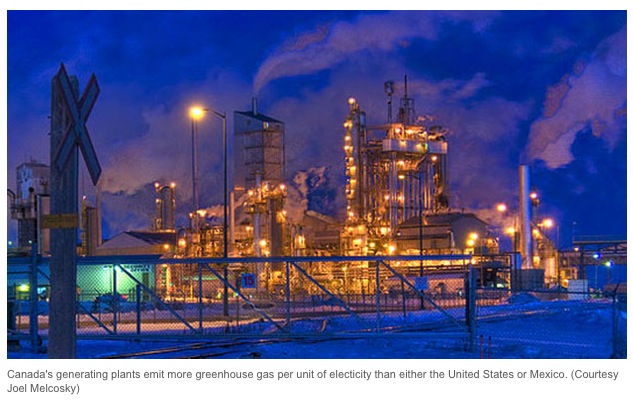
Canada's fossil fuel electricity has highest carbon emissions

By Stephen Leahy

UXBRIDGE, Canada, Jan 15 2013 (IPS)

A majority of major economies have made significant progress in addressing climate change, with countries like South Korea and China taking aggressive action so they can benefit from energy- and resource-efficient economies, a new report released Monday found.

The study by GLOBE International and Grantham Research Institute profiled 33 major economies in an annual examination of climate and energy legislation. 32 of them, including the United States, made significant progress in 2012, while only Canada regressed.

“The study reveals a major trend is underway. More and more countries are acting on climate,” said Adam Matthews, secretary general of GLOBE International, an organisation of legislators.

Be Part of a New Collaborative Approach to Media Coverage of Climate

Screen Shot 2013-10-17 at 10.09.20 PM

Frustrated by the lack of interest in climate coverage by mainstream media, 15 young journalists on 4 continents want to bring a new collaborative approach to climate change journalism. This is a voluntary effort to both increase and improve reporting called the Climate News Mosaic (CNM).


They need your help for their first collaborative project to connect what’s happening at the UN climate conference (COP) in Warsaw this November with climate impacts/perspectives on the ground from their home countries.

Here’s how it will work:

* 2 or 3 journalists will go to the COP in Warsaw to report and co-ordinate. The rest will be back home doing local coverage on climate. Everyone contributes and shares interviews, links to reports, sources, A/V and so on.

* Members (mainly freelancers) do articles, audio and video for their own outlets. Some 25-30 original stories in at least 4 languages will be made available for use in whole or in part by any media outlet anywhere in the world.

* A live blog placed on a number non-profit news sites like IPSEarth Journalism Network , and others will bring the public a wealth of current info on what is happening at the Warsaw COP but also from other countries. (i.e. a short video from Warsaw, a photo from a rally in San Francisco, a soundbite from a press conference in Nairobi, a quote from an interview with an Italian scholar.)

Learn more about CNM participants on this global map with short bios.

I’m sort of the mentor having used crowd-sourced funding to support my science and climate journalism the past 4 years. That support kept me going and in 2012 I was a co-winner of the Prince Albert/United Nations Global Prize for media coverage of climate change.

For-profit media owners are simply not interested in good science and environment reporting. Coverage of climate change has been in sharp decline since the UN climate summit in Copenhagen in 2009. Even the New York Times closed its environment desk this year. It’s not that there isn’t a lot to report on. Quite the opposite.

Here’s how you can help:

Please spread the word about this project. We need to raise $6000 for travel, accomodation and other costs to do the Warsaw COP reporting.  Please click on Indiegogo to contribute what you can. (There are ‘perks’ for contributors including a Google Hangout.)

This is a fresh new idea: Independent journalists in different countries working together to provide all of us with the news and information on the most important issue of our time.

Please join in and help out.

Help Wanted: 27 Planet Earths

This story was featured on the IPS wire and on the Al Jazeera network in 2011. It shows that national parks, conservation and protected areas do not and cannot halt the decline in biodiversity that is humanity’s life support system. It is hopeless without addressing the root causes: too many of us, taking too much and having too big of an impact. On our present course we’ll need 27 planet Earths by 2050 experts conclude. — Stephen 

By Stephen Leahy

UXBRIDGE, Canada, Jul 29, 2011 (IPS)

Protecting bits of nature here and there will not prevent humanity from losing our life support system. Even if areas dedicated to conserving plants, animals, and other species that provide Earth’s life support system increased tenfold, it would not be enough without dealing with the big issues of the 21st century: population, overconsumption and inefficient resource use.

Without dealing with those big issues, humanity will need 27 planet Earths by 2050, a new study estimates.

The size and number of protected areas on land and sea has increased dramatically since the 1980s, now totaling over 100,000 in number and covering 17 million square kilometres of land and two million square kilometres of oceans, a new study reported Thursday.

This independent environmental journalism depends on public support. Click here learn more.

But impressive as those numbers look, all indicators reveal species going extinct faster than ever before, despite all the additions of new parks, reserves and other conservation measures, according to the studypublished in the journal Marine Ecology Progress Series.

“It is amazing to me that we haven’t dealt with this failure of protected areas to slow biodiversity losses,” said lead author Camilo Mora of University of Hawaii at Manoa.

“We were surprised the evidence from the past 30 years was so clear,” Mora told IPS. Continue reading

Fossil Energy Interests Buy Politicians – and they’re cheap says economist

[This interview with economist Robert Repetto (now at Yale) was published two years ago. It is more relevant than ever in showing how fossil fuel money influences politics and prevents real action on climate. — Stephen]

‘What else can you do with coal except burn it? Railways make a lot of money shipping coal’

By Stephen Leahy

UXBRIDGE, Canada, Mar 2, 2011 (IPS)

Powerful fossil energy interests are preventing the United States from making the necessary transition to 21st century energy sources, one of the country’s leading environmental economists documents in a just-published book.

Fossil energy interests are spending “hundreds of millions of dollars” lobbying U.S. politicians in Congress and funding groups to confuse the public about the serious risks climate change poses, says Robert Repetto, author of  “America’s Climate Problem: The Way Forward”.

IPS climate and environment correspondent Stephen Leahy spoke with Repetto about his new book.

Q: Why did you write this book?

A: We’re running out of time. The latest science shows that climate change is coming faster and posing greater risks than previously thought. We are at risk of triggering positive feedbacks that will lead to uncontrollable climate change.

Meanwhile, America is locked in a climate-policy stalemate, with very few in the public comprehending the real risks climate change poses. Most don’t understand that climate change is happening now. They don’t link extreme weather events we’ve been experiencing with climate change. As a result they are not demanding that politicians take action.

Q: Why don’t most Americans understand the fact that climate change is already underway and poses serious risks? Continue reading

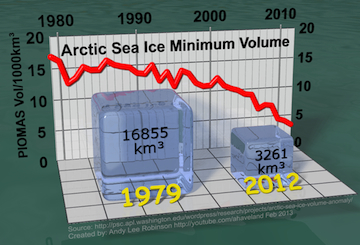
80 percent of Arctic Ice Lost Compared to 30 Years Ago

arctic-sea-ice-min-volume-comparison-1979-2012-small

[This is my first exclusive blog post – virtually everything else on this site are my published articles. Not sure if I’ll have time to do more. Let me know what you think – Stephen ]

A new study released Feb 13 revealed that the volume of Arctic sea ice is declining rapidly. Ice volume in September 2012 had fallen 80 percent compared with the volume of ice in September 1980 according to the latest data from European Space Agency satellite, CryoSat-2. As the Arctic heats up Most of the ice loss has been in recent years. Between 2003 and 2012 the volume declined a whopping 36 percent. Summers with a sea ice-free Arctic are only a few years away, scientists now agree. This will have significant and permanent impacts on weather patterns in the Northern Hemisphere.

My previous article  Ice-Free Arctic Is “Uncharted Territory” documented last September’s one year record area decline of 18 percent. Here’s what this means:

The impacts are already being felt across the entire northern hemisphere. The loss of sea ice in recent years has been affecting weather patterns, recent research has shown. The all-important jet stream – the west-to-east winds that are the boundary between the cold Arctic and the warm mid-latitudes – is slowing down, moving north and become more erratic.

When continent-sized areas of the Arctic Ocean flip from the all-white ice to dark blue, tremendous amounts of heat are absorbed from the 24-hour summer sun. When the bitter cold Arctic winter sets in over the next few weeks, all the heat in the ocean must be released into the atmosphere before ice can form again.

The Arctic will be ice-covered in winter for decades to come but what’s fundamentally changed is that every fall, unprecedented amounts of heat and water vapour will be released into the atmosphere.

“The polar meltdown shows we’re teetering on the brink of climate change catastrophe,” said Shaye Wolf, climate science director at the Center for Biological Diversity’s Climate Law Institute.

As the sea ice declines, Arctic temperatures increase, thawing more and more permafrost, which will release more climate-heating carbon and methane. Permafrost is frozen soil, sediment and rock spanning 13 million square kilometres of the land in Alaska, Canada, Siberia and parts of Europe. It has twice the carbon that the atmosphere currently holds.

A Swedish study released Feb 17 has found a link between sea ice declines and increases in methane emissions. Methane has 40x the warming of carbon. This is may lead to an even faster meltdown of the Arctic risking the release of huge amounts of permafrost carbon and methane.

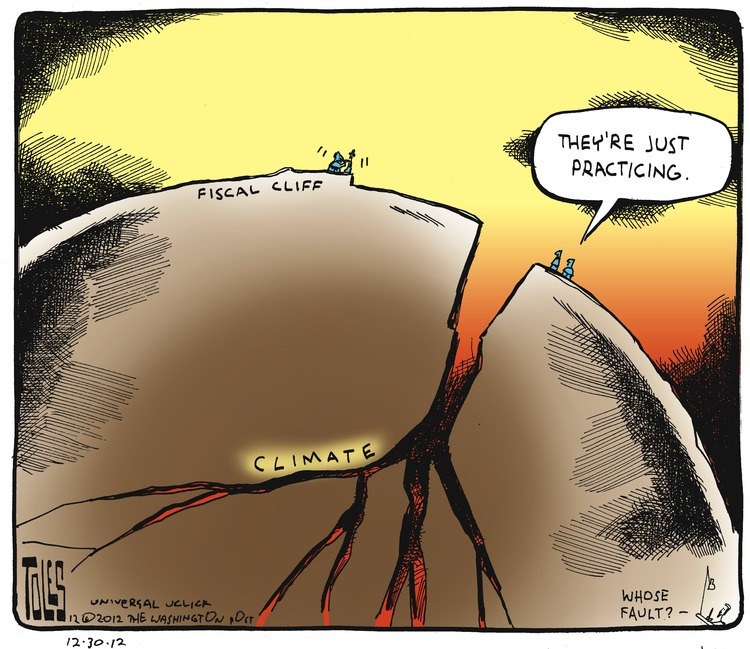
Majority of Oil, Gas and Coal Reserves Too Dangerous To Use – International Energy Agency (IEA)

ttfiscal carbon cliff

Industry spent more than $600 billion on new exploration and production in 2012 

By Stephen Leahy

UXBRIDGE, Canada, Nov 15 2012 (IPS)

Two-thirds of the world’s proven fossil fuel reserves cannot be used without risking dangerous climate change, the International Energy Agency (IEA) warned this week.

Preventing the consumption of those two-thirds will be the primary task of the annual U.N. climate negotiations that resume at the end of this month.

Late Wednesday, U.S. President Barack Obama surprised many by saying climate change will be a personal mission in his second term.

“The re-election of President Obama guarantees continuity of the U.S. pledge of reducing emissions 17 percent below its carbon emissions in 2005 by 2020,” said Christina Figueres, executive secretary of the United Nations Framework Convention on Climate Change (UNFCCC).

“The U.S. is fully aware of the need to increase its ambition in terms of mitigation (emissions reduction) and finance to help developing countries adapt,” Figueres told IPS.

The U.S. emission reduction target is equivalent to a three-percent reduction compared to 1990 levels – a baseline most countries use. Global emissions need to be 25 to 40 percent below 1990 levels in the year 2020 to keep temperatures from rising beyond two degrees C, climate scientists have said.

By contrast, the United Kingdom is already 18 percent below its 1990s level and plans to be 34 percent below in 2020.

In 2010, there was a binding agreement to limit global warming to two degrees C at the U.N. climate conference in Cancun, Mexico, said Andrew Steer, president of the World Resources Institute, a Washington-based NGO.

“We are nowhere near to getting there. The situation is urgent. Climate change is not tomorrow’s problem, it is today’s problem. Superstorm Sandy was a wake-up call to the people of the United States,” Steer said at a press conference. Continue reading

Hurricane Sandy a Taste of More Extreme Weather to Come

By Stephen Leahy

UXBRIDGE, Canada, Nov 2 2012 (IPS)

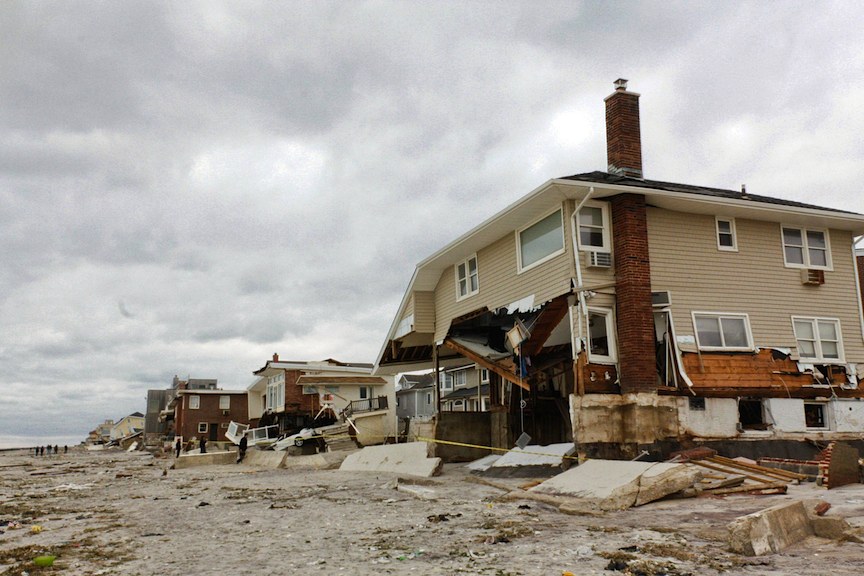
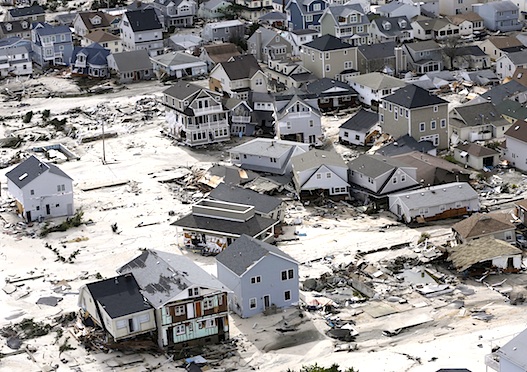
Killing nearly 200 people in the United States, Canada and the Caribbean and crippling much of New York City and surrounding areas earlier this week, Hurricane Sandy was the kind of extreme weather event scientists have long predicted will occur with global warming.

“Climate change is a reality,” said New York Governor Andrew Cuomo after Sandy swept through his state.

Sandy was twice the size of an average hurricane, and it hit the eastern coast of the United States, where sea levels have been rising the fastest, said Kevin Trenberth, senior scientist at the National Center for Atmospheric Researchin Boulder, Colorado.

“All weather events are affected by climate change because the environment in which they occur is warmer and moister than it used to be,” Trenberth, an expert on extreme events, told IPS.

Whether climate change caused Hurricane Sandy is the wrong question to ask, added Trenberth. He explained that climate change helped make Hurricane Sandy more destructive than it otherwise would have been.

“This is the new normal,” Trenberth said. “It doesn’t make sense to rebuild in some regions – they’ll just be swept away again.”

Sandy says: “Childhood is Over: We’re All in this Together”

As the last of my winds and rains ebb I wish you a complete and climate-wise recovery. Our planet is not as it once was. You have seen some of the changes in your lifetime: the superstorms, floods, drought, heat waves, and the melting of the Arctic.

Other changes are invisible such as the 30 percent increase in the acidity of the oceans. This rising acidity is harming coral reefs, fish and many other inhabitants of the oceans. One third of the carbon dioxide (CO2) emitted from burning fossil fuels has been absorbed by the oceans. When CO2 dissolves in seawater it makes them more acidic.

All of these changes and far more with only 0.8C (1F) rise in global temperature. You want to believe all of this is natural. It is true I am part of nature but I have felt and fed off the extra heat energy in the oceans and additional moisture in the air you have unintentionally put there. The air, oceans, landscape have changed. Some call this time of major human impacts on the planet “The Anthropocene”. A big word to describe a big change: the era when humanity is influencing every aspect of life on the planet.

Read full post at Hurricane Sandy Speaks (crosspost)

Ice-Free Arctic Is “Uncharted Territory”

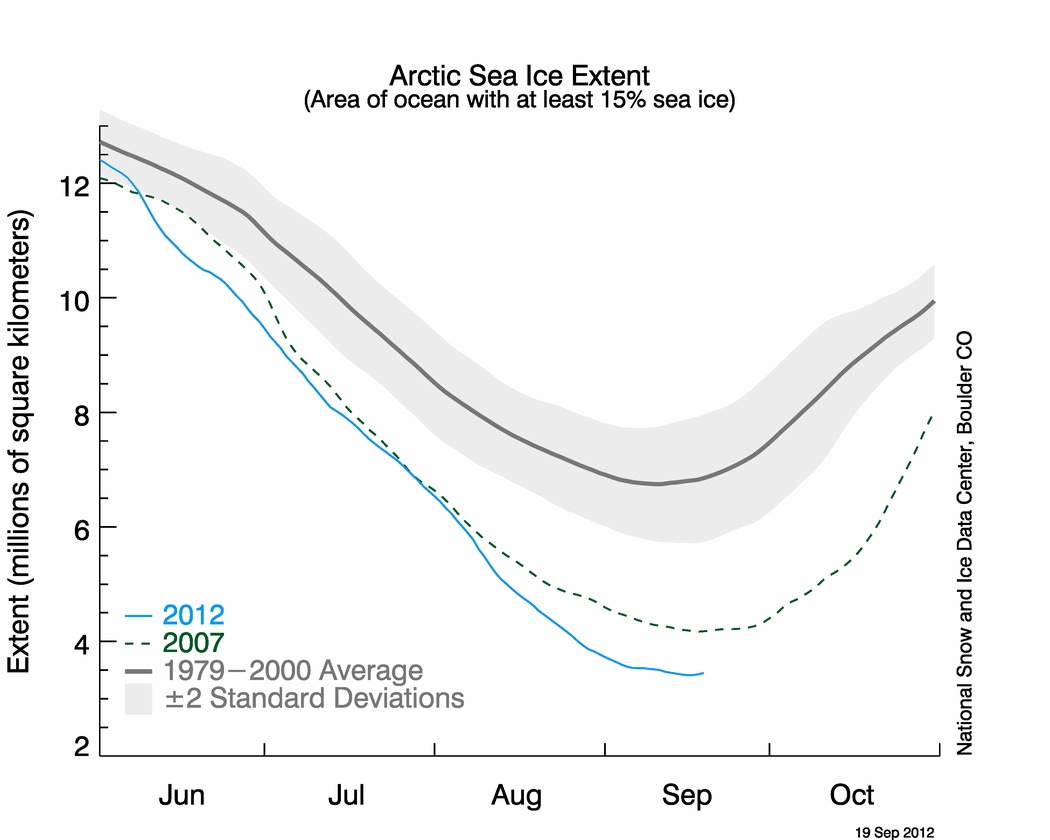
Arctic sea ice extent. Area of ocean with at least 15 percent sea ice as of Sept 12, 2012. Credit: National Snow and Ice Data Center.

Arctic ice half of what it was 30 years ago. Now affecting weather patterns

Heading for +4C and catastrophe – CBD

By Stephen Leahy

UXBRIDGE, Canada, Sep 20 2012 (IPS)

The melt of Arctic sea ice has reached its lowest point this year, shrinking 18 percent from last year’s near-record low.

Summer ice this year is half what it was 30 years ago and is now affecting weather patterns. The massive declines in ice in recent summers have shocked scientists and Arctic experts. Some predict that in just a few years we will witness an event that hasn’t happened in millions of years: the complete loss of summer ice.

“We are now in uncharted territory,” said Mark Serreze, director of the National Snow and Ice Data Center (NSIDC) in Colorado.

“Few of us were prepared for how rapidly the changes would actually occur” as a result of the burning fossil fuels that are warming the planet, said Serreze.

“We could see an essentially ice-free Arctic ocean in late summer by the year 2030,” he told IPS.

Not long ago experts thought the soonest the Arctic would be ice-free was 2070. Now it’s anywhere from four to 18 years away.

The impacts are already being felt across the entire northern hemisphere. The loss of sea ice in recent years has been affecting weather patterns, recent research has shown. The all-important jet stream – the west-to-east winds that are the boundary between the cold Arctic and the warm mid-latitudes – is slowing down, moving north and become more erratic.Measurement of CO2 levels in atmosphere

“Europe, eastern Asia and eastern North America is connected to unique physical processes in the Arctic,” said James Overland of the NOAA/Pacific Marine Environmental Laboratory in the United States.

“In future, cold and snowy winters will be the rule rather than the exception” in these regions, Overland told IPS in Oslo in 2010.

The summer’s record loss of Arctic sea ice may mean a cold winter for the UK and northern Europe, Jennifer Francis, a researcher at Rutgers University, told the Guardian last week.

The region has been prone to bad winters after summers with very low sea ice, such as 2011 and 2007, Francis said. Continue reading